


Communicating threat intel insights to clients works when technical findings are translated into risk, business impact, and clear next steps. Many organizations receive large volumes of indicators but still struggle to decide what actions to take. Security leaders need reporting that explains what happened, who is affected, and what should happen next.
At MSSP Security, we help MSSPs review products, audit security tools, and improve reporting practices. Our experience shows that clients rarely need more data. They need guidance that supports decisions and reduces uncertainty. Keep reading to see how better threat intelligence communication drives action.
Intelligence Into Action: What Clients Need to Know
Clear threat intelligence only creates value when it helps clients understand risk, make decisions, and take action. The most effective reports translate technical findings into business impact, priorities, and next steps.
- Translate technical intelligence into business language that leaders can quickly understand.
- Tailor reports to different audiences so executives and security teams receive the information they need.
- Focus on business impact and recommended actions instead of overwhelming clients with raw indicators.
What Should Clients Understand First About Threat Intelligence?

Clients usually ask four questions before anything else. What happened? Are we affected? How serious is it? What should happen next? Those questions sound simple. Yet many reports never answer them clearly.
Threat intelligence is not a storage room for indicators. It exists to support decisions. Organizations buy outcomes, visibility, and risk reduction. They do not buy spreadsheets full of indicators.
During our consulting engagements, executives rarely ask for malware names. Most want to know whether operations are at risk or if business services could stop. That’s the conversation that matters.
Security teams often forget that technical findings are only one part of the story. Risk, timing, and impact matter more to many stakeholders.
Common questions include:
- What happened?
- Are we affected?
- How serious is the risk?
- What should we do?
Why do clients ignore raw indicators?
Large IOC lists often create confusion. Without context, thousands of indicators become background noise. Most people can’t determine which items matter to them.
What decisions are clients making?
Organizations often evaluate:
- Risk acceptance.
- Immediate actions.
- Resource priorities.
Short answers win. Long reports usually don’t.
Why Do Most Threat Intelligence Reports Fail Stakeholders?
Many reports fail because they focus on technical depth instead of business relevance. A twenty-page document filled with indicators may look impressive. But if nobody knows what to do next, the report failed.
We’ve reviewed reports that included pages of hashes and IP addresses but only one recommendation. That surprised us. Leadership teams delayed decisions because nobody translated the findings into business terms.
Intel theater happens more often than many security teams realize. Reports become collections of data instead of guidance.
Several problems contribute:
- Too many indicators.
- Unclear risk levels.
- Missing recommendations.
- Little business context.
And information overload damages trust.
| Problem | Client Impact |
| Too much detail | Slow decisions |
| Unclear risk | Reduced urgency |
| No priorities | Delayed action |
| No guidance | Confusion |
Clients want clarity. Most people do. Security intelligence becomes valuable only when readers understand what requires attention and what can wait. That’s often the difference between action and inaction.
Who Is the Audience for the Threat Intel Message?
Not every reader wants the same information. Security analysts usually look for technical details, while executives focus on business impact and risk.
During our consulting work with MSSPs, we often review how new products and reports are presented to different stakeholders. One lesson appears often. A single report rarely works for everyone.
Executive teams commonly ask:
- Could this affect revenue?
- Will operations be disrupted?
- Is there a compliance concern?
- What decisions need approval?
Technical teams usually ask:
- Which systems are affected?
- What indicators were found?
- How should detections change?
- What evidence supports the findings?
Our team frequently recommends separate reporting views. One version supports leadership, while another gives analysts the details they need. This approach keeps discussions focused. The risk itself does not change. Only the explanation changes.
We have seen clients spend less time translating technical findings when reports match their role. Meetings become shorter, and decisions happen faster.
Role-based reporting also helps MSSPs evaluate products more effectively because different teams can assess the information that matters to them. Creating executive and technical versions of the same report is often a small change that produces better results.
How Should an Executive Summary Be Structured?
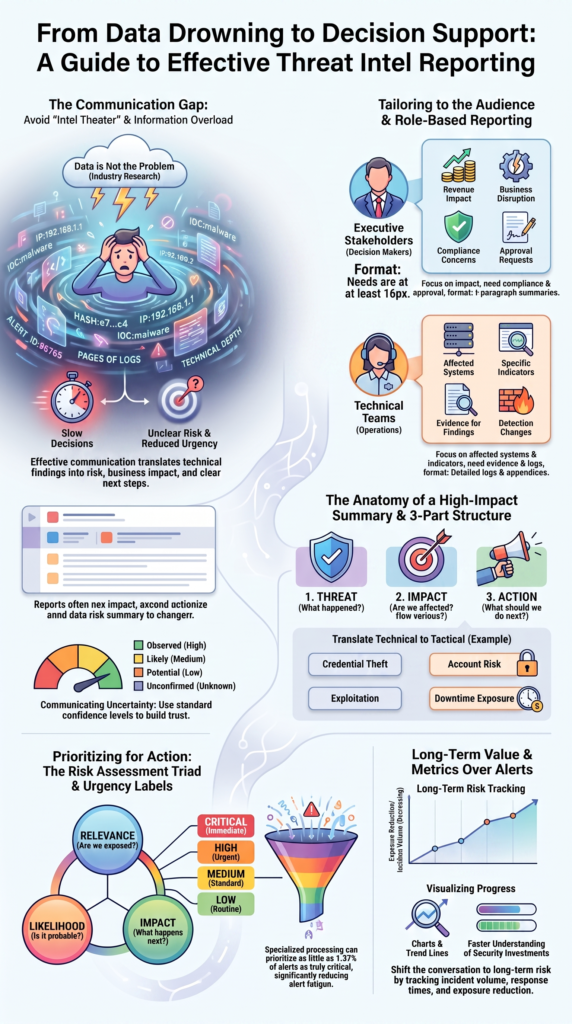
A good executive summary explains the risk quickly. Leaders often spend only a few minutes reviewing reports. The important information must appear immediately.
We often write the executive summary last. Once the analysis is complete, the key message becomes much easier to identify.
A strong summary includes:
- The threat.
- Business impact.
- Recommended action.
For example:
Suspicious credential theft activity targeted cloud users during the past 24 hours. No confirmed compromise has been identified. Additional monitoring and password reviews are recommended. That format works because it answers the main questions quickly.
Keep summaries short:
- One paragraph.
- One risk.
- One action.
Long introductions usually lose attention.
And nobody wants to read three pages before reaching the actual problem. Executives appreciate reports that respect their time. In our consulting work with MSSPs evaluating reporting tools, shorter summaries consistently receive better feedback.
The opening section sets the tone for the entire report. If readers understand the problem immediately, they continue reading.
Why Does Business Impact Matter More Than Indicators?
Business impact drives decisions. Indicators support them. A phishing campaign may seem technical. But invoice fraud gets attention. Credential theft sounds technical too. Account takeover risk feels real.
During one engagement, our team observed a phishing campaign aimed at finance employees. We avoided discussing domains and indicators during the first meeting. Instead, we explained the possibility of payment fraud and business disruption.
Leadership approved additional controls within hours.
Technical findings can often be translated:
- Credential theft becomes account risk.
- Lateral movement becomes disruption.
- Exploitation becomes downtime exposure.
Organizations often evaluate:
- Revenue loss.
- Downtime.
- Compliance issues.
- Reputation damage.
Look at the consequences.
Security teams sometimes underestimate how powerful this shift can be. When reports focus on business outcomes, conversations become easier. In many environments, integrating threat intelligence into SIEM workflows also helps teams connect business impact with operational visibility.
Our consultants frequently help MSSPs assess products that generate enormous volumes of data. The products aren’t always the issue. Reporting often is.
People respond to consequences because consequences affect decisions. That’s usually where action begins.
How Can Threats Be Prioritized for Clients?
Credits: SANS Digital Forensics and Incident Response
Prioritization helps organizations use their time wisely. Not every threat deserves the same response.
We often recommend evaluating three areas: relevance, likelihood, and impact. Together, these factors create a clearer picture of risk.
| Factor | Key Question |
| Relevance | Are we exposed? |
| Likelihood | Is exploitation likely? |
| Impact | What happens next? |
Many organizations also use urgency levels:
- Critical.
- High.
- Medium.
- Low.
Those labels help teams act faster.
Still, labels alone aren’t enough. Reports should explain why something deserves attention. We have seen high-severity findings ignored because the reasoning was missing.
Research from The Journal of Supercomputing shows
“PRIORITI prioritizes 1.27% (i.e., 96703 out of 7.6 million) of captured alerts as critical by processing an average of 1 million alerts within ≈ 20 s.” – The Journal of Supercomputing
Consistency matters too. Regular reporting makes priorities easier to understand over time. Shorter updates often work better than large monthly documents. Risk-based reporting helps clients focus on the threats that matter most instead of chasing every alert.
What Evidence Should Be Included in Client Reports?
Evidence supports decisions, but too much evidence can overwhelm readers. Our teams often place technical material in appendices. The main report stays focused on risk and action. Security teams can review the details later if needed.
Useful evidence may include:
- Affected systems.
- Observed activity.
- Threat context.
- Relevant indicators.
Technical appendices may contain:
- Large IOC lists.
- Raw logs.
- Packet captures.
- Investigation details.
And that separation helps everyone.
Executives receive the information needed for decisions. Security teams still receive technical evidence. We’ve audited many security products for MSSPs that produce enormous data sets. Some platforms create hundreds of pages of output. Most clients never read them.
The goal isn’t more evidence. It’s better evidence. Many organizations discover that threat intelligence integration and actioning processes improve how findings move from technical analysis to practical decision-making.
As noted by Cyber Security: A Peer-Reviewed Journal
“For many organisations the challenge in realising value from their CTI team is not a data problem, it is a communication problem.” – Cyber Security: A Peer-Reviewed Journal
Reports should support action instead of acting as evidence repositories. That’s a lesson our own team learned over several years of client engagements.
How Should Analysts Communicate Uncertainty?
Threat intelligence is rarely complete. Analysts often work with limited information, especially during the early stages of an incident. Good reporting explains what is known, what seems likely, and what still needs more evidence.
Simple terms can help readers understand confidence levels:
- Observed.
- Likely.
- Potential.
- Unconfirmed.
Early in one consulting engagement, our team supported an MSSP that was reviewing a new security product during an active threat campaign. The available data suggested a serious risk, and we spoke with too much confidence. The threat later proved real, but our language caused unnecessary concern for the client. That experience changed how we write reports.
Since then, confidence ratings have become part of our reporting process. We have found that clients respond better when analysts explain uncertainty instead of hiding it.
Analysts should clearly separate:
- Facts.
- Assumptions.
- External reporting.
This distinction matters because trust takes time to build. Once confidence is lost, it can be difficult to regain.
Organizations rely on intelligence to make decisions. Clear language, realistic confidence levels, and honest reporting help leaders understand both the risk and the uncertainty surrounding it.
Why Do Trends and Metrics Improve Client Communication?
One security incident rarely tells the whole story. Clients usually want to know whether risk is getting better or worse over time.
Historical data helps answer that question. Looking at quarterly changes, response improvements, and exposure reductions gives organizations a clearer view of progress.
Useful metrics often include:
- Incident volume.
- Response times.
- Threat categories.
- Exposure reduction.
Visual reports also make a difference. Charts and trend lines help people understand information much faster than long tables or technical details.
During our consulting work with MSSPs, we have seen reporting improve after teams added trend data to their reports. Discussions became less focused on single alerts and more focused on long-term risk. That shift changes how leaders make decisions.
Many executives want to know whether security investments are delivering results. Metrics help answer that question. They show progress and provide evidence that improvements are working.
Our team often helps MSSPs evaluate new products and review reporting practices. In several engagements, trend reporting helped clients understand value more clearly.
Risk trends, quarterly comparisons, and security posture updates often provide more insight than isolated incidents. People tend to remember patterns, and patterns help organizations make better decisions.
How Can Threat Intelligence Become Decision Support?

Every intelligence report should end with a clear recommendation. If a client reaches the last page and still asks, “What should we do now?” The report is not complete.
We have seen this happen during consulting projects with MSSPs that were reviewing new security products. The data looked useful, but the reports offered very little direction. As a result, teams delayed decisions because they did not know which actions mattered most.
Recommendations often include:
- Block suspicious domains.
- Reset affected accounts.
- Increase monitoring.
- Notify users or stakeholders.
Some actions also need priorities. In many cases, clients benefit from separating work into:
- Immediate actions.
- Short-term improvements.
- Long-term investments.
During our work helping MSSPs audit products and improve reporting, we have learned that recommendations drive engagement. Technical findings matter, but guidance helps people move forward. In some cases, automating threat intelligence response workflows allows teams to act on high-priority findings much faster.
Executive updates, operational reports, and strategic briefings all serve different audiences. Still, they should answer the same question: what happens next?
When reports reduce uncertainty, clients make decisions faster. That is the point where threat intelligence becomes decision support.
FAQ
How can client threat intelligence reporting reduce alert fatigue?
Client threat intelligence reporting helps security teams focus on the threats that need attention. It reduces alert fatigue by filtering low-priority events and highlighting actionable intelligence.
Teams can use intelligence prioritization and intelligence relevance to identify the most important risks. Clear threat intel communication also helps decision makers understand security issues without reviewing every alert or technical detail.
What should an executive security briefing include for leadership teams?
An executive security briefing should explain cyber risks in clear and simple language. It should include a threat intel summary, security leadership updates, and risk-based intelligence findings.
Board-level cyber reporting often focuses on business impact, threat severity scoring, and security decision making. A well-written executive summary helps leaders understand security posture updates and make informed decisions.
Why is non-technical stakeholder communication important in cyber threat intelligence?
Non-technical stakeholder communication helps business leaders understand cyber threat intelligence without technical language. Tailored security reporting, intelligence storytelling, and technical-to-business translation make reports easier to read.
Stakeholder threat reporting also supports security awareness messaging and risk communication strategies. This approach improves intelligence dissemination and helps different audiences understand security risks and recommended actions.
How do intelligence confidence levels improve threat report writing?
Intelligence confidence levels show how reliable the available information is. Threat report writing often includes intelligence validation, source credibility assessment, and intelligence confidence scoring.
These methods support context-rich reporting and decision support reporting. Clear confidence ratings also improve intelligence quality assurance and help organizations evaluate threat exposure analysis and possible security risks more accurately.
What information supports better intelligence-to-action security decisions?
Intelligence-to-action decisions require clear recommendations and useful context. Organizations often combine IOCs and TTPs, indicator enrichment, threat attribution context, and threat actor intelligence.
Operational intelligence, strategic intelligence, and threat landscape analysis also support security operations reporting. Actionable recommendations and mitigation guidance improve cyber defense planning, response readiness, and intelligence-driven prioritization.
Turn Intelligence Into Clear Decisions
Threat intelligence creates value when it helps people understand risk and take action. Large collections of indicators often create confusion, while clear reporting gives leaders the information they need to make better decisions. Communication matters because intelligence only works when people understand its impact.
Organizations gain stronger results when reporting focuses on business outcomes and practical guidance. To improve reporting clarity and support better security decisions, discover how MSSP Security can help turn intelligence into action.
References
- https://dlnext.acm.org/doi/10.1007/s11227-024-06465-3
- https://www.ingentaconnect.com/content/hsp/jcs/2021/00000005/00000001/art00003