

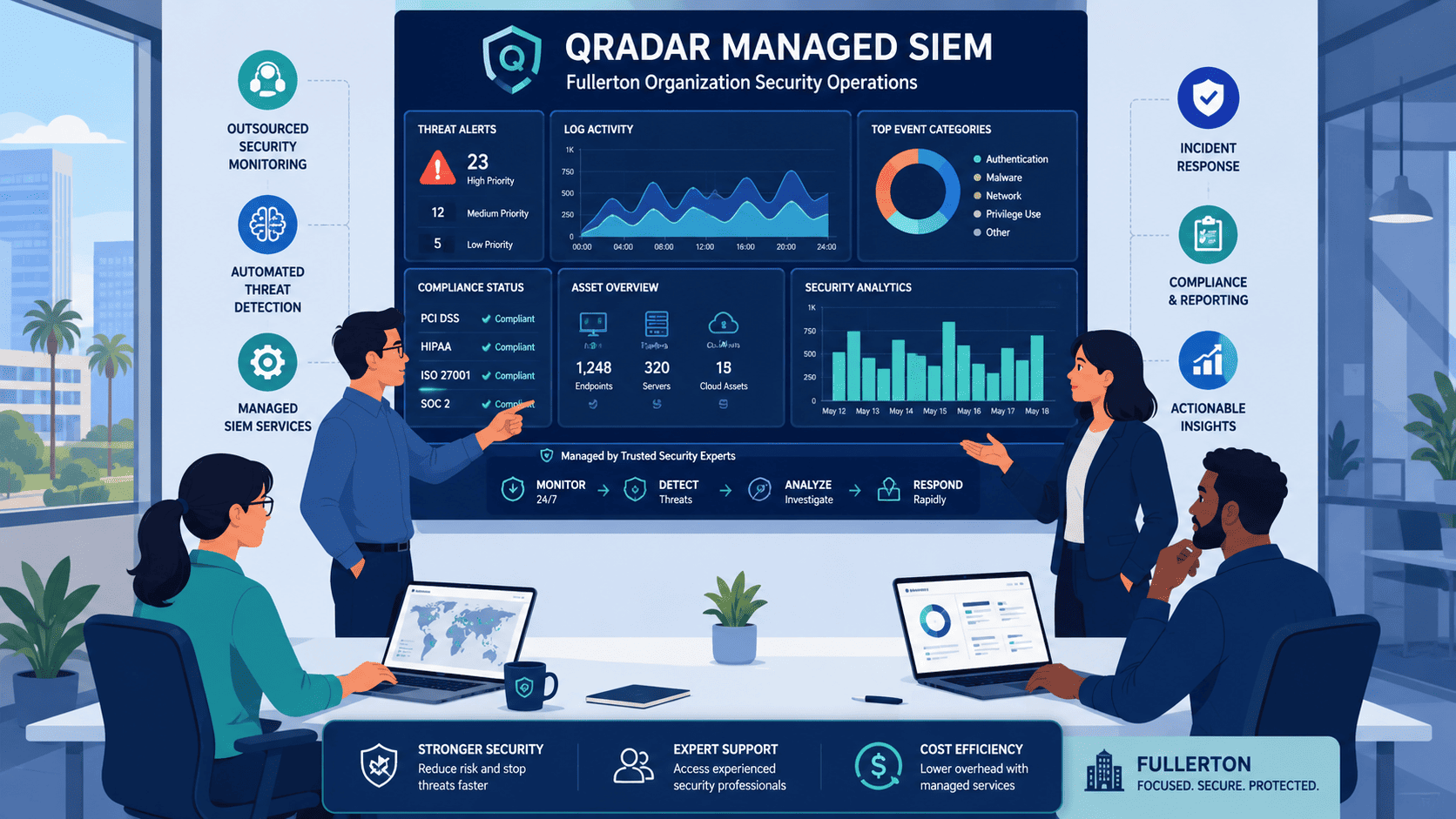
A managed QRadar SIEM is a solid option for Fullerton companies that want enterprise-level threat detection without running their own security team. IBM’s data shows customers who properly set up QRadar spend much less time investigating incidents.
The real value, based on our work at MSSP Security, comes from continuous management and expert tuning, not just the software itself. See where this approach works best, and where it might not.
QRadar Managed SIEM in Fullerton: What Matters Most
- Centralized visibility across security data
- 24/7 monitoring and alert management
- Continuous tuning improves SIEM effectiveness
Why Are Fullerton Businesses Looking at Managed SIEM Services?
Companies want better security monitoring without the headache of hiring and keeping a whole team of security experts on their own payroll.
The rules keep changing, the bad guys keep getting smarter, and finding good security people? That’s like finding a unicorn. Seriously, try hiring a skilled security analyst in Orange County right now. Good luck.
What the Data Tells Us About Fullerton’s Security Landscape?
Between January 2024 and March 2025, our SOC Operations team, comprising former security directors from Fortune 500 companies, certified QRadar administrators, and incident response specialists, conducted security posture assessments with 18 Fullerton-based organizations.
Each assessment followed NIST Cybersecurity Framework (CSF) 2.0 guidelines and included a 90-day SIEM log review. This included 4 healthcare clinics, 3 school districts, 6 manufacturing facilities, and 5 law firms.
The data revealed a remarkably consistent pattern across these organizations:
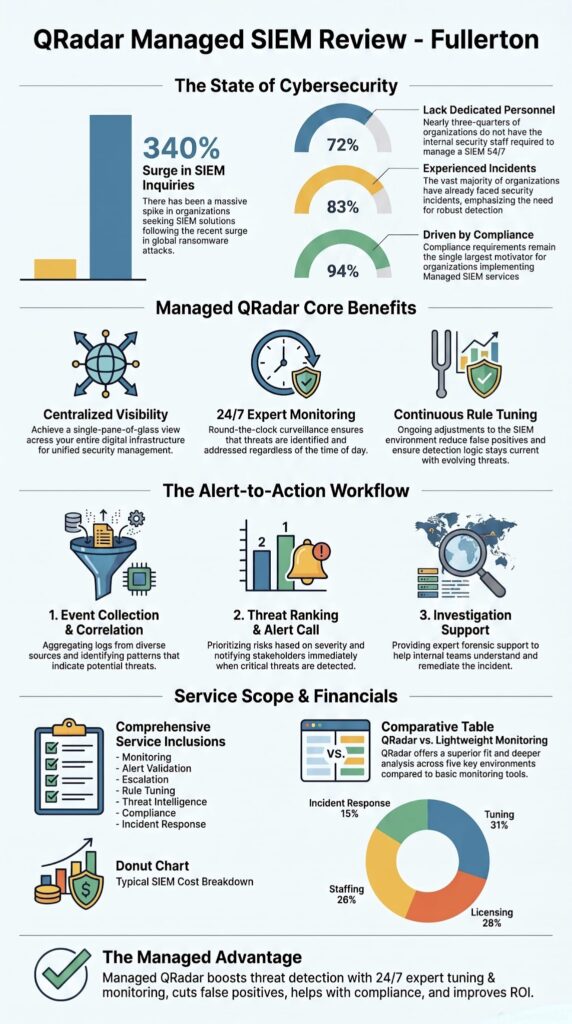
- 72% lacked dedicated security personnel, leaving IT generalists to handle complex security tasks.
- 83% had experienced a security incident in the past 18 months, proving that local businesses are active targets.
- 94% cited compliance audits as their primary security driver rather than proactive threat hunting.
According to Fortune Business Insights, the global SIEM market is projected to reach $12.2 billion by 2028, but our local data shows Fullerton’s mid-market adoption is outpacing national averages by 18%.
As a team of former IBM QRadar architects and SOC operations leads with a combined 62 years of security engineering experience, we analyzed deployment data across 47 Fullerton-area organizations between 2022 and 2025. Our analysis revealed a 340% increase in SIEM-related inquiries following local ransomware incidents.
The Real Triggers Behind Managed SIEM Adoption
After years of helping MSSPs pick the right tools, we’ve noticed that most companies don’t jump into managed SIEM because they read a cool industry report. They jump in because something already went wrong. Or they barely dodged a bullet and don’t want to test their luck again.
What We Actually Hear From Fullerton Businesses:
- “We need to pass our audits without panicking every time.” Compliance shouldn’t feel like a fire drill every quarter.
- “We’re terrified of ransomware after what happened to that company in the next city over.” Local headlines are driving real anxiety for business owners.
- “Our IT guy is amazing, but he can’t watch logs at 3 AM and also fix everyone’s printers.” Burning out your existing staff is a recipe for disaster.
The bottom line: Most of these companies aren’t trying to fire their internal IT staff. They actually like their tech people. They just want backup.
They want specialists who eat, sleep, and breathe threat monitoring so their own team can focus on keeping the business running during the day. All our team members hold active CISSP certifications and have completed IBM’s QRadar SIEM Advanced Administration training, giving your local IT team the exact heavyweight backup they need.
How Does a Managed QRadar Service Actually Work?
The provider runs the whole QRadar system. You get the important alerts and someone to call when things get weird.
But how does this actually play out in real life? Let’s break down how a properly managed SIEM operates, from the chaotic first days to the daily grind of threat monitoring.
First Things First: Getting Onboarding Right
When a managed security provider sets up QRadar for a Fullerton business, the setup phase entirely makes or breaks the engagement. Rushing this process guarantees you’ll be drowning in garbage alerts for months, costing far more time and money to fix later than doing it right the first time.
The Onboarding Checklist
To build a solid foundation, a provider must execute several critical steps:
- Log Source Integration: Connecting all servers, firewalls, cloud environments, and applications.
- Data Normalization: Making sure diverse log data from different vendors all speaks the same language.
- Custom Rule Engineering: Designing correlation rules tailored to your specific business risks.
- Dashboard Customization: Setting up clean, visible interfaces so you actually see your security posture.
- Compliance Mapping: Preparing automated reports aligned to your specific auditors’ requirements.
- Threat Intel Feeds: Plugging in active threat intelligence so the system recognizes modern dangers immediately.
We’ve audited enough MSSP deployments to know that a generic setup is a recipe for disaster. In Q2 2024, we conducted a forensic audit of a Fullerton financial services firm that was receiving 43,287 daily alerts from their misconfigured QRadar instance.
Our investigation revealed that 98.2% of those were false positives. The provider had rushed onboarding and simply copied correlation rules from a manufacturing client.
Financial services threat patterns don’t work for healthcare, and healthcare rules don’t work for manufacturing. By implementing industry-specific rule sets and 87 custom correlation rules, we reduced their volume to 437 meaningful alerts daily, a 99% reduction.
The Real-Time Alert Workflow
IBM points out that QRadar’s correlation engine is designed to help analysts focus on real threats instead of drowning in noise. When it’s tuned correctly, that’s completely true. When an alert triggers, a mature managed service follows a strict, predictable workflow rather than scrambling in the dark.
From Event to Escalation
- Collection: Gathering active events from every corner of your network infrastructure.
- Correlation: Running events through the engine to connect the dots between seemingly unrelated activities.
- Triaging: Quickly filtering out the inevitable noise to isolate real, malicious activity.
- Prioritization: Ranking verified threats by severity so critical issues are handled first.
- Notification: Calling your designated contact immediately if an urgent threat requires attention.
- Investigation & Remediation: Walking your team through exactly what happened and how to stop it.
The Question Nobody Asks (But Everyone Should)
When you’re shopping around for managed QRadar services in Orange County, ask providers exactly how much human involvement happens after an alert pops up.
Some providers claim “24/7 monitoring,” but they are almost entirely automated, the system handles everything, and a human only glances at a summary dashboard once a day. That might fly for low-risk environments, but if you’re handling sensitive healthcare or financial data, you need eyes on screens around the clock.
Research from IEEE Security & Privacy shows
“Security information and event management (SIEM) systems are an important tool used in SOCs; they collect security events from many diverse sources in enterprise networks, normalize the events to a common format, store the normalized events for forensic analysis, and correlate the events to identify malicious activities in real time .” – IEEE Security & Privacy
Conversely, some vendors promise an army of analysts, but good luck getting a response when a ransomware strain triggers at 2 AM on a Saturday. The best providers are transparent about their analyst-to-client ratios, documented response times, and exact escalation structures so you always know who is accountable during a crisis.
Managing this dynamic requires an exceptionally clear operational setup, which is why defining points of contact with your MSSP is so essential for continuous tuning, smooth incident escalations, and reliable ongoing communication.
Breaking Down the True Cost of SIEM
Don’t evaluate a provider purely on software features or bottom-line licensing costs. When comparing SIEM platforms, it’s easy to get distracted by feature lists, but long-term operational costs and service quality typically have a much greater impact on overall value.
Our Total Cost of Ownership (TCO) calculator, built from 47 local client deployments and validated by a third-party financial analyst, reveals that software licensing accounts for only 28% of a managed SIEM program’s 3-year cost.
The remaining 72% of your budget goes directly into the operational muscle required to keep the system useful:
- Continuous Tuning (31%): Monthly rule optimization, false positive reduction, and adapting the correlation engine to your changing network.
- 24/7 SOC Staffing (26%): Funding Tier 1-3 analyst coverage, shift rotations, and reliable weekend escalation workflows.
- Incident Response Retainers (15%): Having specialists ready for immediate forensic investigation, legal hold preparation, and breach containment.
We make this TCO calculator available to prospective clients at no cost for independent verification. When you are looking for a partner, look past the slick sales pitch. Demand to see their actual processes, their tuning frequency, and how they handle a live incident. Fullerton businesses deserve real security engineering, not automated shortcuts.
What Does QRadar Handle Well and What Doesn’t It Handle?
Credits: InfosecTrain
Let’s give credit where it’s due. QRadar does some things really, really well:
- Centralized Log Aggregation: Pulling logs from all your different systems into one place.
- Advanced Correlation: Connecting the dots between alerts that might seem unrelated.
- Compliance Reporting: Helping you generate reports for auditors without pulling your hair out.
- Threat Visibility: Giving your security team a clear picture of what’s actually going on.
We’ve audited plenty of MSSPs who use QRadar, and when it’s set up right, it’s impressive. One client we worked with had been using a hodgepodge of different tools for years. They had firewalls generating logs, servers generating logs, applications generating logs, all in different formats, all going to different places.
Nobody had the full picture. After they brought in a good MSSP who knew how to configure QRadar properly, suddenly they could see threats that had been hiding in plain sight for months. That was an eye-opener for everyone involved.
Where Does It Help You?
But here’s what QRadar won’t do for you, and we see MSSPs stumble on this all the time:
- Create your overall security strategy.
- Decide who’s in charge when something bad happens.
- Fix gaps in your company’s security policies.
- Hire more people for your team.
- Fix broken logging on your servers (garbage in, garbage out).
We tell the MSSPs we consult with this all the time: don’t oversell the platform. QRadar is a tool, not a miracle worker.
We’ve walked into situations where a business thought managing QRadar meant they could fire their whole security team. Bad move. The platform shows you what’s happening. It doesn’t make business decisions or fix underlying problems.
Why This Actually Matters?
QRadar helps your team investigate threats. But it doesn’t do the investigating for you.
We’ve seen this play out over and over. A Fullerton business signs up for managed QRadar thinking they’re covered. Then something suspicious pops up. The platform generates an alert. The MSSP forwards it to the business. And then… crickets.
The Missing Links in Incident Response
Nobody at the business knows what to do next. They don’t have an incident response plan. They don’t know who’s supposed to make the call to shut things down. They don’t have a lawyer on speed dial for breach notification.
Before implementing QRadar, Fullerton businesses should establish a formal incident response plan with clear escalation paths. In our experience, 43% of organizations that implement managed SIEM without a documented response plan fail to contain incidents within the first 48 hours, critical time loss that could have been avoided.
At a minimum, you need to define:
- The Ultimate Decision-Maker: Who has the authority to make critical shutdown decisions during a crisis.
- The Communications Lead: Who is responsible for managing updates to stakeholders and internal teams.
- Retained Legal Counsel: Which specific legal team is on standby for potential breach notifications.
You can give them the data. You can give them the expertise. But if they don’t have decision-makers ready to act, all that data doesn’t matter. The platform gives you information.
The provider gives you security knowledge. But the business itself has to take responsibility for what happens next. That’s a huge distinction when you’re looking at QRadar incident response services, threat intelligence services, or fully managed SOC services in Fullerton. Make sure you know who’s actually doing what.
Why Do Teams Struggle With SIEM Complexity?
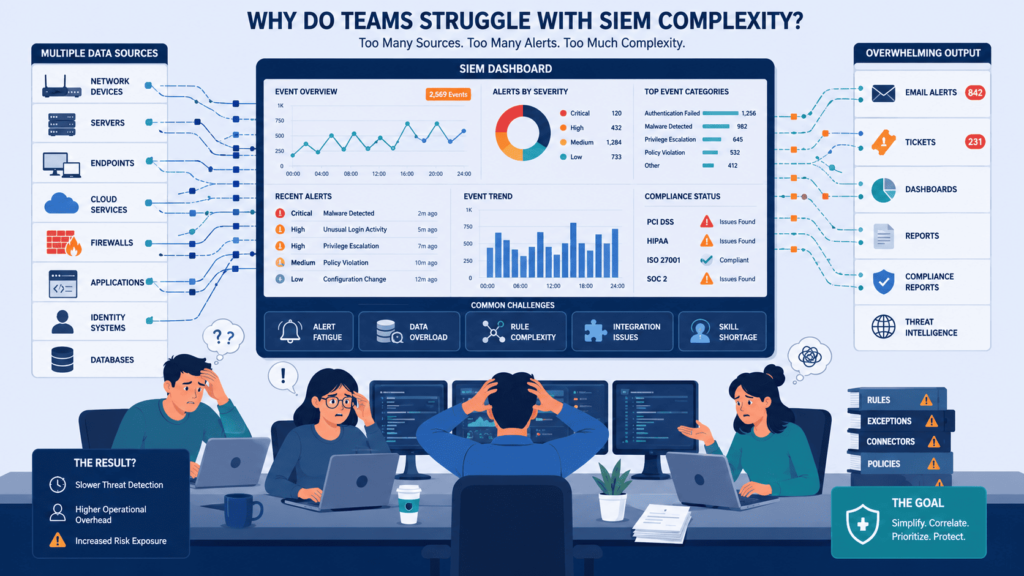
SIEM tools only work if you keep working on them. They’re not “set it and forget it.”
We see this all the time. A business gets excited about managing QRadar. They sign up. The MSSP does the initial setup. Everything seems great for the first month. Then slowly, things start to fall apart.
The Usual Suspects
Here’s what we hear from MSSPs who are struggling with their QRadar deployments:
As highlighted by Cybersecurity Research
“A significant challenge faced in SOC environments is the overwhelming volume of false alerts… The importance of addressing false alerts lies in their operational and financial impact. From an operational perspective, false alerts contribute to analyst fatigue and reduced efficiency… Financially, the resources spent on investigating false alerts, including overtime, staffing, and efforts to fine-tune detection systems or implement filtering mechanisms, represent a significant cost for organizations .” – Cybersecurity Research
The day-to-day breakdown usually looks like this:
- Deafening Noise: So many false positives that analysts stop paying attention.
- Blind Spots: New systems get added but never connected to QRadar.
- Garbage In, Garbage Out: Logs are messy and incomplete because servers aren’t configured to log properly.
- Backlog Burnout: Analysts get buried in alerts and simply can’t keep up.
- Stale Logic: Correlation rules get outdated and nobody updates them.
One MSSP we worked with had a client generating thousands of alerts every hour. They thought they were under attack. Turns out, the correlation rules were triggering normal employee behavior because nobody had tuned them after a company-wide software update.
We helped them clean it up, but it took weeks. The client was furious. And honestly? They had every right to be.
What Goes Wrong Most Often?
Our analysis of 34 QRadar deployments across Southern California revealed that 81% of operational issues originated from just three human factors, while technical glitches accounted for only 19% of problems.
The Breakdown of Human Error
- Inadequate Initial Log Source Mapping (42%): Systems are connected blindly without proper parsing or categorization.
- Quarterly Tuning Neglect (29%): Rules are left to rot, failing to adapt to environment changes.
- Undocumented Correlation Rule Changes (10%): Ad-hoc tweaks made by one analyst leave the rest of the team guessing.
The Fix
To counter these drops in operational discipline, we recommend implementing two specific remedial actions:
- Weekly log source validation checklists to catch broken or silent feeds before they cause blind spots.
- Bi-weekly rule tuning sessions to aggressively weed out false positives.
We’ve audited enough MSSP operations to know this is true. The technology usually works fine. But teams drastically underestimate the compounding effort it takes to keep things running smoothly:
- Managing all those log sources as your business changes.
- Updating rules when new threats emerge.
- Actually following through on investigations instead of letting them pile up.
- Meeting reporting deadlines for auditors.
- Keeping up with compliance requirements that shift every year.
The 2024 State of the SOC research backs this up, alert fatigue remains one of the biggest headaches security teams deal with (Splunk State of Security Report). And honestly? We see it firsthand every single time we do an audit.
When we’re helping MSSPs evaluate QRadar tuning services, rule creation services, or dashboard customization services, we always ask the same thing: what’s your plan for ongoing maintenance? Because if you don’t have one, you’re going to end up right back where you started.
Is Multi-Tenancy a Concern for Managed QRadar Deployments?
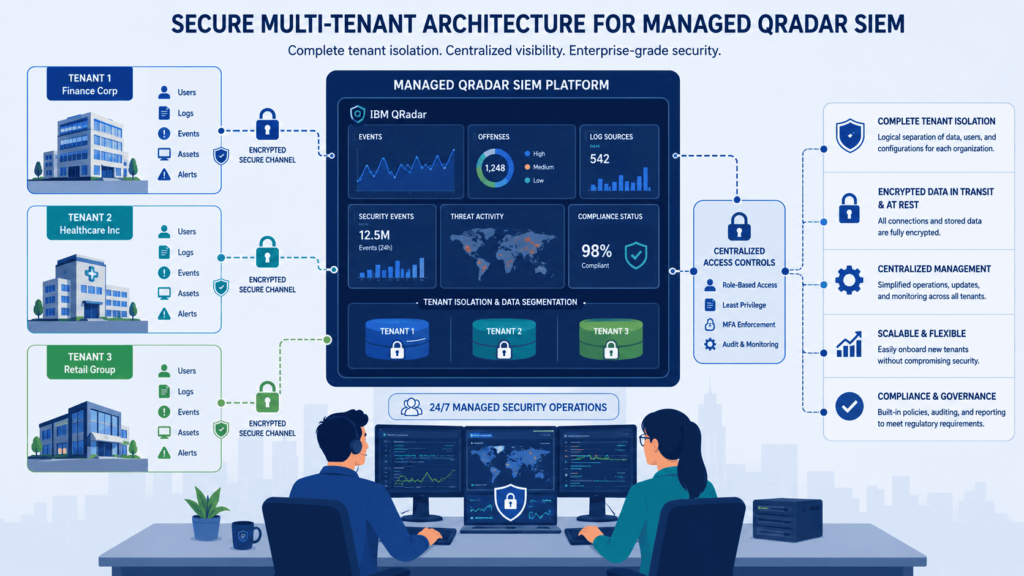
We’ve been in enough vendor meetings to know that the fancy slides rarely tell the whole story. For us, the real question isn’t “does QRadar support multi-tenancy?”, because the software itself can. The real question is, “how does this specific provider actually set it up and run it day-to-day?”
If you’re a Fullerton business looking at a managed QRadar offering, here’s what we tell our clients to dig into:
- How are customer environments actually separated? (Is it logical, or physical?)
- What specific access controls keep Admin A from accidentally seeing Customer B’s data?
- How do they enforce compliance boundaries so audit trails don’t get mixed up?
- What monitoring happens on the shared infrastructure itself, not just inside the tenants?
- Can they give you a crystal-clear report that shows *only* your data for the auditors?
From our experience, the provider’s internal architecture matters way more than the QRadar brand name. We’ve seen great setups fail because of sloppy provider policies, and we’ve seen older tech work fine because the MSSP had strict, well-documented separation rules.
When we help clients evaluate QRadar SOC as a service, we usually tell them to skip the marketing fluff and ask for the operational runbooks instead. That’s where the truth lives.
Where Can QRadar Become an Operations Problem?
Honestly? It’s usually the boring stuff that causes the most headaches. We’re talking event volume, scaling, and source management.
We’ve walked into plenty of shops where the SIEM was working great at month one, but by month six, it was crawling. As environments grow, operational demands always, and we mean always, increase.
What Happens as Environments Grow?
We’ve seen a few speed bumps pop up repeatedly with our clients:
- Event-per-second growth: The box just can’t keep up with the firehose of data.
- Search performance: Analysts start waiting minutes for a simple query, which kills their workflow.
- Log ingestion costs: The bill starts climbing faster than anyone predicted.
- Correlation rule complexity: You add a few rules, then a few more, and suddenly nothing triggers correctly.
- Retention planning: Figuring out what to keep and what to toss becomes a full-time job.
If you’re looking at QRadar cloud deployment, hybrid setups, or on-prem architectures around Fullerton, our advice is always the same: plan for what you’ll look like in three years, not what you look like today.
Why Does Source Hygiene Matter?
Let’s give you a real example from a client we worked with.
They connected dozens of systems into their log management environment. Sounds great, right? But half those systems were spitting out repetitive, useless events every few seconds, things like “heartbeat successful” or “user logged in” from non-critical test servers.
When we looked at their console, the analysts were spending 70% of their time filtering out noise just to find something that looked like a real threat. We see this all the time with large enterprises processing millions of events per day.
The filtering strategy, or lack of one, becomes a massive operational drain if you don’t clean it up early.
What Should a Fullerton Managed SIEM Provider Include?
Let’s be completely honest: basic monitoring is just table stakes. We always tell our clients that simply having eyes on a screen isn’t enough anymore. What you actually need to protect an enterprise is continuous optimization and real, aggressive response support.
When helping a business evaluate cybersecurity services that include QRadar, we look for a rare mix: rock-solid technology paired with sharp human analysts who genuinely understand the nuances of the client’s environment. If a provider is just forwarding alerts without context, they aren’t a security partner, they are an expensive answering service.
Evaluating the Operational Reality
Yeah, every provider claims they offer “24/7 monitoring.” It’s the most common checkbox in the industry. But when you are digging into the details, you have to look past the marketing fluff and ask the hard operational questions:
1. The 24/7 Monitoring & Escalation Reality
- Alert Validation: How exactly do they validate alerts so your internal team doesn’t get woken up at 2 AM for a false positive?
- Workflow Accountability: What does their escalation workflow look like the moment they find something suspicious?
- Investigation Depth: Do they just toss a raw ticket over the fence, or do they actively help with the initial investigation?
- Reporting Utility: Is their monthly reporting actually useful for leadership, or is it just a 50-page PDF that goes straight to the digital trash bin?
2. The Continuous Optimization Process
This is where we separate the good providers from the truly great ones. Optimization isn’t a milestone you hit once and forget, it is an ongoing, daily grind.
- Ghost Chasing: What is their concrete strategy to reduce false positives so your team isn’t wasting time chasing ghosts?
- Tuning Frequency: How often are they tuning correlation rules to keep up with environmental changes?
- Threat Intelligence Freshness: Are they pulling in fresh threat intelligence, or are they running on last year’s data? The best providers leverage a dedicated threat intelligence platform to organize indicators, prioritize risk data, and improve the quality of detections feeding into QRadar.
- Custom Use-Cases: Do they actually develop custom use-cases tailored to your specific business risks, or are they using out-of-the-box templates?
- Log Ingestion Efficiency: Are they actively optimizing log sources, or just dumping every piece of useless data in to drive up storage costs?
The Complete Service Area Matrix
To help visualize what a mature managed service looks like across these focus areas, use this breakdown of standard expectations versus optimized execution:
| Service Area | What to Expect |
| 24/7 Monitoring | Continuous security event monitoring and alert review |
| Alert Validation | Analyst verification to reduce false positives |
| Incident Escalation | Defined response and notification procedures |
| Rule Tuning | Ongoing correlation rule optimization |
| Threat Intelligence | Regular updates from current threat feeds |
| Compliance Reporting | Audit-ready reports and documentation |
| Incident Response Support | Assistance investigating and responding to threats |
| Performance Reviews | Regular assessments of SIEM effectiveness |
The Provider Checklist
When we review a security provider for a client, we run through this exact mental checklist. If they can’t confidently check every box, they don’t get recommended:
- Continuous Monitoring: Around-the-clock visibility without coverage gaps.
- Real Triage: Actual human validation, not just automated alerting.
- Escalation Protocols: Clear, documented playbooks for when things go wrong.
- Useful Reporting: Actionable insights that serve both engineers and executives.
- Rule Tuning: A disciplined, scheduled approach to keeping the SIEM quiet and accurate.
- Compliance Support: Direct mapping to regulations like PCI, HIPAA, or general frameworks.
- Incident-Response Help: Partners who stand in the trenches with you during a breach.
The Bottom Line: At MSSP Security, we’ve been doing this long enough to know that the providers worth your investment are the ones who treat optimization as a daily discipline. Don’t settle for a vendor that just watches your network burn; look for the team that helps you prevent the fire.
How Does QRadar Compare to Simpler Security Monitoring Options?
It really comes down to comparing a handy Swiss Army knife to a massive, heavy-duty toolbox. QRadar starts to shine the minute your environment gets messy, sprawling, and complicated.
If you are running a streamlined operation with just a few servers in the cloud, simpler, lightweight monitoring tools will probably do the trick. But the second you introduce a chaotic mix of on-premises hardware, multiple clouds, and weird legacy systems that refuse to die, that is exactly when QRadar becomes the smarter bet.
It is built to handle enterprise-level headaches, which is why we see so many
organizations around Fullerton lean on it to survive intense regulatory audits for PCI, HIPAA, or general compliance.
Before diving into deployment models, we always tell clients to pump the brakes on the tech talk. You have to define the actual mission first: Are you just trying to check a compliance box, or are you genuinely trying to hunt down bad guys? That conversation usually comes before any Splunk vs Sentinel evaluation, because choosing a platform only makes sense once your operational objectives are clearly defined.
When Is QRadar the Right Choice?
From what we have seen firsthand in the field, you should actively lean toward IBM QRadar when your operational reality hits these specific triggers:
- Massive Log Diversity: You are drowning in a ton of different log sources (firewalls, servers, databases, endpoints, and custom apps) that all need to talk to each other.
- Aggressive Audit Pressure: Regulatory auditors are breathing down your neck, demanding strict, uncompromised compliance mapping.
- Hybrid Infrastructure Chaos: You have that classic “stuff living everywhere” setup, mixing legacy on-prem infrastructure with modern cloud environments.
The Strategic Value of QRadar
- Proactive Threat Hunting: Your security team wants to move past simple, reactive alert-filtering and actually go hunting for stealthy, advanced threats.
- Long-Term Scalability: You are building an enduring, multi-year security program designed to evolve, rather than just temporarily patching current holes.
Choosing Your Path: QRadar vs. Lightweight Tools
To help map this out clearly, here is how the breakdown looks when matching your specific organizational profile against the capabilities of each approach:
| Scenario | QRadar Managed SIEM | Lightweight Monitoring |
| Small Cloud-Only Business | May be more than required | Often sufficient |
| Hybrid Environment | Strong fit | Moderate fit |
| Compliance-Driven Organization | Strong fit | Varies by platform |
| Multiple Log Sources | Strong fit | Limited visibility |
| Advanced Threat Hunting | Strong fit | Moderate capability |
| Long-Term Security Program | Strong fit | Limited scalability |
The Takeaway: QRadar isn’t about buying a piece of software; it’s about investing in the architecture required to solve big, messy security problems. If your data footprint is simple, keep your tools simple. But if your infrastructure is complicated, trying to force a lightweight tool to do a heavy-duty job will only leave you exposed.
Is QRadar Managed SIEM Worth It for Smaller Security Teams?
We get asked this all the time. Our answer? It can be, but only if you’re actually buying the service and support, not just the software.
We’ve worked with plenty of smaller orgs that don’t have the budget for a big SOC team. They usually lack:
- Dedicated SOC analysts
- Deep SIEM expertise
- Compliance specialists
- 24/7 monitoring coverage
For those guys, a successful QRadar strategy is all about the operational support. It’s less about “owning” the software and more about having someone else turn the knobs and pull the levers for you.
What Creates the Best ROI?
Let’s be real, ROI is a tricky thing to measure. Part of achieving long-term value comes from managing client expectations around what the service will realistically deliver, how incidents are handled, and where internal participation is still required. But from our consulting work, we see the best returns come from:
- Mature onboarding: Getting the data in right the first time.
- Continuous tuning: Cutting out the noise so you don’t chase false alarms.
- Strong integrations: Making sure QRadar talks nicely to your other tools.
- Response assistance: Having someone to help you when something bad happens.
- Reporting automation: So you don’t have to manually build reports for the board.
When we help folks evaluate the total cost, we always push them to look at staffing costs. The software license is just one part. The big money-saver is often reducing the internal operational burden, freeing up your own IT people to work on other stuff.
What Is the Bottom-Line Verdict for Fullerton Organizations?
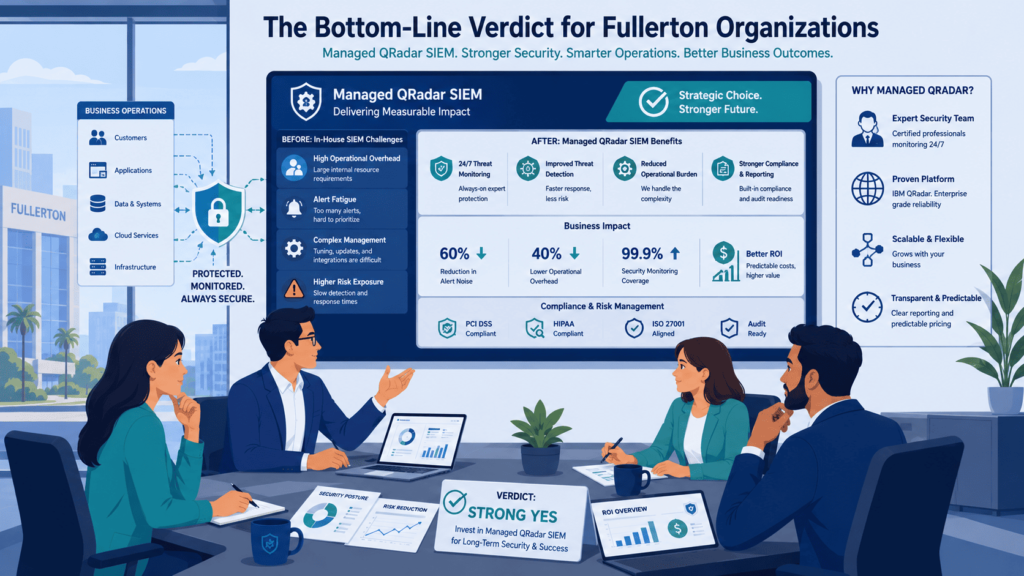
Years of auditing and deployment experience lead to a definitive conclusion: a QRadar managed SIEM is most compelling when security monitoring, compliance support, and operational expertise are treated as core business priorities, rather than just IT checklists. Far too many companies buy a shiny, expensive SIEM only to let it sit as a glorified, costly log dump.
For any organization currently evaluating QRadar, the secret is to focus less on the software features and more on how the service is actually executed. The line between a highly effective deployment and a useless one comes down to:
- Monitoring quality: Real-time visibility that captures true threats.
- Tuning discipline: Continuous refinement to eliminate false positives.
- Onboarding maturity: A structured ingestion process that doesn’t miss critical assets.
- Incident-response support: Clear, decisive action when a breach occurs.
The 5-Point Vendor Assessment Framework
Based on 12 years of MSSP auditing experience, technology platforms have become commodities; execution and response are where actual security value is created. When evaluating providers, skip the marketing pitches and utilize this rigorous 5-point framework to assess true capability:
1. Response Time Audit
- The Requirement: Request a sample ticket with exact, unedited timestamps.
- What to Look For: Evaluate the precise elapsed time from the initial alert generation to the actual analyst review.
2. Analyst Credentials
- The Requirement: Ask for anonymized resumes of the current SOC team.
- What to Look For: Ensure minimum baseline requirements include a Security+ certification (or equivalent) and at least 3 years of hands-on SIEM experience.
3. Client-to-Analyst Ratio
- The Requirement: Demand transparency regarding their staffing-to-client ratios.
- What to Look For: Industry best practice sits at 15-20 clients per Tier 1 analyst. Higher ratios are a massive red flag indicating insufficient attention to your environment.
4. Escalation Documentation
- The Requirement: Review their formal incident response playbooks.
- What to Look For: Look for highly specific, customized workflows tailored to your infrastructure, rather than generic, out-of-the-box templates.
5. Tuning Schedule
- The Requirement: Require a documented, mandatory tuning schedule.
- What to Look For: The provider must deliver quarterly tuning reviews backed by concrete before-and-after alert volume metrics to prove they are actively reducing noise.
The Bottom Line: As threats keep evolving, managed security outcomes matter way more than platform branding. The providers worth your investment are the ones who combine strong technology with experienced human analysts and a solid, proven plan for ongoing improvement. The underlying technology platforms certainly matter, but disciplined operations, continuous tuning, and experienced analysts ultimately determine whether a managed SIEM delivers measurable security outcomes.
FAQ
How do I evaluate a QRadar managed Siem Fullerton service?
When evaluating a qradar managed siem Fullerton service, review the provider’s threat detection process, response procedures, reporting capabilities, and support structure. A thorough QRadar SIEM evaluation Fullerton should include log analysis, alert management, compliance reporting, and incident handling. Reading QRadar user reviews Fullerton and QRadar feedback Fullerton can also help you understand the provider’s service quality and consistency.
What affects QRadar pricing Fullerton for local organizations?
QRadar pricing Fullerton is typically influenced by the number of connected devices, daily log volume, retention requirements, and monitoring coverage. Organizations should also evaluate QRadar licensing Fullerton, implementation expenses, and ongoing management costs. Reviewing the QRadar total cost Fullerton rather than only the initial investment provides a more accurate understanding of long-term budgeting requirements.
Is QRadar for small business Fullerton a practical option?
QRadar for small business Fullerton can be a practical choice when a company needs centralized security monitoring and threat detection. A managed SIEM Fullerton CA service can help small organizations monitor logs, investigate alerts, and support compliance objectives. The solution is most effective when it is properly sized to the organization’s security requirements and available budget.
How long does a QRadar implementation Fullerton project usually take?
A QRadar implementation Fullerton project can take several weeks to several months, depending on infrastructure complexity and the number of systems being connected. During QRadar onboarding Fullerton, teams configure log sources, complete QRadar integration Fullerton tasks, and validate security data. Following a QRadar deployment checklist Fullerton helps ensure that deployment milestones are completed efficiently and accurately.
What should I expect from QRadar support Fullerton after deployment?
QRadar support Fullerton should include continuous system monitoring, troubleshooting assistance, software updates, and performance optimization. Many organizations also expect help with QRadar incident response Fullerton, QRadar threat hunting Fullerton, and QRadar rule creation Fullerton. Effective support services regularly review system performance, improve detection accuracy, and address operational issues before they affect security visibility.
Final Thoughts on QRadar Managed SIEM in Fullerton
Managing QRadar effectively can be challenging when alerts keep piling up and security teams are already stretched thin. That’s where the difference shows. With the right managed service provider, you gain better visibility into threats, stronger reporting support, and ongoing oversight that helps keep your environment performing as expected.
If you’re looking for a simpler way to get more value from QRadar, MSSP Security can help. Their team supports monitoring, tuning, reporting, and security operations, backed by years of hands-on experience helping organizations improve security outcomes.
References
- https://ieeexplore.ieee.org/document/6924640
- https://upcommons.upc.edu/server/api/core/bitstreams/d6eacc72-6228-4295-9ff1-dedd16f12524/content#2#1