

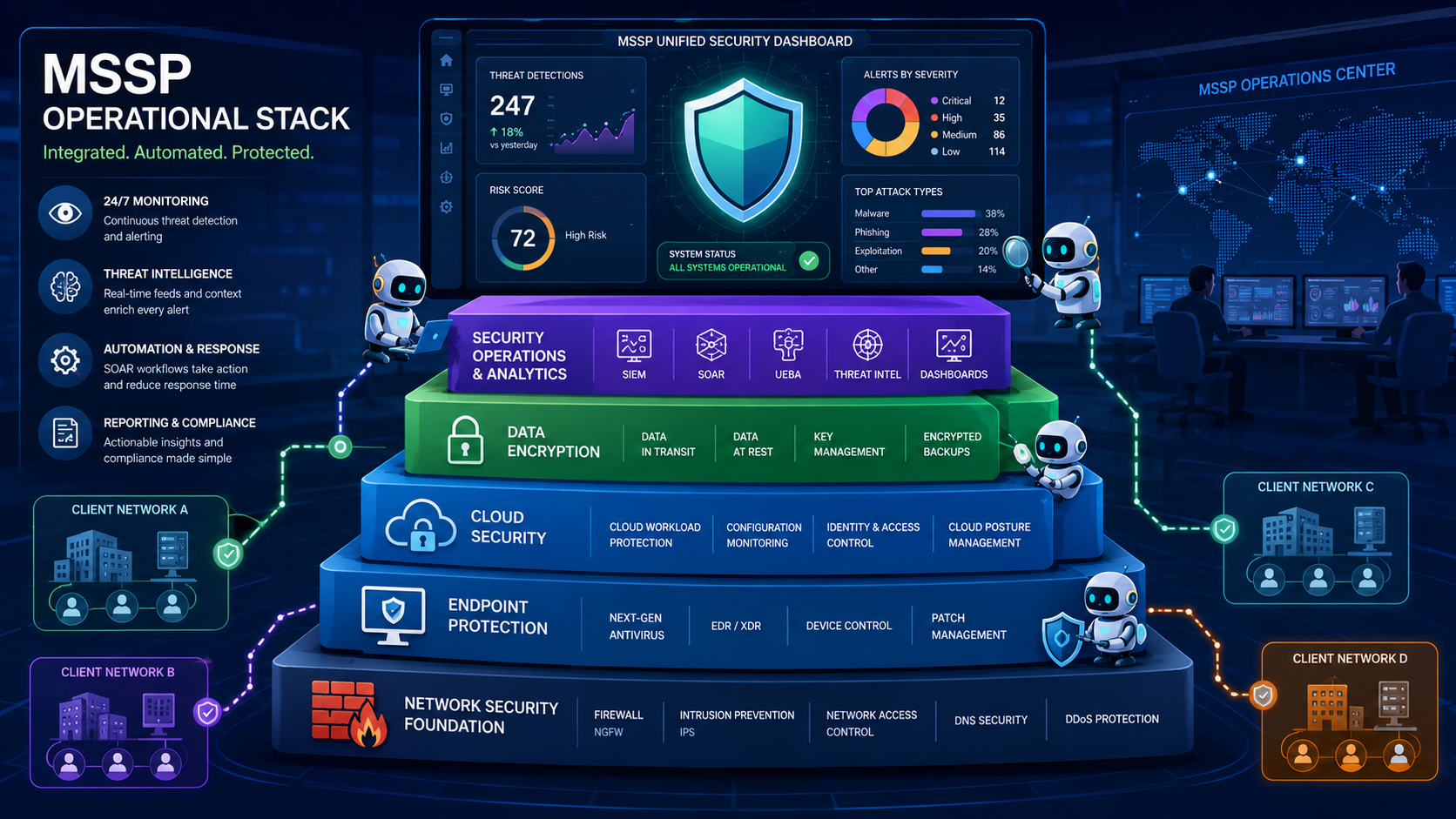
Modern cybersecurity depends on more than individual security tools. The technology and platforms utilized by an MSSP determine how effectively threats are detected, investigated, and contained. At MSSP Security, we have found that strong protection starts with visibility.
That is why Network Threat Detection serves as a foundational layer, helping security teams understand what is happening across the environment before taking action. From monitoring and automation to cloud protection, every platform plays a specific role in a connected security ecosystem. Keep reading
Security Stack Snapshot
Before exploring each platform, here are three key takeaways:
- True security comes from integrated platforms, not isolated tools.
- Visibility, starting with the network, is the absolute foundation for all other actions.
- The client portal and backend integrations are critical for transparency and speed.
What Is the Role of Network Threat Detection in an MSSP Technology Stack?
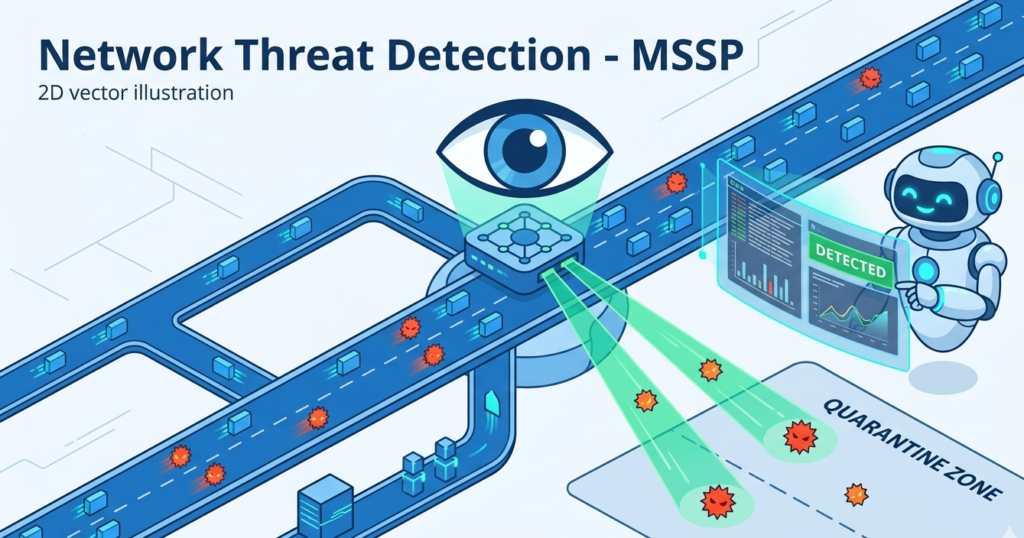
Everything starts with visibility. If you don’t see the initial probe, you’re already behind. Network Threat Detection provides that foundational view. It’s not just watching for known bad signatures, it’s understanding the normal flow of your business traffic, the rhythm of data between departments, to the cloud, to external partners.
We use it to spot the anomalies. A server that only talks internally suddenly sending gigabytes to an unknown foreign IP. A low-and-slow scanning pattern that a firewall might allow but that spells reconnaissance.
This real-time traffic analysis supports every other platform in the stack. It provides the context that turns a standalone endpoint alert into a broader incident. It sees the lateral movement after an initial compromise, the command-and-control callbacks. Many MSSPs start here because the network doesn’t lie.
It shows the raw conversation, the intent, before a payload is ever executed. You build your understanding from this outward, adding layers of detail and automation. Without this lens, you’re securing a room in the dark.
How Do MSSPs Compare Different SIEM Platforms?
A SIEM is the central nervous system. It’s where data goes to become information. Comparing them isn’t about who has the most features, it’s about fit.
“CISOs in our research shared that they are turning to unified platforms to consolidate multiple functions for reasons such as efficiency, data integration, cost, and vendor strategy. According to the data, approximately 70% of CISOs indicated they are in the process of consolidating or have consolidated multiple software solutions into one or more integrated platforms.” – Security Boulevard
Can it handle your data volume without choking? Does it normalize logs from your specific applications so they can be correlated? The best SIEMs we’ve worked with turn chaos into a timeline. They take a firewall block, a weird process on an accounting laptop, and a failed cloud login, and ask if they’re related.
What Features Are Most Important in a SIEM?
Centralized log management is the basic job. Correlation engines are the brain. They run rules and machine learning models over that data to find the needles. Good compliance reporting turns security work into audit evidence. Scalability is everything, because your data will grow 30% a year without trying.
How Does a SIEM Support Security Operations?
It’s the tool for investigation and hunting. An analyst lives here, building searches, following trails. It provides long-term retention for understanding attack patterns over months. It defines the security monitoring workflow, the process from alert to ticket.
What Challenges Should Organizations Consider?
Data growth costs real money. Alert fatigue is a silent killer, too many false positives and real threats get missed. Integration requirements are massive; if it doesn’t connect easily to your other tools, it becomes a data silo. The operational cost isn’t just the license, it’s the people to tune it.
How Can Organizations Choose the Right SOAR Platform?
Credits: begginertuts
If the SIEM is the brain that finds the problem, the SOAR platform is the hands that fix it. Choosing one is about evaluating its ability to take consistent, fast action. We look at the integration ecosystem first.
Does it have pre-built connectors for our most common tools? Can it easily talk to the ticketing system and the firewall API? Then, automation flexibility. Can we modify playbooks without a PhD in coding?
What Does SOAR Actually Do?
It orchestrates actions across different systems. It automates the initial response. It manages the incident workflow, ensuring steps aren’t missed. Think of it as a digital runbook that actually executes the commands.
Which Factors Should Guide Platform Selection?
Beyond integrations, consider ease of deployment. A tool that takes a year to implement loses its value. Reporting capabilities matter for proving the time saved. The interface must be clear for the analysts who will build and maintain the playbooks.
Which EDR and XDR Tools Help Improve Endpoint Security?
Endpoints are where attacks often land. EDR tools are your dedicated sentries on each device. XDR expands the view, connecting endpoint data to email, identity, and network alerts. The difference is scope. EDR is deep on the endpoint. XDR is broad across the environment.
What Is the Difference Between EDR and XDR?
EDR focuses on detection and response on the endpoint itself—process lineage, registry changes, fileless attacks. XDR correlates that endpoint data with signals from other sources. It might link a phishing email opened by a user to the malicious PowerShell script that later runs on their laptop, and then to the outbound network connection it creates.
What Capabilities Matter Most?
Accurate threat detection with low false positives is paramount. Behavioral analytics that spot unusual activity are key. The tool must provide deep investigation support for analysts. Automated containment, like cutting off a machine from the network, is a critical last line of defense.
How Do MSSPs Use EDR and XDR Daily?
They provide continuous endpoint monitoring, 24/7. They are the primary tools for targeted threat response on a device. They generate the security reporting that shows endpoint risk. They are the mechanism for deploying containment actions across thousands of devices at once.
How Does Vulnerability Scanner Technology Help Reduce Risk?
You can’t respond your way out of every problem. Some you need to find and fix first. Vulnerability scanners are your proactive search team. They systematically identify weaknesses in systems, applications, and network devices, the unpatched software, the misconfigured databases.
Why Are Threat Intelligence Platforms (TIPs) Valuable for Security Teams?
Context changes everything. A failed login is normal. A failed login for a user whose credentials were just posted on a hacker forum is critical. Threat Intelligence Platforms provide that external context.
What Firewall Technology Options Do MSSPs Commonly Deploy?
Firewalls remain one of the most important layers in a modern security stack, but their role has changed significantly. They are no longer limited to blocking traffic based on ports and protocols. Today’s firewall technologies can understand applications, inspect traffic in greater detail, and help security teams respond to threats faster.
Modern firewalls provide much deeper visibility into network activity. Instead of simply identifying where traffic is going, they can determine which applications are being used and whether that activity appears suspicious. This makes them more effective at detecting threats that may be hidden within normal network communications.
Key capabilities MSSPs typically look for include:
- Deep traffic inspection and visibility
- Application-aware traffic control
- User-based policy management
- Integrated threat prevention
- Support for hybrid and cloud environments
- Real-time threat intelligence integration
Firewalls also work closely with other security technologies. Security logs are forwarded to SIEM platforms for analysis, while threat intelligence feeds help update block lists automatically.
In many environments, SOAR workflows can use firewalls as an enforcement point, automatically blocking malicious IP addresses or restricting suspicious connections during an active incident. When combined with Network Threat Detection and other security tools, firewalls help create a stronger and more coordinated defense against modern cyber threats.
Why Is a Customer Portal Service Interface Important?
Trust requires transparency. A customer portal is the window into the security service. It turns a black box into a collaborative partnership.
What Information Should Customers Access?
Real-time security alerts and their status. Open incident tickets and remediation progress. Compliance reports for audits. Service metrics like mean time to detect and respond.
How Does Self-Service Improve Security Operations?
It enables faster communication, no waiting for an email. It provides better transparency into the work being done. It offers easier access to historical reports for board meetings or internal reviews.
What Makes a Good Customer Portal?
Simple, intuitive navigation. Real-time data updates, not just daily summaries. Secure access controls, often with multi-factor authentication. It should be useful, not just a brochure.
How Do MSSPs Integrate Ticketing Systems with Security Operations?
An alert without a ticket is just noise. A ticket without integration is manual, slow work. Connecting the security stack to the ticketing system is what creates accountability and a smooth workflow.
What Log Collector and Aggregator Options Support Security Monitoring?
Before the SIEM can analyze, data must be collected and normalized. Log collectors and aggregators are the unsung heroes of the data pipeline.
“One MSSP deployment reported 144,000 monthly alerts reduced to 200 requiring human review — a 99.86% reduction in manual workload. The financial impact: documented gross margin shift from 35–50% (human-only SOC) to 70–85% (Morpheus-augmented SOC).” – D3 Security Morpheus for MSSPs
Why Is Log Collection So Important?
It is the basis for all security visibility. It supports compliance mandates that require log retention. It ensures investigation readiness; you can’t hunt for an attack from six months ago if you didn’t store the logs.
What Features Should Organizations Evaluate?
Data normalization is crucial, turning different log formats into a common language. Scalability to handle growing data volumes. Rock-solid reliability; losing logs means losing evidence. Storage efficiency to control costs.
How Do Aggregators Support SIEM Performance?
They reduce complexity by feeding the SIEM clean, normalized data streams. They provide better data organization. They improve analytics performance by offloading some pre-processing work.
Which Cloud-Native Security Tools Are MSSPs Using Today?
The cloud is different. It’s dynamic, ephemeral, and operates on a shared responsibility model. The tools must be built for that environment.
What Makes Cloud Security Different?
Infrastructure is dynamic, servers spin up and down in minutes. The cloud provider secures the platform, you secure your data and access. Environments need to scale security instantly with the business.
What Cloud-Native Capabilities Matter Most?
Configuration monitoring to catch misconfigured storage buckets or open security groups. Identity protection for complex cloud IAM roles. Workload security for virtual machines and serverless functions. Container visibility for Kubernetes and Docker environments.
How Do MSSPs Manage Multi-Cloud Environments?
They seek tools that provide unified visibility across AWS, Azure, and GCP. They implement automated monitoring that adapts as resources change. The goal is consistent policy enforcement, no matter where the workload lives.
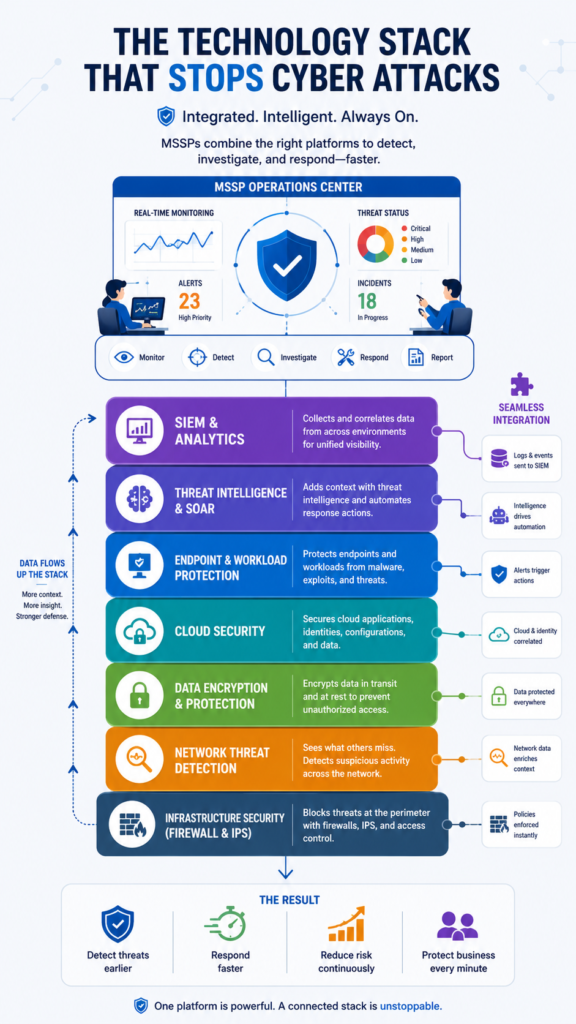
How Do These Security Technologies Work Together?
The magic isn’t in any single box. It’s in the connections. An integrated stack acts as a single organism.
| Technology | Primary Purpose | Security Benefit |
| Network Threat Detection | Network visibility & discovery | Early detection of suspicious activity |
| SIEM | Centralized monitoring & correlation | Faster investigation & hunting |
| SOAR | Security automation & orchestration | Reduced response time & workload |
| EDR/XDR | Endpoint protection & cross-layer detection | Improved threat containment |
| Vulnerability Scanner | Proactive risk identification | Better remediation planning |
| TIP | Threat intelligence management | Stronger threat context & prioritization |
| Firewall | Traffic control & threat prevention | Reduced attack surface |
| Customer Portal | Service transparency & reporting | Better communication & trust |
| Ticketing System | Incident workflow management | Improved accountability & tracking |
| Log Aggregator | Data collection & normalization | Reliable analytics & retention |
| Cloud Security Tools | Cloud-specific protection | Stronger cloud security posture |
Here’s how it flows. The Network Threat Detection sensor sees an anomalous outbound connection. It sends a log to the SIEM. The SIEM enriches that log with data from the TIP, noting the destination IP is on a watchlist. It correlates it with a vulnerability scan report showing the source server is unpatched.
A high-severity alert is created. The SOAR platform picks it up, runs a playbook that opens a ticket, isolates the server via the EDR tool, and pushes a block rule to the firewall. The ticket appears in the client portal. The entire sequence, from detection to initial containment, happens in under two minutes.
What Should Organizations Consider When Evaluating MSSP Technology Platforms?
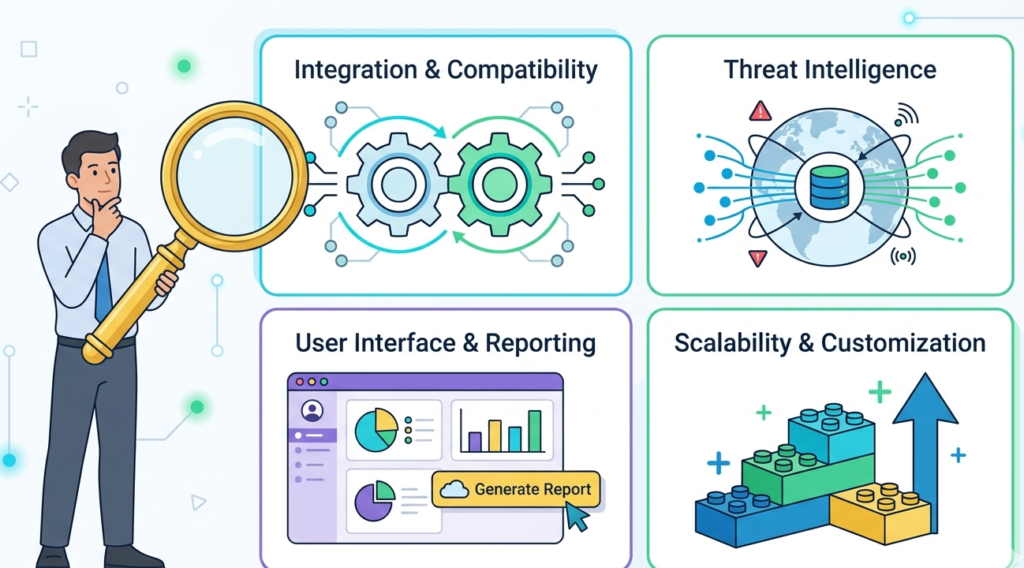
Look beyond the vendor logos. Ask how they connect. Evaluate your own security requirements and compliance objectives. Consider the integration capabilities, will these tools work with your existing investments? Assess the MSSP’s operational maturity in managing the stack.
Ensure it meets your scalability needs for growth. Think long-term. The right stack is a platform that evolves with the threat landscape.
FAQ
What technology is most important in an MSSP environment?
No single tool is most important. The critical factor is the integration between them. However, visibility is the foundational requirement, which is why comprehensive Network Threat Detection is often positioned as the essential starting point for understanding the environment before layering on other controls.
How does Network Threat Detection support other security platforms?
It provides the initial context and the “patient zero” data point. It can identify the early reconnaissance or command-and-control traffic that other endpoint-focused tools might miss until later in the attack chain.
This data enriches SIEM correlations, informs SOAR playbooks, and gives EDR/XDR tools a broader picture of the incident.
What is the difference between SIEM and SOAR?
A SIEM is primarily for detection and investigation. It collects and analyzes data to find threats. A SOAR platform is for response and automation. It takes the alerts from the SIEM and other tools and automates the containment and remediation workflows. Think of SIEM as the alarm system and SOAR as the automated locks, sprinklers, and security call service.
Why are cloud-native security tools becoming more important?
Because traditional security tools often lack visibility into cloud-specific APIs, temporary resources, and shared responsibility models. Cloud-native tools are built for the dynamic scale and architecture of the cloud.
They understand cloud identities, monitor for misconfigurations, and protect workloads that may only exist for a few hours, which is essential as business operations continue to shift.
Building a Defense That Actually Works
A modern security stack should drive resilience, not complexity. If your current toolset feels disconnected or heavy on overhead, it might be time to optimize.
Let’s collaborate to build an integrated, highly visible defense system that truly protects your clients and aligns with your operational maturity. Ready to streamline your operations, reduce tool sprawl, and elevate your service quality? Partner with our expert consulting team today to transform your security capability.
References
- https://securityboulevard.com/2026/01/the-mssp-security-management-platform-enabling-scalable-intelligence-driven-cyber-defense/
- https://d3security.com/morpheus/use-case/mssp/