


An incident doesn’t end when the threat is removed, it ends when the root cause is fixed. From our experience, many organizations focus only on containment, ignoring what comes next. Post incident remediation activities are critical to ensure the same issue doesn’t happen again.
By aligning these activities with automated remediation actions MSSP and MSSP Security, we can turn incidents into learning opportunities. This article explains how structured remediation after an incident strengthens long-term security. Keep reading to build a smarter recovery approach.
Key Insights: Post Incident Remediation Activities
Post incident remediation activities focus on long-term improvement, not just recovery.
- Identify and fix root causes
- Strengthen automated remediation actions MSSP
- Improve MSSP Security processes
What Are Post Incident Remediation Activities?

Post incident remediation activities are actions taken after an incident to fully resolve vulnerabilities and prevent recurrence.
These typically include:
- Root cause analysis
- System patching and updates
- Configuration corrections
- Policy and process improvements
In automated remediation actions MSSP, these activities help refine automation rules. MSSP Security ensures that lessons learned are translated into stronger defenses across all systems.
Why Post Incident Remediation Activities Matter
Credits: Crisis Response Coach
Stopping an attack is only the first step. Without remediation, risks remain.
- Vulnerabilities may still exist
- Attackers could exploit the same weakness again
- Security posture remains weak
From our experience, organizations that prioritize post incident remediation activities significantly reduce repeat incidents. MSSP Security frameworks ensure these improvements are applied consistently.
“A security incident is an event that may indicate a breach of systems or data, requiring response and recovery actions.” – Wikipedia
Key Steps in Post Incident Remediation Activities
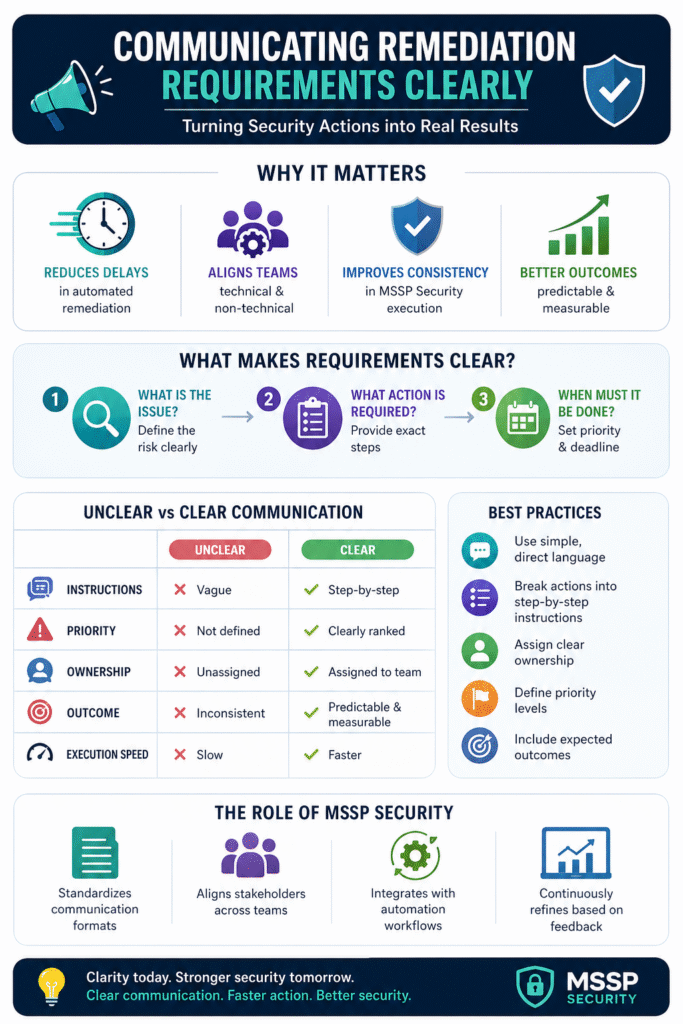
A structured approach ensures nothing is missed.
- Root Cause Analysis: Identify how and why the incident occurred
- Remediation Actions: Fix vulnerabilities and misconfigurations
- Validation: Confirm the issue is fully resolved
- Documentation: Record findings and actions taken
- Improvement: Update processes and automation
In automated remediation actions MSSP, these steps help refine future responses and improve efficiency.
Table: Incident Response vs Post Incident Remediation
| Aspect | Incident Response | Post Incident Remediation Activities |
| Focus | Immediate containment | Long-term prevention |
| Timeline | During incident | After incident |
| Goal | Stop the threat | Prevent recurrence |
| Approach | Reactive | Proactive |
| Outcome | Temporary resolution | Sustainable security improvement |
Common Challenges in Post Incident Remediation Activities
Organizations often face:
- Incomplete root cause analysis
- Lack of documentation
- Poor communication between teams
- Delayed implementation of fixes
These challenges weaken automated remediation actions MSSP. MSSP Security helps address them by standardizing processes and ensuring accountability.
“Incident management includes identifying, analyzing, and correcting hazards to prevent future reoccurrence.” – Wikipedia
Best Practices for Post Incident Remediation Activities
- Conduct thorough root cause analysis
- Prioritize fixes based on risk level
- Update automated remediation actions MSSP rules
- Improve monitoring and detection
- Train teams based on lessons learned
We’ve seen that MSSP Security becomes more effective when remediation is treated as a continuous improvement cycle, not a one-time task.
Role of MSSP Security in Post Incident Remediation Activities

MSSP Security plays a critical role in ensuring remediation is consistent and scalable.
- Standardizes remediation workflows
- Integrates lessons into automation
- Ensures compliance and reporting
- Continuously improves security posture
From our experience, MSSP Security bridges the gap between response and long-term protection, making automated remediation actions MSSP more effective.
FAQ
What are post incident remediation activities?
They are actions taken after a security incident to fix vulnerabilities, address root causes, and prevent similar incidents from happening again.
Why are post incident remediation activities important?
They ensure that the underlying issues causing the incident are resolved, reducing the risk of recurrence and improving overall security posture.
How do automated remediation actions MSSP support post incident remediation activities?
Automation helps apply fixes consistently, update rules based on past incidents, and ensure faster response to similar threats in the future.
How does MSSP Security improve remediation processes?
MSSP Security provides structured frameworks, continuous monitoring, and optimization, ensuring remediation activities are effective and aligned with security goals.
Post Incident Remediation Activities for Stronger Security
Post incident remediation activities are essential for turning incidents into long-term security improvements. By identifying root causes and applying structured fixes, organizations prevent future threats and strengthen resilience.
Through automated remediation, we ensure improvements are consistent, scalable, and effective. If you want to build a stronger defense, focus not just on response, but on what comes after. Build a Tech Stack That Aligns With Your Goals Partner With Our Experts Today!
References
- https://en.wikipedia.org/wiki/Computer_security_incident
- https://en.wikipedia.org/wiki/Incident_management