


Even the most advanced security tools fail if remediation instructions are unclear. From our experience, many delays in automated remediation actions MSSP come not from detection, but from confusion in execution. Clear communication ensures every stakeholder understands what to fix, how to fix it, and when it must be done.
Through MSSP Security, we focus on translating technical findings into actionable steps that teams can follow without hesitation. Keep reading to see how clarity transforms remediation into measurable results.
Key Insights: Communicating Remediation Requirements Clearly
Clear communication bridges the gap between detection and action.
- Reduces delays in automated remediation actions MSSP
- Aligns technical and non-technical teams
- Improves consistency in MSSP Security execution
Why Clear Communication Matters in Remediation

Remediation often fails not because of complexity, but because of unclear instructions.
- Teams misunderstand priorities
- Actions are delayed or skipped
- Security gaps remain unresolved
In automated remediation actions MSSP, clarity ensures automation rules are correctly implemented and understood. From firsthand experience, MSSP Security workflows become significantly more effective when instructions are simple, structured, and actionable.
“Communication is the act of conveying meanings from one entity or group to another through the use of mutually understood signs, symbols, and rules.” – Wikipedia
What Makes Remediation Requirements Clear?
Clear remediation requirements should answer three core questions:
- What is the issue? (Define the risk clearly)
- What action is required? (Provide exact steps)
- When must it be done? (Set priority and deadline)
In MSSP Security, we structure remediation guidance to remove ambiguity. This approach ensures that both humans and systems interpret instructions consistently, reducing the likelihood of manual errors.
Common Communication Gaps in Remediation
Credits: Ayehu (Now Part of Resolve)
Organizations often struggle with:
- Overly technical language
- Missing context about risk impact
- Lack of prioritization
- अस्पष्ट ownership of tasks
These gaps slow down automated remediation actions MSSP and create inconsistencies. We’ve seen that simplifying language and defining ownership dramatically improves execution speed.
“Clarity and shared understanding are critical to successful coordination in complex systems.” – Sage Journals
Unclear vs Clear Remediation Communication
| Aspect | Unclear Communication | Clear Communication |
| Instructions | Vague | Step-by-step actionable |
| Priority | Not defined | Clearly ranked |
| Ownership | Unassigned | Assigned to specific team |
| Outcome | Inconsistent | Predictable and measurable |
| Execution Speed | Slow | Faster |
Best Practices for Communicating Remediation Requirements Clearly
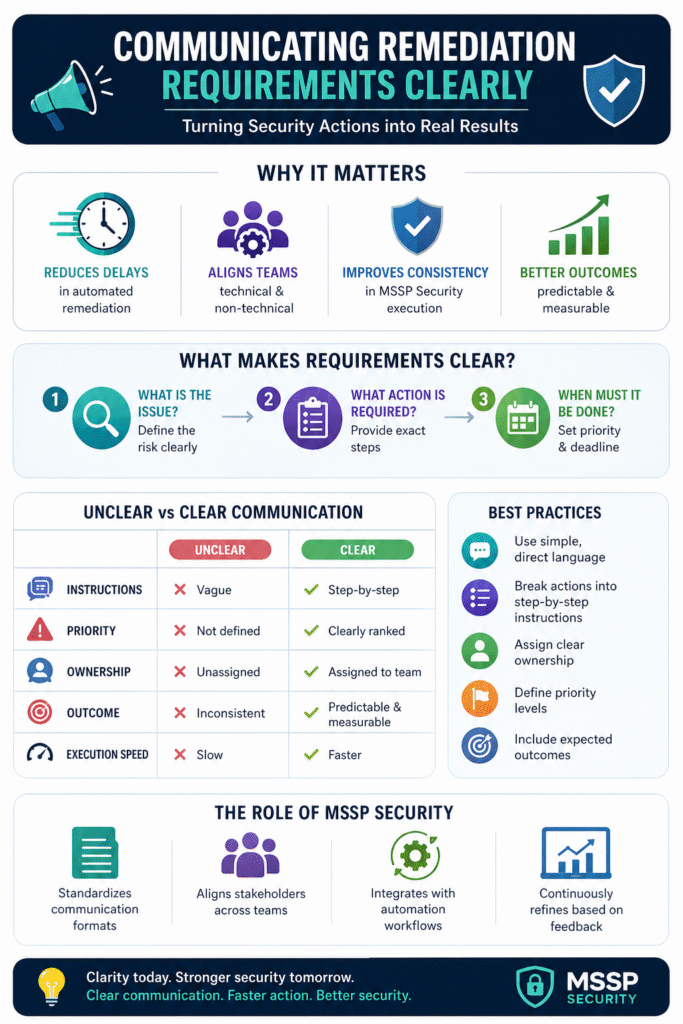
- Use simple, direct language
- Break actions into step-by-step instructions
- Assign clear ownership
- Define priority levels
- Include expected outcomes
When deploying automated remediation actions, these practices ensure that automation rules and manual actions remain perfectly aligned. MSSP Security frameworks benefit greatly from using these standardized communication templates.
Role of MSSP Security in Communication

MSSP Security plays a key role in ensuring clarity across all processes, specifically when tracking remediation progress to maintain visibility. We focus on standardizing formats and aligning stakeholders across technical teams.
- Standardizes communication formats
- Aligns stakeholders across teams
- Integrates communication with automation workflows
- Continuously refines instructions based on feedback
From our experience, MSSP Security acts as a bridge between technical detection and practical execution, ensuring automated remediation actions MSSP deliver real impact.
FAQ
What does communicating remediation requirements clearly mean?
It means providing clear, actionable, and structured instructions for fixing security issues, including what needs to be done, who is responsible, and when it should be completed.
Why is clear communication important in automated remediation actions MSSP?
Because automation depends on predefined rules. If instructions are unclear, automation may fail or produce incorrect results, reducing effectiveness.
How can organizations improve remediation communication?
By simplifying language, defining priorities, assigning ownership, and using standardized templates. Continuous feedback also helps refine communication over time.
Does MSSP Security improve communication processes?
Yes. MSSP Security provides structured frameworks, ensuring remediation requirements are consistently communicated and aligned with operational workflows.
Communicating Remediation Requirements Clearly for Better Security Outcomes
Clear communication is vital for ensuring security actions are executed accurately. In automated remediation actions MSSP, precision allows human teams and automated systems to collaborate seamlessly, reducing delays and improving outcomes.
With over 15 years of expertise, we offer specialized MSSP consulting to optimize your technology stack and streamline operations. Our vendor-neutral approach ensures your tools align with your business goals, providing actionable recommendations for a resilient defense. Enhance Your Security with MSSP Security
References
- https://en.wikipedia.org/wiki/Communication
- https://doi.org/10.1177/0956797614535810