

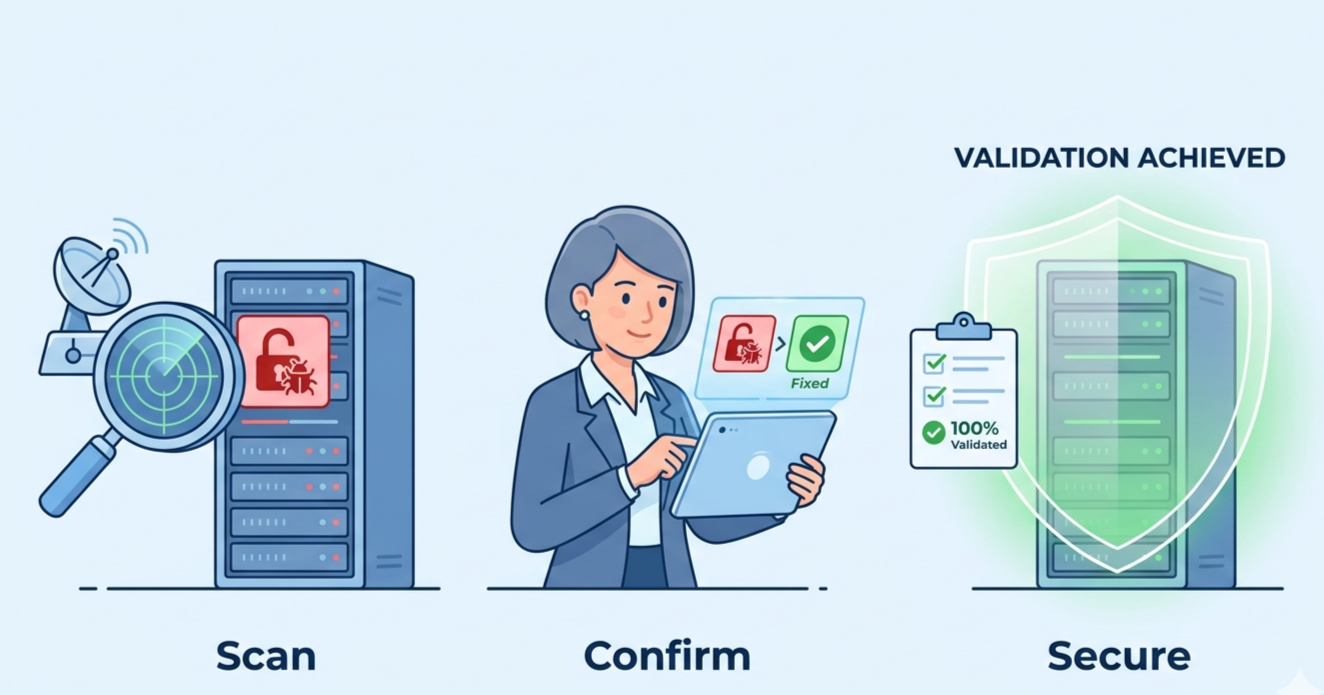
Understanding validating remediation effectiveness scans is essential for organizations that want to ensure their security fixes actually work. Applying a patch or configuration change does not automatically mean the vulnerability is resolved.
Without proper validation, organizations risk leaving hidden weaknesses that attackers can still exploit. Validating remediation effectiveness scans provide a reliable way to confirm that remediation actions are successful. This article explains how validation works and why it is critical for long-term protection. Keep reading.
Key Insights on Validating Remediation Effectiveness Scans
Validating remediation effectiveness scans ensures that fixes truly eliminate vulnerabilities rather than just masking them.
- Verification step: Confirms vulnerabilities are fully resolved
- Risk reduction: Prevents false assumptions of security
- Continuous monitoring: Supports long-term protection
Why Validating Remediation Effectiveness Scans Matters
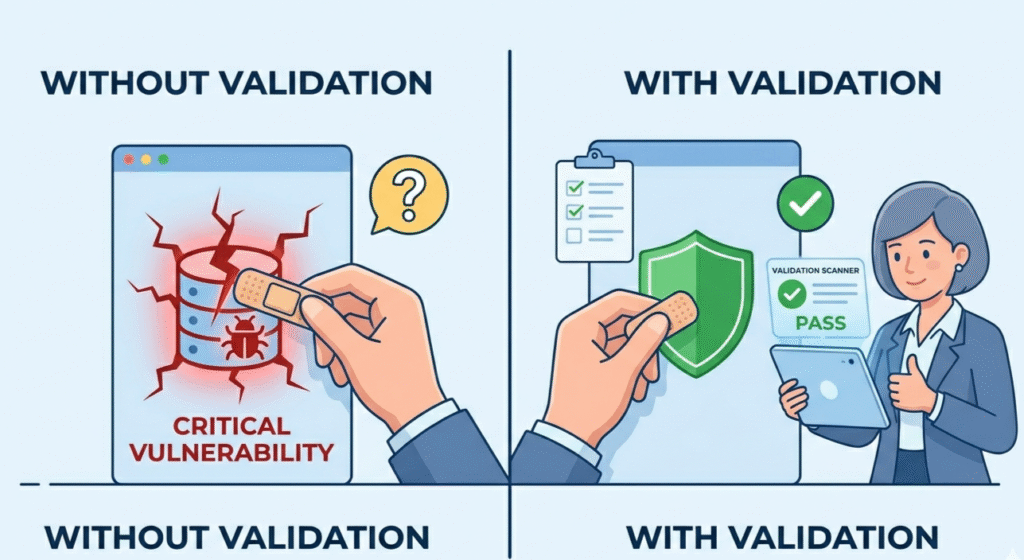
Remediation without validation can create a false sense of security, which is why following structured remediation steps is vital to ensure no phase of the fix is overlooked.
Key risks:
- Incomplete fixes
- Reintroduced vulnerabilities
- Misconfigurations
Validating remediation effectiveness scans ensures that remediation efforts deliver real, measurable security improvements.
Types of Scans Used in Validating Remediation Effectiveness Scans
Different scanning methods are used to confirm whether vulnerabilities are fully resolved.
Common types include:
- Vulnerability scans: Detect known weaknesses
- Configuration scans: Verify secure settings
- Compliance scans: Ensure standards are met
- Application scans: Test software security
“A vulnerability scanner is a computer program designed to assess computers, networks or applications for known weaknesses.” – Wikipedia
Using multiple scan types strengthens validation accuracy.
How Validating Remediation Effectiveness Scans Work
Credits: Maurice Gardner
Validating remediation effectiveness scans compare system conditions before and after remediation.
Key steps:
- Re-scan affected systems
- Analyze results
- Confirm vulnerability closure
- Identify remaining risks
This process ensures that remediation actions have successfully removed the issue.
Integrating Validating Remediation Effectiveness Scans into Workflows
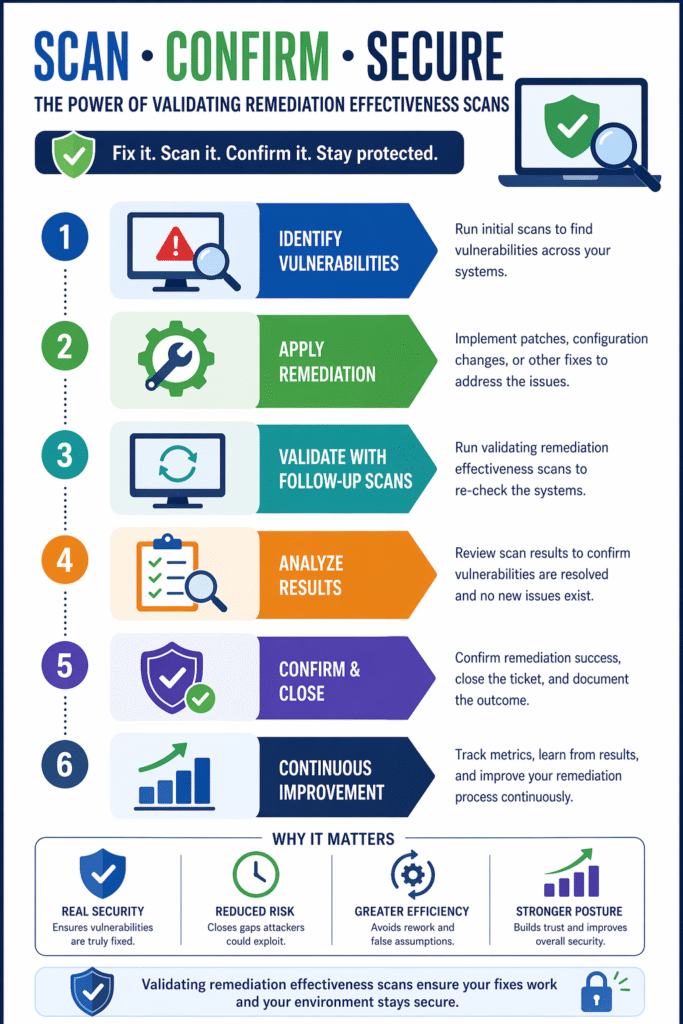
Validation should be embedded into every workflow, especially when coordinating remediation across different teams to ensure everyone is aligned on the final results.
Best practices:
- Schedule scans after fixes
- Automate validation processes
- Integrate with ticketing systems
- Document outcomes
This ensures consistency and accountability.
Common Challenges in Validating Remediation Effectiveness Scans
Organizations often face obstacles when validating remediation.
Common challenges:
- False positives or negatives
- Limited scan coverage
- Tool limitations
- Time constraints
Addressing these challenges improves the reliability of validation results.
Automation in Validating Remediation Effectiveness Scans
Automation enhances the efficiency of validation processes.
Examples:
- Automated rescanning
- Real-time monitoring tools
- Continuous compliance checks
Automation ensures validation is consistent and timely.
Measuring Success in Validating Remediation Effectiveness Scans
Organizations need metrics to evaluate effectiveness.
| Metric | Purpose | Benefit |
| Reopen Rate | Tracks recurring vulnerabilities | Identifies weak fixes |
| Scan Coverage | Measures systems scanned | Ensures completeness |
| Validation Time | Measures verification speed | Improves efficiency |
These metrics help refine validation strategies.
Continuous Improvement Through Validating Remediation Effectiveness Scans
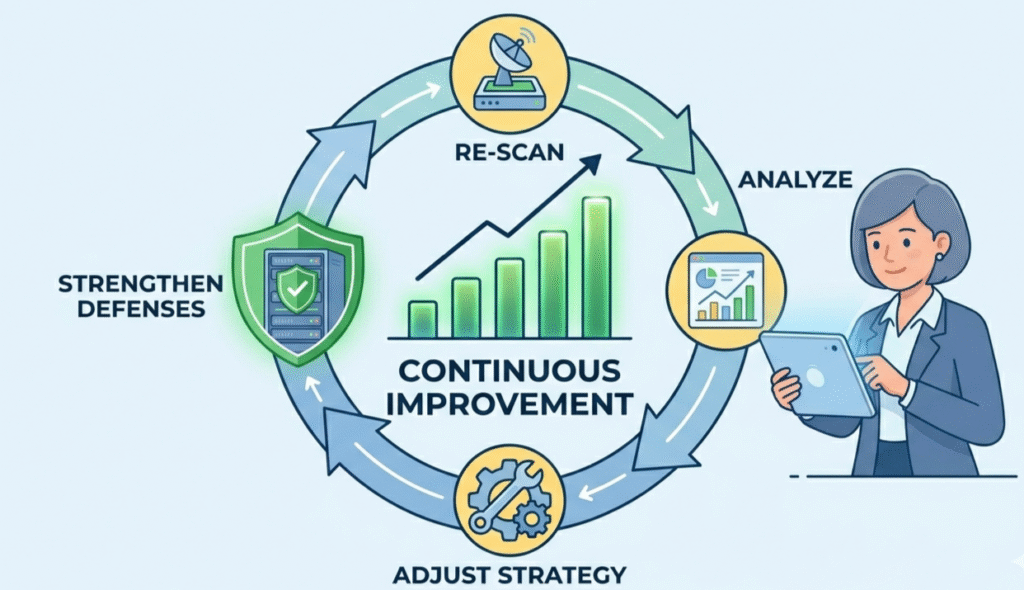
Validation is an ongoing process that supports continuous improvement.
Key actions:
- Review validation results
- Update remediation strategies by leveraging expert remediation guidance to adapt to the ever-evolving threat landscape.
- Improve scanning tools
“Effective security management requires ongoing assessment and improvement of controls.” – ScienceDirect
Continuous validation strengthens long-term security resilience.
FAQ
What does validating remediation effectiveness scans mean?
It refers to the process of verifying that a vulnerability has been completely resolved after remediation. This is typically done through rescanning and analyzing results to ensure no residual risk remains.
Why are validating remediation effectiveness scans important?
Because remediation alone does not guarantee success. Validation confirms whether fixes were properly implemented and whether vulnerabilities have truly been eliminated.
Can validating remediation effectiveness scans detect all threats?
No, they are effective for known vulnerabilities but may not detect unknown or advanced threats. That’s why they are often combined with penetration testing and continuous monitoring.
How often should validating remediation effectiveness scans be performed?
They should be conducted after every remediation activity and regularly as part of a continuous security monitoring strategy.
Closing the Loop with Validating Remediation Effectiveness Scans
Validating remediation effectiveness scans ensure that security efforts lead to real protection, not just assumptions. By confirming that vulnerabilities are fully resolved, organizations can reduce risk and strengthen their defenses.
If you want to improve your validation processes and ensure every fix is effective, MSSP Security can help streamline scanning, monitoring, and remediation for stronger cybersecurity outcomes.
References
- https://en.wikipedia.org/wiki/Vulnerability_scanner
- https://www.sciencedirect.com/science/article/pii/S0167404819301531?via%3Dihub