

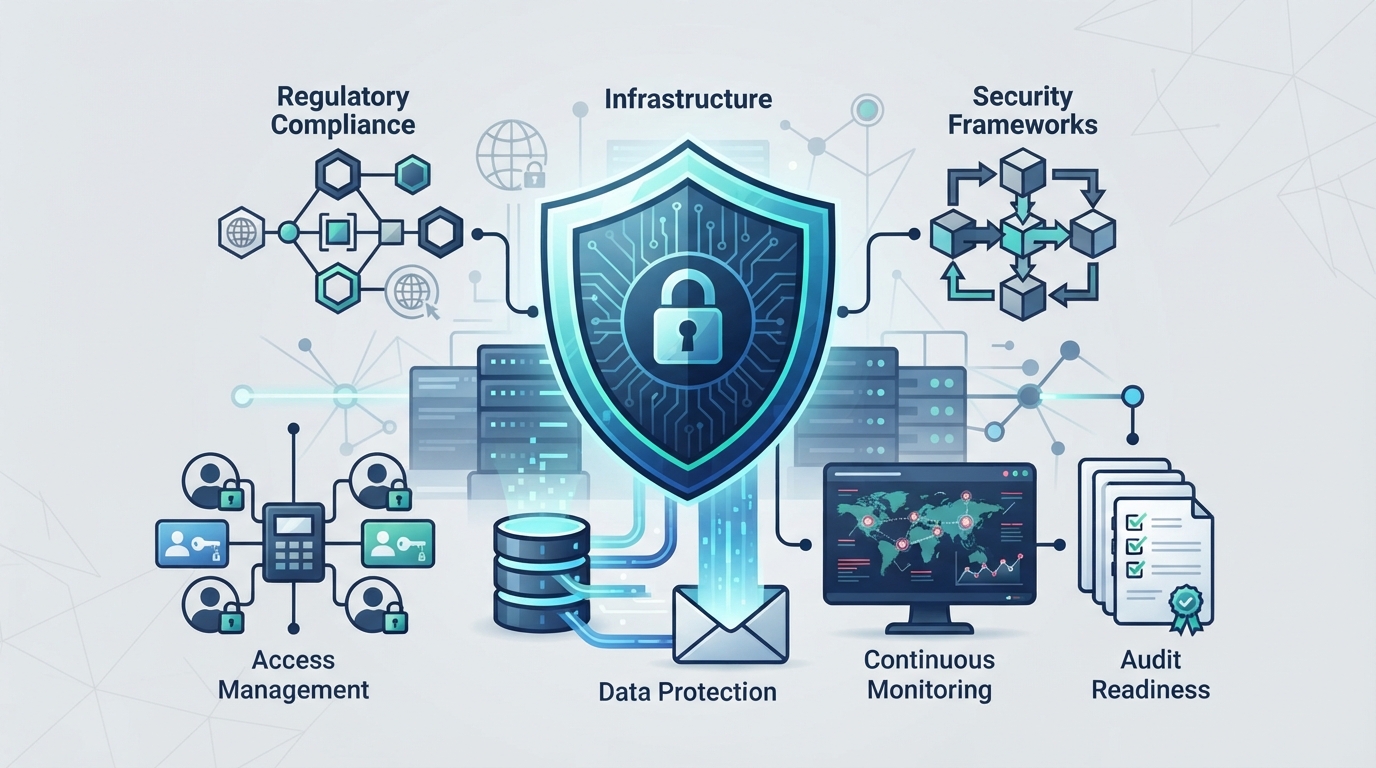
Security compliance requirements MSSP providers include regulatory obligations, industry frameworks, contractual duties, and operational security controls. The specific security compliance requirements mssp providers must meet depend on the industries served, data handled, and services delivered. Frameworks such as ISO 27001, SOC 2, GDPR, HIPAA, PCI DSS, and CMMC help define applicable security standards.
At MSSP Security, we help providers assess security requirements, review control ownership, and prepare for compliance audits. Outsourcing security does not remove a provider’s accountability. Read on to understand the key requirements and how MSSPs can address them.
MSSP Compliance: 3 Things to Get Right
Meeting security compliance requirements takes more than choosing the right framework. MSSPs also need clear ownership and regular checks to keep their controls effective. Here are three areas worth focusing on:
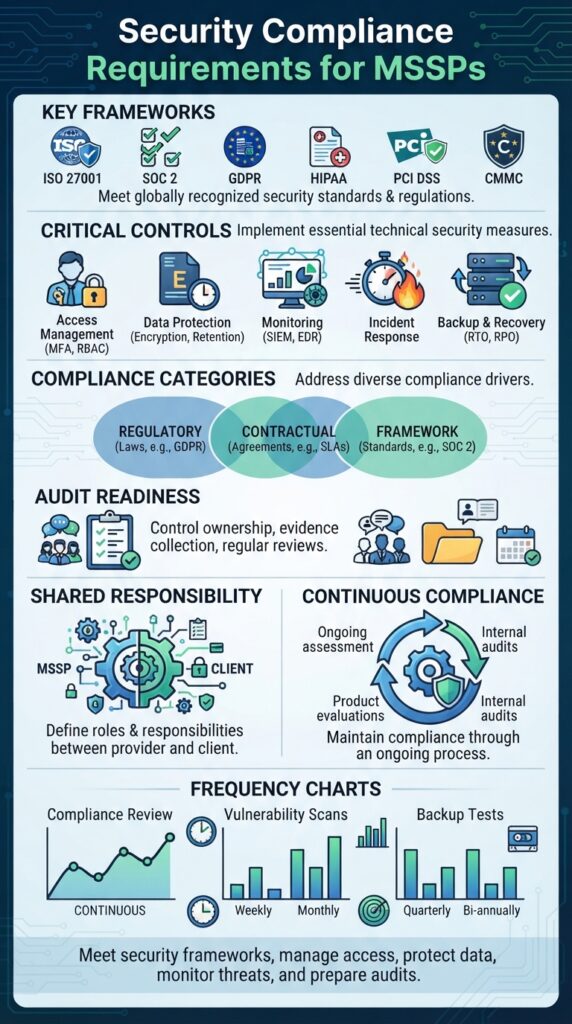
- Choose the right compliance frameworks: Understand how ISO 27001, SOC 2, GDPR, HIPAA, PCI DSS, and CMMC apply to the services provided and the customers served.
- Put security controls into practice: Establish clear procedures for governance, access management, data protection, incident response, and monitoring. Assign responsibility for each control and keep supporting records.
- Keep compliance under review: Conduct regular risk assessments, test security controls, update audit evidence, and review contractual responsibilities with customers.
What Security Compliance Requirements Must an MSSP Meet?
Managing security services for multiple customers means handling different data types, contractual commitments, and regulatory responsibilities. An MSSP must understand which obligations apply to its own operations and which depend on the industries and environments it supports. The security compliance requirements mssp providers face therefore vary by location, customer sector, and services delivered.
These requirements generally fall into three categories:
- Regulatory compliance: Legal obligations under regulations such as GDPR and HIPAA.
- Contractual compliance: Security commitments outlined in customer contracts, service-level agreements (SLAs), and data processing agreements.
- Framework alignment: Standards such as ISO 27001, SOC 2, and NIST that guide security management and control implementation.
Providers must also protect their internal systems, customer data, employee accounts, and security platforms. We recommend reviewing security products against these requirements before adding them to a service portfolio.
At MSSP Security, we help providers evaluate and audit security products to check whether they meet operational needs and support relevant compliance controls. Clear responsibility boundaries also matter, as customers generally remain accountable for their wider regulatory obligations.
Which Compliance Frameworks Should an MSSP Follow?
MSSPs must choose compliance frameworks based on their customers’ industries, contractual obligations, geographical requirements, and the data they handle. The security compliance requirements mssp providers face vary depending on their services and regulatory responsibilities.
Common frameworks include:
| Framework | Primary focus |
| ISO 27001 | Information security management |
| SOC 2 | Security and service organisation controls |
| GDPR | Personal data protection |
| HIPAA | Protected health information |
| PCI DSS | Payment card security |
| CMMC | Defence contractor cybersecurity |
| NIST 800-171 | Controlled unclassified information |
Industry regulations also affect which standards apply. Healthcare providers may need HIPAA-related safeguards, while organisations handling payment data must consider PCI DSS. MSSPs processing European personal data may also have GDPR obligations as data processors.
Article 32(1) of the GDPR states:
“The controller and the processor shall implement appropriate technical and organisational measures to ensure a level of security appropriate to the risk.” – European Parliament and Council
This requirement highlights why MSSPs need security products that support appropriate data protection measures. We recommend assessing these capabilities before selecting new solutions. At MSSP Security, we help providers evaluate and audit security products to determine whether they support relevant compliance controls and service commitments.
What Governance Controls Should an MSSP Establish?

Governance controls help MSSPs manage security responsibilities, maintain documented policies, assess risks, and demonstrate compliance during audits. These controls are essential to meeting the security compliance requirements mssp providers face across their operations and customer environments.
An effective governance programme should establish clear security policies covering information security, access management, incident response, and data handling. Each control also needs an assigned owner responsible for its implementation, monitoring, and regular review.
Through regular risk assessments, MSSPs can identify threats, evaluate vulnerabilities, and maintain updated risk registers. An information security management system (ISMS) provides a structured approach to managing these risks, while management reviews help track audit findings, outstanding issues, and remediation progress.
We recommend maintaining approval records, documenting policy exceptions, and reviewing control effectiveness regularly. When introducing new security products, providers should also assess whether their capabilities support existing governance requirements. At MSSP Security, we help MSSPs evaluate and audit security products to identify potential control gaps before implementation.
How Should MSSPs Secure Privileged Access Across Customer Environments?
MSSPs need strong access controls to protect customer environments and prevent compromised accounts from exposing multiple systems. These measures are essential to meeting security compliance requirements mssp providers face.
An effective access management policy should include least privilege, multi-factor authentication (MFA), role-based access control (RBAC), and privileged access management (PAM). Providers should also use unique administrative credentials for each customer, review permissions regularly, and revoke access promptly when employees change roles or leave.
Microsoft Learn reinforces this approach in its CSP security guidance:
“Regularly review administrative role access in Microsoft Entra ID, and limit access to as few accounts as possible.” – Microsoft Learn
This recommendation supports the principle of least privilege by limiting administrative permissions to users who genuinely need them. Regular access reviews also help MSSPs identify unnecessary privileges before they create security risks.
When selecting new security products, we recommend checking their identity controls, permission management, and session logging capabilities. At MSSP Security, we help providers evaluate and audit these features to ensure they support operational and security requirements.
What Data Protection Requirements Must MSSPs Meet?

A single customer environment may contain personal details, financial records, employee information, and other sensitive data. Each type of information comes with different handling expectations, making data protection a key responsibility for MSSPs.
Providers must understand where customer data is stored, who can access it, how long it is retained, and when it must be securely deleted. These obligations form part of the security compliance requirements mssp providers face under applicable laws and customer contracts.
An effective data protection programme should include:
- Encryption: Protect sensitive information at rest and in transit.
- Data classification: Categorise information by sensitivity and handling requirements.
- Access restrictions: Limit customer data access to authorised personnel.
- Data retention and secure deletion: Follow defined retention periods and remove data safely when no longer needed.
- Data segregation: Prevent unauthorised access between customer environments.
Privacy regulations also affect MSSP operations. GDPR sets requirements for processing personal data, while HIPAA-related business associate arrangements may require additional safeguards for protected health information. Data residency and sovereignty rules can further restrict where information is stored or accessed.
When evaluating security products, we recommend checking encryption, access monitoring, storage locations, and subcontractor arrangements. At MSSP Security, we help providers assess and audit these capabilities to identify potential data protection gaps before deployment.
What Monitoring and Logging Requirements Must an MSSP Meet?
MSSPs need reliable monitoring, centralised logging, and documented security events to meet security compliance requirements mssp providers face and detect threats across customer environments.
An effective monitoring programme should combine:
- SIEM: Collect and analyse security events from multiple systems.
- EDR: Detect suspicious endpoint activity and support investigations.
- Intrusion detection and prevention: Identify unauthorised network activity.
- Centralised logging: Maintain and protect security records.
- Continuous monitoring: Review alerts and investigate unusual behaviour.
- Alert escalation: Follow documented procedures for notifying customers.
A SIEM platform alone does not demonstrate monitoring effectiveness. MSSPs must also document alert investigations, escalation procedures, log sources, and incident ownership. For 24/7/365 monitoring, coverage and handoffs between the MSSP’s SOC and customer security teams must be clearly defined.
When evaluating monitoring products, we recommend checking log coverage, integrations, alert accuracy, and reporting capabilities. At MSSP Security, we help providers assess and audit these features to identify operational gaps.
How Should MSSPs Manage Vulnerabilities and Security Patching?
An unpatched vulnerability can give attackers an opportunity to access customer systems, disrupt services, or compromise sensitive information. For MSSPs managing multiple environments, even a single overlooked weakness can create risks across their service portfolio. Regular vulnerability assessments and timely patching are therefore essential to meeting security compliance requirements mssp providers face. CISA also recommends prioritising known exploited vulnerabilities because attackers are already using them.
An effective vulnerability management process starts with an updated asset inventory and regular vulnerability scans. Providers should assess each weakness based on severity, exploitability, and potential business impact before applying security patches to operating systems, applications, and firmware. After remediation, rescanning helps confirm that identified issues have been resolved.
MSSPs should also retain vulnerability scan reports, patch records, remediation tickets, and verification results as audit evidence. When immediate patching is not possible, each exception needs documented justification, formal approval, and a planned resolution date.
When evaluating vulnerability management products, we recommend checking scan coverage, risk prioritisation, and remediation tracking. At MSSP Security, we help providers assess and audit these capabilities to identify gaps before deployment.
What Incident Response Requirements Must MSSPs Meet?
A delayed response or unclear escalation process can turn a single security incident into a wider customer disruption. MSSPs must therefore establish clear procedures for detecting threats, containing attacks, investigating events, restoring services, and notifying affected customers. These responsibilities form part of the security compliance requirements mssp providers must address.
An effective incident response plan should define incident severity levels, assigned responsibilities, escalation paths, evidence preservation, and post-incident reviews. For example, a critical ransomware alert may require immediate escalation to designated customer contacts.
Service contracts should also specify notification triggers, communication channels, escalation contacts, and reporting timeframes. An MSSP may need to notify customers within an agreed period, while their regulatory breach notification obligations may remain separate.
We recommend defining these responsibilities before service delivery begins. When evaluating incident response products, providers should assess alert management, incident tracking, and reporting capabilities. At MSSP Security, we help providers evaluate and audit these features to identify gaps before deployment.
How Do Backup and Recovery Requirements Affect MSSP Compliance?
When ransomware or system failures disrupt customer services, MSSPs must restore affected environments within agreed timeframes. Meeting security compliance requirements mssp providers face therefore involves more than maintaining backups. Providers also need protected storage, tested restoration procedures, and clear recovery objectives.
A reliable backup programme should include regular backup schedules, restricted administrative access, integrity checks, documented recovery procedures, and records of backup failures and corrective actions.
Recovery readiness depends on two key metrics: Recovery Time Objective (RTO), which defines the maximum acceptable restoration time, and Recovery Point Objective (RPO), which determines the acceptable amount of data loss measured in time.
Backup records alone cannot prove recovery capability. We recommend conducting regular restoration tests and retaining the results as audit evidence. When evaluating backup products, MSSPs should check scheduling, access controls, integrity verification, and recovery reporting. At MSSP Security, we help providers assess and audit these capabilities against customer recovery objectives.
How Should MSSPs Manage Third-Party and Vendor Compliance?
External providers can introduce security risks that affect customer data and service availability. MSSPs must therefore assess vendors and subcontractors as part of their security compliance requirements mssp providers face.
A third-party risk management programme should examine vendor security policies, certifications, data access arrangements, subcontractor responsibilities, incident notification procedures, and contractual security commitments. These checks help determine whether external providers meet the MSSP’s security and operational requirements.
Vendor assessments should also continue after initial approval. We recommend conducting periodic security reviews, checking contractual obligations, and reassessing vendors whenever their services or data processing arrangements change. Subcontractors with access to customer information require particular attention, including clear security responsibilities and appropriate contractual safeguards.
When selecting new security products, we help MSSPs assess vendor capabilities, security controls, and associated risks. At MSSP Security, we also support product evaluations and audits to identify potential compliance gaps before implementation.
How Can an MSSP Prepare for Compliance Audits?
An MSSP must maintain current documentation and operational evidence to demonstrate that security controls are implemented and working effectively. Written policies show expected procedures, while audit records confirm whether employees follow them. These records are essential for meeting security compliance requirements mssp providers face.
Common audit evidence includes security policies, risk registers, MFA records, access reviews, vulnerability scan reports, patch records, incident reports, SIEM logs, backup test results, vendor assessments, contracts, and employee training records.
We recommend making evidence collection part of daily operations rather than waiting for an external assessment. MSSPs can improve audit readiness by:
- Automating evidence collection where possible.
- Maintaining centralised compliance documentation.
- Assigning owners to individual controls.
- Reviewing control effectiveness regularly.
- Tracking audit findings and remediation progress.
When evaluating new security products, we also check whether their logging, reporting, and data export features support audit requirements. At MSSP Security, we help providers assess and audit these capabilities before implementation.
How Should MSSPs Define Compliance Responsibilities With Clients?
MSSPs and clients should document their security responsibilities in contracts, service agreements, and operational procedures. A shared responsibility model clarifies who manages security controls, approves actions, monitors systems, and handles regulatory decisions.
The MSSP typically delivers agreed security monitoring, detects and reports incidents, and controls access for its own personnel. Meanwhile, clients provide the required system access, approve permissions, and make wider business and regulatory decisions. Each party must also remain accountable for its own governance and legal obligations.
Contracts should clearly define service scope, exclusions, control ownership, escalation timelines, customer approval requirements, and audit reporting obligations. We consider these boundaries when assessing whether new security products support an MSSP’s service model and customer requirements.
At MSSP Security, we help providers evaluate and audit product capabilities to identify potential gaps before implementation. Clear agreements also prevent the assumption that outsourcing security services transfers the client’s overall regulatory accountability.
What Common Compliance Mistakes Should MSSPs Avoid?
Credit: CMMC-PNW
MSSPs can create compliance gaps through poor scoping, unclear responsibility boundaries, incomplete audit evidence, and overreliance on security tools. Avoiding these mistakes is essential to meeting security compliance requirements mssp providers face and maintaining audit readiness.
Common mistakes include applying one compliance framework to every client, treating certification as proof of full compliance, and collecting evidence only before audits. Providers should instead map regulatory requirements to each client’s industry and jurisdiction, verify that security controls work effectively, and maintain continuous evidence collection. Clear service agreements and documented change management also help prevent gaps in control ownership and configuration.
CMMC assessments illustrate why technical controls alone are insufficient. An MSSP SOC may support incident monitoring and response, but cannot replace physical safeguards such as visitor monitoring and escort procedures.
When evaluating security products, we assess whether their capabilities support administrative, technical, and physical security requirements. At MSSP Security, we help providers evaluate and audit products to identify potential compliance gaps before implementation.
How Can MSSPs Build a Continuous Compliance Programme?
Keeping compliance on track requires more than checking policies and controls once a year. MSSPs need to know which requirements apply, whether existing safeguards meet those requirements, and what still needs attention. A consistent review process helps providers maintain compliance as their services and customer needs evolve.
A practical MSSP compliance programme should start with identifying applicable frameworks and contractual obligations, defining service scope, assessing control gaps, and assigning clear ownership. Providers must then implement administrative, technical, and physical safeguards, collect audit evidence, and conduct internal audits to check control effectiveness.
Progress can be measured through framework coverage, completed access reviews, outstanding vulnerability findings, incident response performance, audit evidence availability, and overdue policy reviews.
When introducing new security products, we recommend checking whether their features support existing controls, reporting, and compliance objectives. At MSSP Security, we help providers evaluate and audit product capabilities to identify gaps and support continuous compliance.
How Can MSSP Security Support Security Compliance Requirements?
Selecting security products involves more than comparing features. MSSPs must ensure each solution supports their service requirements, security controls, customer obligations, and operational workflows. At MSSP Security, we help providers evaluate new products before implementation to identify potential compliance gaps.
Through our evaluation, selection, and onboarding consulting services, we help MSSPs assess monitoring, detection, and incident response capabilities, check system integrations, review vendor performance, and compare product features against documented requirements. This process helps determine whether a solution supports existing security controls and reporting needs.
A product may offer advanced detection but still create operational gaps if it lacks essential integrations or audit reporting capabilities. We therefore recommend evaluating technology against actual service requirements before making a selection.
Our consulting approach helps MSSPs make informed decisions while considering regulatory compliance, customer expectations, and long-term service delivery. Our evaluation, selection, and onboarding consulting supports this process from product assessment through implementation.
FAQ
What determines which compliance standards an MSSP needs to follow?
The applicable standards depend on the industries served, customer contracts, geographical location, and types of data handled. An MSSP may need to consider ISO 27001, SOC 2, GDPR, HIPAA, PCI DSS, or CMMC based on its services and obligations.
Does an MSSP become responsible for all client compliance obligations?
No. An MSSP is responsible for the security services and controls covered by its agreement, while clients retain accountability for their wider business and regulatory obligations. Both parties should document their responsibilities in service agreements.
What security controls should MSSPs prioritise for compliance?
MSSPs should prioritise access management, data protection, continuous monitoring, vulnerability management, incident response, backup and recovery, and third-party risk management. Each control should have a clear owner and supporting audit evidence.
What evidence do auditors typically request from MSSPs?
Common audit evidence includes security policies, risk registers, MFA records, access reviews, vulnerability scan reports, patch records, SIEM logs, incident reports, backup test results, vendor assessments, and employee training records.
How often should MSSPs review their security compliance?
Compliance should be reviewed continuously through control monitoring, evidence collection, and regular internal audits. Additional assessments are necessary when regulations, customer requirements, vendors, or managed security services change.
What Should MSSPs Remember About Security Compliance Requirements?
Meeting security compliance requirements requires more than adopting recognised frameworks or purchasing security tools. MSSPs need effective security controls, clear governance, documented responsibilities, and reliable audit evidence to maintain compliance and audit readiness.
Regular control assessments, clear customer agreements, and suitable security products help reduce operational gaps and strengthen service delivery. At MSSP Security, we provide vendor-neutral product selection, auditing, stack optimisation, and PoC support. With over 15 years of experience and 48K+ completed projects, we help MSSPs build technology stacks that match their operational needs.Strengthen your MSSP security operations with our consulting services.
References
1. “Regulation (EU) 2016/679 of the European Parliament and of the Council of 27 April 2016 on the Protection of Natural Persons with Regard to the Processing of Personal Data and on the Free Movement of Such Data (General Data Protection Regulation).” EUR-Lex, 4 May 2016. Accessed 17 November 2026.
2. “CSP Security Best Practices.” Microsoft Learn, 14 January 2025. Accessed 17 November 2026.