

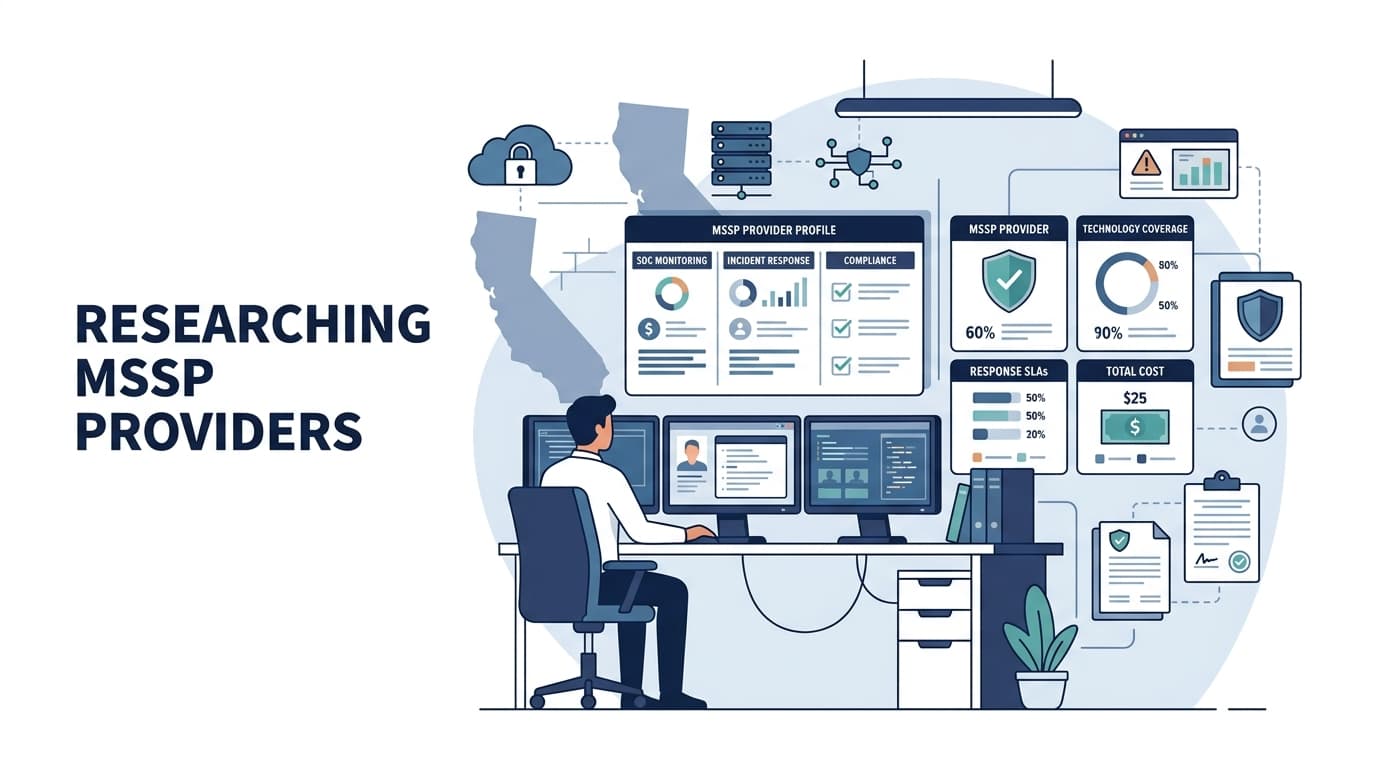
Researching top mssp providers in California takes more than checking rankings. California organizations should compare security operations, compliance controls, response SLAs, technology coverage, and total cost.
In 2026, privacy rules and third-party risks make careful vendor research more useful than brand size. Check what each provider covers, how it handles security incidents, and how fast it responds.
Pricing matters too, since lower costs may mean fewer services or weaker support. Ask for clear details before choosing a provider. Keep reading with MSSP Security for practical tips on comparing California MSSPs.
MSSP Selection Quick Wins
- Compare MSSPs based on SOC operations, response SLAs, technology coverage, compliance support, and total costs.
- Use RFPs and PoCs to verify how providers detect, investigate, escalate, and respond to security incidents.
- Choose the MSSP that fits your organization’s security needs, technology environment, compliance requirements, and internal capabilities.
Which MSSP providers are worth researching in California?
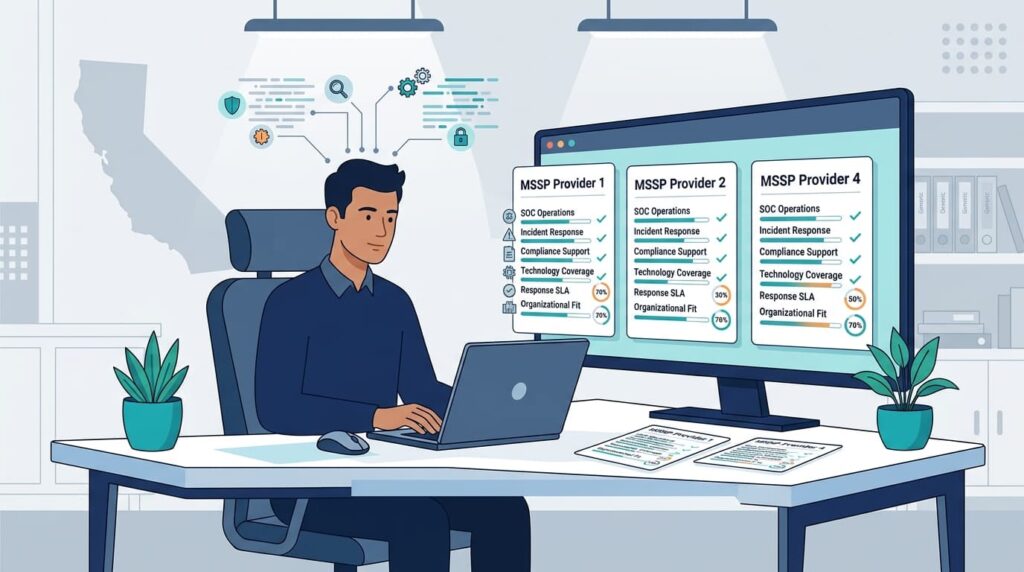
The strongest California MSSP shortlist starts with proof, not a long product list. When researching top MSSP providers California, we look at 24/7 monitoring, analyst skills, response steps, coverage, and clear SLAs.
In our frontline SOC audits, We repeatedly watch buyers get dazzled by shiny XDR feature lists, only to discover later that 80% of triggered alerts sit in an unread queue after 5 PM. That’s why we help MSSPs select and audit products, test integrations, tune SIEM and SOAR workflows, and support PoCs.
MSSP Security can help structure that review with vendor-neutral product evaluation. We also check CCPA requirements, staffing, escalation paths, and response authority. Local providers may offer closer support, while national firms may have larger teams. Vendor research can help organizations focus that comparison on practical differences rather than provider rankings.
Compare both on the same scorecard. Keep reading with MSSP Security for practical MSSP evaluation guidance.
How does California privacy regulation affect MSSP selection?
California organizations should check how an MSSP handles personal data, security duties, contracts, incidents, and compliance records before giving access to sensitive systems.
We’ve seen vendor reviews focus on certifications while missing basic questions: When we review client log pipelines, we map every telemetry source, from M365 email logs to AWS CloudTrail, to verify whether consumer PII is being exposed or stored out-of-state, which directly triggers CPRA compliance liabilities.
Those details matter when SIEM, EDR, identity, email, and cloud logs contain personal information.
For CCPA, CPRA, HIPAA, PCI DSS, SOC 2, or NIST needs, contracts should assign clear duties. Our audits also separate security work from legal responsibility. An MSSP can monitor, investigate, and provide evidence, but the customer still owns key decisions.
Keep reading for practical MSSP Security guidance on vendor reviews.
What should you verify in an MSSP’s SOC operations?
A credible SOC should prove what happens after an alert fires. We look at monitoring hours, analyst workflow, escalation, response authority, and reporting before trusting the sales pitch.
In our product audits, we’ve found that “24/7” can mean human coverage, automated alerts, or an on-call team. Those models aren’t the same. Ask for a real investigation and watch how the provider moves from raw data to triage, evidence, escalation, and response.
For MSSPs, our PoC work helps test products before purchase and catch gaps early. During 30-day PoC tests we run for clients, we intentionally inject synthetic credentials and off-hours lateral movement to see whether the provider’s tier-1 analyst actually investigates or simply forwards a raw alert.
According to Market Guide for Outsourced Managed Security Services
“Outsourced managed security services providers deliver cybersecurity services to meet regulatory demands and talent shortages. Sourcing and vendor management leaders should use this research to identify OMSS partners and enhance security operations.” – Market Guide for Outsourced Managed Security Services
- Verify real monitoring hours.
- Check analyst escalation paths.
- Review sample incident reports.
- Confirm response authority.
Keep reading for more MSSP Security guidance.
Why do MTTD and MTTR matter when comparing MSSPs?
MTTD and MTTR only help if an MSSP contract defines what each number means. We’ve seen SLA reviews where a 15-minute acknowledgement was presented as a 15-minute response. Those aren’t the same.
In our SLA reviews, We reject vague MTTR metrics. We enforce explicit contract definitions that separate ‘Mean Time to Acknowledge’ from ‘Mean Time to Contain’, because stopping lateral movement inside a client’s network requires active containment, not just an automated email confirmation.
Our audits check P1-P4 severity levels, analyst actions, escalation times, containment duties, and reporting.
For MSSP vendor comparison California, we also ask for past or anonymized SLA reports. Shorter numbers aren’t always better. Clear terms matter more.
According to Data Breach Investigations Report (DBIR)
“A longer mean time to detect a breach, or MTTD, means more opportunity for cyber criminals to steal data, extend their reach across the network or achieve persistence and escalate their privileges. That’s why your organization shouldn’t just try to shorten the mean time to detect a breach, but the mean time to recovery (MTTR) as well.” – Data Breach Investigations Report (DBIR)
- Define human response times.
- Separate alerts from investigations.
- Set escalation deadlines.
- Document customer dependencies.
Keep reading for more MSSP Security guidance.
What should you examine in an MSSP’s technology stack?
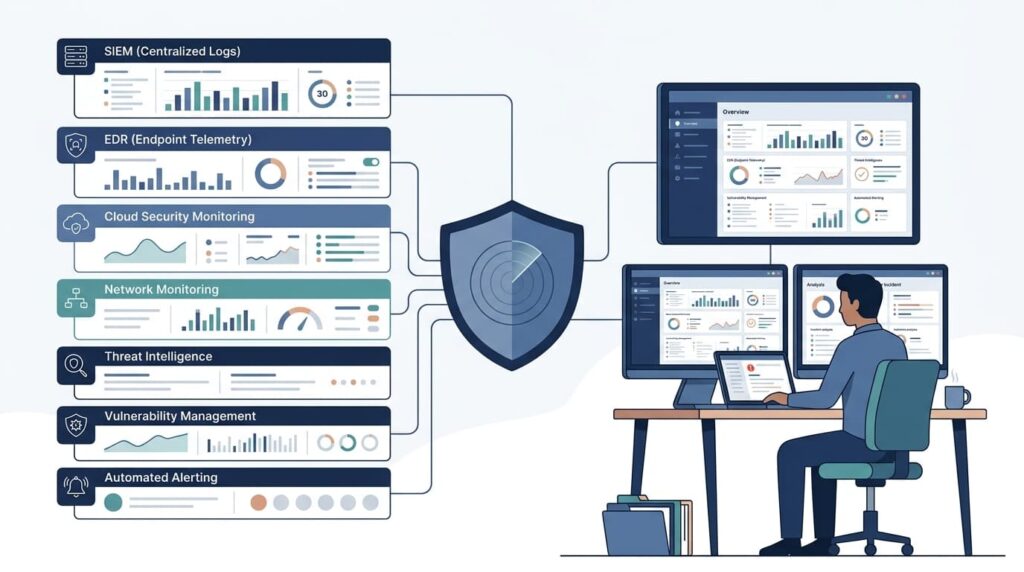
An effective MSSP should connect endpoint, identity, network, email, cloud, and vulnerability data into one workflow analysts can use. We’ve seen strong tools fall short when their data stays in separate systems.
For managed detection and response California or EDR managed services California, we check whether analysts can use telemetry to investigate real events. EDR/XDR, SIEM, identity monitoring, cloud security, and network detection all matter. So do threat hunting and intelligence.
During technical validation, We test how the provider ingests raw telemetry across multi-cloud setups, specifically checking whether cross-platform correlation holds up when tracing an identity attack from Azure AD into an AWS S3 bucket.
NIST’s Cybersecurity Framework gives buyers a useful way to check coverage across the security lifecycle.
- Map tools to real risks.
- Test integrations before purchase.
- Check for missing telemetry.
Keep reading for more MSSP Security guidance.
How should companies compare co-managed and fully managed MSSPs?
Co-managed security suits teams that can handle remediation but need outside help with monitoring or investigations. Fully managed security fits companies that need the MSSP to run most daily security work.
| Model | Best fit | Main concern |
| Co-managed | Existing team | Shared duties |
| Fully managed | Small team | Outsourced work |
| MDR-focused | Detection needs | Response depth |
| Full MSSP | Complex setup | Broad coverage |
We’ve sat in war rooms where co-managed setups collapsed during a midnight ransomware outbreak because no one explicitly documented whether the MSSP had API permissions to isolate endpoints or block compromised Active Directory accounts.
A clear comparison of MSSP vendors and services can help expose these differences before a contract is signed.
Our product audits check these duties before pricing enters the discussion. Small teams may need help with overnight monitoring, threat hunting, and incident response.
Keep reading for more MSSP Security guidance.
What hidden MSSP costs should California buyers investigate?
Credits: The TSP Advisory
MSSP pricing can look low until extra costs appear. We’ve seen quotes change once log sources, cloud data, storage, or incident response enter the scope.
We always advise clients to model their SIEM ingestion costs before signing; We’ve seen ‘discounted’ base rates spike by 40% in quarter two simply because firewall verbose logging and cloud telemetry weren’t factored into the initial volume caps.
A 500-endpoint setup can grow fast when servers, cloud workloads, and identity systems are added.
Ask each finalist for the same cost breakdown.
- SIEM ingestion
- Log sources
- Cloud telemetry
- Data retention
- Endpoint growth
- Response fees
- Implementation
- Offboarding
We also check minimum commitments and exit costs. When We negotiate offboarding clauses, We ensure clients retain full ownership of custom SIEM detection rules and parser configurations, while establishing clear SLAs for bulk log export so you aren’t held hostile by vendor lock-in.
Keep reading with MSSP Security.
How does SOC 2 Type II help evaluate an MSSP?
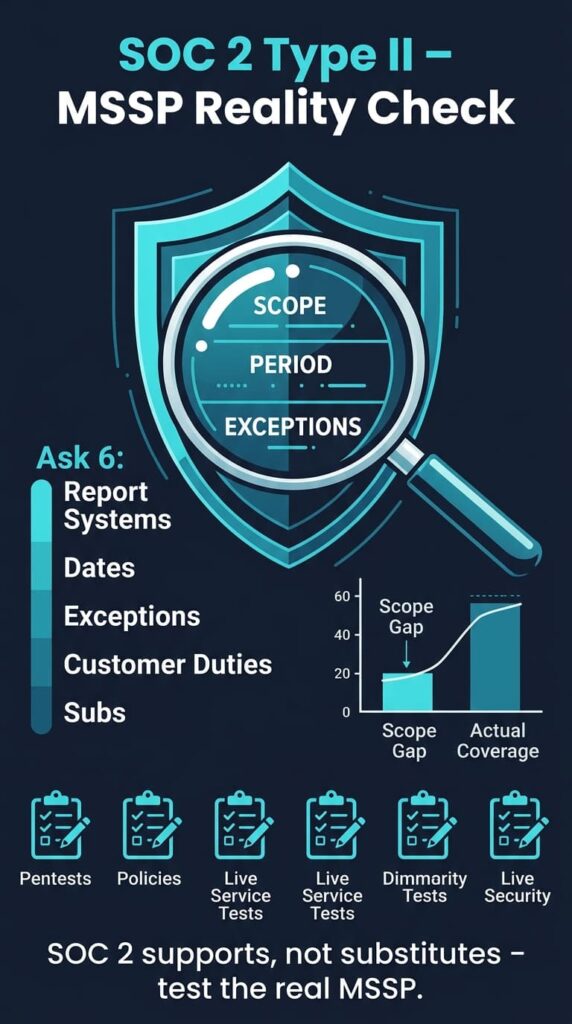
SOC 2 Type II can show how a provider’s controls operated during a set period. But it’s not a blanket security score.
When we review MSSP assurance reports, we check the scope, systems covered, test period, exceptions, and customer responsibilities. A report can look strong while leaving key services outside its scope. We’ve seen this matter when an MSSP relies on outside cloud or security platforms.
For MSSP product audits, we use SOC 2 as supporting evidence, then test the actual service. Ask for:
- Current SOC 2 report
- Covered systems
- Test period
- Control exceptions
- Customer responsibilities
- Subservice providers
Check penetration tests and security policies too. Keep reading with MSSP Security for practical vendor review guidance.
How should you evaluate MSSPs through a proof of concept?
A strong MSSP PoC should test real workflows, not fill a report with alerts. We use representative logs and controlled events to see how analysts detect, investigate, escalate, and respond.
In our product audits, we’ve used endpoints, cloud logs, identity events, and network data without copying a full production setup. Then we test cases such as unusual logins, malware-like activity, privilege changes, or odd cloud behavior.
A 30-day trial can reveal useful gaps. We check alert quality, analyst context, severity choices, response steps, and reporting.
What should the PoC test?
- Connect sample telemetry.
- Run controlled security events.
- Review analyst investigations.
- Test escalation and containment.
- Check incident reports.
- Compare response metrics.
PoCs have limits, so we also review staffing, references, and service reports. Keep reading with MSSP Security.
Which MSSP is best for different California organizations?
There’s no single best MSSP for every California company. We match the provider to the team’s size, risks, tech, and compliance needs.
| Organization | Shortlist direction |
| SMB | MDR or regional MSSP |
| Mid-market | Co-managed or MDR |
| Enterprise | Enterprise MSSP |
| Cloud-heavy | Cloud-focused provider |
| Regulated | Strong compliance evidence |
An SMB may need steady pricing and 24/7 monitoring. A larger team might need SIEM management, threat hunting, or deeper integrations. Finding local MSSP providers can also help California companies assess regional options alongside larger national firms.
In our reviews, we’ve found that scale can expose gaps fast. So we score SOC operations, technology coverage, SLAs, compliance evidence, cost, and PoC results.
How should organizations narrow the shortlist?
Remove providers that can’t meet required controls. Then compare the rest using the same scorecard. Keep reading with MSSP Security.
What questions should you ask before choosing an MSSP?
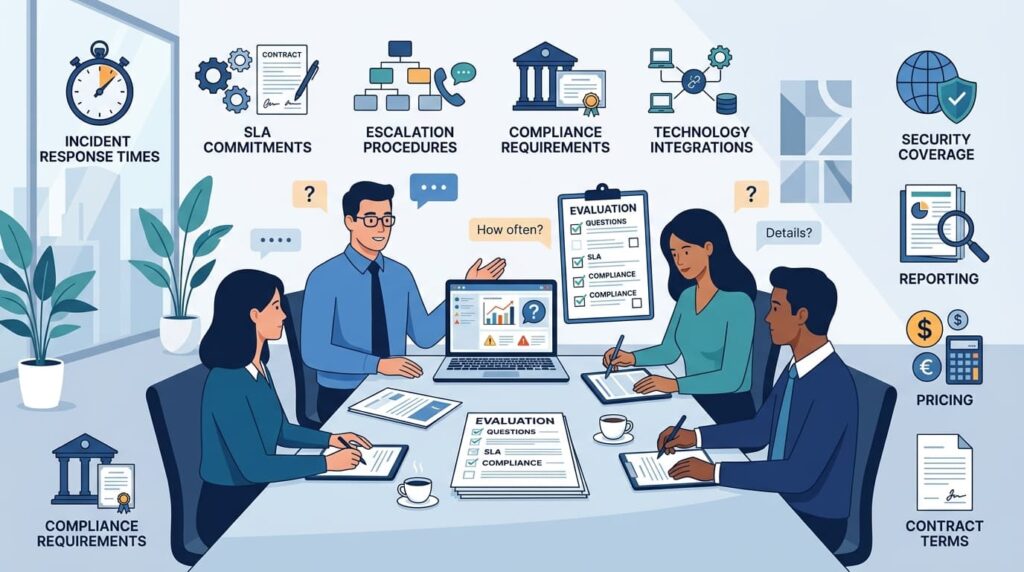
A good RFP can expose gaps that sales material hides. In every RFP we structure, we present vendors with a live-fire scenario: a simulated P1 credential dump at 2:00 AM on a holiday. We evaluate them on analyst escalation speed, decision authority, and how fast they deliver an actionable forensic summary.
In our audits, vague terms cause problems fast. “24/7 monitoring” might mean analysts are always working, or it may mean alerts are forwarded after hours. Ask who investigates, what actions they can take, and when customers get called.
Which questions belong in the RFP?
- Who handles critical alerts?
- What happens before notification?
- Who can contain threats?
- Where are analysts based?
- Which logs are included?
- How are overages billed?
- What happens at offboarding?
We score responses against the same requirements, so presentation style can’t carry the decision. Keep reading with MSSP Security.
How can MSSP Security help evaluate providers?
MSSP Security helps teams assess providers using evidence, security needs, and real testing instead of picking from a list.
We look at the environment first, including endpoints, identities, cloud systems, network tools, staffing, and current gaps. In our work, we’ve seen teams choose an MSSP before checking what they already have. That can lead to paying for tools they don’t need.
Our services include product selection, security audits, PoCs, SIEM tuning, SOAR workflows, and security-stack reviews. We use those checks to see whether a provider can close real gaps.
What should organizations evaluate?
- Monitoring coverage
- Detection and response
- Compliance needs
- SLA terms
- Technology integrations
- Contract risks
- PoC results
Keep reading with MSSP Security for practical vendor guidance.
What should California companies do after creating an MSSP shortlist?
California organizations should define security needs, check compliance, compare SOC operations, set clear SLAs, and test finalists before choosing an MSSP.
We start with the environment, not provider names. Then we map privacy and industry requirements, including CCPA/CPRA, HIPAA, PCI DSS, SOC 2, NIST, or ISO 27001.
In our reviews, we narrow the field to 3-5 providers and give each the same questionnaire, RFP, SLA terms, and PoC scenarios. This makes weak answers easier to spot.
Cost needs the same treatment. Extra logs, endpoints, cloud workloads, retention, and response services can change the bill.
What is the selection sequence?
- Define security needs.
- Check compliance needs.
- Shortlist 3-5 providers.
- Compare SOC operations.
- Review evidence.
- Set measurable SLAs.
- Run a PoC.
- Choose using evidence.
Keep reading with MSSP Security.
FAQs
How should businesses assess MSSP pricing and service packages before signing a California security contract?
When comparing MSSP pricing California, review what each package includes, such as 24/7 cybersecurity monitoring, incident response California, SIEM management California, and vulnerability management California.
Check whether pricing changes based on users, endpoints, log volume, response coverage, or contract length.
What compliance evidence should buyers request from California managed security service providers?
Ask whether the provider supports your compliance requirements and can explain how its services address them.
During MSSP vendor evaluation California, request compliance reports, assessment results, and documentation for CCPA cybersecurity compliance, CPRA security compliance, HIPAA cybersecurity California, SOC 2 compliance services, or other applicable standards.
When does an SMB need an MSSP instead of handling security operations internally?
An SMB may need an MSSP when internal staff cannot provide consistent security coverage. For mid-market teams lacking a 24/7 internal SOC, an MSSP delivers instant operational maturity, giving you enterprise EDR monitoring, active threat hunting, and immediate incident containment at a fraction of the cost of hiring an 8-person analyst team.
What response-time details should buyers confirm with California SOC providers?
Ask how quickly analysts investigate alerts, escalate incidents, and communicate during security events. A proper MSSP provider comparison should examine 24/7 SOC monitoring California, real-time threat detection California, cybersecurity incident response services, escalation procedures, response responsibilities, and the security incident response SLA.
How can a business tell whether an MSSP will scale with its security needs?
During MSSP provider selection, ask whether the provider can support additional users, locations, endpoints, and cloud workloads. Review managed cybersecurity services California across network, endpoint, identity, and cloud environments. Also confirm how service changes affect MSSP service packages California, staffing, reporting, and pricing.
How Can Organizations Choose the Right California MSSP?
Choosing the right California MSSP means finding a provider that can protect your systems, meet compliance needs, respond quickly, and keep costs clear. Don’t choose based on a provider list alone.
Ask how the team monitors threats, what data they can see, how they respond, and what happens when a real threat appears. The details matter.
Start with clear evidence. Use documentation, an RFP, and a PoC to compare providers on the same terms.
Review how personal information is handled and which security tasks stay with your team. If you need help comparing vendors or improving your security stack, MSSP Security: Start Your California MSSP Evaluation can support needs analysis, vendor shortlisting, and PoC planning.
References
- https://www.gartner.com/en/documents/7306730
- https://intelisys.com/insights-verizon-data-breach-investigations-report/