Address
304 North Cardinal St.
Dorchester Center, MA 02124
Work Hours
Monday to Friday: 7AM - 7PM
Weekend: 10AM - 5PM
Address
304 North Cardinal St.
Dorchester Center, MA 02124
Work Hours
Monday to Friday: 7AM - 7PM
Weekend: 10AM - 5PM

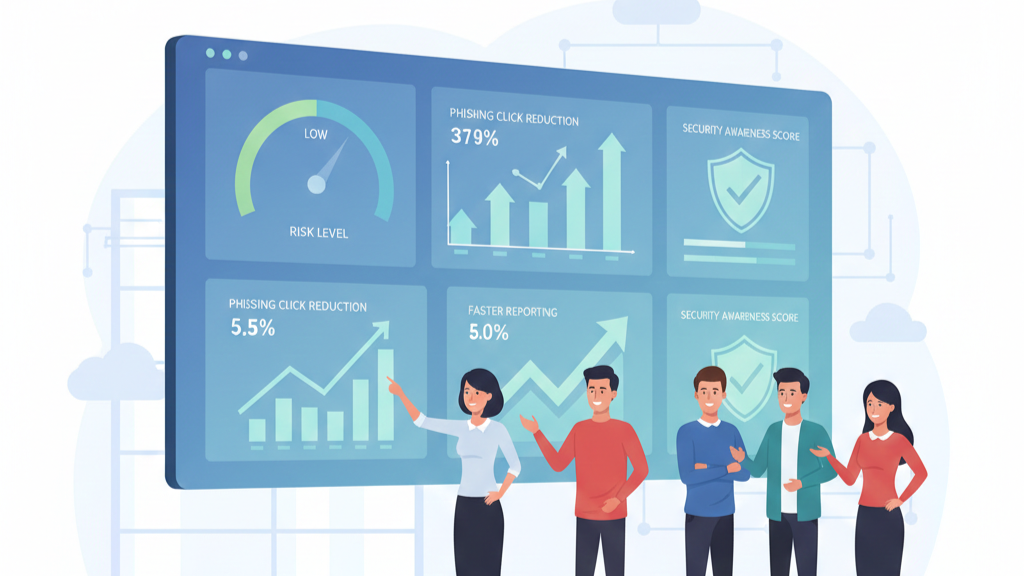
Your training stats look good, but the real-world results aren’t there. A high completion rate doesn’t mean your team is actually safer. You need to measure what people do, not just what they’ve watched. Start by tracking real behavioral changes, like the number of phishing reports filed or a drop in repeated security mistakes.
When employees start acting as your frontline sensors, you’ll see dwell time and incident costs fall. That’s the only proof that matters. Let’s look at how to measuring security awareness effectively.
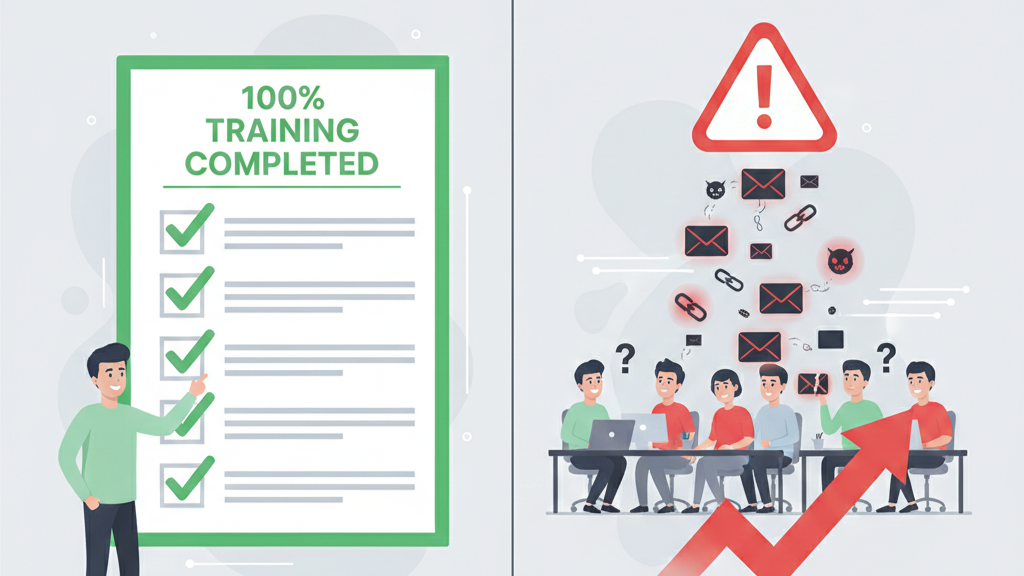
We’ve all been there. You hit 95% completion on the mandatory security training. It feels like a win, and it keeps the auditors happy for PCI DSS or ISO 27001. But we have to be honest: that metric just tracks who showed up, not who learned anything.
We’ve seen employees pass the quiz while multitasking on their phones, forgetting everything the moment the module ends.
“Completion rates tell you nothing about effectiveness. The real question isn’t ‘Did they take the training?’ It’s ‘Did the training change anything?’ … Metrics stagnate when training is generic, punitive, and badly timed.” – Edwin Kwan via Medium
Attackers aren’t giving quizzes. They’re probing for those ingrained, distracted habits. In our work with MSSPs, we see this disconnect constantly. A partner will have flawless compliance scores, but without active security awareness training management, they can still get hit with a business email compromise from one well-timed phishing email.
The high completion rate creates a dangerous illusion of safety while the real risk stays the same. Our focus is always on what happens after the training ends. That’s where your security either gets stronger or falls apart. We help MSSPs move past the theater of compliance to find and fix these gaps.
Credits: Edwin Kwan
Forget quiz scores. We measure what people actually do. The most important metric is your phishing reporting rate. It tells you who’s actively defending the network by raising their hand, not just who avoided a click. When that number goes up, your entire team becomes a live sensor network.
Then look at dwell time. How long does a suspicious email sit in an inbox before someone reports it? Speed cuts the attacker’s advantage. We also track repeat clickers. A handful of employees who consistently fail simulations show you exactly where to focus your coaching.
These are the KPIs that prove the health of your managed security awareness training program, showing that security is improving rather than just your compliance record.
| KPI | What It Measures | The Target |
| Phishing Reporting Rate | % of employees who report a simulated or real phish. | >70% indicates a proactive culture. |
| Mean Time to Report (MTTR) | Average time from threat delivery to employee report. | Minutes, not hours or days. |
| Repeat Offender Rate | % of staff who fail simulations repeatedly. | <5% of total workforce. |
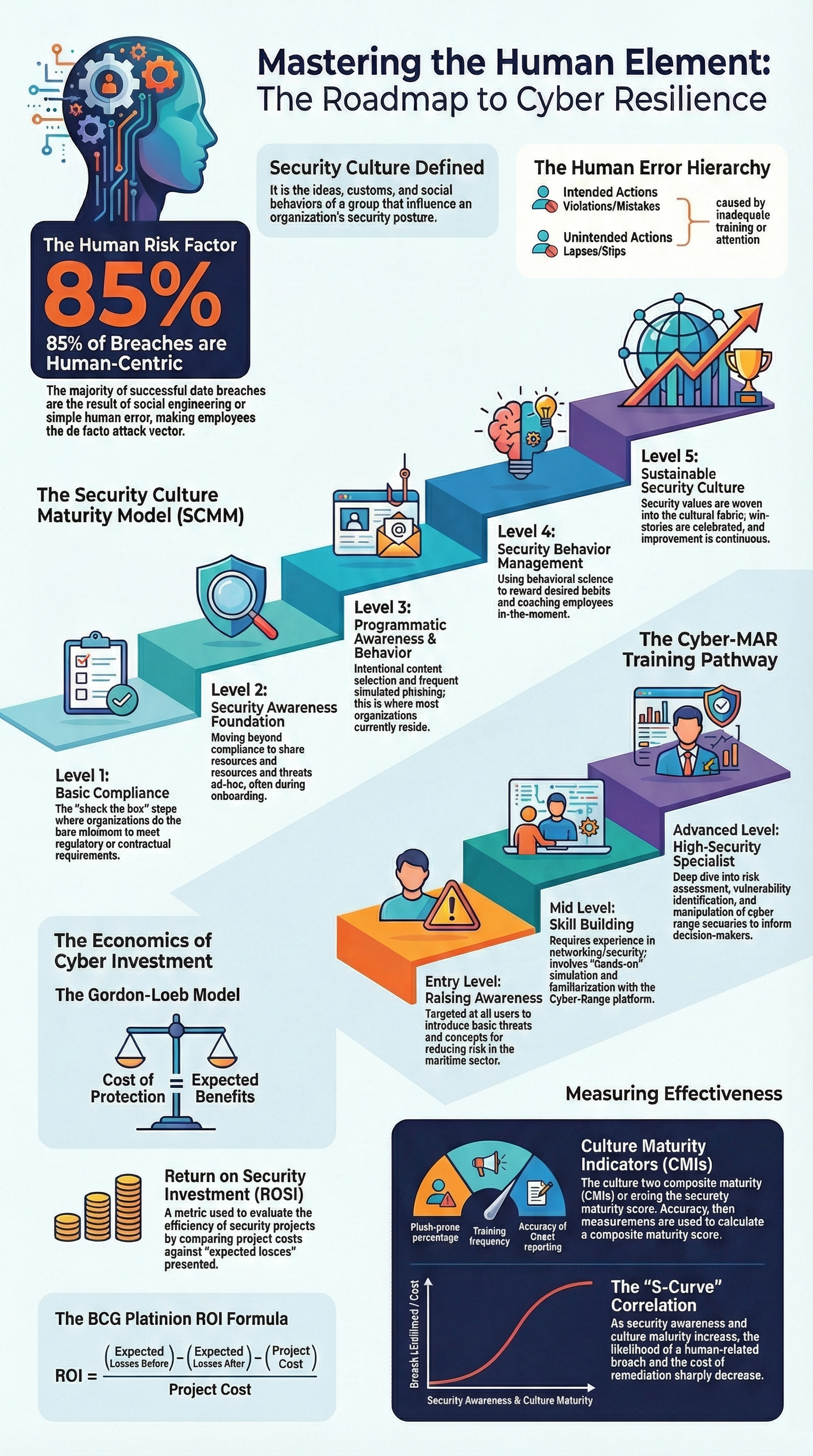
This is how you speak to the board. Behavioral metrics must ladder up to business outcomes. For instance, a reduced dwell time directly impacts the bottom line. Studies show breaches detected in under 200 days cost millions less than those that linger. When your awareness program shortens detection time, you’re saving tangible money.
“Simulation reporting rate should be your headline number. It measures positive action rather than failure. … Reporting rate measures the percentage of employees who correctly identify and report suspicious emails. This metric captures proactive behavior rather than passive non-clicking.” – Brightside AI Blog
Likewise, a rising reporting rate should correlate with a decrease in validated security incidents handled by your SOC. For an MSSP, this data is integrated. We can correlate a spike in user reports from a department with our threat hunting, often catching attacks earlier in the kill chain.
This alignment proves the program isn’t an HR exercise, but a critical business control that reduces operational risk and protects customer trust.
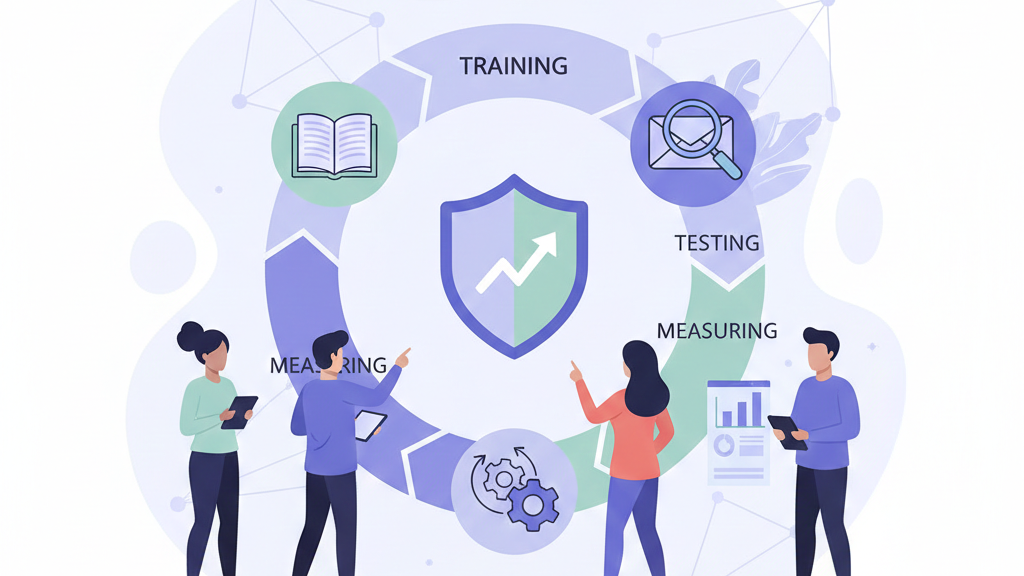
Measurement isn’t a one-time report. It’s a cycle. Start with a baseline through outsourced phishing simulation training to see your true starting point; the results often humble even the most confident teams.Then, implement targeted training, not for everyone, but for the groups or individuals the data reveals are most at risk.
After the intervention, measure again. Compare the new data to your baseline. Did reporting rates rise in the targeted group? Did dwell time fall? This cycle of test, train, and re-test creates a feedback loop where your program adapts and evolves.
It moves security awareness from a static annual event to a dynamic, living component of your security posture, continuously refined by real behavioral data.
Measuring security awareness effectiveness should focus on real behavior change, not just training completion rates. Look at phishing simulation results, reporting rates, detection speed, and how employees respond to social engineering attacks.
These security metrics reveal whether security knowledge is improving, risks are dropping, and the security culture is strengthening across daily work, not just during training sessions.
Strong programs track click rates on simulated phishing emails, user reporting behavior, incident response time, and reductions in security incidents. Behavioral indicators such as credential theft attempts stopped, faster Mean Time to Detect, and fewer data breaches show real security behaviour change.
These measurements reflect how well employee training improves security posture across the threat landscape.
Phishing simulation testing exposes how employees react to realistic phishing attacks and deceptive emails. By tracking fake phishing email clicks, reporting rates, and response speed, teams see where social engineering risks remain.
Over time, these results show behavior change trends, reveal vulnerable areas, and guide improvements in security awareness campaigns and targeted employee training.
Data analytics turns raw security metrics into clear insights about cyber risk and behavior patterns. It connects training efforts with reduced cybersecurity incidents, faster incident response, and lower breach costs.
Using statistical and analytical measurements helps organizations adjust security practices, strengthen risk management, and continuously improve their cybersecurity program based on real operational outcomes.
Real security isn’t a checkbox; it’s a culture. It’s about making safe actions, like reporting a phish, a natural reflex. When your metrics track these real behaviors instead of completion rates, you get proof of protection, not just proof of training.
This evidence is what you need to justify better tools and smarter processes. For MSSPs, the right technology stack is critical for turning this culture into a service advantage. If you’re ready to build that foundation, let’s discuss your stack.

