


An independent security assessment California helps organizations determine whether their security controls are properly designed, implemented, and working as intended. An independent assessor can identify gaps that internal reviews may overlook.
The scope depends on the organization’s needs. California state entities may face specific requirements, while private organizations may focus on regulations, contracts, customer expectations, or security risks.
A useful assessment explains why findings matter and what actions should follow. Keep reading to learn how MSSP Security approaches independent security assessments and helps organizations address security risks.
What to Know Before You Start
Before looking at the assessment process, it helps to understand these three points:
- Independence supports objective findings. An independent assessor can review security controls, policies, procedures, and technical safeguards without being responsible for operating those controls.
- Scope determines what gets reviewed. California requirements, organizational risks, contracts, and security frameworks can all affect which systems, controls, and processes are included.
- Findings should lead to action. The assessment should help teams understand their risks, prioritize important issues, plan remediation, and verify that corrective actions actually work.
What Is an Independent Security Assessment?
An independent security assessment California is a structured review of an organization’s security controls by an assessor who is separate from the team responsible for managing them. The goal is to see whether those controls are properly designed, implemented, and working as expected.
The scope can vary based on the organization’s needs. An assessment may review:
- Security governance and policies
- Access management
- Network and application security
- Vulnerability management
- Incident response
- Risk management
- Cloud security and data protection
Independence gives the assessor room to review evidence objectively and question assumptions. For example, an internal team may confirm that multifactor authentication is enabled, while an independent assessor can check whether it is consistently applied across relevant systems and accounts.
Organizations may work with a third-party security assessment California provider when they need an outside review. Before the assessment begins, both sides should agree on the scope, criteria, evidence, testing methods, and reporting process.
What Are California’s Security Assessment Requirements?

California organizations do not all follow the same cybersecurity assessment requirements. The process depends on factors such as whether the organization is a state entity, regulated business, contractor, or private company with specific obligations.
An independent security assessment California engagement for a government organization may involve terms such as AB 670 assessment California, Government Code 11549.3 assessment, and California state entity security assessment. We recommend confirming which requirements apply before defining the assessment scope.
State entities may also encounter processes involving the California Department of Technology (CDT), Office of Information Security, and CDT independent security assessment activities. Depending on the situation, this may include an Office of Information Security ISA, ISA Phase II California, or ServiceNow ISA request California.
The process can include:
- Defining the scope and criteria
- Providing required evidence
- Conducting technical and administrative testing
- Reporting findings and tracking remediation
Requirements such as a biennial security assessment California should always be confirmed for the specific entity rather than assumed to apply universally.
What Does an Independent Security Assessment Evaluate?

An independent security assessment California looks at more than whether an organization has security documents in place. It examines whether the information security program and its controls are properly designed, implemented, and working as expected.
For organizations that also want to understand their overall security maturity, a Security Maturity Evaluation Service California can provide a broader view of how security capabilities align with business needs and improvement priorities.
The assessment may review:
- Security governance: roles, risk ownership, leadership oversight, and security decisions
- Information security programs: policies, procedures, standards, risk management, incident response, and vendor management
- Security controls: access management, monitoring, and other safeguards
A security policy assessment checks whether policies are current and practical, while a security procedure assessment looks at how those policies are applied. A security standard assessment examines whether requirements are followed consistently.
“The procedures are customizable and can be easily tailored to provide organizations with the needed flexibility to conduct security and privacy control assessments that support organizational risk management processes and are aligned with the stated risk tolerance of the organization.” – NIST
A security control assessment California can also involve security controls testing, security controls validation, and evaluation of security controls effectiveness. In our experience auditing security products, a control or product may look effective on paper but perform differently in the real environment. That practical gap is what an independent assessment should help uncover.
What Technical Security Assessments Should You Consider?
Technical testing shows how security controls work in a real environment. The right approach depends on the systems being reviewed, the assessment goals, and the risks the organization needs to address.
A network security assessment California may review:
- Network architecture and segmentation
- Exposed services and firewall settings
- Remote access and authentication
- Network monitoring
A web application security assessment California can focus on authentication, authorization, session management, input validation, access controls, and application configuration.
A vulnerability assessment California identifies known weaknesses across systems and infrastructure. From our experience auditing security products, scan results still need human review. False positives, asset importance, and existing safeguards can all affect how findings should be prioritized.
Independent penetration testing California takes a different approach by testing whether selected weaknesses can be exploited. A cloud security assessment California may review access, configurations, logging, and data protection, while an AI security assessment California can address data exposure, integrations, access, and governance.
An independent security assessment California brings these findings together and helps connect technical issues with the organization’s actual security risks.
How Does an Independent Assessment Compare With Other Cybersecurity Audits?
Security assessments, audits, vulnerability assessments, and penetration tests may cover similar areas, but they have different goals. Understanding the difference helps organizations choose the right type of review.
| Assessment Type | Primary Purpose |
| Independent security assessment | Review defined security controls and practices objectively |
| Vulnerability assessment | Find known technical weaknesses |
| Penetration testing | Test whether selected weaknesses can be exploited |
| Compliance audit | Check whether specific requirements are being met |
| Risk assessment | Identify and prioritize cybersecurity risks |
A vulnerability assessment, for example, may find outdated software without showing whether the organization’s vulnerability management process is effective. A penetration test can prove that an application is exploitable, but it may not cover governance, security policies, or incident response.
We see this distinction when helping MSSPs review and audit security products. A tool can work well for one task while leaving gaps elsewhere in the security process.
“The CPGs allow organizations to align investments and assess gaps based upon the most common and impactful threats and adversary tactics, techniques, and procedures (TTPs) observed by CISA and its government and industry partners.” – CISA
The assessment criteria may come from:
- NIST CSF maturity assessment tool
- NIST security assessment California
- ISO 27001 audit California
- SOC 2 audit California
- FedRAMP, CMMC, HIPAA, CCPA, or GDPR requirements
These frameworks are not interchangeable. A cybersecurity compliance assessment California should focus on the specific requirements being tested, while a broader risk assessment California cybersecurity can uncover risks beyond formal compliance.
How Should You Choose an Independent Security Assessment Provider?
Credit: National Institute of Standards and Technology
Choosing an assessment provider should start with what the organization needs to learn, not simply the services a provider offers. A suitable independent security auditor California should clearly explain the scope, criteria, evidence, testing approach, and reporting process.
Organizations working with managed security providers may also benefit from an MSSP needs assessment consultant California when they need help defining requirements, evaluating tools, or aligning security investments with operational needs.
Before selecting a provider, consider:
- Independence: Check for potential conflicts of interest and how they are managed.
- Experience: Look for technical skills that match the systems and controls being assessed.
- Qualifications: Review relevant certifications and terms such as certified security assessor California, ANAB accredited assessment California, and A2LA accredited assessment California.
- Assessment criteria: Confirm whether the review follows regulatory, NIST, ISO, contractual, or internal requirements.
- Reporting: Make sure findings are clear enough to support remediation.
We use a similar approach when helping MSSPs evaluate and audit security products. At MSSP Security, we look at how tools perform in the organization’s actual environment, not just what they promise.
Broader security consulting California or vCISO services California can provide additional support when needed.
What Happens After an Independent Security Assessment?
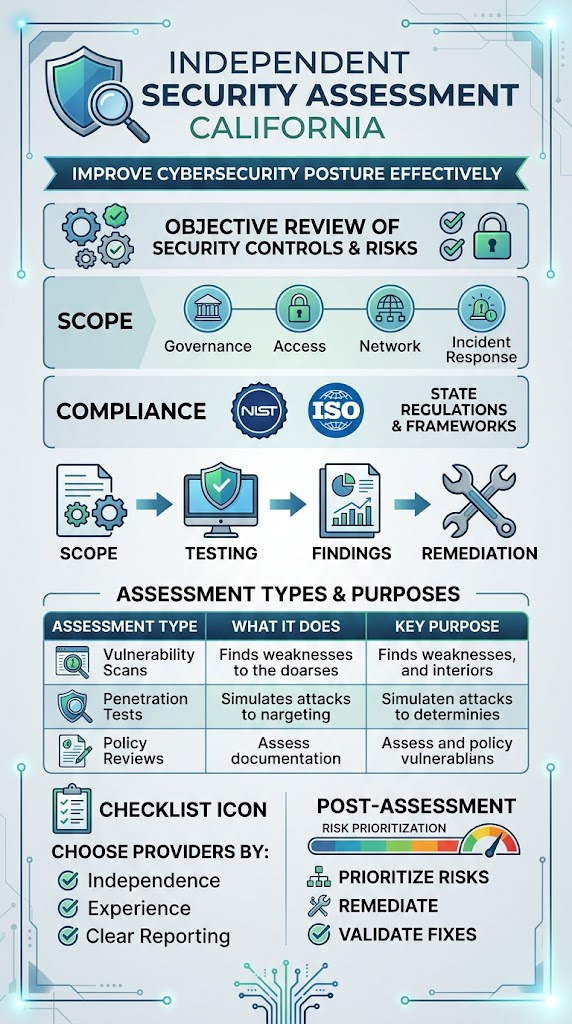
An independent security assessment California is only useful if its findings lead to action. After the review, teams should understand each finding, identify affected systems, and use the available evidence to determine its actual impact.
The next step is to prioritize risks based on factors such as:
- Severity and likelihood
- Business impact and asset criticality
- Exposure and exploitability
- Regulatory requirements
A security remediation plan can then assign owners, corrective actions, priorities, and timelines. Security remediation California may include fixing configurations, patching vulnerabilities, removing unnecessary access, updating policies, improving monitoring, or adding controls.
We also recommend validating changes before closing findings. A corrected setting does not always mean the underlying issue is resolved. Our experience auditing security products shows why testing the result against the original problem matters.
Finally, continuous security monitoring California and periodic reassessment help organizations respond as systems, vendors, applications, and threats change.
FAQ
How independent does a security assessor need to be?
The assessor should be sufficiently independent from the personnel responsible for implementing or operating the controls being evaluated. The exact independence requirements can depend on the assessment program, regulatory obligation, contractual requirement, and organizational context.
Can penetration testing replace an independent security assessment?
Not necessarily. Penetration testing primarily evaluates whether selected vulnerabilities or attack paths can be exploited. An independent security assessment can have a broader scope that includes governance, policies, procedures, risk management, security controls, and control effectiveness.
What evidence should an organization prepare for an assessment?
Evidence can include security policies, procedures, system documentation, asset inventories, access records, configuration information, vulnerability reports, incident records, risk assessments, training records, and control-related documentation. The exact evidence depends on the assessment criteria and scope.
How long does an independent security assessment take?
There is no single timeline. Duration depends on factors such as the number of systems, organizational size, assessment criteria, technical testing requirements, evidence availability, and the complexity of the environment. A narrowly scoped assessment may take considerably less time than an enterprise-wide evaluation.
What should an organization do after a critical security finding?
A critical finding should be evaluated promptly based on its actual exposure and business impact. The organization may need to implement immediate containment or corrective measures, assign ownership, document a remediation plan, and perform follow-up validation to confirm that the risk has been appropriately addressed.
How Can an Independent Security Assessment Improve Security?
An independent security assessment California gives organizations an objective way to evaluate security controls, identify risks, and improve their cybersecurity program. California state entities may follow specific requirements, while private organizations may focus on compliance, contracts, or technical risks. A strong assessment connects clear scope, meaningful findings, security remediation, and follow-up validation.
At MSSP Security, we take a practical approach based on each organization’s environment and objectives. Contact MSSP Security to discuss how an assessment can support better security decisions and measurable improvement.
References
- https://csrc.nist.gov/pubs/sp/800/53/a/r5/final
- https://www.cisa.gov/cross-sector-cybersecurity-performance-goals/cross-sector-cybersecurity-performance-goals