


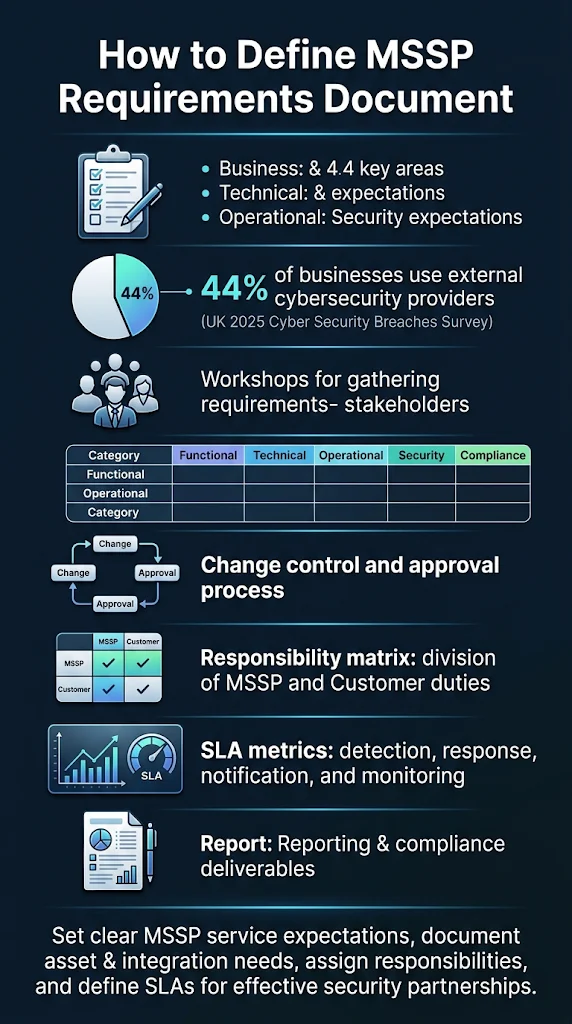
An MSSP requirements document outlines the business, technical, operational, and security expectations an organization sets before hiring a managed security service provider. Understanding how to define an MSSP requirements document helps security teams assess provider capabilities, clarify responsibilities, and determine whether proposed services meet their needs.
The UK Government’s 2025 Cyber Security Breaches Survey found that 44% of businesses used an external cybersecurity provider. For organizations considering this approach, documenting requirements before selecting a provider can prevent gaps in service coverage and unclear responsibilities. MSSP Security recommends defining these expectations early. Keep reading to learn what to include and how to prepare your document.
MSSP Requirements: 3 Things to Get Right
Creating a useful MSSP requirements document comes down to getting three things right:
- Know what your business needs: Document business objectives, stakeholder expectations, and functional, technical, operational, and compliance requirements.
- Be clear about service expectations: Define asset coverage, integration capabilities, incident response responsibilities, SLAs, and reporting requirements.
- Agree on how success will be measured: Set acceptance criteria, pricing expectations, and contract conditions to guide provider selection, implementation, and performance reviews.
What Is an MSSP Requirements Document and Why Does It Matter?
Knowing how define mssp requirements document starts with understanding what the business needs from its security services and tools. An MSSP requirements document outlines the services, technical capabilities, responsibilities, and performance expectations that guide those decisions. It turns business security objectives into practical requirements that providers can use when evaluating products, planning integrations, and delivering services.
In our consulting work with MSSPs, we see how unclear requirements can make product selection and evaluation more difficult. A provider may need 24/7 threat monitoring, endpoint coverage, SIEM integration, incident notifications, and monthly security reports. Documenting these needs helps us assess whether a product or service can meet operational demands before the MSSP commits to it.
The document also gives teams a consistent basis for comparing vendor proposals and identifying capability gaps. It serves a different purpose from related contractual documents:
- Requirements specification: Defines business needs, technical requirements, and acceptance criteria.
- Statement of work (SOW): Outlines agreed activities, deliverables, and timelines.
- Service-level agreement (SLA): Sets measurable performance targets, including response times.
- Master service agreement (MSA): Establishes broader contractual terms.
An MSSP service catalog lists the capabilities a provider offers, while the requirements document identifies which ones are needed. We use that distinction to help MSSPs evaluate security products against actual service priorities rather than selecting tools based on features alone. Our defining MSSP service requirements approach helps providers establish clear expectations before making technology decisions.
Why Should You Define MSSP Requirements Before Engagement?

Knowing how define mssp requirements document gives organizations a clearer basis for choosing a managed security service provider (MSSP). It helps procurement and security teams compare vendor capabilities, service coverage, pricing, and service-level agreements (SLAs) against the same set of expectations.
The UK’s 2025 Cyber Security Breaches Survey highlights the importance of reviewing third-party risks:
“Relatively few businesses or charities were taking steps to formally review the risks posed by their immediate suppliers and wider supply chain.” – Department for Science, Innovation and Technology (DSIT) & Home Office, GOV.UK.
This finding reinforces the need to assess external providers before engagement. Organizations should understand their security risks, evaluate vendor capabilities, and retain oversight of business-critical decisions.
In our work helping MSSPs select and audit security products, we find that requirements need to reflect the environments and customers a provider actually supports. A financial institution may need strong identity monitoring and customer data protection, while a manufacturer may place greater importance on operational technology and production networks. These differences affect which tools and integrations are suitable.
Without clear requirements, MSSPs and their customers can run into:
- Gaps in asset coverage and security monitoring.
- Integration delays caused by overlooked technical dependencies.
- Confusion over incident escalation and response authority.
- Unexpected costs for services outside the agreed scope.
- Inconsistent reporting and unclear performance measures.
We use structured requirements reviews to help MSSPs identify capability gaps, assess product fit, and establish realistic service expectations before an engagement begins. This process supports evaluation, selection & onboarding (consulting) by helping providers make informed decisions before adopting new security solutions.
How Do You Gather Business and Stakeholder Requirements?
Credit: National Institute of Standards and Technology
Understanding how define mssp requirements document starts with gathering input from the people who understand the organization’s business priorities, risks, and technical environment. Requirements gathering should involve security teams, IT operations, business owners, compliance personnel, procurement, and senior management.
A structured MSSP requirements workshop helps turn these different perspectives into practical service expectations. We recommend following these steps:
- Identify stakeholders: Determine who influences security decisions and service delivery.
- Review existing documentation: Examine security policies, risk assessments, compliance obligations, and current service agreements.
- Discuss security priorities: Identify critical systems, incident response needs, and expected provider capabilities.
- Document and prioritize requirements: Record functional, technical, operational, and compliance needs, including ownership and business importance.
- Resolve conflicts and obtain approval: Clarify responsibilities, technical limitations, and decisions requiring management approval.
For example, IT teams may want to avoid production disruption, while security teams prefer automatic endpoint isolation. We encourage MSSPs to document these differences and agree on approval procedures before finalizing requirements. This creates a clearer foundation for vendor evaluation and service planning.
Which Functional, Technical, and Operational Requirements Should You Define?
When working out how define mssp requirements document, start by separating requirements into five areas: functional, technical, operational, security, and compliance. This gives MSSPs a practical way to assess what a customer expects and whether the provider’s existing tools and processes can deliver it.
| Requirement category | What to document |
| Functional | Security monitoring, threat detection, investigation, and response capabilities |
| Technical | SIEM and EDR integrations, APIs, telemetry sources, and system compatibility |
| Operational | Monitoring hours, escalation procedures, communication, and reporting |
| Security | Access controls, encryption, data protection, and incident handling |
| Compliance | Regulatory obligations, audit evidence, and relevant certifications |
These categories need to reflect the customer’s actual environment. For instance, technical requirements should identify the platforms and data sources a security product must support. Operational requirements, meanwhile, should explain monitoring schedules, escalation contacts, and measurable response targets. Defining technical requirements for managed security services also helps MSSPs assess whether their tools can support integration needs and operational demands.
We often find that a product’s feature list does not tell the whole story. An MSSP also needs to know whether the tool integrates with its existing security stack, handles the required telemetry, and fits its service delivery model. Our product selection and audit work helps providers examine these practical considerations before committing to a solution.
Established cybersecurity frameworks can also help connect business security objectives with governance, risk management, and everyday security operations.
How Do You Document In-Scope Assets and IT Environments?

When defining how define mssp requirements document, start with a reliable inventory of the customer’s IT environment. It should identify which systems, applications, and infrastructure fall under the MSSP’s responsibility. Without this information, providers may overlook important assets or discover integration gaps after onboarding has started.
The inventory should cover network infrastructure, including firewalls, routers, switches, and VPN gateways. It should also include endpoints such as workstations, laptops, mobile devices, and servers. Cloud accounts, virtual machines, SaaS applications, identity providers, privileged accounts, databases, and other business-critical applications should be recorded as well.
For each asset, document its owner, location, business function, and required monitoring coverage. We also recommend recording integration methods, access permissions, available log sources, and retention periods.
Consider a customer with separate development and production cloud accounts. The requirements should clarify whether both environments need monitoring and what telemetry the MSSP must collect. When we help MSSPs assess security products, these details matter because a tool may offer the right features but still lack compatibility with part of the customer’s environment.
Keep the inventory updated as the customer adds systems, changes infrastructure, or adopts new applications.
What Integration Requirements Should an MSSP Support?
When working out how define mssp requirements document, don’t overlook how the provider’s tools will connect with the customer’s existing systems. Integration requirements should identify the platforms, interfaces, data flows, and permissions needed to deliver the agreed security services. Without these details, even a capable security product may not provide the visibility an MSSP needs.
Common integration points include SIEM platforms for log collection, EDR tools for endpoint alerts, firewalls for network events, cloud security platforms for account activity, and identity providers for authentication data. Ticketing systems also matter because they help both parties track incidents, investigation updates, and outstanding actions.
For each connection, document supported data formats, API access, connectivity methods, authentication requirements, and deployment responsibilities. We also encourage MSSPs to check what actions their tools can perform and which ones require customer approval.
For example, an MSSP might be allowed to investigate an EDR alert but need approval before isolating a production endpoint. When we help providers select or audit security products, we examine these permission boundaries alongside compatibility and integration limitations. A product that works well in a test environment may still present challenges when connected to a customer’s actual infrastructure.
Defining these requirements early gives both parties a clearer onboarding plan and helps avoid unexpected integration work.
How Should You Define Incident Response and Escalation Requirements?
When working out how define mssp requirements document, make incident response responsibilities clear before security monitoring begins. The document should explain how the MSSP handles detection, investigation, notification, containment, and recovery, including which actions require customer approval.
For example, an MSSP may investigate suspicious login activity and recommend disabling an account, while the customer retains authority to approve access restrictions. We recommend documenting these boundaries and setting emergency authorization rules in advance so analysts know how to act when a serious incident occurs.
An escalation matrix should identify who receives notifications based on incident severity. Critical incidents may require immediate contact with security leadership, while lower-priority alerts can follow routine escalation procedures.
Notification requirements should also specify communication channels, response timelines, designated contacts, and the information each alert must contain. This typically includes the affected system, incident severity, detection time, available evidence, and recommended next steps.
Established incident response frameworks can help organizations structure preparation, detection, response, and recovery activities. We also assess whether security products support the investigation, escalation, and response workflows an MSSP needs to deliver.
How Do You Define MSSP Responsibilities and Service Boundaries?
An important part of how define mssp requirements document is assigning clear responsibilities between the MSSP and its customer. A shared responsibility model helps prevent ownership gaps by defining who performs security tasks, approves decisions, and receives updates.
The UK’s National Cyber Security Centre (NCSC) emphasizes the importance of documenting service boundaries and responsibilities:
“The contract should clearly specify what is and what is not included. A matrix of responsibilities detailing what the MSP will do and what is expected from you as the customer is good practice.” – National Cyber Security Centre (NCSC)
This guidance highlights why both parties should agree on their obligations before service delivery begins. For example, the MSSP may monitor alerts and investigate suspicious activity, while the customer maintains its infrastructure and approves changes that could affect business operations.
We recommend using a RACI matrix to clarify ownership across monitoring, vulnerability management, incident response, and service reviews. It identifies who is Responsible, Accountable, Consulted, and Informed for each activity.
Customer responsibilities should also be documented. These may include maintaining accurate asset inventories, providing system access, approving containment actions, and reporting infrastructure changes.
Finally, define service exclusions so customers understand what the provider does not cover. Common examples include hardware replacement, application development, physical security, unauthorized remediation, and penetration testing outside approved targets.
When we help MSSPs assess security products and service capabilities, we also review these boundaries to ensure the proposed solution supports the provider’s actual responsibilities.
Which SLA Metrics and Service Levels Should You Define?
When defining how define mssp requirements document, include measurable service-level agreements (SLAs) to clarify how the provider’s performance will be evaluated. These expectations should cover detection, response, notification, monitoring, and reporting.
Each SLA measures a different part of service delivery. Detection targets establish expectations for identifying security events, while response targets measure how quickly the MSSP acknowledges or investigates them. Notification SLAs define how soon customers receive incident updates, and monitoring SLAs specify coverage hours and service availability.
We recommend linking these targets to incident severity. A critical security incident should receive more urgent attention than a low-priority alert. The agreement should also identify covered assets, log sources, planned maintenance periods, and any monitoring limitations.
To assess ongoing performance, MSSPs and customers can track monitoring coverage, time to detect and acknowledge alerts, incident notification compliance, and reporting delivery.
In our product assessments, we also examine whether security tools provide the telemetry and reporting capabilities needed to measure these service commitments. SLA targets should reflect the agreed service model and operational capacity rather than generic industry benchmarks.
What Reporting and Compliance Requirements Should You Include?
When considering how define mssp requirements document, specify the reporting, audit, and compliance evidence customers expect from the provider. These requirements help MSSPs demonstrate service performance and give customers visibility into their security operations.
Monthly service reports should cover security alerts, incident statistics, monitoring coverage, integration status, investigation findings, vulnerability results, outstanding recommendations, and SLA performance. Executive dashboards can present the same information at a higher level, focusing on significant risks, service performance, and unresolved issues.
We also recommend documenting applicable regulatory obligations, audit evidence, and security certifications. Depending on the customer’s industry, this may include records of access controls, incident handling, and monitoring activities.
Data governance deserves equal attention. Define where customer information can be stored and processed, who can access it, and how encryption, privileged access, retention, and deletion are managed.
When we assess security products for MSSPs, we examine whether their reporting and audit capabilities can support these obligations. The required certifications and assurance reports should also match the services being delivered.
How Do You Define MSSP Acceptance Criteria and Vendor Evaluation Requirements?
A practical part of how define mssp requirements document is setting clear acceptance criteria before evaluating providers. These criteria give procurement and security teams a consistent way to compare technical capabilities, service delivery, incident response, compliance, reporting, and commercial terms.
When reviewing MSSP proposals, we recommend checking how each provider will meet the documented requirements rather than relying on broad service descriptions. An RFP should outline the organization’s security objectives, required services, asset inventory, integration needs, SLAs, reporting expectations, data protection conditions, and pricing requirements.
Acceptance criteria should also explain how each requirement will be tested and approved. For example, SIEM integration may only be accepted after the specified log sources are successfully connected and the required security events appear in the monitoring platform.
In our consulting work, we help MSSPs assess vendor capabilities and validate whether security products meet technical and operational expectations. This makes provider evaluation more objective and gives both parties a clearer basis for approving service readiness.
How Should You Define MSSP Pricing, Contract, and Exit Requirements?
An important part of how define mssp requirements document is documenting the commercial and contractual terms before an engagement begins. Clear expectations help both parties understand service costs, legal obligations, and what happens when the agreement ends.
Pricing requirements should explain the billing model and what each charge covers. Consider monitored endpoints or assets, monthly or annual fees, onboarding costs, data ingestion and storage, additional integrations, and incident response services.
We also recommend checking that the contract, statement of work (SOW), and service-level agreement (SLA) reflect the same agreed requirements. Pay particular attention to service boundaries, responsibilities, confidentiality, data ownership, liability, and change control procedures.
Exit arrangements deserve equal attention. Define how customer data will be returned or retained, how accounts and access permissions will be revoked, and whether the provider must transfer documentation or assist with the transition.
When we help MSSPs evaluate security products and service arrangements, these details matter because commercial terms and exit conditions can affect long-term service delivery.
FAQ
Who Should Be Responsible for Maintaining an MSSP Requirements Document?
The customer and MSSP should maintain the document together. Security leaders, IT teams, and service managers should review it whenever business needs, infrastructure, or security priorities change.
How Often Should MSSP Requirements Be Reviewed?
Review requirements at least annually and whenever significant changes occur, such as new infrastructure, regulatory obligations, security incidents, or changes in service scope.
What Is the Difference Between MSSP Requirements and an RFP?
An MSSP requirements document defines the organization’s security and service expectations. A Request for Proposal (RFP) uses those requirements to invite providers to explain how they can meet them.
Can an MSSP Use the Same Requirements Document for Every Customer?
A standard template can provide consistency, but each customer needs tailored requirements. Differences in infrastructure, risk exposure, compliance obligations, and service priorities affect the tools and services required.
What Happens If MSSP Requirements Change After Service Begins?
Changes should follow an agreed change control process. Both parties should review the impact on service scope, integrations, responsibilities, pricing, and SLAs before approving and documenting updates.
How Can MSSP Security Help Organizations Define Their Requirements?
Defining MSSP requirements helps organizations clarify business goals, technical needs, security priorities, and service responsibilities before an engagement begins.
At MSSP Security, we provide tailored consulting to help MSSPs reduce tool sprawl, optimize security stacks, and improve service quality. Our services include vendor-neutral product selection and auditing, needs analysis, vendor shortlisting, PoC support, and integration assessments.
With over 15 years of experience and 48K+ projects completed, we deliver actionable recommendations to help MSSPs choose tools that match their operational needs and business goals.
Work with MSSP Security to strengthen your security strategy and build a more effective technology stack.
References
- “Cyber security breaches survey 2025.” GOV.UK, 19 June 2025. Accessed 10 November 2026.
- “Choosing a managed service provider (MSP).” National Cyber Security Centre, 24 November 2025. Accessed 10 November 2026.