


Treat EDR as an ongoing security process, not a one time installation. Many organizations run into problems after deployment when they begin managing alerts, policies, device visibility, and response actions. The software may be installed correctly, but daily operations often reveal gaps that need attention.
At MSSP Security, we have seen teams get better results when they test configurations, review workflows, and adjust their approach over time. Good EDR management requires more than turning on features. It requires a clear plan and regular review. Keep reading to learn how to avoid common EDR deployment problems.
EDR Deployment Reality Check
Building an effective EDR strategy requires attention to technology, people, and daily security operations.
- EDR deployment requires more than installing endpoint agents.
- Effective EDR operations depend on continuous monitoring and tuning.
- Managed expertise can improve EDR success.
Why Do EDR Deployments Fail During The Early Stages?
Installing EDR is usually the easy part.
The harder part comes after that. Teams have to make sure the right devices are covered, policies fit the business, and alerts are useful instead of overwhelming.
We have reviewed many security products for MSSPs, and one thing keeps coming up. A good EDR platform does not fix poor planning. Even the strongest tool can fail if nobody knows which systems need protection or how the team should handle alerts.
The early decisions matter.
A rushed rollout can create gaps that are difficult to notice until there is a security event. That is why organizations should spend time understanding their environment before turning on full protection.
How Can Better Planning Prevent EDR Deployment Gaps?

EDR deployment requires more than installing endpoint agents. Organizations first need to understand what devices exist, which systems need protection, and how the rollout will be managed.
Missing laptops, unmanaged servers, remote devices, or outdated systems can create endpoint coverage gaps that attackers may use as entry points. Before deployment, teams should review their asset inventory, identify high-risk endpoints, and define ownership for the rollout process.
“Understanding the business context, the resources that support critical functions, and the related cybersecurity risks enables an organization to focus and prioritize its efforts.” – National Institute of Standards and Technology (NIST)
A pilot deployment is often a practical first step. Testing EDR with a smaller group of users and systems helps identify compatibility issues, performance concerns, and policy problems before expanding across the organization.
A phased EDR rollout strategy allows teams to improve protection while reducing disruption. By planning deployment carefully, organizations can avoid common EDR implementation issues and create a stronger security foundation.
Why Does EDR Create Operational Challenges After Deployment?
Deployment is only the beginning.
After EDR is installed, security teams need to review alerts, update policies, adjust settings, and check whether the platform is working as expected.
This ongoing work is where many organizations struggle.
We have worked with teams that purchased strong EDR products but never adjusted the settings after deployment. Over time, alerts became noisy. Analysts stopped trusting the system. Important events became harder to find.
The problem was not the tool.
The problem was the lack of ongoing management.
EDR needs regular attention because business environments change. New applications appear. User behavior changes. Attack methods change too.
How Does Alert Fatigue Affect EDR Effectiveness?

Too many alerts can make a security team less effective.
EDR platforms are designed to find suspicious activity, but not every alert represents a real threat.
Common false positives include:
- Administrative scripts
- Software updates
- Normal user behavior
- Business applications
When alerts are not tuned properly, analysts spend hours reviewing harmless activity. Real threats can become harder to notice.
We often find this during EDR audits. A company may think the product is failing because the team is overwhelmed. After reviewing the settings, the issue is usually related to configuration.
How Can Teams Improve EDR Alert Management and Integration?
Strong EDR operations depend on useful alerts, not simply more alerts. When detection policies are not tuned properly, analysts may spend too much time reviewing false positives instead of investigating real threats.
Teams can improve alert management through regular detection tuning, better prioritization, and integrating EDR, XDR, SIEM, and SOAR to connect endpoint activity with broader security events. This approach helps analysts add more context to investigations, improve visibility, and respond faster when multiple security signals appear together.
The goal is not to collect every possible event. It is to help analysts identify important activity and respond with better information.
How Can Teams Manage EDR With Limited Security Resources?
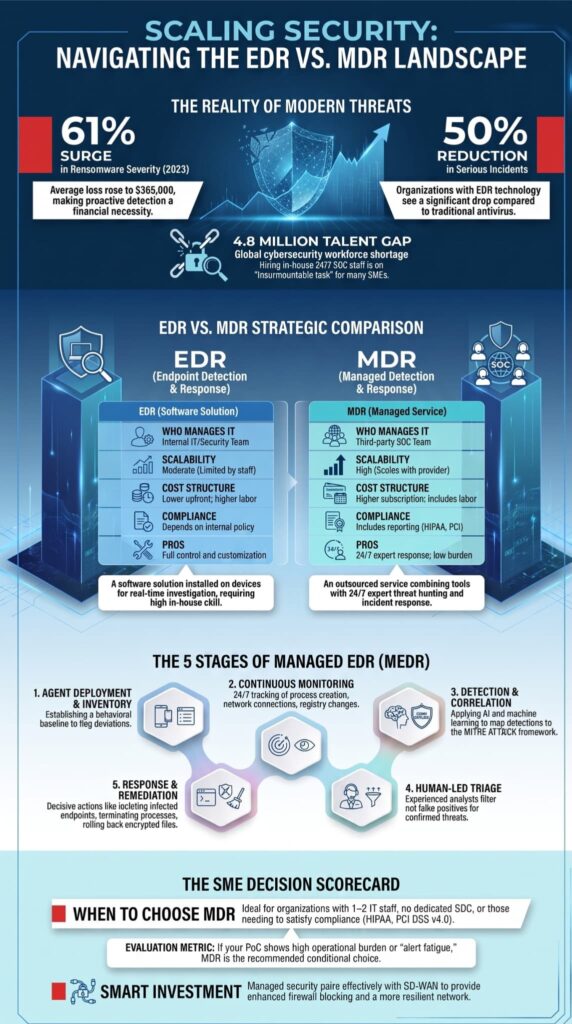
EDR provides detailed security information, but teams still need the skills to investigate alerts, understand attack behavior, and respond correctly. Many organizations struggle because their security teams have limited time, staffing, or experience managing endpoint threats.
This challenge can increase operational overhead after deployment. Organizations may need additional support for monitoring, investigation workflows, policy reviews, and continuous improvement. Working with a managed XDR service can also help organizations improve visibility across security environments while providing additional monitoring expertise when internal resources are limited.
Managed EDR services can help teams maintain effective security operations by providing additional expertise and monitoring support without requiring a large internal SOC team.
Why Are EDR Response Playbooks Important?
Response playbooks help teams react faster.
They usually cover:
- Alert review
- Escalation steps
- Device isolation
- Recovery actions
Without a clear process, even a good detection can lead to a slow response.
“The playbook provides a standard set of procedures to identify, coordinate, remediate, recover, and track successful mitigations from incidents and vulnerabilities affecting systems, data, and networks.” – Cybersecurity and Infrastructure Security Agency (CISA)
What Are The Risks Of Automated EDR Actions?
Automation can help, but it needs testing.
| Capability | Benefit | Risk |
| Device isolation | Stops threats | Can affect users |
| Blocking actions | Stops known attacks | May block valid activity |
| Process removal | Removes threats | May stop needed tools |
We recommend testing automation before using it widely. A small mistake can create business problems.
How Can Organizations Improve EDR Deployment Success?
Source: CyberAlpedia – WissenX Akademie
EDR needs regular review after deployment.
Teams should check:
- Policies
- Updates
- Configurations
- Detection results
Before expanding an endpoint security strategy, organizations should complete an EDR XDR tools review to understand how different capabilities fit their environment, integration needs, and operational goals. Evaluating tools based on daily management requirements can help teams avoid unnecessary complexity after deployment.
Useful measurements include endpoint coverage, response time, and false positive rates.
These numbers show whether the platform is helping or creating more work.
FAQs
What are the biggest challenges during EDR deployment?
EDR deployment can involve several challenges beyond installing endpoint agents. Common EDR deployment challenges include integration issues, policy configuration errors, endpoint coverage gaps, and coordination problems between security and IT teams. A clear deployment plan, proper testing, and a phased rollout approach can help organizations reduce disruption while improving endpoint protection.
How can teams reduce problems during EDR implementation?
Many EDR implementation issues occur when organizations deploy solutions too quickly without sufficient testing. A pilot deployment can help identify endpoint agent rollout problems, compatibility concerns, and potential user impact before expanding across the environment. Teams should also define ownership, maintain clear communication, and review security policies regularly.
Why does EDR create too many security alerts?
A high volume of security alerts often occurs when detection policies are not properly configured or maintained. Alert fatigue in EDR can result from excessive notifications, inaccurate detection rules, or poor tuning processes. Effective EDR false positives management requires reviewing alerts, adjusting detection settings, and providing analysts with enough context to prioritize real threats.
How can organizations manage EDR performance concerns?
Some organizations worry about the performance impact of EDR after deployment, especially when protecting older devices, remote endpoints, or systems with limited resources. Proper testing helps teams measure EDR resource consumption and EDR network bandwidth usage before full deployment. Organizations should monitor device performance, optimize configurations, and plan infrastructure requirements carefully.
How do teams improve EDR operations after deployment?
Effective EDR management requires continuous improvement after initial deployment. Teams can strengthen operations through regular policy reviews, EDR baseline policy tuning, incident analysis, and collaboration between SOC and IT teams. Tracking detection metrics, response times, reporting accuracy, and EDR post-incident review processes helps organizations maintain reliable endpoint security over time.
Improve Your EDR Deployment With the Right Approach
EDR deployment can become difficult when tools are added without proper planning. You need clear visibility and a setup that your team can manage. That’s where many organizations struggle.
MSSP Security helps organizations evaluate EDR solutions with vendor neutral consulting, product selection support, auditing, and deployment guidance. With more than 15 years of experience and over 48,000 completed projects, the team helps build security strategies that support daily operations and long term goals.
References
- https://www.nist.gov/cyberframework/csf-11-five-functions
- https://www.cisa.gov/topics/cybersecurity-best-practices/executive-order-improving-nations-cybersecurity