


Choose a managed XDR service if you need better visibility across your entire environment, not another standalone security tool. It brings together threat detection, expert analysis, and around the clock monitoring for endpoints, cloud workloads, networks, identities, and email.
In our work at MSSP Security, we have seen security teams spend less time chasing disconnected alerts once everything is viewed in one place. The difference is noticeable. Better context often leads to faster decisions and fewer missed threats. Keep reading to learn which managed XDR capabilities matter most before choosing a provider.
Managed XDR Quick Wins
A managed XDR service helps organizations improve threat detection, response, and security operations through better visibility and expert support.
- A managed XDR service delivers 24/7 monitoring, expert-led investigations, and faster incident response across multiple security layers.
- Unified visibility reduces alert fatigue by correlating endpoint, cloud, network, identity, and email telemetry into meaningful investigations.
- Organizations often strengthen cyber resilience, improve compliance support, and lower operational costs without building a full internal Security Operations Center (SOC).
Why Are Organizations Moving Beyond Traditional Security Tools?
Most organizations already use security tools for endpoints, cloud services, email, and networks. The challenge is that these systems often operate separately, making it difficult to understand how threats move across the environment.
Managed XDR addresses this problem by combining security data into a single investigation view. Instead of reviewing isolated alerts, analysts can see activity across endpoints, identities, networks, cloud services, and email. This broader context helps teams detect threats earlier and respond more effectively.
“The Framework provides a common language for understanding, managing, and expressing cybersecurity risk both internally and externally. It can be used to help identify and prioritize actions for reducing cybersecurity risk.” – National Institute of Standards and Technology (NIST)
By connecting security information in one place, organizations spend less time switching between dashboards and more time focusing on real incidents.
Which Managed XDR Benefits Deliver The Biggest Business Value?

Instead of opening several management consoles, analysts can investigate activity from a single location. That may sound like a small improvement, but it changes how quickly incidents are understood.
We have watched security teams cut investigation time because they no longer needed to jump between multiple tools. Organizations comparing security approaches often review different EDR XDR tools to understand how detection, visibility, and response capabilities fit into their broader security operations.
| Capability | Why It Matters |
| Cross domain visibility | Connects activity across security tools |
| Threat intelligence | Improves detection of known threats |
| Behavioral analytics | Finds suspicious activity that signatures miss |
| Alert prioritization | Helps analysts focus on real incidents |
| Automated response | Speeds up containment and recovery |
One of the biggest advantages of managed XDR is centralized visibility. Analysts can investigate activity from a single console instead of moving between multiple tools, reducing investigation time and improving response.
Managed XDR also improves alert quality by correlating telemetry from different sources and filtering low priority events. This helps analysts focus on incidents that require immediate attention instead of reviewing thousands of unnecessary alerts.
How Does Managed XDR Improve Incident Response?
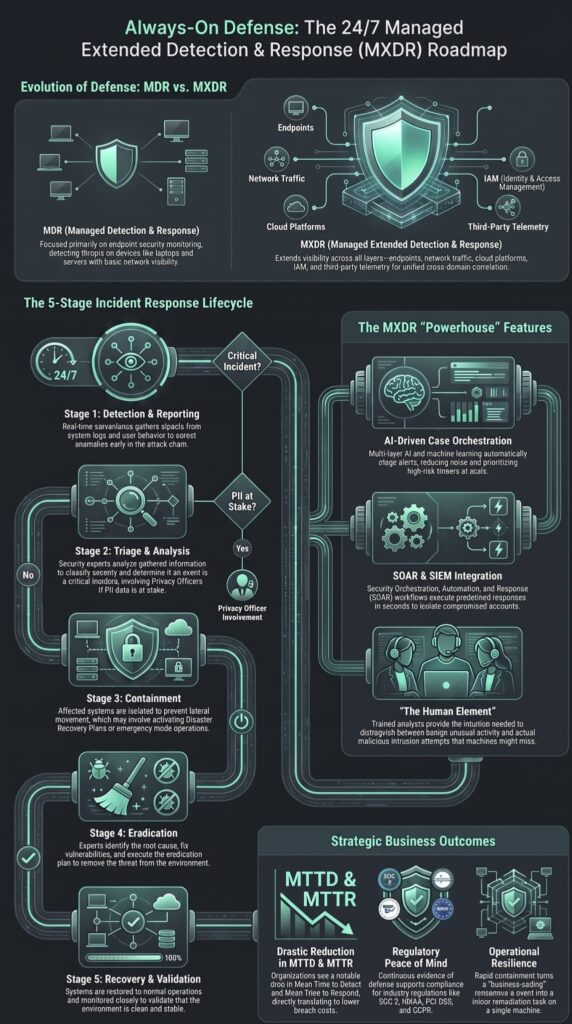
Managed XDR combines detection, investigation, and response into one workflow. Analysts can understand what happened, identify affected systems, and take action without switching between multiple tools.
Response actions such as isolating compromised endpoints, blocking malicious activity, and investigating suspicious accounts help limit attacker movement. With 24/7 monitoring and SOC support, organizations can respond to threats even outside normal business hours.
Continuous monitoring also helps teams detect issues earlier and reduce the impact of security incidents.
“Incident management is the process through which an organisation responds to security incidents. It includes the detection, analysis, prioritisation, and handling of security incidents, as well as the recovery and lessons learned phases.” – European Union Agency for Cybersecurity (ENISA)
Is Managed XDR Better Than EDR Or MDR?

EDR focuses mainly on endpoint activity, while managed XDR extends visibility across endpoints, cloud environments, identities, networks, and email.
This broader approach helps organizations detect attacks that move across multiple systems instead of focusing on one device at a time. Companies with mature security teams may prefer EDR, while organizations needing wider monitoring and expert support may benefit more from managed XDR.
When evaluating endpoint-focused solutions, reviewing important EDR features can help teams understand whether a tool provides the right level of detection, investigation, and response before expanding into a broader XDR approach.
How Does Managed XDR Reduce Cybersecurity Costs?
Building an internal Security Operations Center requires skilled analysts, security tools, and continuous monitoring coverage. For many organizations, maintaining these resources can be difficult and expensive.
Managed XDR helps reduce this burden by combining monitoring, investigation, and response into one managed service. It allows organizations to improve security operations without expanding internal teams significantly.
For organizations that need additional endpoint expertise without managing everything internally, an endpoint managed service approach can also help provide ongoing monitoring, support, and operational coverage.
While managed XDR does not replace essential practices such as patch management, vulnerability management, and user awareness training, it helps teams use existing security investments more effectively.
How Does Managed XDR Support Compliance And Risk Management?
Compliance is not only about passing an audit. It is about showing that security controls are Managed XDR supports compliance by centralizing security logs, investigation records, response actions, and reporting. This helps organizations show that security controls are working and simplifies internal reviews.
Better reporting also improves risk management by giving security teams and leadership clearer visibility into security trends, vulnerabilities, and ongoing improvement areas.
What Should You Compare Before Choosing A Managed XDR Provider?
Choosing a managed XDR provider requires looking beyond security features. Organizations should evaluate analyst expertise, detection accuracy, integrations, reporting quality, scalability, and service level agreements.
A proof of concept remains one of the best ways to compare providers because it shows how the service performs in a real environment instead of relying only on marketing claims.
Why Choose MSSP Security For Managed XDR?
Source: Pro Tech Show
Our role is different from a software vendor.
We work with managed security service providers that want independent guidance before recommending new security products to their clients. That means our focus stays on evaluating technology, reviewing operational fit, and identifying strengths and weaknesses through structured testing.
Every engagement starts with understanding the environment first. We look at existing security tools, business priorities, compliance needs, and how the operations team works each day. From there, we build an evaluation process that reflects real business requirements instead of generic checklists.
Over the years, we have reviewed many security platforms. Some delivered excellent visibility but created too much operational overhead. Others were easier to manage and produced better results because they fit the team’s workflow. Those lessons come from testing products in real environments, not from reading specification sheets.
Our goal is straightforward. Help managed security service providers choose solutions they can recommend with confidence and continue supporting long after deployment.
FAQs
What are the biggest benefits of a managed XDR service?
A managed XDR service helps organizations detect and respond to cyber threats more effectively. It combines 24/7 monitoring, around-the-clock threat detection, incident response, and expert-led monitoring into a single service. This approach improves security visibility, enables rapid response, and strengthens cyber resilience without requiring a large internal security operations center.
How does managed XDR reduce alert fatigue for security teams?
One of the main MXDR benefits is reducing the number of low-priority alerts that analysts must review. Through alert correlation, alert prioritization, false positive reduction, and security analytics, the service highlights the most significant threats first. This process helps security teams work more efficiently while improving threat hunting and response accuracy.
Can managed XDR protect cloud, endpoint, and remote work environments?
Yes. Managed detection and extended detection and response provide centralized visibility across endpoint protection, network security, cloud security, identity protection, and email security. This unified approach also supports remote workforce protection, hybrid workforce protection, and better threat visibility across distributed environments.
How does managed XDR improve incident response and threat containment?
A managed XDR service uses threat intelligence, behavioral analytics, machine learning detection, and automated response to identify and contain threats more quickly. It also supports automated remediation, incident containment, digital forensics, and forensic investigation. Together, these capabilities help reduce business disruption while improving risk reduction and overall cyber defense.
When is a managed XDR service the right choice for a business?
A managed security service is a practical choice for organizations that need access to cybersecurity experts without expanding their internal team. It can provide SOC support, outsourced security, compliance support, security reporting, scalable security, business continuity, and security governance while helping reduce staffing costs and improve long-term security maturity.
Build a Managed XDR Strategy That Delivers Real Value
Security threats don’t wait, and slow response can leave your business exposed. The right managed XDR service helps you see what’s happening, respond faster, and support your team with clear insight when it matters most.
A structured evaluation helps you choose a service that fits your goals before you make a long term commitment. If you need expert guidance, MSSP Security provides vendor neutral assessments, compliance support, vendor shortlisting, proof of concept assistance, and technology planning.
With more than 15 years of experience and over 48,000 completed projects, the team helps organizations choose managed XDR solutions that deliver lasting value.
References
- https://www.nist.gov/blogs/taking-measure/identify-protect-detect-respond-and-recover-nist-cybersecurity-framework
- https://www.enisa.europa.eu/news/enisa-news/new-guide-on-cyber-security-incident-management-to-support-the-fight-against-cyber-attacks