


Choosing the right Managed Security Service Provider (MSSP) starts with clear business requirements MSSP selection, defined security objectives, and assigned responsibilities. Organizations need to assess their operational needs, compliance obligations, risk exposure, and budget before entering an agreement. A poor selection can leave security gaps and increase costs.
IBM’s 2025 research puts the global average cost of a data breach at $4.44 million, highlighting the financial impact of inadequate security decisions. At MSSP Security, we believe provider selection should begin with a clear understanding of business needs. Keep reading to learn how to build a practical MSSP selection framework.
MSSP Selection: What Buyers Need to Get Right
Before choosing a provider, make sure these core requirements are covered:
- Set clear security priorities: Identify critical assets, compliance obligations, business risks, and operational needs before approaching MSSPs.
- Check what the provider can deliver: Review SOC monitoring, incident response, staff expertise, infrastructure compatibility, and SLA commitments.
- Look beyond the quoted price: Compare total costs, reporting requirements, data ownership, and exit terms to avoid unexpected expenses or service gaps.
What Should Business Requirements for MSSP Selection Include?
Business requirements MSSP selection define the security outcomes, operational responsibilities, and contractual expectations an organization needs from a managed security provider. They help leadership, procurement, and IT teams determine whether a service supports business priorities and addresses existing security risks.
These requirements differ from technical requirements. Business requirements explain what an organization wants to achieve, such as protecting critical operations, meeting regulatory obligations, reducing financial risks, controlling security spending, and maintaining service availability. Technical requirements translate those expectations into specific capabilities, including SIEM and EDR tools, security logging, threat detection, infrastructure integrations, and incident escalation workflows.
Both need to align. For example, a company that cannot afford prolonged downtime may require continuous threat monitoring, supported by suitable SOC coverage and clearly defined response procedures.
At MSSP Security, we help MSSPs evaluate and audit new security products against their service requirements, existing infrastructure, and operational needs. This gives providers a clearer basis for selecting solutions that support service delivery and customer commitments.
How Should Organizations Define Security Objectives for MSSP Selection?

Defining clear security objectives is a key part of business requirements MSSP selection. Organizations should identify critical assets, business risks, compliance obligations, and acceptable risk levels before choosing a provider. Input from leadership, IT, compliance, and operational teams helps establish priorities that reflect actual business needs.
The Canadian Centre for Cyber Security emphasizes the importance of setting security goals before evaluating providers:
“Your security goals need to be identified before any decisions are made. Not all MSSPs offer the same sets of services or capabilities, so you should choose a provider that can address your organization’s security requirements.” – cyber.gc.ca
A structured cybersecurity risk assessment can help organizations connect security activities with business objectives. Common concerns include data breaches, ransomware, unauthorized access, regulatory penalties, and operational downtime.
We recommend prioritizing these risks based on their likelihood and potential financial impact. Organizations can then establish measurable objectives for monitoring coverage, incident response, escalation, and remediation.
For example, financial institutions may prioritize identity protection, while manufacturers may focus on network availability and operational technology security.
When helping MSSPs evaluate new security products, we use these priorities to assess product capabilities, infrastructure compatibility, and service requirements. This helps providers select solutions that address customer needs and support their existing service model.
What Service Scope and Responsibilities Matter for MSSP Selection?
Defining service scope is one of the key business requirements mssp selection. An MSSP contract should specify which security tasks the provider manages and which remain with the client. This includes SOC monitoring, SIEM management, EDR/XDR, vulnerability management, incident response, firewall/VPN management, threat intelligence, and security reporting.
Organizations should begin by defining MSSP service requirements to establish the expected services, deliverables, and responsibility boundaries. The agreement should also clarify whether patch management, penetration testing, digital forensics, and disaster recovery support are included or charged separately. For example, an MSSP may identify vulnerabilities while the client’s IT team handles patch deployment. Another provider may manage the entire remediation process.
These expectations should be documented when creating MSSP statement work (sow). A clear Statement of Work (SOW) can describe the service scope, deliverables, responsibilities, implementation activities, and reporting expectations. We recommend using a responsibility assignment matrix to define ownership of monitoring, incident approval, remediation, communication, and recovery. These details help prevent confusion during security incidents.
When helping MSSPs select and audit new products, we assess whether each solution supports the provider’s service commitments, reporting needs, and escalation procedures. Every service should have a clear owner, defined deliverables, and agreed responsibilities.
How Should Organizations Evaluate an MSSP’s Industry and Compliance Experience?
Industry knowledge and regulatory expertise are important business requirements mssp selection. Organizations should assess whether a provider understands their sector’s risks, data protection obligations, and security expectations. Requirements may differ across healthcare, e-commerce, and financial services, affecting access controls, incident reporting, data handling, and audit procedures.
Common frameworks and regulations include GDPR, HIPAA, PCI DSS, ISO/IEC 27001, and SOC 2. Buyers should identify which apply to their operations and check how the MSSP supports those obligations. Data residency also matters, particularly where security logs and customer information are stored and processed.
We recommend verifying compliance claims through relevant audit reports, certifications, security policies, data retention procedures, and incident notification workflows. References from organizations with similar requirements can provide further insight.
When helping MSSPs assess security products, we also examine whether their capabilities support specific compliance needs. A provider should clearly explain which security activities it manages and which responsibilities remain with the client.
What Staffing and Security Expertise Should an MSSP Demonstrate?
Staffing capacity and technical expertise are essential business requirements mssp selection. An MSSP needs qualified analysts, incident responders, engineers, and service managers to deliver its contracted services. Buyers should look beyond technology claims and check whether the provider has enough personnel to maintain monitoring coverage and handle security incidents.
During evaluation, organizations should ask about analyst availability, 24/7 monitoring, incident escalation, staff qualifications, specialist support, and backup arrangements. Multinational businesses may also need to consider language support and coverage across different regions.
Certifications can indicate professional knowledge, but they do not guarantee service quality. We recommend checking them alongside practical experience and operational capacity.
| Evaluation area | Evidence to request |
| Analyst expertise | Relevant certifications and experience |
| SOC staffing | Staffing model and shift coverage |
| Incident response | Documented response procedures |
| Industry experience | Comparable customer references |
| Specialist availability | Escalation and specialist support arrangements |
| Service continuity | Staff replacement and backup arrangements |
When helping MSSPs evaluate security products, we also consider whether their teams have the expertise to deploy, operate, and support each solution. A credible provider should explain who delivers the service and how it maintains coverage when additional expertise is needed.
How Can Organizations Assess SOC Capabilities and Incident Response Readiness?

SOC capabilities and incident response readiness are important business requirements mssp selection. Organizations need to know whether an MSSP can detect threats, investigate alerts, and coordinate responses within agreed timelines. A monitoring dashboard alone does not guarantee effective security operations. The provider must also have processes for prioritizing alerts and managing incidents.
When evaluating an MSSP’s SOC, buyers should examine:
- Monitoring coverage: Visibility across endpoints, networks, cloud workloads, and applications.
- SIEM management: Collection and analysis of security events.
- EDR/XDR: Endpoint and extended threat detection.
- Threat intelligence: Use of external threat information during investigations.
- Alert prioritization: Identification of critical incidents.
- Forensic investigation: Evidence preservation and attack analysis.
- Vulnerability prioritization: Identification and assessment of security weaknesses.
Incident response procedures should cover detection, classification, investigation, escalation, containment, recovery, and reporting. The contract must also clarify who can isolate endpoints or disable accounts and whether client approval is required.
At MSSP Security, we consider response authority and communication procedures when helping MSSPs assess security products. Each solution should support the provider’s monitoring responsibilities, escalation process, and agreed response commitments.
What SLA Requirements Should an MSSP Meet?
SLA commitments are essential business requirements mssp selection because they turn service expectations into measurable targets. An MSSP’s Service Level Agreement should define what the provider promises, how performance is tracked, and what happens when agreed targets are missed.
Key metrics to consider include:
| SLA metric | What it measures |
| Monitoring availability | Availability of contracted monitoring services |
| Mean Time to Detect (MTTD) | Average time required to detect an incident |
| Mean Time to Respond (MTTR) | Time required to begin the defined response activity |
| Escalation time | Time required to notify designated contacts |
| Incident notification | Time between classification and client notification |
| Reporting frequency | Delivery schedule for security reports |
| Service availability | Availability of agreed MSSP services |
Metric definitions matter. For example, MTTR may refer to response initiation, containment, or recovery. The contract should specify which activity is being measured.
We recommend including incident severity levels, response and notification targets, monitoring coverage, reporting schedules, escalation procedures, and agreed remedies for missed commitments. Buyers should also check whether the provider has sufficient staffing to meet these targets outside regular business hours.
When helping MSSPs select and audit security products, we examine whether each solution supports the SLA commitments the provider intends to make. Monitoring capabilities, alert handling, reporting, and operational capacity should align with the promised service levels.
How Should an MSSP Accommodate Existing Infrastructure and Hybrid Environments?
Infrastructure compatibility is an important part of business requirements mssp selection. An MSSP should support the organization’s existing technology, including cloud platforms, on-premises systems, and hybrid environments. Compatibility affects integration costs, monitoring coverage, onboarding, and ongoing service delivery.
Before requesting proposals, organizations should document the following infrastructure requirements:
- Cloud environments: Cloud accounts, workloads, storage, and access configurations.
- On-premises systems: Servers, databases, network equipment, and business applications.
- Endpoints: Workstations, laptops, mobile devices, and servers.
- Network architecture: Firewalls, VPNs, remote connections, and network segmentation.
- Identity systems: User directories, authentication platforms, and privileged accounts.
- Existing security tools: SIEM, EDR, vulnerability scanners, and monitoring platforms.
- Legacy systems: Unsupported operating systems, older hardware, and applications with limited security integration.
Planned changes, such as cloud migration, acquisitions, or business expansion, should also be considered to avoid future compatibility issues.
Unsupported endpoints need particular attention. If an older operating system cannot be replaced immediately, the MSSP should identify its security exposure and recommend suitable controls. The client can then decide whether to upgrade, isolate, replace, or formally accept the risk.
We recommend checking these areas during infrastructure assessments:
- Asset inventory: Confirm that all relevant systems are documented.
- Compatibility: Identify integration requirements and potential limitations.
- Legacy systems: Record unsupported technology and associated security risks.
- Security tools: Decide which existing solutions should be retained or replaced.
- Cloud coverage: Define which cloud workloads and services require monitoring.
- Scalability: Confirm that the solution can support future infrastructure growth.
When helping MSSPs select and audit security products, we also assess integration requirements, legacy system support, and scalability. A suitable solution should fit the provider’s current environment while accommodating future changes.
How Should Organizations Evaluate MSSP Proposals and Pricing?
Credit: NinjaOne IT Tech Tips
Comparing proposals is an important part of business requirements mssp selection. Organizations should look beyond the initial price and consider service coverage, staffing, implementation requirements, SLA commitments, and total cost of ownership. Additional charges for onboarding, integrations, incident response, or increased asset coverage can affect the final cost.
A structured procurement process helps make provider comparisons more consistent. Organizations can begin with a Request for Information (RFI) to understand each provider’s capabilities, technical expertise, and available services. Once the requirements are clearer, a Request for Proposal (RFP) can be used to request detailed offers based on specific business and security needs.
Each proposal should explain the service scope, pricing structure, assigned personnel, implementation timeline, technology requirements, and measurable SLA commitments. Buyers should also request customer references, sample security reports, and details about contract renewal, flexibility, and termination conditions. These details make it easier to identify differences that may not be obvious from the quoted price.
A structured evaluation, selection & onboarding (consulting) process can help organizations assess provider capabilities, compare proposals against documented requirements, and prepare for service implementation. Before preparing a proposal, an MSSP should assess the client’s infrastructure, asset volume, cloud complexity, existing security tools, and compliance obligations. These factors influence the resources and products needed to deliver the service.
At MSSP Security, we consider the same factors when helping MSSPs evaluate and audit security products. Understanding the environment first provides a clearer basis for assessing product suitability, service requirements, and overall costs.
How Should Organizations Establish Reporting and Security Performance Requirements?
Reporting requirements are an important part of business requirements mssp selection because they help organizations understand security performance, incident trends, and remediation progress. Reports should serve different audiences. Technical teams need detailed findings to investigate issues, while executives need clear information about business risks and security priorities.
Organizations should define which reports they expect from an MSSP. Common examples include security incident summaries, vulnerability reports, threat intelligence updates, SLA performance reports, compliance reports, remediation progress reports, and executive security summaries. Each report should have a clear purpose and an agreed delivery schedule. Critical incident notifications may require immediate communication, while operational and performance reviews can take place monthly or quarterly.
Reports should also explain the business impact of technical findings. For example, a vulnerability report should identify affected systems, explain their importance to business operations, and recommend remediation priorities.
We recommend agreeing on reporting formats, metrics, recipients, and delivery frequency during procurement. When helping MSSPs evaluate security products, we also examine whether their reporting capabilities provide accurate findings and useful information for customer reviews. This helps connect technical performance with measurable service objectives.
What Exit, Data Ownership, and Risk Acceptance Terms Should an MSSP Contract Include?
Exit planning and data ownership are important business requirements mssp selection because organizations need to retain control over security information, infrastructure access, and unresolved risks. An MSSP contract should address the following provisions:
- Data ownership: Clarify ownership of security logs, reports, configurations, and incident records.
- Data transfer: Define acceptable file formats and secure transfer procedures.
- Access revocation: Establish how provider credentials and administrative access will be removed.
- Configuration handover: Ensure relevant security policies and system configurations are accessible.
- Incident continuity: Require documentation of unresolved investigations and vulnerabilities.
- Transition support: Specify assistance when moving to another provider.
- Data deletion: Define retention periods and secure deletion procedures.
- Confidentiality and privacy: Address subcontractor access, data residency, and applicable privacy obligations.
The General Data Protection Regulation (GDPR), under Article 28(3)(g), establishes a specific requirement for returning or deleting personal data when processing services end:
“At the choice of the controller, deletes or returns all the personal data to the controller after the end of the provision of services relating to processing, and deletes existing copies unless Union or Member State law requires storage of the personal data;” – EUR-Lex
This provision highlights why MSSP contracts should clearly define data return, deletion procedures, and responsibilities at the end of a service agreement. Organizations subject to the GDPR should ensure their processor agreements address this obligation.
Organizations should also document residual risks, which are exposures that remain after security controls have been applied. For example, a business may continue using a legacy application because replacing it could disrupt essential operations. The MSSP should identify the exposure and recommend safeguards, while formal risk acceptance remains with the organization’s designated risk owner.
We recommend maintaining a risk register that records:
- Identified risk: Describe the security exposure.
- Business impact: Explain the potential consequences.
- Existing controls: Document current safeguards.
- Recommended action: Identify possible remediation steps.
- Risk owner: Assign accountability.
- Approval: Record formal risk acceptance.
- Review date: Set a schedule for reassessment.
When helping MSSPs select and audit security products, we also examine data portability, access controls, and configuration handover. These capabilities help reduce provider dependency and make future transitions easier to manage.
How Can Organizations Compare MSSPs Using a Business Requirements Checklist?
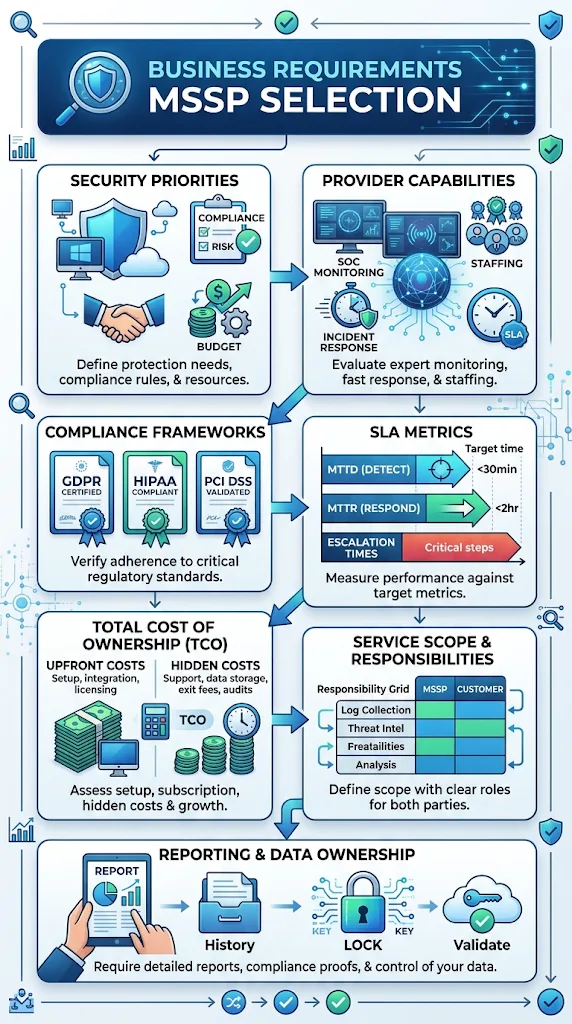
A structured evaluation checklist helps procurement and security teams compare providers against consistent business requirements mssp selection. Rather than relying on presentations or marketing claims, organizations should assess whether each MSSP can demonstrate the capabilities, resources, and service commitments needed to meet their requirements.
The evaluation should cover business alignment, service scope, compliance expertise, staffing, SOC capabilities, incident response, SLAs, infrastructure compatibility, pricing, reporting, and exit arrangements. Buyers should request supporting evidence, such as risk assessments, service agreements, audit documentation, staffing plans, incident response procedures, detailed proposals, and sample security reports. This makes it easier to identify differences between providers and verify whether their commitments are realistic.
Organizations can also assign scores from 1 to 5 to measure how well each provider meets individual requirements. A score of 1 indicates that a requirement is not met, while 5 means the provider exceeds it with demonstrated results. We recommend giving greater weight to critical priorities. For example, businesses handling sensitive customer information may prioritize compliance and data protection, while organizations with strict uptime requirements may focus on monitoring availability and incident response.
Every score should be supported by evidence rather than assumptions. Critical requirements should also have minimum acceptance thresholds so that strong performance in less important areas cannot outweigh serious security gaps.
At MSSP Security, we help MSSPs translate business needs into product evaluation criteria and audit security solutions. This provides a clearer basis for determining whether selected products support their service capabilities and operational requirements.
FAQ
What information should an organization prepare before contacting an MSSP?
Organizations should prepare an inventory of critical assets, existing security tools, infrastructure, compliance obligations, operational risks, and budget expectations. This information helps MSSPs understand the environment and propose services that match business priorities.
What is the difference between business requirements and technical requirements when choosing an MSSP?
Business requirements define the security outcomes an organization wants, such as reducing breach risks, protecting operations, and meeting compliance obligations. Technical requirements specify the capabilities needed to achieve those outcomes, including SIEM, EDR, threat detection, and system integrations.
How can an organization determine whether an MSSP’s SLA is realistic?
Review the provider’s monitoring coverage, staffing model, incident response procedures, escalation process, and historical performance evidence. SLA metrics should also define exactly how detection, response, notification, and service availability are measured.
What hidden costs should buyers look for in an MSSP proposal?
Potential additional costs include onboarding, security tool licensing, system integrations, infrastructure changes, after-hours incident response, additional asset coverage, and contract termination. Buyers should compare these expenses as part of the total cost of ownership rather than focusing only on the initial service fee.
Why should organizations establish an exit plan before signing an MSSP contract?
An exit plan helps organizations retain control of security data, system configurations, administrative access, and unresolved incident records when changing providers. It should define data transfer, access revocation, deletion procedures, and transition support to reduce disruption.
What Should Organizations Prioritize When Selecting an MSSP?
Selecting an MSSP requires clear business requirements, measurable accountability, and alignment with organizational risks. Buyers should assess service scope, compliance, staffing, SOC capabilities, incident response, SLAs, pricing, reporting, and data ownership before signing an agreement. Regular service reviews also help ensure providers continue meeting security objectives as business needs evolve.
At MSSP Security, we help MSSPs select and audit security products, optimize technology stacks, and reduce tool sprawl. With over 15 years of experience and 48K+ projects completed, we provide vendor shortlisting, PoC support, and actionable recommendations.
Explore our consulting services to improve your security technology decisions.
References
1. “Choosing the best cyber security solution for your organization – ITSM.10.023.” Canadian Centre for Cyber Security, October 3, 2022. Accessed November 13, 2026.
2. “Regulation (EU) 2016/679 of the European Parliament and of the Council (General Data Protection Regulation).” Official Journal of the European Union, May 4, 2016. Accessed November 13, 2026.