


Aligning requirements business objectives means making sure every project requirement supports a clear business goal. It gives teams a practical basis for deciding which features to build, what resources to allocate, and how to measure results. Without this connection, projects can lose focus and spend time on work that does little to support organizational priorities.
At MSSP Security, we recognize the value of connecting business needs with technical requirements from the outset. This guide covers how to define measurable objectives, prioritize requirements, and track alignment throughout delivery. Keep reading to learn how to make each project decision count.
Requirements Alignment: 3 Things to Keep in Mind
Before wrapping up, here are three practical points to remember when aligning requirements business objectives:
- Connect requirements to business goals: Give every requirement a clear purpose, an accountable owner, and measurable success criteria.
- Keep requirements on track: Use traceability, regular validation, and change impact analysis to prevent scope creep and respond to shifting priorities.
- Choose security solutions with purpose: MSSPs should assess product capabilities, integration, and security risks against operational needs to make informed decisions and reduce tool sprawl.
What Does Aligning Requirements Business Objectives Mean?
Aligning requirements business objectives means making sure every business and technical requirement supports a specific organizational goal. Each requirement should have a clear purpose and contribute to an outcome the organization can measure.
Business objectives explain why an organization undertakes a project. Business requirements describe what it needs to achieve those objectives, while solution requirements define how a system, product, or process will meet those needs.
According to the International Institute of Business Analysis (IIBA), the BABOK Guide defines a requirement as:
“A condition or capability needed by a stakeholder to solve a problem or achieve an objective.” – IIBA
This definition highlights why requirements should be based on actual stakeholder needs rather than a list of desired features.
We follow the same principle when helping MSSPs assess new security products. A product may offer a long list of features, but those features have little value if they do not address the provider’s operational needs or service goals.
The relationship between these elements follows a clear sequence:
Strategic goals → Business objectives → Business requirements → Solution requirements → Acceptance criteria → Measurable results
Consider an organization that wants to increase online sales by 15% within 12 months. After identifying checkout abandonment as a problem, the business may set a requirement to simplify the purchasing process. Functional requirements would then describe the checkout features needed to support that change.
We apply similar thinking when consulting with MSSPs on product selection and audits. Before assessing a security tool’s capabilities, we look at the problem it needs to solve, how it fits existing operations, and what results the provider expects from it.
This gives each requirement a clear business purpose. If a proposed feature or deliverable cannot be linked to an organizational need, its place in the project deserves a closer look.
Why Should Aligning Requirements Business Objectives Focus on Measurable Outcomes?
Aligning requirements business objectives helps teams ensure that project work supports measurable business outcomes. Without clear targets, organizations risk spending time and money on features that meet technical specifications but fail to address business priorities. This can lead to scope creep, budget waste, and delayed delivery.
The Project Management Institute (PMI) highlights the importance of measuring project success through the benefits it delivers:
“The success of a project is ultimately measured by the benefits it delivers (planned and/or unplanned) when its output is in use.” – PMI
We apply this principle when helping MSSPs select and audit security products. A tool’s detection capabilities, reporting features, and integrations should address specific operational needs and justify their cost.
Organizations should connect each requirement to an approved business objective, define measurable benefits, and compare expected results with actual performance. Regulatory obligations and security risks also need documented justification, even when they do not generate direct revenue.
How Can You Translate Business Objectives into Actionable Requirements?
Credit: Techcanvass
Translating business objectives into actionable requirements starts with identifying measurable goals, understanding stakeholder needs, and defining the capabilities needed to achieve them. The SMART framework helps teams set objectives that are specific, measurable, achievable, relevant, and time-bound.
Once objectives are clear, business analysts can document required capabilities, separate business requirements from functional and non-functional requirements, and review technical feasibility.
We use a similar process when helping MSSPs select and audit security products. Before assessing a tool’s features, we identify operational gaps and determine whether its capabilities address the provider’s needs. Establishing these priorities also involves defining MSSP service requirements so that product capabilities support specific service goals and operational needs. This is where aligning requirements business objectives becomes relevant: each product capability must support an identified business need.
Acceptance criteria then connect requirements with testable results. For example, a security product assessment may examine detection accuracy, endpoint visibility, integration compatibility, and incident response performance.
Each requirement should have a measurable target, an accountable business owner, and clear validation conditions. This gives stakeholders a consistent basis for prioritization, requirements verification, and evaluating whether the selected solution delivers the expected business value.
How Does a Requirements Traceability Matrix Help with Aligning Requirements and Business Objectives?
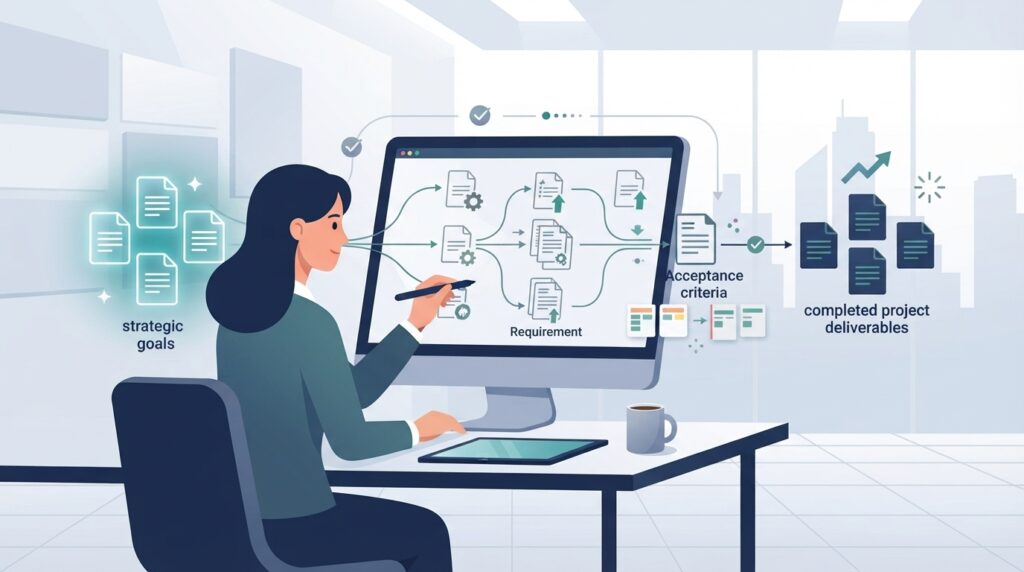
A requirements traceability matrix (RTM) connects business objectives with requirements, project deliverables, and verification activities. It helps teams understand why each requirement matters, who owns it, and how its success will be measured.
For MSSPs evaluating new security products, we use traceability to check whether proposed features address actual operational needs. This makes aligning requirements business objectives easier by ensuring that each product capability supports a documented business goal.
An effective RTM should include:
- Business objectives and expected outcomes.
- Requirement IDs and descriptions.
- Stakeholders or business owners.
- Related KPIs and success criteria.
- Acceptance criteria, test cases, and status.
Tools such as Jira, a project management platform, help teams organize tasks, track progress, and connect requirements with development and testing activities. This can also reveal gaps, duplicate requirements, and conflicting priorities.
Forward traceability links objectives to requirements and deliverables, while backward traceability checks whether each requirement has a valid business justification. We use both when auditing security products to confirm that selected capabilities meet documented needs and deliver measurable value.
How Does Requirements Prioritization Help Align Requirements with Business Objectives?
Requirements prioritization helps teams focus on work that delivers measurable business value. When aligning requirements business objectives, teams should consider business impact, implementation costs, urgency, risks, and technical dependencies rather than simply following the order of a requirements backlog.
When helping MSSPs select or audit security products, we assess whether each requested capability addresses an operational gap, reduces security risks, or supports a measurable business goal. Several frameworks can make these decisions more consistent:
| Framework | Evaluation method | Best application |
| MoSCoW | Must-have, Should-have, Could-have, Won’t-have | Defining delivery priorities |
| RICE | Reach, Impact, Confidence, Effort | Comparing competing initiatives |
| Kano | Evaluates customer satisfaction | Understanding customer expectations |
| Cost of delay | Estimates the consequences of postponement | Time-sensitive business decisions |
MoSCoW separates essential requirements from optional improvements, while RICE compares initiatives based on potential impact and required effort. These frameworks support decision-making, but should not replace business judgment.
Business representatives should own prioritization decisions, review requirements regularly, and resolve competing demands with project sponsors. We also recommend revisiting priorities throughout delivery as business goals, costs, and security risks change. This keeps approved requirements relevant to the outcomes the organization needs to achieve.
How Can You Resolve Stakeholder Conflicts When Aligning Requirements with Business Objectives?

Conflicting stakeholder requirements often arise because departments have different priorities. Finance may focus on cost reduction, while operations want better efficiency and customer service expects faster response times. Aligning requirements business objectives requires evaluating these competing demands against business value, implementation costs, urgency, and project risks.
Conflicting priorities are easier to manage when stakeholders share an understanding of business needs. Structured discussions help clarify expectations, identify gaps, and agree on priorities. Requirements gathering workshop facilitation can support this process by bringing relevant stakeholders together to discuss and document their requirements.
When helping MSSPs select or audit security products, we use stakeholder alignment to distinguish essential operational needs from individual feature preferences. A practical approach includes:
- Mapping stakeholders, responsibilities, and expectations.
- Identifying conflicting requirements and dependencies.
- Comparing proposed features against shared business goals.
- Involving business owners and project sponsors in priority decisions.
If stakeholders cannot agree, the project sponsor should make the final decision based on approved objectives.
Once resolved, teams should document decisions in a decision log. This record should include the approved requirement, decision owner, business justification, rejected alternatives, and relevant constraints. It also supports future change impact analysis and prevents unnecessary disputes.
How Do You Validate Requirements When Aligning Requirements with Business Objectives?
Requirements validation confirms that documented requirements address actual business needs. It involves stakeholder reviews, feasibility assessments, business-value analysis, and measurable acceptance criteria. Validation checks whether requirements support the intended business outcomes, while verification ensures they are clear, complete, consistent, and testable.
When aligning requirements business objectives, teams should assess each requirement against several practical criteria:
- Is it linked to an approved business objective?
- Can its expected benefit be measured?
- Has an accountable business owner approved it?
- Is it technically and operationally feasible?
- Are dependencies and constraints documented?
- Can testing verify the expected outcome?
- Does it reflect current business priorities?
For MSSPs selecting or auditing security products, we use these checks to determine whether proposed capabilities address real operational needs. We also compare expected benefits with implementation costs before approval. This helps prevent unnecessary stakeholder requests from entering the delivery backlog and ensures each approved requirement has a clear purpose, measurable value, and accountable owner.
What Causes Requirements to Drift When Aligning Requirements with Business Objectives?
Requirements drift occurs when project scope expands, stakeholder priorities change, or technical decisions become disconnected from business needs. Requirements that initially support an approved business case may lose their relevance as organizational goals and operating conditions evolve. This often happens when new requests are added without proper justification, business and technical teams misunderstand expectations, or no one takes responsibility for resolving competing priorities.
When helping MSSPs select or audit security products, we review whether proposed capabilities continue to address actual operational needs. This is essential for aligning requirements business objectives, particularly when security priorities or operational demands change.
A formal requirements change-control process helps prevent this drift. Teams should regularly review approved requirements, conduct change impact analysis before accepting modifications, update traceability links and acceptance criteria, and document approval decisions. We also recommend communicating changes to all relevant stakeholders. These steps help ensure that requirements remain relevant and continue to deliver measurable business value throughout the project.
How Can Technical Requirements Support Business Goals?
Technical requirements translate business needs into practical solution specifications. Business requirements define the desired organizational outcomes, while functional, non-functional, technical, and security requirements describe the capabilities and standards needed to achieve them.
For example, an organization aiming to reduce operational disruption may require reliable system availability, stronger access controls, and incident monitoring. Each specification should support the original business objective rather than become an isolated technical task.
When aligning requirements business objectives, teams should maintain clear links between business needs and technical decisions. When helping MSSPs select or audit security products, we assess whether product features, integrations, and security capabilities address actual operational requirements.
Business representatives should also participate in solution validation, particularly when technical limitations affect expected benefits. Keeping requirements separate from design decisions allows teams to consider different solutions without losing sight of business priorities. This helps prevent technical requirements from drifting away from the outcomes the organization expects.
What Tools Help Maintain Alignment Between Requirements and Business Objectives?
Requirements management and collaboration tools help teams document, prioritize, track, and review business requirements throughout a project. When aligning requirements business objectives, the right tools make it easier to maintain traceability and ensure that project activities support measurable outcomes.
Common tools serve different purposes:
| Tool | Primary application |
| Jira | Requirements tracking and backlog management |
| Confluence | Requirements documentation and team collaboration |
| Microsoft Excel | Creating lightweight traceability matrices |
| Requirements management platforms | Managing the requirements lifecycle centrally |
For smaller projects, spreadsheets may be enough to track requirements and ownership. Larger initiatives often need dedicated platforms with version control, approval records, change tracking, and reporting capabilities.
When helping MSSPs select or audit security products, we use documentation and tracking tools to organize product requirements, evaluation criteria, and findings. However, tools alone cannot maintain business alignment. Clear objectives, accountable business owners, and regular stakeholder communication remain essential.
How Can MSSP Security Help Align Security Requirements with Business Objectives?
MSSP Security helps managed security service providers (MSSPs) evaluate security products based on operational needs, business priorities, and measurable outcomes. Through evaluation, selection, and onboarding consulting, we help MSSPs assess potential solutions, compare product capabilities, and determine whether selected tools fit their existing operations and service goals.
Our consulting approach covers EDR, XDR, SIEM, and SOAR solutions, with assessments of detection accuracy, endpoint visibility, incident response, integration compatibility, and management requirements.
For example, reducing incident response time may require better automated threat detection, while improving endpoint visibility may involve centralized monitoring. These requirements should have measurable success criteria, such as lower mean time to respond (MTTR) or broader endpoint coverage.
By aligning requirements business objectives, we help MSSPs determine whether a product fits their existing infrastructure and service delivery model. Through security product evaluations and solution audits, MSSP Security supports better-informed decisions based on technical suitability, operational value, and long-term business needs.
What Should You Check Before Approving Business Requirements?
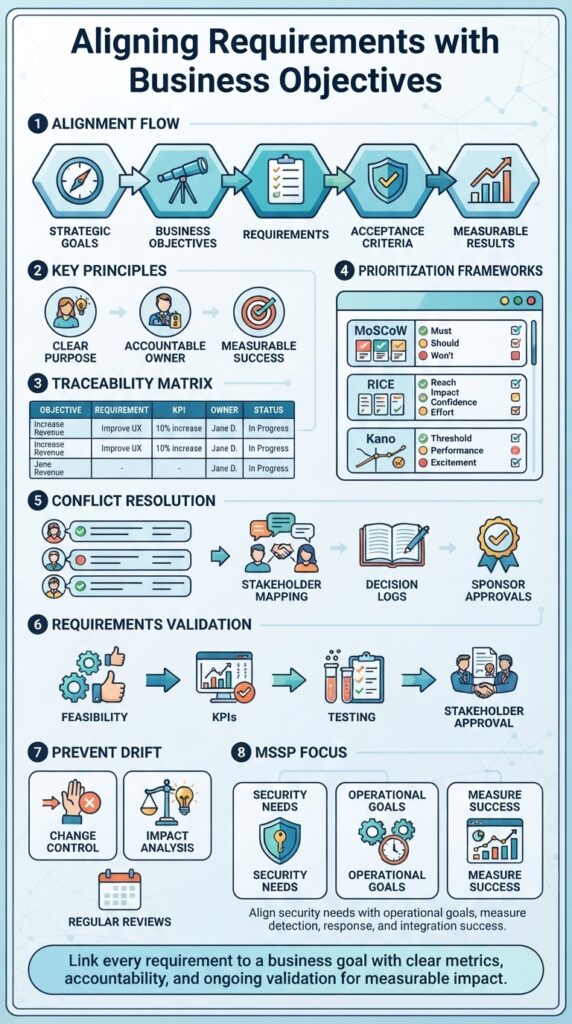
Before approving business requirements, teams should confirm that every requirement has a clear purpose, an accountable owner, measurable outcomes, and a direct connection to an approved business objective. Aligning requirements business objectives also means checking whether proposed requirements are feasible, properly prioritized, and supported by clear acceptance criteria.
When helping MSSPs evaluate security products, we examine whether each requirement addresses an actual operational need and contributes to a measurable outcome. Stakeholder approval, business value, technical feasibility, and requirements traceability all play a role in this assessment. Dependencies, assumptions, and constraints should also be documented, while any proposed changes must follow an established approval process.
We recommend reviewing requirements carefully before they enter the delivery backlog, particularly when their business value is unclear. Mandatory security, compliance, and operational requirements may need separate justification based on risk reduction or regulatory obligations. A consistent approval process helps maintain business alignment, strengthen requirements verification, and support ongoing project governance.
What Are the Most Common Questions About Aligning Requirements with Business Objectives?
What Is the Difference Between a Business Objective and a Business Requirement?
A business objective describes the outcome an organization wants to achieve, while a business requirement defines what is needed to reach that outcome. For example, increasing online sales is an objective, while simplifying checkout is a supporting requirement.
How Can Organizations Measure the Success of Requirements?
Organizations can use KPIs, measurable acceptance criteria, benefits-realization metrics, and performance data. Each requirement should have clear success indicators linked to an approved business objective.
Who Should Approve Business Requirements?
Business owners and project sponsors typically approve requirements, with input from business analysts, product owners, project managers, and relevant stakeholders. Their involvement ensures that requirements reflect organizational priorities.
What Should Teams Do with Requirements That No Longer Provide Business Value?
Teams should review, revise, deprioritize, or remove outdated requirements. However, mandatory security, compliance, and operational requirements may remain necessary when supported by valid risk or regulatory considerations.
Can One Requirement Support Multiple Business Objectives?
Yes. A single requirement can contribute to several objectives when each relationship has a clear justification. For example, automating security processes can reduce operational costs while improving incident response times.
How Can Teams Keep Requirements Focused on Business Value?
Aligning requirements business objectives requires clear business purposes, accountable owners, and measurable success criteria. A requirements traceability approach helps prevent scope creep, manage competing priorities, and connect business goals with technical requirements.
Regular validation and change impact analysis also keep requirements aligned as business needs evolve. For MSSPs, this process connects security product capabilities with operational priorities, security risks, and business needs.
MSSP Security provides vendor-neutral product selection, security tool audits, stack optimization, and PoC support to help MSSPs make informed decisions and reduce tool sprawl.
Explore MSSP Security’s consulting approach to evaluate solutions against measurable business requirements.
1. “Needs and Solutions, Requirements and Designs.” International Institute of Business Analysis (IIBA), Accessed November 23, 2026.
2. Byatt, Gareth. “Delivering project benefits–a practical plan for success.” Project Management Institute, February 24, 2010. Accessed November 23, 2026.