


Reporting communication requirements MSSP agreements define how security incidents, findings, and service performance are communicated to clients. Clear contractual terms help managed security service providers avoid late notifications, missed escalations, and disputes over responsibilities. At MSSP Security, we recognise that reporting procedures must reflect each client’s security needs and agreed service levels.
Guidance from CISA and the National Cyber Security Centre (NCSC) also supports clear responsibilities when organisations work with managed service providers. Read on to explore the reporting standards, incident notification procedures, communication protocols, and SLA requirements that MSSPs should include in their service agreements.
MSSP Reporting: What You Need to Know
Before looking at the details, here are three points worth keeping in mind:
- Set clear reporting rules: Agree on reporting schedules, required information, incident notification deadlines, and approved communication channels.
- Make incident responsibilities clear: Define escalation procedures, client approval requirements, and who handles each stage of incident response.
- Track SLA performance: Monitor MTTD, MTTR, acknowledgement times, escalation compliance, and report delivery against agreed targets.
What Should Reporting Communication Requirements MSSP Agreements Include?
Reporting communication requirements MSSP agreements should define reporting schedules, incident notifications, escalation procedures, and service-level expectations. Clear terms help both parties understand their responsibilities during routine operations and security incidents.
An effective agreement should cover:
- Reporting obligations: Set report frequency, formats, required information, and recipients.
- Incident notification: Define notification deadlines and acknowledgement times based on incident severity.
- Escalation procedures: Identify severity levels, emergency contacts, and escalation steps.
- Shared responsibilities: Clarify MSSP duties and client approval requirements.
- SLA performance: Establish measurable response, resolution, uptime, and reporting targets.
- Evidence retention: Specify how incident records and investigation histories are stored.
The Australian Cyber Security Centre (ACSC) reinforces the need to include incident notification obligations in customer agreements:
“Include cyber security incident notification clauses in your contract with your customer.” – ACSC
These requirements should reflect each client’s operational needs, service scope, and security priorities. MSSPs can establish a stronger foundation by clearly defining MSSP service requirements before agreeing on reporting obligations and service-level expectations.
This guidance also supports our recommendation to establish notification responsibilities before service delivery begins. We recommend checking whether selected security products support these requirements. In our consulting work with MSSPs, identifying reporting limitations before deployment can help avoid operational problems later.
What Should Regular MSSP Security Reports Include and How Often?
Regular MSSP security reports should present security findings, identified risks, operational performance, and recommended actions. Clear reporting communication requirements MSSP agreements help ensure clients receive relevant information, understand their security posture, and monitor service quality.
Reports should cover five key categories, each providing information that supports operational decisions and security reviews.
| Report category | Required information |
| Operational reports | Alert volumes, ticket status, confirmed incidents, response times |
| Security posture | Patch compliance, endpoint coverage, backup status, vulnerabilities |
| Threat intelligence | Emerging threats, blocked indicators, detection trends |
| Improvement reports | Alert tuning, corrective actions, prioritised recommendations |
| Executive reports | Risk exposure, security trends, service performance |
Reporting frequency should reflect the client’s risk profile and service scope. Daily or weekly updates can cover operational activity, while monthly reports can track security trends and SLA compliance. Quarterly reviews help assess changing risks and improvement priorities, whereas annual assessments provide a broader view of long-term security performance.
We also recommend tailoring report content to its recipients. Technical teams need investigation details and detection data, while executives require clear information about business impact, risk exposure, and decisions requiring approval. When helping MSSPs assess security products, we examine whether their reporting features support these reporting communication requirements and provide relevant information to both audiences.
What Incident Communication Requirements Should MSSPs Follow?
Reporting communication requirements MSSP agreements should define incident notification deadlines, escalation channels, investigation updates, and closure reports. Clear procedures help clients understand security incidents, response actions, and their responsibilities.
An effective incident communication plan should cover five stages:
- Detection: Notify designated contacts when an event reaches the agreed severity threshold.
- Investigation: Share verified findings, potential impact, and relevant evidence.
- Containment: Explain recommended actions and identify required client approvals.
- Recovery: Provide updates on response progress, outstanding risks, and recovery status.
- Closure: Deliver a final report covering the incident timeline, root cause, response actions, and remediation recommendations.
Initial notifications should include incident severity, detection time, potentially affected systems, and the expected time of the next update. Critical incidents, such as ransomware attacks, require faster escalation than low-priority findings.
We also recommend assessing whether security products support alert prioritisation, escalation workflows, and timely reporting. These features help MSSPs meet communication deadlines. Service agreements should clarify approval responsibilities for containment measures and external communications, including regulatory notifications and customer disclosures.
Which Communication Channels Support Reporting Communication Requirements for MSSPs?

Reporting communication requirements MSSP agreements should identify approved channels for incident notifications, escalation, and client updates. Each channel serves a different purpose:
- Email: Formal incident notifications, security summaries, and documented decisions.
- Ticketing systems: Investigation updates, assigned tasks, and remediation tracking.
- Customer portals: Security dashboards, historical reports, and service documentation.
- Phone or pager: Urgent incidents requiring immediate attention.
- Backup channels: Alternative contact methods during outages.
MSSPs must also maintain auditable communication records, including notification timestamps, recipients, acknowledgements, escalation attempts, and client decisions. These records support incident investigations, security reviews, and contractual accountability.
We also recommend checking whether security products provide reliable logging, access controls, and audit trails. When helping MSSPs select and audit new tools, we assess whether these features protect sensitive incident information and preserve communication histories. This helps ensure that reporting processes remain secure, traceable, and consistent with agreed service requirements.
Who Is Responsible for MSSP Reporting and Incident Escalation?

When a security incident occurs, the MSSP may identify the threat, but the client often controls the systems and business decisions needed to contain it. Reporting communication requirements MSSP agreements must therefore establish who handles monitoring, alert investigation, incident notifications, containment approval, and remediation.
The MSSP typically investigates alerts, reports incidents, and recommends response actions. Meanwhile, the client provides environment access, acknowledges notifications, approves business-critical changes, and manages applicable regulatory obligations.
A structured requirements gathering workshop can help both parties define these responsibilities, agree on escalation procedures, and clarify communication expectations before service delivery begins.
For example, if a client declines a recommendation to disable a compromised account, the provider should document the identified risk, proposed action, decision-maker, and any agreed alternative controls. This creates a clear record of the decision and its potential consequences.
When helping MSSPs select and audit security products, we also examine whether access permissions, reporting features, and audit logs support these responsibilities. Suitable tools should make security decisions traceable and help both parties remain accountable throughout incident response.
Which SLA Metrics Should MSSPs Include in Reporting?
A service may meet its monitoring obligations but still fall short of client expectations if incidents take too long to detect, acknowledge, or resolve. Reporting communication requirements MSSP agreements should therefore include measurable SLA metrics that show how well the provider delivers its services. These metrics need clear definitions, calculation methods, reporting intervals, and contractual targets.
Mean Time to Detect (MTTD), Mean Time to Respond (MTTR), and Mean Time to Resolve help measure incident handling performance. Other useful indicators include critical alert acknowledgement times, escalation compliance, and reporting compliance. Together, they give clients a clearer view of response speed and service reliability.
We recommend comparing actual results against agreed SLA targets and explaining any missed deadlines. Delays may stem from restricted system access, client approval requirements, or complex investigations. When helping MSSPs select and audit security products, we examine whether reporting and analytics features can measure these metrics consistently and accurately.
The National Cyber Security Centre reinforces the importance of measurable service expectations:
“These agreements help establish clear expectations for response times, resolution times, and overall service delivery and help you evaluate your MSP’s performance.” – National Cyber Security Centre (NCSC)
This guidance supports the use of clearly defined SLA targets when assessing MSSP performance. Ultimately, those targets should reflect the client’s environment, operational needs, and risk tolerance.
What Do Clients Expect From MSSP Reporting Communication?
Reporting communication requirements MSSP agreements should focus on useful security updates rather than large volumes of raw data. Clients want clear incident findings, risk assessments, and recommendations that explain what happened and what action is needed.
Effective reports should include incident severity, investigation results, business impact, remediation ownership, and access to technical contacts. For example, reporting 500 security alerts has little value without showing how many were investigated, escalated, or confirmed as genuine threats.
We recommend supporting routine reports with relevant threat intelligence, prioritised vulnerability findings, investigation records, and evidence of detection improvements. These details help clients assess security performance and understand changing risks.
When helping MSSPs select and audit security products, we examine whether reporting features provide useful alert context, investigation history, and detection analytics. Clients need evidence of meaningful security work, not dashboards or documents filled with activity counts.
How Should MSSPs Handle Communication Failures?
Credit: Software Engineering Institute | Carnegie Mellon University
An unanswered critical alert or a notification sent to an outdated contact can delay incident response. Reporting communication requirements MSSP agreements should explain how providers handle missed notifications, delayed responses, and unresolved client decisions, including when to escalate and which backup channels to use.
MSSPs should keep contact lists current, test communication procedures, and track unresolved security findings. Technical teams, executives, and legal contacts also need clearly assigned responsibilities.
Client decisions require proper documentation. If a client declines a remediation recommendation, the MSSP should record the identified risk, proposed action, decision-maker, and follow-up attempts. When helping MSSPs audit security products, we examine whether notification, logging, and reporting features support these requirements. Accurate records help clarify responsibilities and reduce disputes over incident communication.
What Reporting Challenges Do Multi-Tenant MSSPs Need to Address?
Multi-tenant MSSPs must maintain customer-specific reporting while managing shared security operations. Reporting communication requirements MSSP agreements should protect tenant data, preserve evidence ownership, and ensure each client receives accurate security findings.
MSSPs should separate incident records, restrict access by tenant, distinguish customer findings from internal metrics, and apply consistent retention policies. A centralised SOC can monitor several environments, but each client must only receive its authorised security information. CISA guidance also highlights access controls, incident notifications, and response planning for MSP customer relationships.
SIEM and SOAR integrations add further reporting challenges. SIEM platforms collect and correlate security events, while SOAR tools automate investigations and agreed response workflows. Ticketing systems track remediation, and reporting tools turn operational data into customer-specific updates.
When helping MSSPs select and audit security products, we assess tenant separation, access permissions, integration behaviour, and reporting controls. These checks help prevent cross-tenant data exposure and inaccurate reports.
How Can MSSPs Establish an Effective Reporting and Communication Framework?
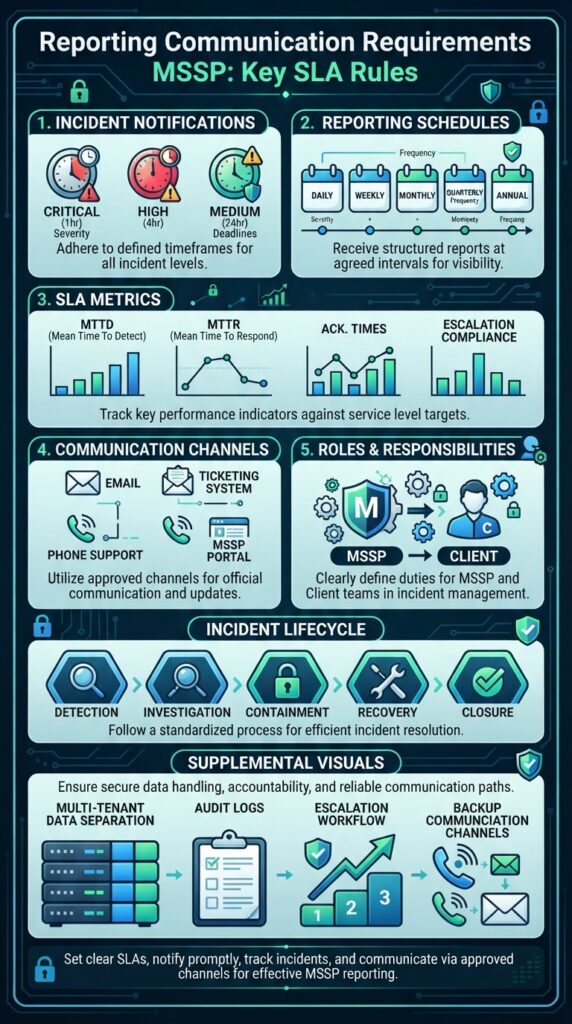
Clear reporting communication requirements MSSP agreements should be agreed upon before service delivery begins. MSSPs need to define reporting schedules, incident notification thresholds, escalation procedures, responsibilities, and measurable SLA targets to avoid confusion when security incidents occur.
The framework should also specify report formats, delivery frequency, recipients, and the information each report must contain. Incident severity levels, acknowledgement deadlines, and the responsibilities of both parties should be clear. Approved communication channels and backup contacts help ensure that important updates reach the right people. Regular reviews can then track SLA compliance, response times, and reporting quality.
During client onboarding, MSSPs should confirm technical contacts, escalation procedures, approval requirements, and communication preferences. Providing sample operational and executive reports can also help clients understand what to expect. The same requirements should guide security product selection.
Through our evaluation, selection, and onboarding consulting, we help MSSPs assess whether potential tools support reliable reporting, timely notifications, and effective client communication. We also review integration requirements and operational visibility to identify gaps before deployment.
Addressing these gaps early helps MSSPs build a technology stack that supports their reporting commitments and reduces communication issues once services are running.
FAQ
What Information Should an MSSP Include in an Initial Incident Notification?
An initial notification should include the incident severity, detection time, potentially affected systems, known impact, and the expected time of the next update. This helps clients understand the situation and prepare for any required response actions.
How Can Clients Verify Whether an MSSP Meets Its SLA Commitments?
Clients can review regular SLA reports covering Mean Time to Detect (MTTD), Mean Time to Respond (MTTR), alert acknowledgement times, escalation compliance, and report delivery. Comparing actual performance against contractual targets helps identify service gaps.
Why Should MSSPs Maintain Records of Client Communication?
Communication records provide evidence of notifications, acknowledgements, escalation attempts, and client decisions. They also help resolve disputes, support incident investigations, and establish accountability between the MSSP and its customers.
How Can Multi-Tenant MSSPs Prevent Customer Data Exposure?
Multi-tenant MSSPs should apply tenant-based access controls, separate customer incident records, and maintain individual investigation histories. SIEM and SOAR integrations must also preserve customer context to prevent unauthorised data access and inaccurate reporting.
What Should MSSPs Evaluate When Selecting Reporting Tools?
MSSPs should assess reporting accuracy, automated notifications, escalation workflows, access controls, audit logs, SIEM and SOAR integrations, and customer-specific reporting capabilities. These features help maintain secure, consistent, and measurable communication processes.
How Can MSSP Security Improve Reporting and Communication?
MSSP Security helps managed security service providers strengthen reporting communication requirements MSSP agreements through vendor-neutral product selection, auditing, and operational consulting. We assess whether security tools support monitoring, incident reporting, client communication, and reliable evidence collection.
Our services include needs analysis, vendor shortlisting, PoC support, and technology stack optimisation to reduce tool sprawl and improve integration. MSSPs should also establish clear notification deadlines, escalation contacts, customer-specific reports, measurable SLA targets, and auditable communication records.
With over 15 years of experience and 48,000+ projects completed, we provide actionable recommendations aligned with each provider’s operational needs.
Explore MSSP Security’s Consulting Services
References
- “Managed service providers: How to manage risk to customer networks.” Australian Cyber Security Centre, 21 December 2018 (last reviewed 5 April 2023). Accessed 19 November 2026.
- “Choosing a managed service provider (MSP).” National Cyber Security Centre, 24 November 2025. Accessed 19 November 2026.