

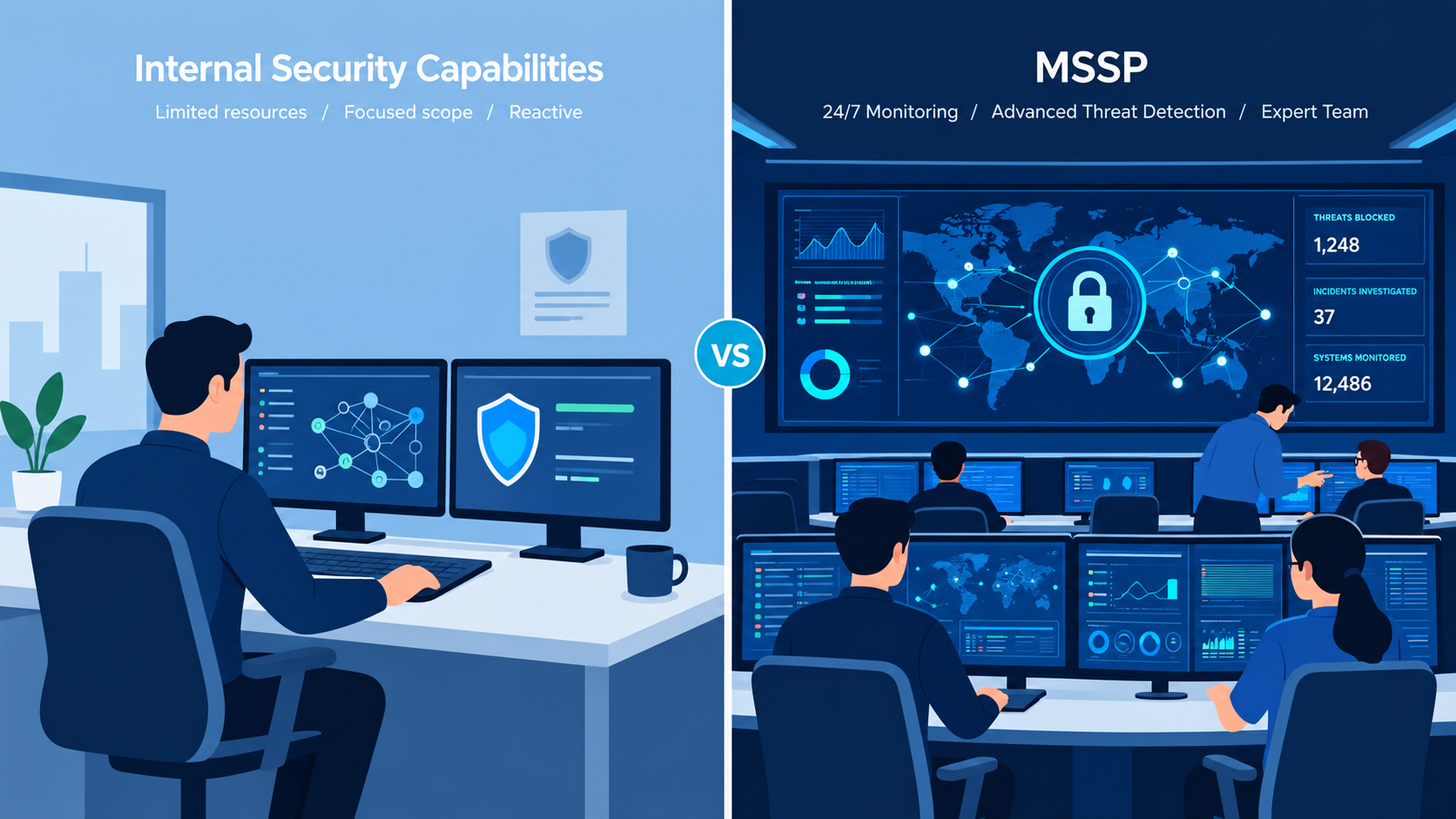
Organizations often compare in-house security teams with Managed Security Service Providers (MSSPs). In-house teams understand the business well and give you direct control. MSSPs provide 24/7 monitoring, specialized skills, and easy scaling.
At MSSP Security, we see this as a choice of operating model, not an “either-or” decision. Many organizations benefit from pairing internal knowledge with external support. The best approach depends on which tasks you need to manage directly and which ones work better with outside scale.
SOC Coverage Quick Reads
Choosing between an in-house SOC and an MSSP depends on four factors: control, expertise, scalability, and clear daily duties.
- In-house teams offer direct control and know your business well. MSSPs offer specialized skills and flexible monitoring that can easily grow.
- Running an in-house SOC 24/7 usually requires 12 to 14 full-time staff, depending on their specific tasks and roles.
- MSSP contracts must clearly define responsibilities. These include who has the authority to respond, service level agreements (SLAs), data sharing, and who fixes issues.
How Do Internal Cybersecurity Capabilities Compare With an MSSP?
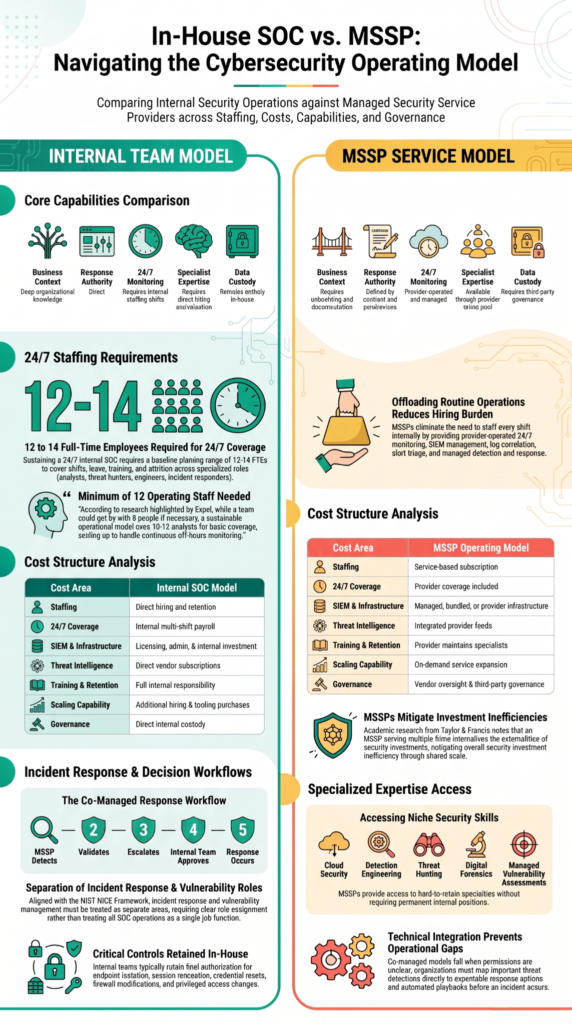
The difference is most visible in five areas:
| Capability | Internal team | MSSP |
| Business context | Deep organizational knowledge | Requires onboarding and documentation |
| Response authority | Direct | Defined by contract and permissions |
| 24/7 monitoring | Requires internal staffing | Provider-operated |
| Specialist expertise | Requires hiring and retention | Available through provider |
| Data custody | Remains in-house | Requires third-party governance |
For us, that distinction is central. A balanced approach is often most effective. An MSSP can handle repeatable security operations. Meanwhile, internal personnel can focus on business risk, governance, and critical decision-making.
Can an Internal SOC Sustain 24/7 Coverage?
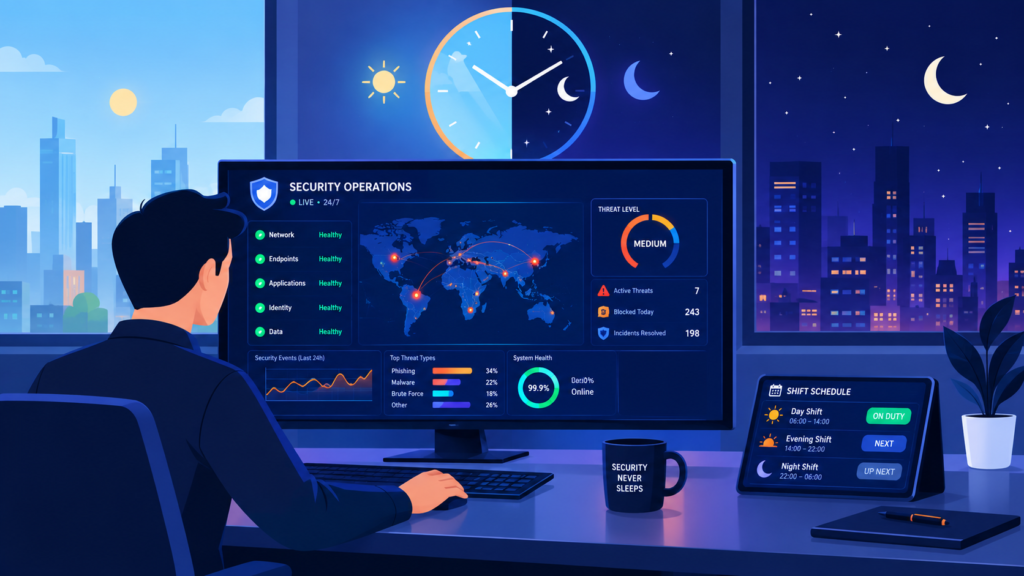
A sustainable 24/7 internal SOC requires enough personnel to cover shifts, leave, training, and attrition. You also need staff for specialist roles to ensure there are no operational gaps.
Research suggests a planning range of 12-14 full-time employees for continuous coverage. This requirement grows if you include analysts, threat hunters, engineers, incident responders, and leadership.
As highlighted by Expel
“The minimum number of people operating in a SOC is 12, though you could get by with eight if absolutely necessary. A more sustainable model uses 10-12 analysts for basic coverage.” –Expel
A small team may excel during business hours but struggle with overnight monitoring and leave. Expanding the team solves these coverage issues. However, it also increases costs for hiring, training, tooling, and retention.
Managed security services can offer a different staffing model. An MSSP provides 24/7 monitoring, log management, alert triage, and threat detection. This removes the need for an organization to staff every shift internally.
Internal experts remain necessary for tasks involving business knowledge, governance, architecture, and response authority. You do not need the same team to handle every security responsibility.
How Can an MSSP Reduce the Internal Staffing Burden?
An MSSP can take on recurring security operations so internal teams can concentrate on higher-value decisions and business-specific risk.
The service can extend across:
- 24/7 monitoring and alert triage.
- SIEM management and log correlation.
- Threat intelligence and threat hunting.
- Vulnerability scanning and vulnerability management.
- Endpoint, email, firewall, and network security.
- Managed detection and response.
- Security reporting and dashboards.
We use managed services for routine monitoring, analysis, and detection. At the same time, we keep key business decisions close to the client. This lowers the need for internal teams to hire every specialist full-time. However, outsourcing does not remove accountability. Internal leaders must still manage overall security, risk, compliance, and vendor relationships.
How Do Costs Differ Between Internal SOCs and MSSPs?
Internal SOCs carry direct staffing, infrastructure, tooling, training, and maintenance costs, while MSSPs generally shift much of that expenditure into a service-based operating model.
The broader cost structure is more useful than any single benchmark:
| Cost area | Internal SOC | MSSP |
| Staffing | Direct hiring and retention | Service-based |
| 24/7 coverage | Internal shifts | Provider coverage |
| SIEM | Licensing and administration | Managed or bundled |
| Threat intelligence | Direct subscriptions | Provider capability |
| Training | Internal responsibility | Provider maintains specialists |
| Scaling | Additional hiring and tooling | Service expansion |
| Infrastructure | Internal investment | Provider infrastructure |
| Governance | Direct custody | Vendor oversight |
Telemetry can affect either model. High-volume SIEM ingestion, storage, bandwidth, and data normalization can increase costs regardless of who operates the platform.
Our experience is that organizations sometimes compare an MSSP subscription with employee salaries while overlooking integration, telemetry, retention, and remediation requirements. A meaningful cost comparison needs to include the complete operating model.
Insights from Taylor & Francis indicate
“The MSS provider serving multiple firms can internalize the externalities of security investments and mitigate the security investment inefficiency.” –Taylor & Francis
An internal SOC can still provide value through direct control and institutional knowledge. An MSSP can provide scale without requiring the organization to build every capability internally.
Does an MSSP Have the Same Incident Response Authority?
Credits: Right of Boom
Detection and containment are distinct responsibilities. An MSSP does not automatically have permission to perform every response action.
An MSSP may identify suspicious behavior through SIEM correlation, endpoint telemetry, anomaly detection, or threat intelligence. The client may still control endpoint isolation, identity changes, firewall modifications, credential resets, or application shutdowns.
A typical workflow is:
MSSP detects → validates → escalates → internal team approves → response occurs
The contract and technical architecture should define who can perform each action.
Key response controls include:
- Endpoint isolation.
- Session revocation.
- Credential resets.
- Firewall changes.
- Privileged access controls.
- Incident containment.
- Forensics preservation.
- Threat remediation.
The NIST NICE Framework treats incident response and vulnerability management as separate areas. This highlights the need to assign clear roles instead of viewing all security operations as a single job.
Clear SLA language is essential. Metrics like time to detect, acknowledge, escalate, and contain must be measured separately.
Which Capabilities Benefit From Specialized MSSP Expertise?
MSSPs can provide specialist capabilities that may be difficult to recruit and maintain internally, including cloud security, detection engineering, threat intelligence, vulnerability management, and digital forensics.
Modern environments span cloud-native security, containers, IAM, endpoint security, network security, database security, application security, and DLP. Each area can require different knowledge and tooling.
| Capability | Internal approach | MSSP approach |
| Cloud security | Dedicated internal expertise | External specialist access |
| Threat intelligence | Internal subscriptions and analysts | Provider intelligence feeds |
| Detection engineering | Internal engineering | Provider detection team |
| Digital forensics | Dedicated capability | Specialist support |
| Vulnerability management | Internal scanning and remediation | Managed assessment |
| Threat hunting | Internal analysts | External hunting expertise |
| Incident response | Direct authority | Contract-defined support |
Our experience is that security maturity is not simply about owning more tools. An MSSP readiness assessment can help identify the expertise needed when those tools produce meaningful signals.
An MSSP can provide access to specialist functions without requiring every organization to maintain every specialty as a permanent internal position.
What Technical Gaps Can Appear in Co-Managed Security?
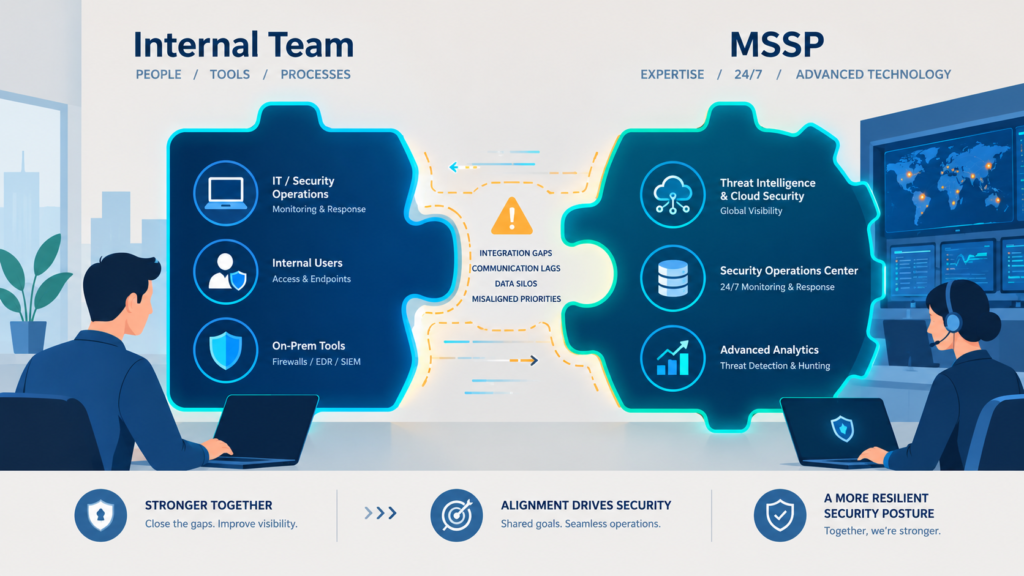
Co-managed security can stall when permissions, integrations, or remediation ownership are unclear. A security gap analysis can help identify these weaknesses.
In a co-managed environment, an MSSP can connect directly to your security tools. This includes endpoint security, identity systems, firewalls, and network controls. Each integration needs defined permissions and response actions.
For example, an MSSP may detect a compromised account but lack permission to revoke its active sessions. The internal team may have that authority but not receive the escalation quickly enough.
Organizations should define:
- Identity permissions.
- Session revocation.
- Endpoint isolation.
- API integrations.
- Cross-platform telemetry.
- Cloud application access.
- Privileged access management.
- Incident-response playbooks.
Microsoft has documented partner-led security operations that depend on delegated capabilities and integrations. The broader lesson is simple: detection must connect to an executable response.
Before an incident occurs, teams should map important detections to the actions they can trigger. That turns an alert into an operational workflow.
FAQs
What should you check when comparing an MSSP’s 24/7 monitoring and security operations center capabilities?
When selecting a partner, prioritize experienced analysts and continuous 24/7 monitoring. Ensure they provide effective alert triage, threat intelligence, and clear SLA commitments.
How can an MSSP support vulnerability management beyond basic vulnerability scanning?
To fix security weaknesses effectively, a provider should combine three steps. They should check for vulnerabilities, run penetration tests, and update system patches.
What should an MSSP provide for incident response and threat remediation?
Look for a provider that offers comprehensive managed detection and response. This should include incident containment, digital forensics, threat hunting, and security automation.
How can an MSSP support compliance, governance, and security reporting?
An MSSP can help your organization meet standards like NIST, CIS, CMMC, and HIPAA. They can also assist with governance, policy management, and compliance reporting.
Which capabilities matter when evaluating MSSP scalability and cost efficiency?
Check your security needs for the cloud, devices, and network. Also, review what you need for managing user identities and keeping costs down.
Build a Security Model That Fits Your Organization
To choose the best security model, first look at your organization’s needs and capabilities. Know your requirements before you hire outside help. Decide who will respond to incidents. Check your team’s current skills. Figure out if you need 24/7 monitoring. Finally, decide who will manage your SIEM tools.
Managed support can help address capability gaps while keeping ownership visible. Get expert MSSP guidance to optimize your security operations with needs analysis, vendor-neutral recommendations, stack optimization, and practical support tailored to your goals and operational maturity.
References
- https://www.tandfonline.com/doi/abs/10.2753/MIS0742-1222300104?src=recsys
- https://expel.com/cyberspeak/cost-to-build-and-operate-a-24×7-soc/#expels-take#1