

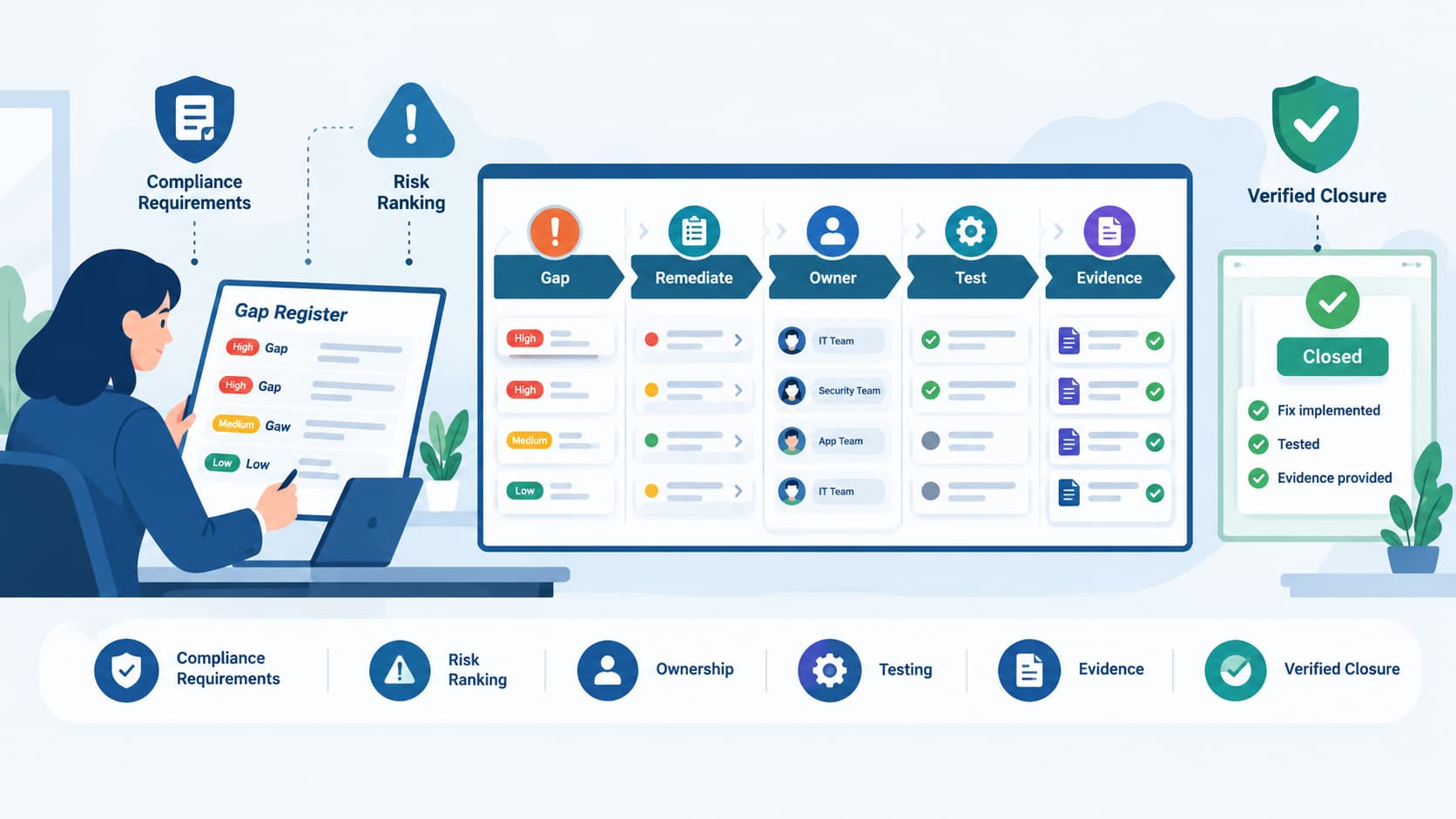
Over fifteen years of compliance audits, compliance professionals have seen teams celebrate closing tickets only to fail the actual audit weeks later. True remediation is not about checking a box. It is about proving that the fix works and remains effective over time.
The process covers scoping, risk ranking, remediation, testing, evidence collection, and tracking remaining risk. Finding a gap is often the easy part. Proving it is fixed requires testing and clear evidence another reviewer can verify.
MSSP Security applies this practical, evidence-driven approach to help organizations strengthen remediation programs and prepare for audit review. Keep reading to learn how.
Remediation Quick Wins
Effective compliance gap analysis remediation turns findings into tested fixes, clear ownership, and evidence that can stand up to audit review.
- Map and prioritize gaps: Link every finding to a specific requirement, assess its risk and business impact, then assign an accountable owner and deadline.
- Fix, test, and prove: Address the root cause, re-test the control, and collect current evidence that clearly supports closure and any remaining residual risk.
- Monitor what changes: Track overdue actions, recurring findings, evidence failures, and control drift so remediation continues after the initial audit.
What does compliance gap analysis remediation actually involve?
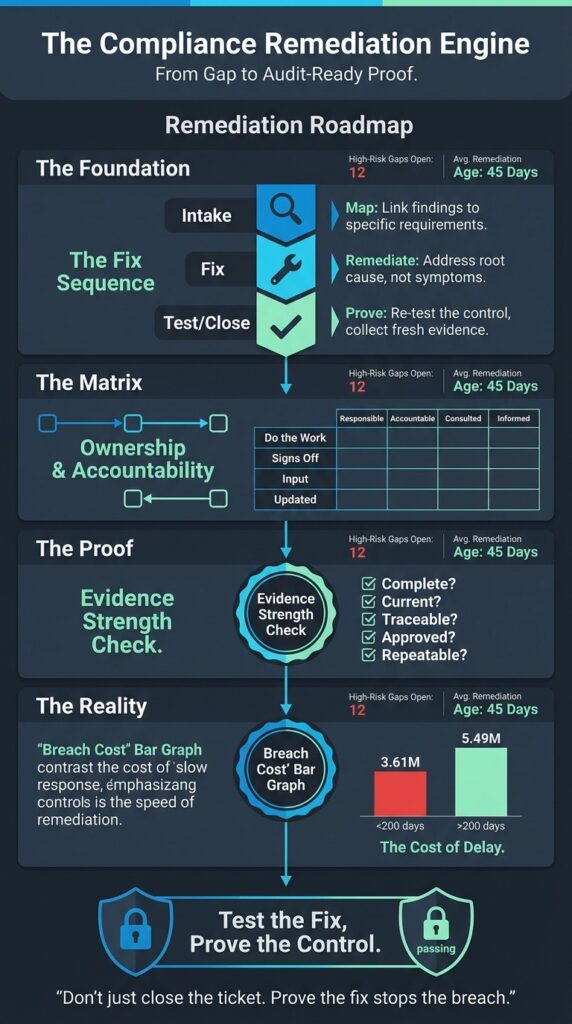
Remediation turns a gap register into corrective actions that are implemented, tested, and supported by evidence. A clear gap analysis report can help organize those findings around the affected controls, risks, and required actions.
The work starts with intake and triage. Each finding should show the affected asset, control, requirement, risk level, business impact, and current status. That gives the team a clear record to work from. From there, the team defines what needs to change.
During compliance audits, experienced auditors often separate fixes into two categories: corrective actions and preventive actions. A corrective action fixes a broken lock immediately. A preventive action addresses the underlying issue to prevent the door frame from rusting out next year.
If you only fix the broken lock without fixing the rust, the issue comes right back. Fixing only the symptom without addressing the root cause can allow the same weakness to reappear.
Ownership matters too. A named owner can deal with dependencies, request resources, update milestones, and explain delays. Without clear ownership, remediation can turn into another spreadsheet that nobody trusts.
The operating sequence is straightforward:
- Intake and triage
- Design corrective actions
- Assign owners and dates
- Implement required changes
- Test affected controls
- Collect fresh evidence
- Close or track residual risk
Research from IEEE Xplore shows:
“Their probabilistic nature conflicts with the reproducibility and deterministic evidence handling required in security audits whenever an incorrect token is statistically more plausible than the factually correct one.” – IEEE Xplore
For MSSPs, this process often connects with product selection and audit work. When we assess a new security product, we don’t stop at the vendor’s claims.
We look at whether the product supports the required control, what evidence it can produce, and whether that evidence can be checked during an audit.
That last part gets missed more often than it should. Regulatory requirements also change as systems, vendors, and business processes change.
NIST CSF 2.0 provides informative references that map to other frameworks (ISO 27001, SOC 2, PCI DSS, NIST SP 800-53/171), helping organizations align controls across multiple requirements. Our job is to help MSSPs connect those requirements to products and controls that can be tested in the real environment.
Why is “no reference, no gap” the first rule?
A gap only means something when there’s a clear requirement to compare it against. Without that benchmark, an assessment can become subjective. Identifying gaps requires a clear view of the current security posture and the regulation, framework, industry standard, contract requirement, or control baseline that applies.
Then the team can make a defensible pass, partial, or fail decision. That mapping gives each finding somewhere specific to land. The requirement connects to the policy, system, process, control owner, and evidence source.
In our product audits, this helps us separate a compliance issue from a broader security weakness. Not every security weakness is a regulatory nonconformity.
When auditing European financial clients under the EU Digital Operational Resilience Act (DORA) Article 6, the audit team verifies that the ICT risk management framework explicitly tracks critical audit findings.
If you operate in the EU financial sector, your remediation roadmap must map directly to DORA’s statutory mandates rather than generic internal guidelines.
The same mapping discipline can be used with ISO 27001, SOC 2, HIPAA, GDPR, PCI DSS, NIST CSF, CMMC, and NIS2, even though the exact requirements differ.
A defensible framework mapping process should:
- Define the applicable requirement
- Map requirements to controls and evidence
- Record pass, partial, or fail decisions
- Document the mapping criteria
- Review mappings with relevant teams
- Update mappings through change control
NIST CSF 2.0 includes informative references that help organizations connect cybersecurity outcomes with other resources and practices.
For MSSPs dealing with several compliance requirements, that can make overlapping controls easier to review. In our experience, good mapping saves work later.
A finding should point to a specific requirement, control objective, affected environment, and expected evidence. If those details aren’t clear, remediation is starting too soon.
How should a gap register become a POA&M?
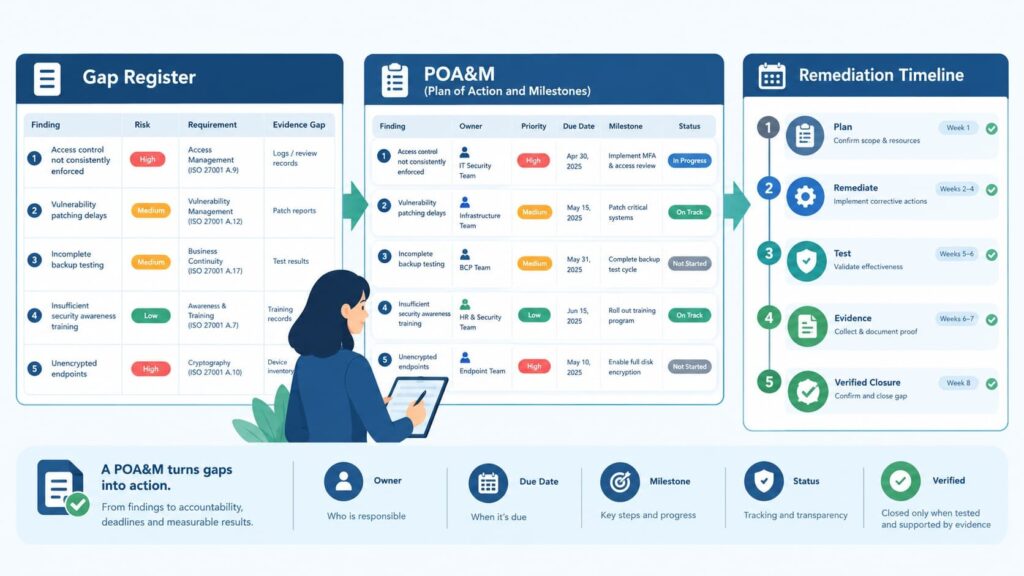
A good gap register does not just list your problems. Your compliance lead must link every finding directly to six core elements: the risk level, the accountable owner, the step-by-step fix, the due date, and the required audit proof.
A readiness assessment can also help show which findings could affect the organization’s ability to meet its target compliance state.
This operational layout turns a static list into a living Plan of Action and Milestones (POA&M). The difference is practical. A POA&M gives people something they can manage.
It can support corrective action plans, remediation roadmaps, dashboards, and management updates. We’ve found that the strongest registers also separate the symptom from the root cause. Take a missing access review.
The missing review is the symptom. The cause might be unclear ownership, a broken joiner-mover-leaver process, or an application that isn’t connected to the identity system. Fix the symptom alone, and the finding may return.
The register should capture:
- Requirement reference
- Current gap
- Root cause
- Risk or maturity score
- Remediation action
- Accountable owner
- Required effort
- Target date
- Dependencies
- Verification method
The exact fields can change based on the framework and assessment method. HIPAA, for example, puts risk analysis at the center of identifying reasonable and appropriate safeguards under its Security Rule.
That makes evidence part of the work, not something added at the end. For MSSPs, this matters during product selection too. If a new platform is meant to support a control, the team should know what the product is expected to do before the purchase or deployment.
We look for that connection early, because it’s much harder to prove value after a product is already in place. A fix isn’t finished because someone changed a setting. It’s finished when the control passes its test and the evidence supports that result.
What remediation timelines should compliance teams expect?
Fixing a compliance issue can take days, weeks, or months. A policy update may move quickly. A change that touches identity systems, legacy technology, vendors, contracts, or several internal teams can take much longer.
We’ve seen timelines stretch for reasons that have little to do with the original finding. A vendor may miss a delivery date. An old system may need a workaround.
Several teams may need to test the same change. Then, after implementation, someone still needs to verify the control and collect current evidence.
Common causes of delay include:
- Assessor availability
- Vendor delivery delays
- Legacy technology
- Cross-team dependencies
- Testing and evidence work
In practice, setting a target date without allocating a budget or engineering resources often leads to failure. When reviewing remediation roadmaps, the audit team requires security teams to establish intermediate checkpoints every two weeks.
These checkpoints help expose vendor delays and technical bottlenecks well before the final deadline approaches. For MSSPs, the same thinking applies when selecting new products.
A product may appear to solve a control gap, but deployment time, integrations, testing, and evidence collection can change the real timeline. We check those details before treating a product as the answer.
Why do gaps often hide outside the security team?
Security teams often find the problem, but they may not own the fix. Infrastructure, engineering, HR, procurement, legal, application teams, or business owners may control part of the process.
Access control is a common example. Identity governance may sit with one team, HR may control employee status, and the application owner may control permissions. The finding belongs to the control, but several people may need to act before it can close.
Data retention creates the same problem. A policy may require records to be deleted after a set period, but old applications, backups, or third-party services may not support that rule.
You cannot solve cross-department gaps by asking ‘Who owns this issue?’ Your team must assign a RACI matrix to every single control.
Clearly label who does the work (Responsible), who signs off on the fix (Accountable), who provides input (Consulted), and who gets progress updates (Informed). That gives the remediation team a clearer path.
How should third-party compliance gaps be remediated?
Vendor approval isn’t the end of compliance review. A supplier can meet requirements during onboarding and create a new risk later after a system change, subcontractor change, acquisition, configuration change, or new data use.
We’ve seen this matter when MSSPs review products that depend on third-party services. A vendor’s evidence may look good at selection time, but the question is whether the control can still be verified after deployment.
Third-party remediation should include:
- Initial control mapping
- Clear remediation tasks
- Named owners and dates
- Follow-up testing
- Regular reassessment
- Change monitoring
- Exception escalation
Whenever a third-party vendor claims that “we updated our controls,” the audit team immediately flags the ticket as incomplete.
As part of the audit process, lead auditors reject vendor self-attestations unless they include fresh system configuration exports, verified access logs, and a signed review from the vendor’s security lead.
A better record shows that updated evidence was received, reviewed, and tested against the required control. That distinction is small on paper. During an audit, it matters.
How can AI speed up remediation without becoming audit evidence?
AI can reduce manual work. It can search documents, extract requirements, flag possible gaps, draft remediation tasks, and summarize large finding sets. But its output shouldn’t become evidence by default.
We use AI as an assistant, not as the final reviewer. A qualified person still needs to decide which requirement applies, whether the proposed fix addresses the control, and whether the evidence proves the result.
AI can help with:
- Finding relevant documents
- Extracting requirements
- Flagging possible gaps
- Drafting remediation tasks
- Summarizing findings
- Updating dashboards
Human review still covers:
- Requirement applicability
- Control design
- Fix quality
- Evidence validity
- Control effectiveness
- Residual risk
This is especially relevant when an MSSP is assessing an AI-enabled security product. The product may produce useful analysis, but we also need to understand how it handles access, logging, approvals, and review.
A fast answer isn’t enough if nobody can explain how the answer was checked. Treat AI output as a draft. Then test it.
What makes evidence strong enough to close a gap?
A ticket showing that a change happened is not the same as proof that a control works. Strong evidence should show what changed, which control it supports, when it was tested, who reviewed it, and what the test found.
When my team audits compliance evidence, we test every document against five plain-English questions:
| Evidence check | Key question |
| Completeness | Did you attach every log file and system export? |
| Currency | Does this proof reflect your current system setup? |
| Traceability | Can an auditor trace this proof straight back to the regulation? |
| Approval | Did the correct manager sign off on this change? |
| Reproducibility | Can an outside reviewer run the same test and get the exact same result? |
Consider an access-control change. Changing a role may fix one setting, but testing should confirm that the right users have access and that unauthorized users do not.
The team should also retain the test result and enough supporting evidence for another reviewer to follow the same path. That’s where many closure decisions go wrong. The technical change is real, but the proof is thin.
A practical closure sequence is:
- Fix the control
- Re-test the control
- Collect current evidence
- Compare results to criteria
- Record residual risk
- Approve closure
How should teams sequence remediation?
Closing the easiest findings first can make a dashboard look better without reducing much risk. We prefer to look at risk, control dependencies, business impact, and root cause before setting the order. High-risk regulatory findings may need fast action.
Foundational controls may need attention early because other controls depend on them. Complex fixes should have milestones rather than one distant deadline. A RACI model can also help. It shows who is responsible, accountable, consulted, or informed.
That can prevent the familiar situation where everyone knows about a finding but nobody owns the next step.
Your security engineers must test every control weeks before the final audit deadline. When our teams test controls early, we catch fatal design flaws before engineers spend months building the wrong solution.
Why does continuous remediation beat point-in-time checks?
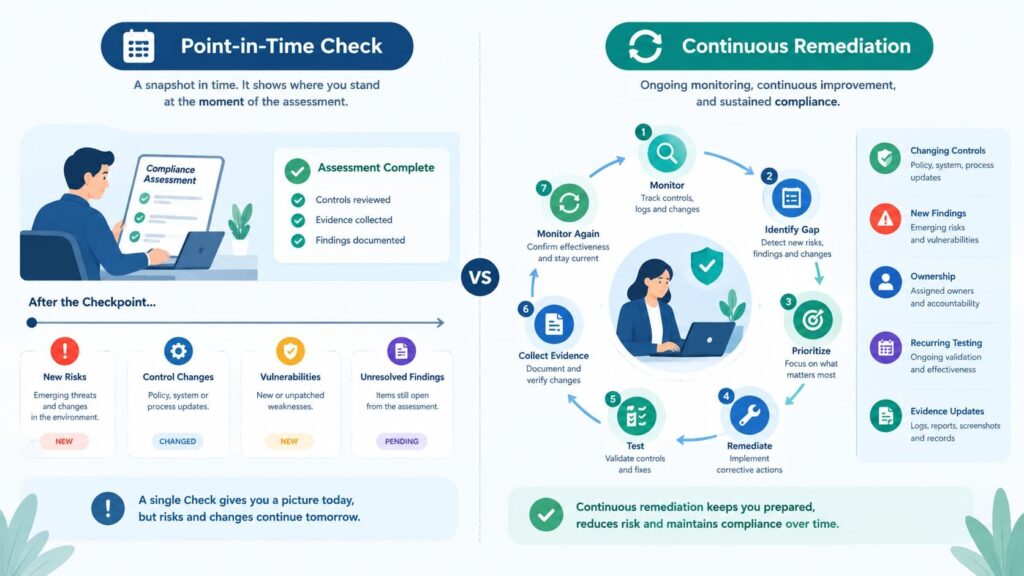
Security leaders often remind their teams that an audit report is just a single frame in a full-length movie. The day after an auditor leaves, a developer could open an unauthorized cloud port or add an unvetted administrator account, changing the organization’s risk profile almost immediately.
We build automated drift-detection alerts so our clients catch these hidden configuration changes the moment they happen. None of those changes will appear in an audit report that has already been completed.
Continuous remediation helps teams respond to these changes by using ongoing monitoring and validation rather than relying only on periodic assessments. This can include: Ongoing telemetry instead of relying only on periodic assessments.
Automated signals to identify changes that may affect controls. Fresh evidence collected as controls change or are re-tested. Faster validation when a significant change occurs. Control-drift detection so changes that could weaken compliance can be reviewed.
Continuous monitoring does not mean alerting on every small change. The useful approach is to identify changes that could affect a control and route them to the right owner.
Data from COMPYL demonstrates:
“The gap between audits is where risk lives. According to IBM’s Cost of a Data Breach Report 2025, organizations took an average of 241 days to identify and contain a breach 158 days just to find it. Breaches contained in under 200 days cost an average of $3.61M; those that ran longer cost $5.49M, a $1.88M difference driven almost entirely by how fast problems are detected.” – COMPYL
For MSSPs, this is also where product selection becomes practical. A tool that can detect control drift, preserve useful evidence, and support follow-up testing may offer more value than one that produces a strong report once a year.
How should remediation programs measure success?
Count more than closed tickets. A high closure rate can hide weak evidence, repeated findings, overdue high-risk actions, or controls that fail after implementation.
Useful measures include:
- Open versus closed gaps
- Average remediation age
- Remediation cycle time
- Overdue actions
- Residual risk
- Evidence failures
- Recurring root causes
- Third-party remediation status
- Control drift
- Re-test success
Leadership needs to see both delivery and exposure. Remediation metrics show what the team has completed. Risk indicators show what remains.
Security executives can replace basic ticket counts with six direct, risk-focused questions that provide a clearer view of remediation effectiveness.
| Compliance Metric | What Executive Leadership Must Ask |
| Remediation Age | Which high-risk gaps have remained open over the past 30 days? |
| Re-test success | Did our engineering fixes actually pass the re-test? |
| Residual risk | What security exposure remains active today? |
| Evidence failure rate | Will an outside auditor accept our proof? |
| Recurring findings | Did we fix the root cause, or just the symptom? |
| Control drift | What system settings changed since our last audit? |
That changes the discussion from “How many findings remain?” to “Which risks remain, why are they open, and what will close them?”
How can MSSP Security turn gap analysis into an ongoing remediation program?
For MSSP Security, the process starts with a practical question: can the control actually be supported, tested, and evidenced in the environment?
Our approach follows eight steps:
- Scope: Set the rules and standards that apply.
- Map: Link controls to systems, data, workflows, and evidence.
- Assess: Rate findings by risk and business impact.
- Assign: Give each action a clear owner.
- Remediate: Fix the control and its root cause.
- Verify: Test the control with current evidence.
- Monitor: Watch for meaningful control drift.
Report: Track risk, deadlines, evidence, and repeat findings. The exact process will vary by organization. ISO 27001, SOC 2, HIPAA, GDPR, PCI DSS, NIST CSF, CMMC, DORA, and NIS2 don’t ask for identical controls, so the roadmap has to follow the requirements that actually apply.
We also recommend defining “done” before remediation begins. Changing a configuration or approving a policy isn’t enough. The team needs a test, evidence of the result, an accountable owner, and a clear decision on any remaining risk.
That turns the gap register into something people can use. It can feed the POA&M, compliance dashboard, audit file, risk register, and management reporting without becoming another static document.
Strategic Guidance for Regulatory Compliance Gap Analysis
Credits: Bare Metal Cyber
Performing a comprehensive gap analysis requires evaluating your security and privacy posture against applicable legal requirements, industry standards, and regulatory frameworks.
By mapping controls to clear ownership and identifying deficiencies, organizations can prioritize actionable remediation steps based on risk.
Addressing foundational governance and documentation gaps first establishes a clear, verification-ready roadmap for long-term audit readiness.
FAQ
How does compliance mapping help identify gaps across different requirements?
Compliance mapping connects regulatory requirements, industry standards, and control objectives to the controls an organization uses. It can show where one control supports several obligations and where coverage is missing. This makes it easier to compare the current state with the target state and spot compliance gaps that need attention.
How should teams track remediation progress after a gap assessment?
A remediation roadmap can track each finding from assignment through gap closure. Teams can use a gap register or compliance dashboard to monitor owners, deadlines, status, and overdue actions. Useful compliance metrics and KPIs can show whether remediation is moving forward, while KRIs can highlight growing compliance risk.
What role does control effectiveness play in compliance gap remediation?
Control effectiveness shows whether a control works as intended in practice. A control may exist on paper but still fail during compliance testing or an audit. Reviewing control design, implementation, and test results helps teams decide whether to strengthen the control, accept the residual risk, or take further risk mitigation steps.
How can organizations maintain continuous compliance after remediation is complete?
Continuous compliance requires more than closing individual findings. Teams should use compliance monitoring, regular control testing, and evidence collection to check that controls continue to work. A compliance program can also use a maturity model, compliance baseline, and recurring assessments to track changes in the compliance posture over time.
What should compliance leaders do next?
Once a compliance gap analysis is complete, the real work is turning findings into actions that can be assigned, tracked, tested, and verified. Each gap needs an owner, deadline, and evidence showing the fix works.
Templates and AI can streamline remediation, but human review remains essential for validating risk and audit evidence.
For MSSPs, the same approach can guide security product decisions by assessing whether tools support required controls and produce audit-ready evidence.
MSSP Security’s consulting services provide vendor-neutral guidance for product selection, auditing, PoC support, and stack optimization.
References
- https://ieeexplore.ieee.org/document/11637193/similar#similar#1
- https://compyl.com/blog/how-to-monitor-controls-between-audits/