


Benchmarking security maturity level helps organizations understand how well their cybersecurity capabilities work and where gaps remain. Tools, policies, and controls may already exist, but inconsistent processes, unclear ownership, or weak governance can limit their effectiveness.
A maturity benchmark establishes a baseline, evaluates capabilities against defined criteria, and adds context through peer comparisons. In our experience, the assessment should look beyond scores and review the evidence behind findings.
This helps teams prioritize improvements based on risk, resources, and business needs. Keep reading to see how MSSP Security can help.
Security Benchmarking: What to Keep in Mind
A few practical points can make security maturity benchmarking more useful and easier to act on:
- Establish a clear baseline: Start by assessing current security capabilities across governance, controls, processes, and operations so the organization has a reliable starting point for measuring maturity.
- Benchmark with the right context: Compare maturity scores against relevant frameworks, industry expectations, or peer organizations while considering business risk, regulatory requirements, and organizational complexity.
- Prioritize gaps based on risk: Use benchmarking findings to identify the most critical maturity gaps and guide security decisions based on risk exposure, business impact, and available resources.
What Is Benchmarking Security Maturity Level?
Benchmarking security maturity level measures how well an organization develops, manages, and maintains its cybersecurity capabilities. It compares those capabilities with a maturity model, industry benchmark, baseline, or peer group. Instead of only checking whether security controls exist, it looks at how well they work in practice.
From our experience, having the right security product does not always mean having a mature security program. An organization may use a vulnerability management platform but still have gaps in areas such as:
- Risk prioritization and remediation
- Clear ownership and accountability
- Defined remediation timelines
- Verification after issues are fixed
Maturity benchmarking also differs from other security assessments. A vulnerability assessment finds weaknesses, while penetration testing checks whether they can be exploited. A compliance assessment checks whether requirements are met. Cybersecurity maturity benchmarking takes a broader view of how security technology, processes, governance, and capabilities work together.
For MSSPs, this broader view can support better product selection, security audits, and investment decisions.
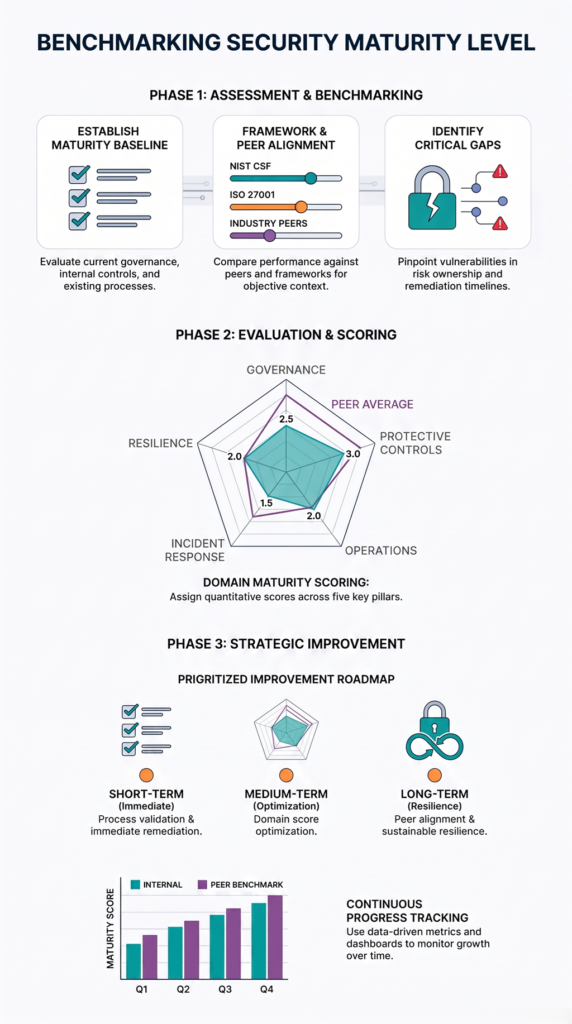
How Can You Establish a Security Maturity Baseline?

A security maturity benchmarking assessment needs a clear process for establishing a reliable baseline. Rather than counting security tools or checking whether policies exist, the assessment should show how those capabilities are actually being used and managed.
Organizations looking for a structured Security Maturity Evaluation Service California can use this type of assessment to establish a more reliable view of their current security posture.
In our work with MSSPs, we usually start by defining what needs to be assessed and what evidence will support the findings. A practical approach includes:
- Define the scope: Identify the security capabilities, systems, teams, and business areas being assessed.
- Set maturity criteria: Choose a suitable framework or maturity model and establish clear expectations for each maturity level.
- Collect evidence: Review policies, procedures, risk registers, configurations, incident records, vulnerability reports, access reviews, and other relevant records.
- Interview stakeholders: Talk with security and operational teams to understand how processes work beyond what the documentation shows.
- Assess implementation: Check whether controls and processes are consistently applied and managed.
- Score capabilities: Assign maturity levels based on consistent criteria and supporting evidence.
- Validate findings: Review the results with relevant stakeholders before finalizing the baseline.
One point we have seen repeatedly is that documentation alone does not prove maturity. A policy may look complete on paper, but if teams do not follow it, measure its performance, or review it regularly, the capability may not be as mature as it appears. We apply the same thinking when helping MSSPs audit existing products or evaluate new ones.
The result is a more realistic security maturity baseline that can support product selection, security audits, and future improvement decisions.
Which Frameworks Can Support Cybersecurity Maturity Comparison?
No single framework is the right fit for every organization. The choice usually depends on what needs to be measured, the organization’s risk profile, regulatory requirements, and how its security program is already structured.
Several frameworks can provide a useful starting point:
| Framework | Primary Focus | How It Supports Maturity Benchmarking | Best Used For |
| NIST CSF 2.0 | Cybersecurity risk management | Provides a flexible structure for assessing and communicating cybersecurity outcomes | Organizations that need a flexible approach to managing cybersecurity risk |
| ISO/IEC 27001 | Information security management | Helps assess how well an information security management system is established, maintained, and improved | Organizations that need a structured ISMS |
| CIS Controls | Prioritized security safeguards | Helps organizations assess the implementation of practical security safeguards and prioritize improvements | Organizations focused on practical and prioritized security improvements |
| CMMI-style Models | Process capability and consistency | Helps evaluate how consistently security processes are established, managed, and improved | Organizations focused on process maturity and operational consistency |
One distinction we always keep in mind is the difference between a security framework and a maturity model. Frameworks such as NIST CSF, ISO/IEC 27001, and CIS Controls provide structures, outcomes, requirements, or safeguards. They do not all provide a standard 1–5 maturity scale. An organization can build a maturity scoring method around a framework, but that scoring approach should be clearly defined rather than presented as an official framework rating.
This becomes especially relevant when we help MSSPs evaluate or audit security products. A framework may help define which capabilities matter, while the assessment method shows how consistently those capabilities are delivered. Our focus is not on using as many frameworks as possible. It is on choosing a practical basis for comparison that helps MSSPs make clearer product, audit, and security investment decisions.
How Can You Score Security Maturity Across Core Security Domains?

A cyber maturity scorecard helps organizations measure security maturity across the areas that matter most to their risk profile. We look beyond whether a control exists and consider how well it is implemented, managed, measured, tested, and supported by evidence.
A practical assessment can group security capabilities into several core areas:
- Governance and risk: Security strategy, accountability, risk management, third-party risk, and compliance.
- Protective controls: IAM, data protection, vulnerability management, security awareness, and cloud security.
- Security operations: SOC, SIEM, security monitoring, and detection capabilities.
- Incident response: Incident handling, security testing, and penetration testing.
- Resilience: Business continuity, disaster recovery, recovery testing, and lessons learned.
We also separate technical, operational, and management controls when reviewing maturity. A company may have strong endpoint protection, for example, but weak processes for reviewing alerts. Likewise, well-written security policies do not necessarily show mature practices if employees rarely follow or measure them.
The scoring method should be defined before the assessment begins so similar findings receive consistent ratings. For MSSPs, the resulting security maturity score can support product audits and selection by showing where solutions meet requirements and where capability gaps remain.
How Do You Compare Your Security Maturity Against Industry Peers?
After establishing an internal baseline, organizations can use benchmarking security maturity level to see how their capabilities compare with organizations facing similar risks. An industry security maturity benchmark can provide useful context, but the comparison only makes sense when the organizations being compared have similar conditions.
Before comparing results, we recommend normalizing factors such as:
- Company size and complexity
- Industry and regulatory exposure
- Security budget and existing investment
- Technology environment and cloud adoption
- Number of employees and critical assets
- Threat exposure and business-critical systems
These factors can make a significant difference. A financial institution and a small software company, for example, may face very different regulatory requirements, threat levels, technology environments, and resource constraints. For smaller organizations and MSSPs, a small business mssp assessment California can provide more relevant context than comparing against broad industry averages.
In our experience, peer data works best as context rather than a score to chase. When helping MSSPs evaluate security products, we look at whether a solution addresses the client’s actual risks and requirements, not simply whether it can raise a maturity score.
Maturity should be appropriate to risk, not maximized for its own sake. The goal of benchmarking security maturity level is to identify meaningful gaps and support better security, product, and investment decisions.
How Can You Identify Security Maturity Gaps From Benchmarking Results?
Once benchmarking security maturity level results are available, the next step is to understand what the gaps actually mean. A security maturity gap analysis compares the current maturity of a capability with its target state, then looks at the reason behind the difference.
For example:
- Current maturity: Level 2
- Target maturity: Level 4
- Gap: Inconsistent privileged access reviews
- Risk: Excessive privilege exposure
- Priority: High
The same approach can be applied across other security domains. An IAM gap, for instance, may come from weak identity lifecycle processes, limited authentication coverage, unclear ownership, or incomplete privileged account monitoring. The score shows the size of the gap, but the underlying finding explains what needs attention.
We have found that this distinction makes benchmarking security maturity level results much more useful. A target state security assessment should reflect business criticality, regulatory obligations, threat exposure, and potential impact rather than assuming every domain needs the highest maturity level.
For MSSPs, this analysis can also reveal whether a security product is contributing to the gap. The focus then shifts from simply raising the score to addressing the risks that matter most.
How Can You Turn a Security Maturity Benchmark Into an Improvement Roadmap?
A security maturity roadmap turns benchmarking security maturity level results into practical next steps. Instead of trying to improve every area at once, organizations can prioritize actions based on risk, business impact, available resources, and ownership.
“No more ‘one-and-done’ programs that don’t monitor security over time.” – Center for Internet Security (CIS)
The quote reflects an important part of maturity improvement: benchmarking should lead to ongoing action, not a one-time score. A practical roadmap can group initiatives into:
- Short term: Address critical control gaps, fix high-risk configurations, assign ownership, and improve key documentation.
- Medium term: Standardize security processes, strengthen monitoring and reporting, automate repetitive tasks, and improve incident response.
- Long term: Improve security architecture, connect risk and performance data, and establish continuous improvement.
We also look at whether planned investments address the gaps identified during benchmarking. Security investment benchmarking can support spending decisions, while cybersecurity ROI benchmarking can help communicate the expected value of major initiatives.
For MSSPs, these findings can guide product decisions. A gap may point to a configuration issue, process weakness, or limited product capability. Our role is to help determine whether a solution should be improved, replaced, or evaluated further rather than simply adding another tool.
How Can Organizations Track Security Maturity Progress Over Time?
Credit: Skillweed
Security maturity should not be measured once and then forgotten. After setting a baseline and improvement roadmap, organizations can use benchmarking security maturity level to track whether their capabilities are improving over time. Security maturity metrics and cybersecurity maturity indicators can provide the ongoing data needed to support this comparison.
NIST also recommends measuring progress against defined improvement goals, noting that organizations should:
“Measure and evaluate your progress in achieving specific improvement goals.” – NIST
This supports the idea that maturity tracking should focus on meaningful improvements, not just changes in scores.
One distinction we make when reviewing security programs is between performance metrics and maturity indicators. For example, 95% of critical vulnerabilities remediated within SLA is a performance metric. A maturity indicator goes further by showing whether vulnerability management has:
- Clear ownership and accountability
- Risk-based prioritization
- SLA and exception tracking
- Regular reporting and review
In our work with MSSPs, we have found that a security maturity dashboard can also help when auditing or selecting security products. It brings key measures together and shows whether a product is strengthening an underlying capability or simply producing better numbers.
Formal assessments can then be repeated periodically and compared with the original baseline. This approach supports measuring security maturity progress as cloud services, applications, vendors, and business processes change. For MSSPs, the results can also highlight where a product should be improved, replaced, or evaluated further.
How MSSP Security Can Support Benchmarking Security Maturity Level?
Organizations that want an outside perspective can work with a security assessment provider to understand their current maturity and decide which improvements should come first. For MSSPs, the same process can provide useful context when selecting or auditing security products for clients.
At MSSP Security, we focus on making maturity benchmarking useful beyond the final score. Our approach considers the evidence behind each finding, how capabilities align with relevant frameworks, and whether identified gaps create meaningful risk.
In our experience, the most useful maturity assessments are the ones that can explain the reason behind each score and connect that finding to a practical security decision. This means looking at:
- Evidence-based assessment: Supporting maturity ratings with relevant documentation, processes, and operational evidence.
- Framework alignment: Comparing capabilities against frameworks that fit the organization’s needs.
- Risk-based prioritization: Focusing improvement efforts on gaps that could have the greatest impact.
- Gap analysis: Identifying what separates the current state from the desired maturity level.
- Actionable roadmap: Turning findings into practical improvements with clear priorities.
- Ongoing measurement: Using relevant indicators to track whether improvements are working.
The value of benchmarking security maturity level ultimately depends on how the results are used. A score shows where an organization stands, but a useful assessment should also explain why it reached that position and what decision should come next. For MSSPs, this can make benchmarking a practical input for product selection, product audits, and broader security improvement decisions.
FAQ
What Is the Difference Between Security Maturity and Security Compliance?
Security maturity measures how consistently and effectively an organization manages its security capabilities, processes, and controls. Compliance focuses on whether the organization meets specific regulatory or standard-based requirements. An organization can be compliant while still having gaps in how consistently its security program operates.
How Is a Security Maturity Score Calculated?
A security maturity score is usually based on predefined criteria covering areas such as control implementation, process consistency, governance, measurement, and continuous improvement. Each domain can be assessed against defined maturity levels, with the results combined into an overall security maturity score.
Can an Organization Benchmark Security Maturity Without Using a Single Framework?
Yes. Benchmarking security maturity level does not require one specific framework. Organizations can combine relevant frameworks, internal requirements, industry benchmarks, and risk considerations to create an assessment approach that fits their environment. The scoring criteria should be clearly defined so results remain consistent.
What Should an Organization Do After Identifying a Maturity Gap?
The organization should determine why the gap exists, assess the associated risk, and decide what action is appropriate. This may involve improving a process, strengthening a control, changing a configuration, or reviewing whether an existing security product meets the organization’s needs. A prioritized roadmap can then guide implementation.
How Often Should Security Maturity Be Reassessed?
The frequency depends on the organization’s risk profile, regulatory requirements, and rate of change. A formal assessment can be performed periodically, while security maturity metrics and cybersecurity maturity indicators can be monitored throughout the year to track progress between assessments.
How Can Benchmarking Security Maturity Level Support Better Security Decisions?
Benchmarking security maturity level helps organizations understand their current cybersecurity capabilities, identify meaningful gaps, and focus improvement where it matters most. A strong security maturity baseline provides context for making decisions based on risk rather than simply chasing a higher score. The goal is to build capabilities that fit business needs and continue improving as risks change.
For MSSPs seeking support with product selection, product auditing, or stack optimization, MSSP Security’s consulting services can help turn assessment findings into practical technology decisions.
References
- https://www.cisecurity.org/insights/blog/assessing-risk-and-security-posture-with-cis-controls-tools
- https://www.nist.gov/blogs/blogrige/be-ready-what-leaders-can-do-protect-organizations-against-cyberattacks