

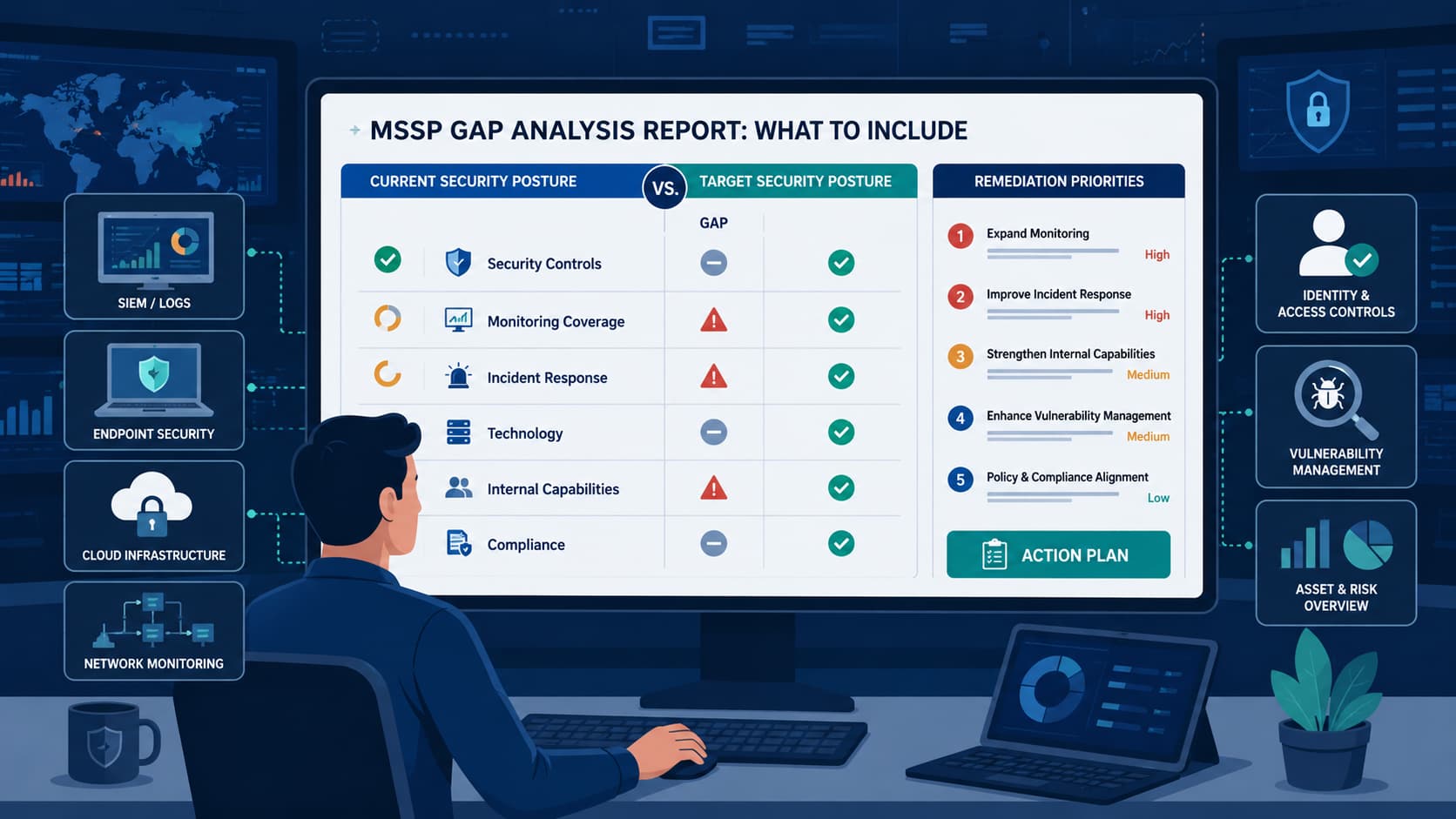
Signing an MSSP contract without a thorough gap analysis can waste six figures on duplicate security coverage. A proper gap report does more than identify missing tools.
It exposes operational gaps across staff, workflows, and technology before an expensive contract is signed. Controls also need to work in daily operations, so the review should examine how security tasks are performed, tracked, and tested.
A well-structured report can help teams reduce risk, prepare for compliance, compare MSSP options, and plan security spending. MSSP Security can help organizations turn these findings into practical priorities. Read on to learn how to build and use one.
MSSP Gap Analysis: 3 Priorities That Matter
A strong MSSP gap analysis report helps organizations understand their security weaknesses, prioritize the right fixes, and make better decisions about internal and managed security capabilities.
- Identify and validate security gaps. Compare the current security state with the target state using evidence from systems, logs, policies, access records, processes, and testing. Look across people, processes, technology, governance, compliance, and operations.
- Prioritize gaps based on risk and impact. Rank findings by business impact, exploitability, compliance needs, dependencies, and remediation effort. Critical issues should receive faster attention, while lower-risk findings can be tracked through planned improvement cycles.
- Turn findings into measurable actions. Assign every major gap an owner, deadline, remediation step, dependency, and validation method. Use the results to assess whether an MSSP can address capability gaps and support the organization’s security goals.
What an MSSP Gap Analysis Report Should Deliver?
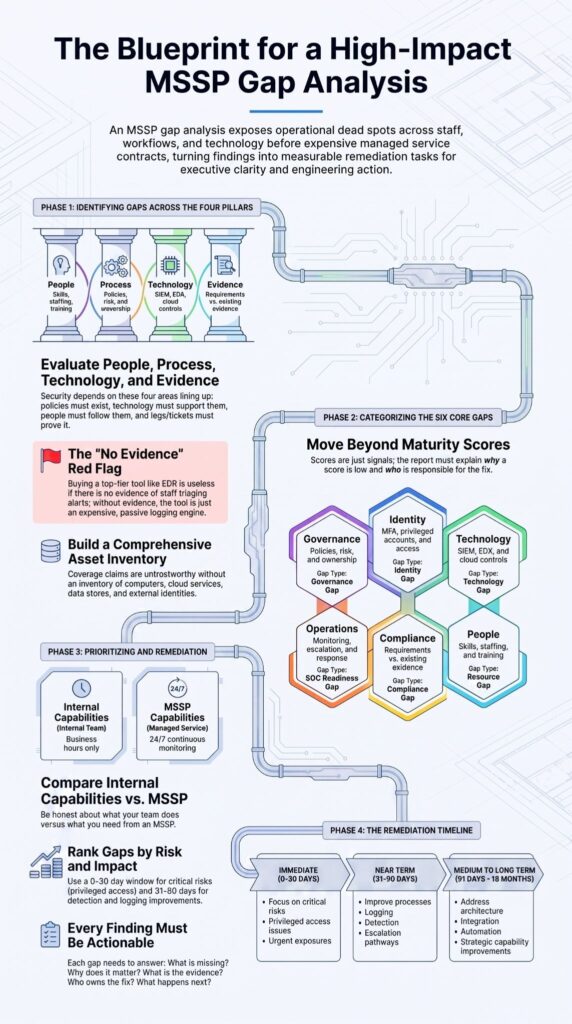
A useful MSSP security gap analysis report should show the difference between where security is now and where it needs to be. But it shouldn’t stop with a list of missing controls. Each finding needs evidence, a risk level, an owner, and a clear action.
NIST Cybersecurity Framework 2.0 can help with this. Its Profiles let organizations compare a current state with a target state. That makes the framework useful for checking whether an MSSP service can support the controls and outcomes the business expects.
Across the 80+ MSSP gap audits led by the team, two recurring problems appear in reports: they either overwhelm executive stakeholders with low-level SIEM telemetry noise or provide advice so vague that security engineering teams cannot turn it into a single actionable Jira ticket.
Neither approach delivers meaningful value. Every finding should answer a few basic questions:
- What’s missing?
- Why does it matter?
- What proves the gap exists?
- Who owns the fix?
- What needs to happen next?
For example, stating that “IAM needs improvement” is not enough. A proper review examines privileged accounts, MFA, authorization, account provisioning and removal, service accounts, and access reviews, then links each finding to supporting evidence.
That level of detail also helps when an organization is comparing MSSPs or security products. If a provider claims its service can cover a control, the report gives the team something concrete to test against.
How Do You Identify Security Program Gaps and Weaknesses?
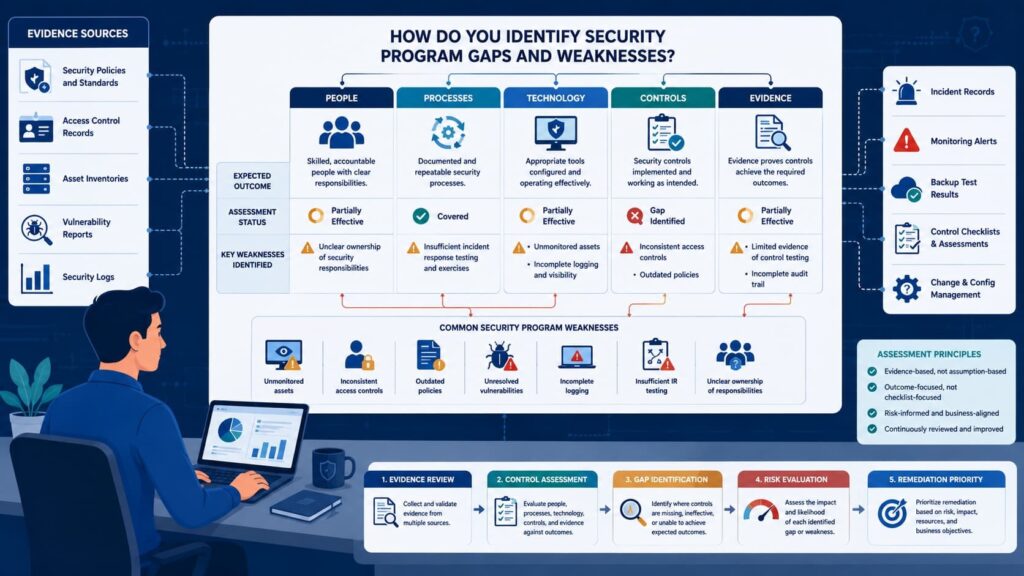
Security program gaps don’t always sit in obvious places. A company may have a policy for incident response, for example, but that policy means little if nobody knows where the current copy is or the team has never practiced it.
So the review needs to test both written controls and real-world use. A practical assessment normally checks governance, risk management, asset tracking, identity and access, vulnerability management, logging, detection, incident response, and recovery.
NIST CSF 2.0 groups these areas under Govern, Identify, Protect, Detect, Respond, and Recover. The framework gives teams a useful map. But it doesn’t mean every company should look identical.
Security usually depends on three things lining up: the policy says what should happen, the technology supports it, and there’s evidence that people follow the process. That last part causes plenty of trouble.
Look at these four areas:
- People: skills, staffing, training, ownership
- Process: steps, approvals, escalation, reviews
- Technology: SIEM, EDR, IAM, network and cloud controls
- Evidence: logs, tickets, reports, tests, approvals
No evidence? Big problem.
An MSSP should assess whether these areas work together effectively. In enterprise SOC audits, organizations have repeatedly been found to invest in top-tier EDR platforms while allowing alerts to accumulate without timely review.
Buying an enterprise tool doesn’t close a gap if your internal team lacks the bandwidth to triage alerts at 2 AM, that tool is just an expensive, passive logging engine.
How Does a Security Gap Analysis Consulting Service Work?
A security gap analysis consulting engagement usually begins by defining the scope. The team needs to know which systems, business processes, regulations, security goals, and maturity targets are part of the review. Business needs should come first.
A hospital may put more weight on patient data and system availability. A software company may care more about cloud security, developer access, and source code. Then comes evidence collection.
This can include architecture diagrams, asset inventories, policies, procedures, vulnerability reports, access reviews, security configurations, incident records, and monitoring data. Interviews are useful too, because they can reveal a mismatch between what a policy says and what staff do.
A scoring model can stay short and clear:
| Area | What to check | Gap |
| Governance | Policies, risk, ownership | Governance gap |
| Identity | MFA, access, privileged accounts | Identity gap |
| Technology | SIEM, EDR, cloud controls | Technology gap |
| Operations | Monitoring, escalation, response | SOC readiness gap |
| Compliance | Controls and evidence | Compliance gap |
| People | Skills, staffing, training | Resource gap |
The score itself isn’t the answer. It’s a signal. If a control receives a low score, the report should explain why. It should also state what needs to change and who should handle it.
Most people mess this up by treating maturity scores as the final product. They’re not. The useful part is what happens after the score.
How Do You Identify Gaps in the Current Security Posture?
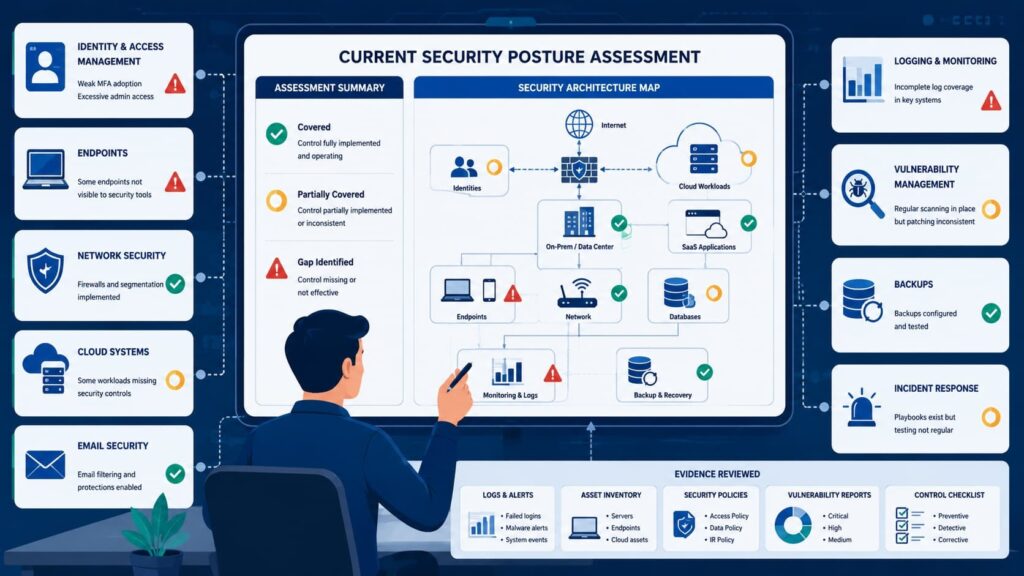
You can’t find every security gap by reading documents. The review needs evidence from system configurations, processes, access records, logs, and day-to-day operations.
A structured approach to identifying gaps in the current security posture helps teams assess whether security controls work as intended. First, build an inventory of important assets.
That can include computers, servers, user accounts, applications, cloud services, data stores, network connections, security tools, and external services. Without that inventory, coverage claims are hard to trust.
During real-world assessments, the team routinely finds organizations locking down corporate laptops with tight controls while leaving critical cloud workloads and contractor access accounts completely unmonitored.
CISA’s Cybersecurity Performance Goals provide another useful reference. They focus on practical steps that organizations can take to lower common cyber risks. They can help teams decide which gaps need attention first.
But risk isn’t equal across every asset. A weakness in a privileged identity system deserves more attention than a minor documentation issue on a low-risk system.
The report should also show how gaps connect. For example, poor asset tracking can make vulnerability management harder.
Weak logging can slow incident response. Poor identity controls can increase the damage caused by a compromised device. So don’t treat every finding as an isolated problem.
What Should an MSSP Readiness Assessment Report Measure?
An MSSP readiness assessment report checks whether an organization can support a managed security service before onboarding begins.
That means looking beyond whether the company has bought the right tools. The MSSP needs usable logs, clear escalation paths, named contacts, known assets, agreed priorities, and a shared understanding of what the service covers.
A readiness review can examine:
- Log source coverage
- SIEM configuration
- Detection quality
- Endpoint and network data
- Identity visibility
- Incident response
- Escalation paths
- Service-level agreements
- Reporting needs
- Internal ownership
Then ask practical questions.
- Are the important systems sending useful logs?
- Do alerts reach the right people?
- Does everyone agree on alert severity?
- Can someone respond to a serious event outside normal business hours?
Get those answers early. Aligning with CISA’s Cross-Sector Cybersecurity Performance Goals (CPGs 2.T and 2.U), we mandate that clients implement write-once-read-many (WORM) log retention and establish explicit, named escalation pathways before offloading monitoring responsibilities to a third-party MSSP.
So logging isn’t only about connecting another source to a SIEM. The organization needs to know what data matters, how long it should be kept, and who will use it. An MSSP readiness report should make these gaps visible before service activation.
That can prevent an awkward situation where the provider is ready to monitor, but the customer can’t supply the data needed to monitor properly.
How Does Compliance Gap Analysis Support Remediation?
Compliance gap analysis compares current controls and evidence with the requirements an organization needs to meet.
As highlighted by He, Y., Xin, T., & Luo, C.:
“However, these economic-driven models heavily rely on financial indicators, simplify technical complexity, and ignore non-economic factors, such as compliance and reputation risks. It may lead to investment decisions being out of touch with actual risk scenarios ” – Springer
That sounds straightforward. But compliance gaps can take different forms, and each one needs a different fix.
A useful report can place findings into three groups:
- Control doesn’t exist
- Control exists, but isn’t consistent
- Control works, but lacks evidence
That distinction matters during an audit. A company may have MFA enabled, for example, but have no evidence showing that all privileged accounts use it. Another organization may have an incident response plan but no record of testing it.
Frameworks and standards such as NIST, ISO 27001, SOC 2, and CMMC can help define the requirements. The exact rules depend on the organization and its industry.
Each compliance finding should record:
- Related requirement
- Current control state
- Evidence reviewed
- Gap description
- Risk impact
- Control owner
- Remediation action
- Target date
- Validation evidence
This gives teams a way to track progress without turning the audit into a last-minute rush. Still, compliance shouldn’t be treated as the full security picture. A weakness can create real risk even when no specific compliance requirement mentions it.
How Should Technology Gap Analysis Examine Security Tools?
More tools don’t automatically mean better security. What matters is whether the tools cover important systems, produce useful data, work together, and help people respond to threats.
The review should look at existing technology such as SIEM, endpoint detection, vulnerability scanners, firewalls, identity platforms, cloud security controls, email protection, and data security tools.
A structured technology gap analysis of security tools can help identify weaknesses in coverage, configuration, integration, and operational use. Then test the coverage.
A SIEM may collect millions of events while missing logs from an important server. Endpoint protection may cover laptops but not critical workloads. A vulnerability scanner may report a weakness without confirming whether it has been fixed.
A technology gap review should ask:
- Which assets have coverage?
- Are tools configured correctly?
- Do systems share useful data?
- Are alerts accurate?
- Can analysts investigate events?
- What responses can be automated?
Shadow AI adds another concern. Organizations need to know which unauthorized AI tools are being used, what data they can access, and who is responsible for them. Activity should also be logged where appropriate.
Identity needs the same level of attention. The review should include employee accounts, service accounts, API keys, automation identities, AI agents, privileged accounts, and secrets. Every important identity needs an owner and a valid business reason.
Access should match that need, and accounts should be removed when they’re no longer required.
How Should an MSSP Compare With Internal Capabilities?
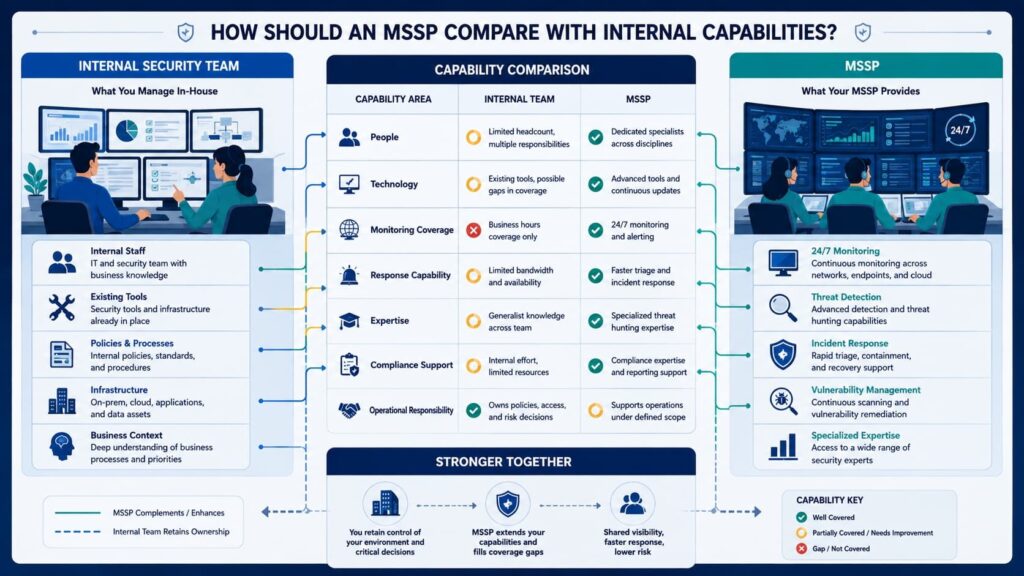
Before signing an MSSP retainer, be brutally honest about what your team actually does every day versus what you hope an external provider will take off your plate. The point isn’t to prove that outsourcing is better.
It’s to find operational gaps before a sourcing decision gets made. For example, an internal team that works during business hours has a different model from an MSSP that offers continuous monitoring.
A structured comparison of internal capabilities with an MSSP can help identify where internal resources fall short of the service level the organization expects. Incident response also needs the right skills.
Detection engineering, threat hunting, forensics, malware analysis, cloud investigations, and incident coordination aren’t the same job. An internal capability review should compare each security function with the level of service expected from an MSSP.
Focus on:
- Monitoring: business-hours coverage vs. continuous monitoring
- Detection: existing rules vs. continuously tuned detection
- Threat hunting: periodic internal activity vs. a defined managed service
- Incident response: internal escalation vs. managed response support
- Reporting: manual reporting vs. scheduled service reporting
- Staffing: fixed internal capacity vs. scalable specialist resources
The comparison can then show whether each capability should be built internally, outsourced, or shared between the organization and MSSP. This gives leadership a clearer choice: build, buy, or combine capabilities.
MSSP security may make sense when the organization can’t support continuous monitoring or specialist response skills in-house. But the gap analysis should come first.
Otherwise, the company risks buying a service before it knows what problem it needs to solve. That’s backwards.
How Can Organizations Prioritize Security Investment Gaps?
Not every security investment gap needs the same response time. . Trying to fix everything together can spread people and money too thin. A better approach ranks findings based on risk, business impact, compliance needs, effort, and dependencies.
A privileged identity problem, for example, may need action before a minor documentation issue. The report can use a basic rating: Priority Recommended timeframe
| Priority | Recommended timeframe | Typical focus |
| Critical | 0–30 days | Critical risks, privileged access, active exposure |
| High | 31–90 days | Detection, logging, process weaknesses |
| Medium | Next review cycle | Planned security improvements |
| Low | Track or improve | Documentation and lower-risk issues |
Risk scoring can help during budget discussions. But scores should support judgment, not replace it.
Dependencies matter too. MFA deployment may depend on having a complete identity inventory. Better SIEM detection may depend on collecting missing logs.
Incident response improvements may depend on naming the right people first. So the priority list should show what needs to happen first.
How Does Vulnerability Assessment Fit Into Gap Analysis?
A vulnerability assessment gives you findings. It doesn’t always tell you why those findings keep returning. Take an unpatched server.
The technical issue is clear. But the real gap could be poor asset tracking, unclear ownership, weak patch processes, maintenance constraints, or an exception that was never reviewed.
That’s why vulnerability analysis should connect technical findings with the controls behind them.
Check whether:
- Asset records are accurate
- Important systems are scanned
- Findings are validated
- Patches meet target times
- Exceptions are documented
- Owners are assigned
- Fixes are verified
- Known exploited flaws get priority
CISA recommends giving attention to vulnerabilities that attackers are known to exploit. That helps teams focus on exposure instead of treating every scanner result as equal.
And don’t trust the raw count. An organization with 10,000 findings may have less practical exposure than one with 100 flaws on internet-facing servers or privileged systems. The number matters less than where the weaknesses sit and how easily they can be exploited.
How Should a Remediation Plan Be Developed From Gap Findings?
A remediation plan turns findings into assigned work. Each major issue should have an owner, deadline, dependency, and validation method. Work can then be split into phases so urgent risks get attention without pushing every other project aside.
A practical remediation plan can be organized into four phases:
- Immediate: 0–30 days: Address critical risks, privileged access issues, and urgent exposure.
- Near term: 31–90 days: Improve processes, logging, detection, and escalation.
- Medium term: 91–180 days: Address architecture, integration, and automation improvements.
- Longer term: 6–18 months: Complete strategic security changes and larger capability improvements.
Every task should answer five questions:
- What will change?
- Who owns it?
- When is it due?
- What must happen first?
- What proves it’s fixed?
As noted by Cybersecurity and Infrastructure Security Agency (CISA):
“Organizations have, maintain, update, and regularly drill IT and OT cybersecurity incident response plans for both common and organizationally-specific threat scenarios and TTPs. When conducted, tests or drills are as realistic as feasible. IR plans are drilled at least annually, and are updated within a risk-informed time frame following the lessons learned portion of any exercise or drill.” – CISA
The proof matters. MFA remediation might mean all privileged accounts are covered. Logging work might require agreed systems to send and retain data. Incident response work could include a tabletop exercise.
Without validation, a closed ticket doesn’t prove a closed gap. Zero Trust also needs this kind of planning. Buying a product won’t create a Zero Trust program by itself.
Organizations need to improve identity, privileged access, segmentation, monitoring, application controls, and data protection in a sensible order. The order depends on the environment.
But identity often needs attention early because access decisions depend on knowing who and what is connecting to systems.
How Should Gap Analysis Findings Be Presented to Management?
Executives don’t need every technical detail in the main presentation of gap analysis findings. They need to know where security stands, which gaps matter most, what those gaps could mean for the business, and what decisions are needed.
Keep the main message focused:
- Biggest security gaps
- Business impact
- Fix priorities
- Required resources
Then use technical evidence to support those points. Management can also track a small set of measures, such as overdue critical findings, privileged accounts with MFA, important log coverage, time to detect, time to fix, and closed remediation items.
That gives leaders a way to see whether the security program is moving. The report should also connect findings to funding and ownership. A recommendation without an owner usually becomes another item on a long list.
FAQ
How often should an MSSP gap analysis report be updated?
An MSSP gap analysis report should be updated when major systems, business operations, security risks, or regulatory requirements change. An annual review provides a useful baseline, while significant incidents or major infrastructure changes may require an earlier security posture assessment. Regular reviews also help track security maturity gaps and support better security investment prioritization.
What should a company do after identifying security program gaps?
A company should rank each finding based on its business impact, likelihood, and urgency. The security team can then assign responsible owners, deadlines, and measurable outcomes through remediation plan development. This approach turns security program gaps into specific actions. Teams should also track unresolved findings and reassess them when the organization’s risks or operating environment change.
How can an MSSP gap analysis support security budget decisions?
An MSSP gap analysis can connect security weaknesses to specific business risks and operational needs. Security investment prioritization can then direct funding toward the most important gaps instead of simply adding more security tools or services. A resource gap assessment can also show whether the organization needs additional technology, personnel, expertise, processes, or external security support.
What questions should leaders ask about MSSP service gaps?
Leaders should ask which MSSP service gaps could affect security monitoring, threat detection, incident response, reporting, or coverage. They should also compare existing capabilities with an MSSP capability benchmark and conduct an internal capability comparison. These questions can help determine whether additional managed security support would address important operational weaknesses and improve security outcomes.
How does an MSSP gap analysis help prepare for future security needs?
An MSSP gap analysis can identify security maturity gaps before they create larger operational problems. Reviewing technology, processes, people, and governance can show where current capabilities may not support future business requirements. A technology gap assessment, skills gap analysis, and governance gap analysis can help organizations plan security improvements based on actual needs and risks.
How Can an MSSP Gap Analysis Report Improve Security Decisions?
An MSSP gap analysis report shows where security is falling short and what needs attention first. By connecting weak controls with evidence, risk, ownership, and remediation steps, it helps security teams, leaders, and operations teams make better decisions.
The findings can also define the monitoring, detection, response, and specialist services your organization actually needs. This lets you evaluate MSSPs against clear requirements rather than broad claims.
Need help turning security gaps into practical MSSP requirements? MSSP Security’s consulting services provides vendor-neutral guidance on needs analysis, vendor selection, PoC support, and security stack optimization.
References
- https://link.springer.com/article/10.1007/s10796-025-10625-y?utm_source=researchgate.net&utm_medium=article#1
- https://www.cisa.gov/news-events/news/cisa-unveils-enhanced-cross-sector-cybersecurity-performance-goals
Related Articles
- msspsecurity.com/security-gap-analysis-report-service/
- https://msspsecurity.com/evaluation-selection-and-onboarding-consulting/
- msspsecurity.com/identifying-security-program-gaps-weaknesses/
- msspsecurity.com/security-gap-analysis-consulting-service/
- msspsecurity.com/identifying-gaps-current-security-posture/
- msspsecurity.com/mssp-readiness-assessment-report/
- msspsecurity.com/compliance-gap-analysis-remediation/
- msspsecurity.com/technology-gap-analysis-security-tools
- msspsecurity.com/comparing-internal-capabilities-mssp/
- msspsecurity.com/prioritizing-security-investment-gaps/
- msspsecurity.com/vulnerability-assessment-gap-analysis/
- msspsecurity.com/developing-remediation-plan-gaps/
- msspsecurity.com/presenting-gap-analysis-findings-management/