


A NIST CSF maturity assessment tool helps organizations measure how well cybersecurity practices support desired security outcomes. Rather than checking whether controls exist, it examines how consistently they are implemented, supported by evidence, and maintained.
We use this approach to identify weaknesses and prioritize findings based on risk and business needs. It also helps teams compare current and target profiles before planning remediation. In the sections below, we explain the assessment process, key evaluation areas, and scoring approach. Keep reading to see how MSSP Security can support your assessment.
NIST CSF Maturity Assessment: What to Know
Before starting an assessment, it helps to understand what the process should actually tell you. Here are three points worth keeping in mind:
- Check your current maturity: Review cybersecurity capabilities across governance, risk management, security practices, and the six NIST CSF 2.0 Functions.
- Compare where you are and want to be: Use current and target profiles to spot gaps and focus on risks that matter most to the business.
- Turn findings into next steps: Use the results to plan remediation, track progress, and improve cybersecurity capabilities over time.
What Does a NIST CSF Maturity Assessment Tool Do?
A NIST CSF maturity assessment tool gives organizations a structured way to review how well their cybersecurity practices support NIST Cybersecurity Framework (CSF) 2.0 outcomes. It can bring assessment questions, evidence requirements, maturity criteria, control mappings, and reporting fields into one consistent process.
“The CSF does not prescribe how outcomes should be achieved.” – NIST
This is important when using a maturity assessment tool because organizations can evaluate their existing practices and controls against desired cybersecurity outcomes without being required to follow one specific implementation method.
For organizations looking for a structured way to review cybersecurity capabilities, Security Maturity Evaluation Service California can provide additional support with assessment and security capability reviews.
Unlike a basic compliance checklist, it looks beyond whether a security control or product exists. For example, an incident response policy may be documented, but that alone does not show that it works effectively. We also look at whether it is:
- Properly implemented and understood by the right teams
- Tested and reviewed on a regular basis
- Supported by clear evidence and procedures
- Producing the expected security results
This approach is useful for MSSPs reviewing their security stack or deciding whether a product is meeting its intended purpose. Our experience shows that product features alone do not always tell the full story. The technology also needs to fit the organization’s controls, processes, and security goals.
At MSSP Security, we help MSSPs select and audit security products based on these practical factors. This gives teams a clearer view of current capabilities, areas that need attention, and decisions that may need to be revisited during future assessments.
How Does a NIST CSF Maturity Assessment Tool Work?

A NIST CSF maturity assessment tool helps organizations review their cybersecurity capabilities from the current state toward a defined target state. The process starts by setting the assessment scope, then reviewing existing practices, evidence, and relevant NIST CSF 2.0 outcomes.
A practical assessment typically includes:
- Define the scope: Identify systems, processes, teams, or security capabilities for review.
- Assess the current profile: Document existing cybersecurity practices and supporting evidence.
- Set the target profile: Define desired outcomes based on business needs, risk tolerance, and regulatory requirements.
- Compare the profiles: Identify gaps between current and target capabilities.
- Prioritize findings: Rank issues based on risk, business impact, and available resources.
We have found this approach useful when MSSPs review or audit security products. A solution may appear to address a requirement, but its actual configuration, use, and results provide a better picture of its value.
Repeating the current profile assessment and target profile assessment after remediation also helps track progress over time.
What Should a NIST CSF Maturity Assessment Tool Measure?
Credit: Skiilweed
A NIST CSF maturity assessment tool should assess more than security products. It should review how governance, people, processes, technology, and risk management work together.
NIST’s Zero Trust Architecture also highlights the importance of looking beyond network boundaries when evaluating security posture.
“Zero trust focus on protecting resources (assets, services, workflows, network accounts, etc.), not network segments, as the network location is no longer seen as the prime component to the security posture of the resource.” – NIST
This supports a broader assessment approach that considers the security of resources, processes, and capabilities rather than focusing only on individual technologies.
Key areas include:
- Security governance assessment: Reviews leadership, policies, oversight, and accountability.
- Cybersecurity risk management assessment: Examines how risks are identified, prioritized, and monitored.
- Security policy maturity assessment: Checks whether policies are documented, approved, and updated.
- Identity and access management maturity: Reviews authentication, authorization, and privileged access.
- Vulnerability management: Evaluates discovery, remediation, and validation.
- Cloud, network, and endpoint security maturity: Reviews technical controls and their implementation.
- Incident response maturity assessment: Examines preparation, response, and lessons learned.
- Third-party risk assessment: Reviews risks from vendors and suppliers.
- Security awareness maturity assessment: Considers training and employee awareness.
For MSSPs that need a broader review of their security environment, cybersecurity maturity assessment service California can help connect security capabilities with business and operational requirements.
Our experience shows that strong security products do not always mean strong security maturity. At MSSP Security, we help MSSPs select and audit products by considering how well technology fits existing controls, processes, and security goals. This gives teams a more practical view of where improvements are needed.
How Does a NIST CSF Maturity Assessment Tool Assess the Six Functions?

A NIST CSF maturity assessment tool can review cybersecurity capabilities across the six NIST CSF 2.0 Functions: Govern, Identify, Protect, Detect, Respond, and Recover. Each Function covers a different part of the security program.
- Govern: Reviews cybersecurity strategy, policies, roles, oversight, and risk management.
- Identify: Examines asset management, risk assessment, business context, and improvement planning.
- Protect: Assesses identity and access management, awareness, data security, platform security, and resilience.
- Detect: Reviews continuous monitoring, event analysis, and detection capabilities.
- Respond: Evaluates incident management, analysis, communication, reporting, and mitigation.
- Recover: Assesses recovery planning, execution, communication, and lessons learned.
We also look at how security controls and products support each Function. Our experience shows that having the right technology does not guarantee effective security. At MSSP Security, we help MSSPs select and audit security products by checking how well they support existing processes, controls, and security objectives. This provides a more practical view of actual capability.
What Is Included in a NIST CSF Assessment Questionnaire and Checklist?
A NIST CSF assessment questionnaire gives assessors a consistent way to review cybersecurity practices. Instead of asking only whether a policy or control exists, the questions should explore how it is implemented, maintained, and supported by evidence.
For example, rather than simply asking if an incident response plan exists, we would check whether it is approved, tested, updated, assigned to specific roles, and supported by exercise or incident records. A NIST CSF assessment checklist can then capture those findings in a consistent format.
A useful checklist may include:
- NIST CSF 2.0 Function and relevant outcome
- Assessment question and expected outcome
- Implementation status and supporting evidence
- Responsible owner and maturity rating
- Identified gap and risk priority
- Recommended action
A NIST framework assessment template can keep reviews consistent across teams and assessment periods. In our experience, specific, evidence-based questions produce more useful results. This also helps MSSPs assess whether a security product is actually supporting the capability it was selected to address. At MSSP Security, we use this practical view when helping MSSPs review and audit security products.
How Does NIST CSF 2.0 Control Mapping Support a Maturity Assessment?
NIST CSF 2.0 control mapping links an organization’s existing controls, practices, and capabilities to relevant CSF outcomes. This helps teams understand what their current environment already supports without forcing them to rebuild the security program around the framework.
For example, identity and access management controls may support outcomes related to authentication, access authorization, and system protection. Mapping these capabilities can show where coverage is sufficient and where gaps remain.
A control mapping exercise can highlight:
- Controls that support relevant CSF outcomes
- Outcomes with limited or incomplete coverage
- Duplicate or overlapping security measures
- Controls without supporting policies or procedures
- Controls that are not working as expected
- Capabilities that may need to be added
A NIST CSF control assessment should go beyond confirming that a control exists. We also look at how consistently it operates, what evidence supports it, and whether it produces the expected outcome.
From our experience, this is especially useful when MSSPs review or audit security products. At MSSP Security, we can use control mapping to help MSSPs determine whether a product supports the capabilities it was selected for and where its coverage may fall short. Mapping can then be updated during reassessments as the environment changes.
When product selection or auditing is also part of the review, an mssp needs assessment consultant California can help MSSPs evaluate whether existing or proposed tools meet their actual security needs.
How Does a NIST CSF Maturity Assessment Identify Security Gaps?
A NIST CSF gap assessment compares an organization’s current cybersecurity capabilities with its target outcomes. The goal is to understand which differences create real security risk, rather than producing a long list of findings with no clear priority.
A NIST CSF gap analysis tool can organize findings by Function, category or outcome, maturity level, risk, and priority. This makes it easier to see which issues need attention first.
Common gaps include:
- Missing capability: A required practice or capability is not in place.
- Partial capability: A practice exists but is incomplete or inconsistent.
- Ineffective capability: A control does not address the intended risk effectively.
- Undocumented capability: The activity exists but has limited supporting evidence.
- Unmeasured capability: Effectiveness is not regularly reviewed.
- Unsustained capability: Ongoing monitoring or improvement is missing.
The current state security assessment provides the evidence behind these findings. We then consider factors such as affected systems, business impact, likelihood, and risk.
In our experience, not every gap deserves the same response. For MSSPs, this can also reveal whether a security product is addressing the expected risk or leaving coverage gaps. At MSSP Security, we help MSSPs assess and audit products with those practical considerations in mind.
How Is Cybersecurity Maturity Scored and Reported?
Cybersecurity maturity scoring gives teams a consistent way to describe how well their security capabilities are working. The scoring method should be agreed on before the assessment so each area is judged against the same criteria.
One organization might use a five-level internal scale:
| Maturity Level | General Description |
| Level 1 | Practices are mostly ad hoc or inconsistent |
| Level 2 | Basic practices are being established |
| Level 3 | Processes are defined and consistently applied |
| Level 4 | Capabilities are measured and managed |
| Level 5 | Capabilities are regularly improved |
This is an organization-defined methodology, not a maturity scale mandated by NIST CSF 2.0.
A security maturity scorecard can then show results across Functions, outcomes, or specific security areas. A NIST CSF assessment report should explain the evidence behind each rating, key gaps, and areas that need attention.
In our experience, the score is most useful as a starting point. For MSSPs, it can also help show whether a security product is supporting the capability it was selected for. At MSSP Security, we help MSSPs review and audit products by looking beyond the score to the controls, evidence, and actual performance behind it.
How Can a NIST CSF Maturity Assessment Tool Build a Cybersecurity Improvement Roadmap?
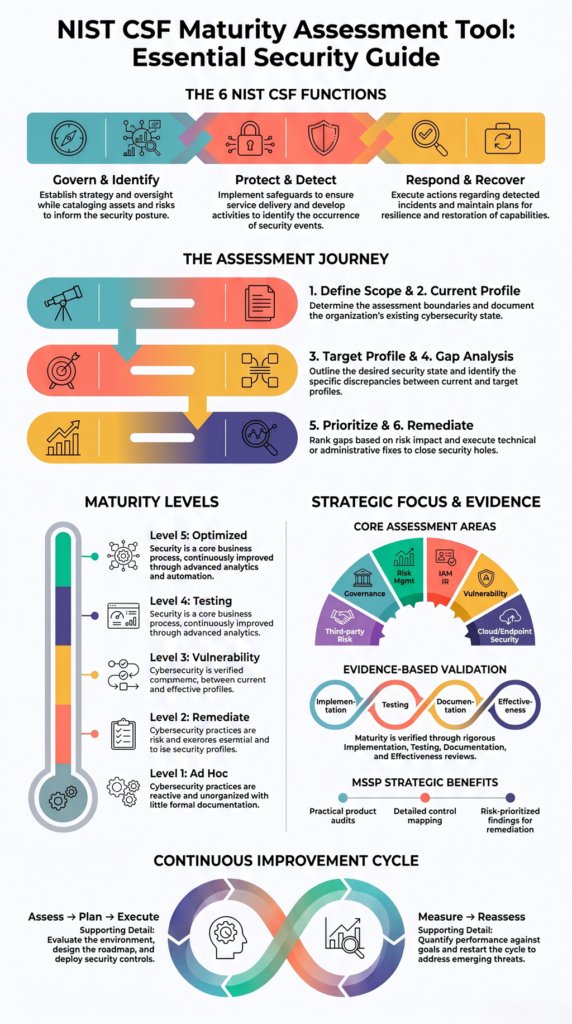
The useful part of a NIST CSF maturity assessment tool starts after the findings are documented. Teams can turn priority gaps into a cybersecurity remediation roadmap that sets out what needs to change, who owns it, and how progress will be measured.
A practical roadmap can link each finding to:
- Risk and business impact: Explain why the issue needs attention.
- Remediation action: Set out the change required.
- Ownership: Assign the work to the right team.
- Resources: Identify required people, technology, and budget.
- Timeline: Set realistic implementation milestones.
- Measurement: Define how progress and effectiveness will be reviewed.
- Reassessment: Check the capability again after remediation.
At MSSP Security, we treat assessment findings as a starting point rather than the final deliverable. When working with MSSPs, we can also consider whether an existing or proposed security product addresses the identified gap and performs as expected.
A security programme maturity review can be repeated as systems, risks, and business needs change. Our experience shows that a simple cycle works best: assess the current state, define the target, identify gaps, prioritize action, measure results, and reassess.
FAQ
What Is the Difference Between a NIST CSF Maturity Assessment and a Self-Assessment?
A NIST CSF self-assessment is usually completed internally to review cybersecurity practices. A maturity assessment goes deeper by reviewing implementation, evidence, effectiveness, maturity, and gaps.
How Often Should Organizations Perform a NIST CSF Maturity Assessment?
Many organizations review maturity annually. Additional assessments may be useful after major technology changes, security incidents, regulatory updates, or significant changes in business risk.
Does NIST CSF 2.0 Require a Specific Maturity Scoring Model?
No. NIST CSF 2.0 does not require a universal scoring model. Organizations can define their own methodology and apply it consistently across the assessment.
What Evidence Is Needed for a NIST CSF Assessment?
Evidence may include policies, procedures, configurations, risk records, monitoring data, incident records, vulnerability reports, and training documentation.
Can a NIST CSF Maturity Assessment Support Audit Readiness?
Yes. It can help document capabilities, identify gaps, organize evidence, and track improvements. However, a maturity assessment is not an audit itself.
How Can a NIST CSF Maturity Assessment Tool Support MSSPs?
A NIST CSF maturity assessment tool helps organizations review cybersecurity capabilities, evidence, control effectiveness, and improvement needs. For MSSPs, the results can also support control mapping, gap analysis, cybersecurity maturity scoring, and product audits.
Our experience shows that the assessment is most useful when findings lead to clear priorities rather than a score alone. At MSSP Security, we help MSSPs with vendor-neutral product selection, auditing, stack optimization, and PoC support. Explore MSSP Security consulting services
References
- https://www.nist.gov/publications/nist-cybersecurity-framework-csf-20
- https://www.nist.gov/publications/zero-trust-architecture