

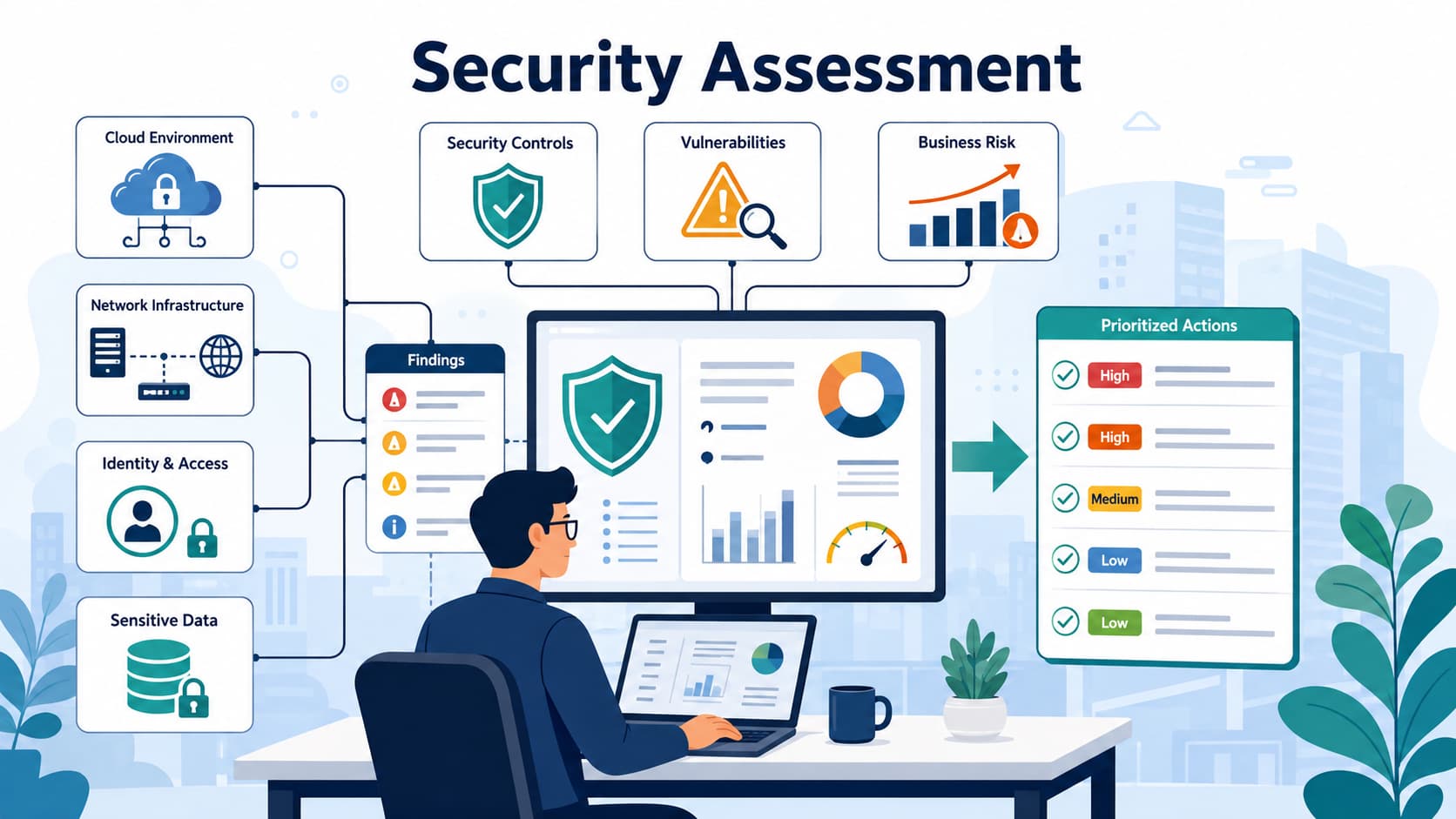
A security assessment expert in California reviews your technology, security controls, data, identity systems, and business risks, then turns the findings into a clear remediation plan.
NIST Cybersecurity Framework 2.0 can help organize that work, from identifying risks to setting priorities and tracking improvements. California privacy rules may also require certain businesses to complete risk assessments and cybersecurity audits.
That makes choosing the right assessor important. MSSP Security can help evaluate risks, verify findings, and provide practical next steps. Automated scans and questionnaires alone won’t show the full picture. Keep reading to learn what to look for.
Security Assessment Quick Wins
- Validate, Don’t Just Scan: Combine automated tools with manual testing to confirm real exposure, control effectiveness, and business impact.
- Prioritize What Matters: Focus first on critical assets, identity, cloud environments, sensitive data, and internet-facing systems based on actual risk.
- Turn Findings Into Fixes: Assign owners, deadlines, and validation steps so security recommendations lead to measurable, verified improvements.
What Does a California Security Assessment Expert Actually Assess?
A California security expert doesn’t just read rules they check if security really works. At MSSP Security, an assessment is more like testing a car, not just reading the owner’s manual.
They look at everything: computers, servers, apps, cloud services, and even outside companies that connect with the business. The NIST CSF 2.0, made by a government group called NIST in 2024, helps organize what to check based on how big or new the company is.
Here’s what a security check usually looks at:
- Who’s in charge of security, the rules they follow, and how well security is set up
- What devices and apps the company uses (including stuff they might not know about)
- How people log in, if they use extra security steps like MFA, who has special access, and how accounts are managed Security on networks, cloud, apps, and interfaces called APIs
- How they find and fix security problems and apply updates
- How they detect attacks, handle incidents, back up data, and recover from problems
- How they protect data, respect privacy, and manage outside vendors
Having good policies is helpful, but it doesn’t prove security works. Paper rules can say one thing, but tests show what really happens.
Why add technical testing with policy checks?
Because policies show what should happen, while testing shows what actually happens. A company might have perfect plans but still leave weak spots, like extra permissions, old software, or poor monitoring.
Checking controls means reviewing rules and who’s responsible. Technical tests check actual systems, settings, and find weak points and risks. From what MSSP Security knows, the best security checks in California do both. Rules set the goal, tests show if they’re really working.
Why Is a Vulnerability Scan Not a Full Security Assessment?
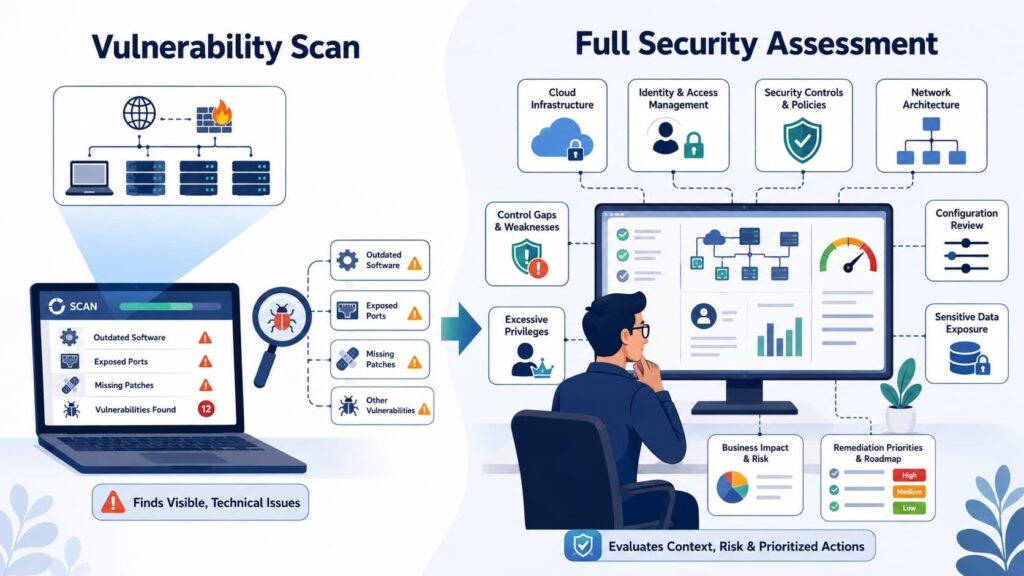
Alt text: A security assessment expert California evaluates vulnerability scans, full assessments, risks, and remediation priorities.
You can’t just rely on a vulnerability scanner to know if a system is truly at risk. It spots possible weak spots, sure, but only a trained assessor can figure out how exposed those flaws really are.
Is the vulnerable service open to the internet? Are there other controls that reduce the risk? Can attackers actually reach and exploit that weakness? These are questions a scanner won’t answer.
The National Institute of Standards and Technology (NIST) sees cybersecurity risk as more than just spotting technical bugs. Their CSF 2.0 framework helps companies not just find problems but understand and talk through their real impact.
So, a proper California vulnerability check should:
- Confirm which versions and settings are affected
- See if dangerous services are actually exposed to attack
- Look for backup controls that lessen risk
- Weed out false alarms
- Tie risks back to business impact
- Follow up to make sure fixes really work
Automated scans still matter; they can cover tons of devices fast and catch patterns. But if you treat scan results as gospel, you’re missing the bigger picture.
How Does Manual Validation Improve Assessment Quality?
Manual checks bring in the context automatic tools just don’t get. Take Multi-Factor Authentication (MFA).
A scan might say “MFA is enabled,” but that doesn’t tell you whether privileged users really use strong MFA, if there are old login methods still working, or if recovery options let people bypass it altogether.
The same goes for apps. Basic lists might miss user-approved OAuth apps with access to Microsoft 365 data.
Here’s the difference:
- Weak proof: “MFA is enabled.”
- Better proof: Testing MFA types, backup paths, privileged accounts, emergency break-glass access, and old authentication.
- Weak proof: “App inventory is complete.”
- Better proof: Checking enterprise apps, OAuth permissions, who owns what, and how access gets removed.
That extra human layer is what turns a list of weaknesses into a clear, fair judgment about risk. California security experts rely on this to give answers that actually hold up.
How Should a California Assessor Address CCPA and CPRA Requirements?
Looking at privacy in California isn’t just about reading the privacy notice. It means tracing how personal data flows through a company who can see it, how it’s kept safe, how long it sticks around, and what happens if something goes wrong.
But when it comes to the exact meaning of the law, that’s for privacy or legal experts to decide. In July 2025, the California Privacy Protection Agency (CPPA) set new rules requiring some businesses to do risk assessments and yearly cybersecurity audits.
A cybersecurity requirements analysis can help organizations map those obligations to the security controls and evidence they actually maintain.
These rules started on January 1, 2026. This gives a clear focus on how companies must handle consumer data in California.
A privacy check usually looks at this:
| Area | What to Check |
| Personal Info | What data exists and where it flows |
| Access | Who can see data and how they log in |
| Protection | Encryption and how keys are handled |
| Vendors | Contracts and how data is shared |
| Retention | How data is deleted or kept |
| Response | Logs and plans for security events |
Often, companies have to connect CCPA rules, CPRA risk checks, data privacy reviews, and technical security controls because they overlap.
But not all California businesses have the same rules. It depends on what they do, how they handle data, and certain legal limits. A good cybersecurity assessor can find gaps in tech and controls but should never give legal advice.
When do these audits really kick in?
The CPPA rules took effect in 2026, but official audit certificates won’t start until 2028 for some businesses. Companies should base their actions on what the CPPA says not marketing pitches that might cause confusion.
A smart cybersecurity consultant in California can help translate the law into clear steps. They show what proof to gather, what controls to test, and where data goes. But when it comes to what the law exactly means, that’s the lawyer’s work.
What Evidence Should a Defensible Security Assessment Produce?
It’s tempting to use screenshots or quick answers from questionnaires when assessing security, but those don’t cut it.
A good assessment digs up fresh, clear evidence you can trace back to a real source. NIST’s Cybersecurity Framework 2.0, out in 2024, helps organize this kind of work. It’s not just a checklist but a way to shape detailed reports and reviews.
The evidence can be things like:
- Policies and asset lists
- Network maps
- Vulnerability scans and fix records
- Identity settings
- Coverage by tools like
- SIEM and EDR
- Backup test results
- Incident reports
- Vendor reviews
- Documents on accepted risks
What really matters is evidence quality. That’s what decides if a finding turns into a real fix or just stays a note on a page.
A screenshot only shows a setup at a single time. A good evidence trail shows who owns the control, when it was tested, what was found, and if things changed.
Here’s what to look for in evidence:
- Current: Recent enough to show how things work today
- Complete: Covers all needed systems and controls
- Attributable: You know who owns it and where it came from
- Representative: Samples match how things really run
- Repeatable: Others can check and get the same results
This matters a lot in California, especially during cybersecurity audits. Whether it’s for customers, regulators, insurers, or internal teams, solid evidence is what makes the difference.
How Can You Evaluate an Independent California Security Assessor?
Certifications alone don’t tell the whole story when picking a California security assessor.
Real value lies in what they’ve done before, how deep their technical skills are, and how well they explain their process from start to finish.
NIST CSF 2.0 fits all kinds of organizations, big or small, but it doesn’t lock you into one way of doing things. This means the assessor’s judgment really matters.
Here’s what to look for:
- Experience with similar systems and risks
- Independence, with no conflicts of interest
- Ability to do hands-on technical testing
- Familiarity with frameworks like NIST CSF 2.0, CIS, ISO 27001, or SOC 2
- Reports backed by solid evidence
- Clear rules about how the assessment is done
- Relevant certifications plus real project experience
Also, keep in mind that a big company’s security review isn’t the same as one for a small business. How deep they go, how many people work on it, and how much evidence they gather can differ a lot.
What about certifications?
They show some basic skills but don’t replace real-world experience.
Some useful credentials might be:
- CISSP if they lead security programs
- CISM for managing security strategies
- OSCP for hands-on hacking and penetration testing
- GIAC for specific tech skills
- CREST when it fits the job
- Privacy certifications for privacy work
Still, the better question is whether an assessor has done work like yours before, say assessing networks, apps, cloud setups, or security governance under similar rules and limits.
In the end, credentials are just one part of the picture. Practical experience and how they handle your particular risks matter more.
What Should an MSSP Security Assessment Examine?
An MSSP assessment should examine monitoring coverage, tenant separation, logging, escalation, client evidence, shared responsibility, administrative access, and reporting.
For organizations using a managed security provider, the assessment must identify which controls belong to the client, the MSSP, cloud providers, and other vendors. A thorough MSSP needs assessment can help clarify these responsibilities before testing begins.
At MSSP Security, we would examine SIEM and EDR coverage, secure log forwarding, alert triage, escalation paths, administrative privileges, evidence retention, and client-facing reporting.
The goal is not to criticize the service model. It is to establish whether responsibilities are clearly assigned and operating as expected.
A practical MSSP security assessment California engagement should answer:
- Who owns each security control?
- Which logs reach the monitoring platform?
- How are alerts triaged?
- What triggers escalation?
- How are tenants separated?
- Who can administer client systems?
- How long is evidence retained?
- How are incidents communicated?
This also applies to a SOC assessment California or security operations assessment California where the organization wants to test detection quality rather than simply confirm that a SIEM exists.
Why should OAuth applications be part of the assessment?
Traditional application inventories can miss user-consented SaaS integrations with delegated access to business data.
Microsoft environments deserve particular attention because an assessor may need to review enterprise applications, OAuth consent grants, mailbox permissions, calendar access, application owners, inactive integrations, and revocation procedures.
The same principle applies beyond Microsoft 365. SaaS platforms, AI tools, browser extensions, and third-party integrations can create access paths that formal software inventories do not capture.
That is why identity and access management assessment California engagements should look beyond whether MFA exists. The assessor should understand how identity is granted, elevated, recovered, monitored, and removed.
How Should a Security Assessment Handle Tight Budgets?
A budget-conscious assessment should begin with business-critical assets and likely attack paths, then prioritize controls according to exposure, likelihood, impact, and remediation cost. Not every system needs identical testing.
A public-facing payment application might deserve deeper attention than an isolated internal workstation. Practical scoping managed security services can help define which systems, controls, monitoring responsibilities, and testing activities deserve attention first.
A practical California cyber risk consultant can establish a baseline first and then add targeted testing.
That might mean an external attack surface assessment followed by identity, cloud, application, or penetration testing where the evidence points to higher risk.
What should receive priority first?
Internet-facing identity, critical applications, sensitive-data systems, privileged accounts, and recovery infrastructure generally deserve early attention.
A practical sequence is:
- External attack surface
- Identity and privileged access
- Critical applications
- Sensitive-data systems
- Backup and recovery
- High-impact third parties
- Lower-risk internal weaknesses
Of course, budget constraints sometimes require uncomfortable choices. A good assessor should explain the tradeoff rather than quietly reduce testing depth while preserving the appearance of comprehensive coverage.
The goal is a defensible security gap assessment California organizations can actually act upon, not a long list that consumes the budget without reducing meaningful risk.
What Questions Should You Ask Before Authorizing a Penetration Test?
Before penetration testing begins, establish scope, authorization, test windows, prohibited actions, emergency contacts, evidence handling, and stop conditions.
Authorized testing needs clear rules because a penetration test can interact with production systems in ways a routine vulnerability scan does not.
As highlighted by PCI Security Standards Council:
“A third party cannot perform penetration testing if they were involved in the installation, maintenance, or support of the systems being tested.” – PCI Security Standards Council
A professional penetration testing California engagement should define:
- Which systems and applications are in scope?
- Which source IPs will be used?
- When can testing occur?
- Which actions are prohibited?
- Who can stop the test?
- How will sensitive evidence be handled?
- What happens if production systems become unstable?
- How will findings be validated?
We treat authorization and safety as part of assessment quality. The technical objective does not justify uncontrolled testing.
How is penetration testing different from vulnerability assessment?
A vulnerability assessment identifies potential weaknesses, while a penetration test uses authorized exploitation techniques to establish practical impact.
As noted by National Institute of Standards and Technology (NIST):
“Vulnerability scanning identifies and reports recorded vulnerabilities, whereas penetration testing attempts to exploit the vulnerabilities to determine whether unauthorized access or other malicious activity is possible.” – National Institute of Standards and Technology (NIST)
- Vulnerability assessment: Finds potential weaknesses and missing patches.
- Penetration test: Tests exploitability and practical impact.
- Security program assessment: Reviews governance.
- Cloud assessment: Tests AWS, Azure, or GCP environments.
- Red team: Tests detection and response.
- Privacy assessment: Reviews privacy risk.
The distinction helps organizations avoid buying the wrong service. A vulnerability assessment California engagement may be appropriate for broad exposure discovery, while web application penetration testing California or API security assessment California may be better for application-specific concerns.
How Can Findings Become a 30/60/90-Day Remediation Roadmap?
A useful remediation roadmap assigns every finding an owner, priority, dependency, deadline, corrective action, and validation criterion. The final output should connect the technical problem to the operational work required to fix it.
A security remediation roadmap California organization can execute should also account for staffing, maintenance windows, vendor dependencies, and business priorities.
- 0–30 days: Address critical exposure, privileged access, and urgent vulnerabilities.
- 31–60 days: Improve configuration, monitoring, identity, and backups.
- 61–90 days: Address process maturity, application security, and supplier controls.
We often find that remediation becomes easier when recommendations are written as specific engineering tasks rather than broad security advice. That means separating immediate exposure reduction from longer-term governance improvements.
A slight configuration change can sometimes reduce risk today while a larger architecture project takes several months.
What makes a remediation recommendation actionable?
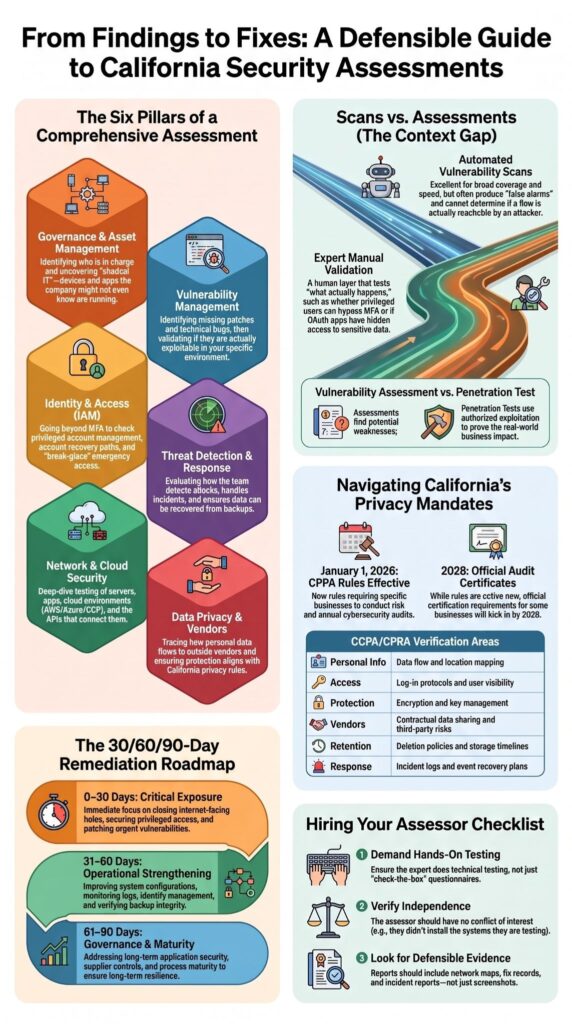
Alt text: A security assessment expert California reviews cybersecurity gaps, remediation steps, privacy mandates, and assessment pillars.
An actionable recommendation specifies what changes, who owns it, why it matters, and how successful remediation will be verified.
- Weak: “Improve MFA.”
- Actionable: Require phishing-resistant MFA for privileged accounts, remove legacy authentication, and verify enforcement through sign-in evidence.
The same principles clear ownership, evidence, risk rationale, corrective action, and validation apply across firewall, cloud, backup, and third-party assessments, but the testing procedures and evidence requirements should be tailored to each scope.
What Should a California Security Assessment Report Contain?
A professional report should give executives a clear risk picture while providing technical teams enough evidence to reproduce and remediate findings.
NIST CSF 2.0 provides a common language for communicating cybersecurity outcomes. It can structure a report, but it does not prescribe a mandatory report format or require a fixed control set.
A report can use that structure without forcing every organization into identical controls. A strong cybersecurity assessment report may include:
- Executive summary
- Technical findings report
- Risk register
- Maturity assessment
- Remediation roadmap
- Control-mapping workbook
- Management presentation
- Validation report
The technical findings should identify affected assets, evidence, severity, business impact, attack paths where applicable, corrective actions, and validation criteria.
How should findings be prioritized?
Findings should be prioritized using exploitability, exposure, business impact, control weakness, existing safeguards, and remediation urgency rather than severity labels alone.
Consider:
- Internet exposure
- Active exploitation
- Privilege gained
- Sensitive data reachable
- Operational impact
- Existing compensating controls
- Remediation complexity
This approach supports a more useful cybersecurity maturity assessment California organizations can use for investment planning, governance, and future assessments.
Which Security Assessment Should a California Business Choose?
The right assessment depends on the business question, followed by targeted testing where baseline evidence identifies meaningful risk.
| Business need | Best starting point |
| Broad security posture | Security program assessment |
| Missing patches or exposed services | Vulnerability assessment |
| Exploitation risk | Penetration test |
| Cloud configuration risk | Cloud security assessment |
| Consumer-data and privacy risk | privacy/security assessment, subject to applicable law, business size, processing activities, sector, and contractual obligations.” |
| Detection and response validation | purple-team exercise, threat-informed test, incident-response exercise, or red team, depending on objectives and authorization. |
| Managed security concerns | MSSP/SOC assessment |
For many organizations with limited prior assessment evidence, a baseline program review combined with external exposure and vulnerability analysis is a practical starting point.
From there, findings might justify AWS security assessment California, Azure security assessment California, Microsoft 365 security assessment California, Active Directory security assessment California, application testing, or third-party reviews.
The same decision logic applies whether the assessor is local, remote, or serving another California region; competence, scope, methodology, and independence matter more than city. Location matters for availability and local context, but methodology matters more.
Why Do Security Assessments Fail Before Testing Begins?
Poor scope, unclear ownership, incomplete inventories, weak evidence processes, and undefined testing rules can undermine an assessment before technical testing starts.
The recurring practitioner lesson is simple: assessment work is evidence-heavy. A defensible assessment plan should define requested artifacts, control objectives, interviews, scanning, authorized testing, evidence handling, and reporting procedures.
That reflects a practical truth we see repeatedly: Each evidence item should have an accountable owner, source, collection date, scope, and retention location.
Common warning signs include:
- No defined assessment scope
- No evidence owner
- Incomplete asset inventory
- No testing authorization
- Generic questionnaires
- Scanner output without validation
- Compliance promises without control testing
- No remediation owner
- No validation phase
- Recommendations are not supported by documented requirements, alternatives, cost considerations, operational fit, and conflict-of-interest disclosure
A California information security consultant should be able to explain the reason behind each recommendation.
If the assessor cannot connect a proposed control to a threat, business requirement, or risk reduction objective, the organization should ask for more evidence.
That said, no assessment eliminates uncertainty. Good assessment work makes uncertainty visible, measurable, and manageable.
Common Security Assessment Blind Spots
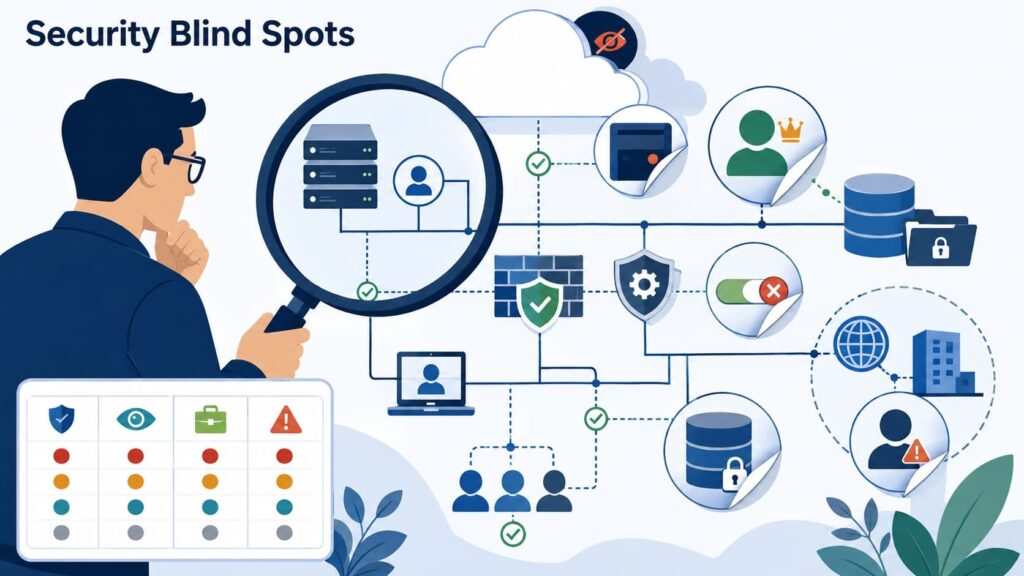
Alt text: A security assessment expert California identifies blind spots across networks, identities, cloud systems, data, and security controls.
OAuth applications, MFA recovery paths, failed patching, cloud permissions, edge configurations, and changing external exposure can escape conventional reviews.
A narrowly scoped IT assessment can identify missing patches while not evaluating identity paths, cloud permissions, or SaaS application access.
A cloud review might find excessive permissions without examining whether those permissions are actively used. That is why a mature assessment connects identity, network, application, cloud, and data risks instead of treating them as isolated checkboxes.
Which identity gaps deserve special attention?
Authentication strength depends on primary methods, fallback and recovery paths, privileged access, legacy protocols, session controls, conditional access, and service-account governance, not merely whether MFA is enabled.
Review:
- Phishing-resistant MFA
- Recovery methods
- Privileged accounts
- Legacy protocols
- Conditional access
- Emergency accounts
A privileged-access assessment should verify that administrative access is limited, monitored, periodically reviewed, time-bounded where practical, and removed when no longer needed.
Why does changing external exposure require reassessment?
Internet-facing systems can change after the original assessment, making point-in-time findings stale. A service might gain a new endpoint, change its firewall configuration, add a SaaS integration, or expose a new API after the report is delivered.
A stronger model can therefore:
- Monitor the external attack surface.
- Track material infrastructure changes.
- Recheck edge controls.
- Review security events.
- Trigger targeted reassessments.
This is especially relevant to external attack-surface reviews, network penetration tests, and rapidly changing cloud environments.
How Do You Know a California Security Assessment Expert Is Worth Hiring?
A well-qualified assessor should connect authorized technical testing, California-specific obligations, defensible evidence, business risk, and verified remediation.
A buyer can use a simple decision filter before signing an engagement:
- Can the assessor explain the methodology?
- Does the team test beyond questionnaires?
- Can automated findings be manually validated?
- Does the team understand cloud and identity risk?
- Does the assessor distinguish technical security findings from legal, privacy, and regulatory conclusions?
- Are testing rules documented?
- Is the assessor sufficiently independent?
- Are findings tied to business impact?
- Does the report include owners and deadlines?
- Is remediation independently validated?
We also recommend asking for an example of how the assessor turns one technical finding into a business-level recommendation. The answer often reveals more than a certification list.
A strong independent security assessment California provider should be comfortable saying what the evidence does not prove. That restraint matters.
This reduces the risk of overstating assurance or treating compliance documentation as evidence that controls operate effectively.
Optimizing Cybersecurity Posture Through EDR Assessment
Credits: infotex inc
Automated security controls must be rigorously audited and tested in the same manner organizations evaluate human personnel.
Simply deploying endpoint agents is insufficient; continuous stress-testing ensures that behavioral detection, telemetry logging, and isolation mechanisms function effectively during active threat scenarios.
Regular EDR testing transforms static software into a proactive, reliable asset capable of defending against evolving cyber risks.
FAQ
What should I ask a security assessment expert in California before hiring one?
Ask how the assessment will be scoped, which systems will be tested, and how findings will be verified. A California security assessment consultant should explain the testing approach, evidence collection, reporting process, and follow-up support. You should also ask whether the assessment covers technical risks, business impact, and compliance concerns relevant to your organization.
When should a California cybersecurity consultant recommend an independent security assessment?
An independent security assessment California engagement can provide an objective view of your organization’s security weaknesses. It can help validate internal findings, prepare for an external review, or give leadership independent evidence about security risks. Ask whether the assessor is sufficiently independent from your daily security operations to identify weaknesses without creating a conflict of interest.
How often should a California business conduct a cybersecurity risk assessment?
The appropriate frequency depends on your business changes, risk exposure, regulatory obligations, and previous assessment findings. You should reconsider a cybersecurity risk assessment California engagement after major technology changes, acquisitions, serious security incidents, or significant changes to security controls. Organizations with higher risk exposure may also need assessments more frequently than once a year.
What should a cloud security assessment California organization receive?
A cloud security assessment California organization receives should examine access controls, cloud configurations, identity management, data protection, logging, and administrative privileges. You can also request a cloud compliance assessment when specific regulatory requirements apply. Before testing begins, confirm which cloud environments, accounts, applications, and data stores are included so that important systems are not excluded from the assessment.
How can a security assessment report California leaders receive help prioritize fixes?
A useful cybersecurity assessment report California leaders receive should identify each affected asset, explain the security weakness, describe its potential business impact, provide supporting evidence, and recommend a specific corrective action. Ask whether findings are prioritized according to business risk rather than technical severity alone. A security remediation roadmap can then assign owners, deadlines, and measurable follow-up actions.
From Security Findings to Verified Risk Reduction
A security assessment should show what puts your organization at risk, what needs attention first, and whether your controls are working. A long vulnerability list isn’t enough. California organizations need clear evidence, defined priorities, and a practical path to verified remediation.
MSSP Security can help turn findings into a focused security program. With 15+ years of experience and 48K+ projects completed, MSSP Security provides needs analysis, auditing, vendor-neutral consulting, and stack optimization.
Whether you need network, application, cloud, third-party, or penetration testing support, the goal is simple: understand the risk and verify the fix.
References
- https://listings.pcisecuritystandards.org/pdfs/infosupp_11_3_penetration_testing.pdf
- https://csrc.nist.gov/glossary/term/penetration_testing