

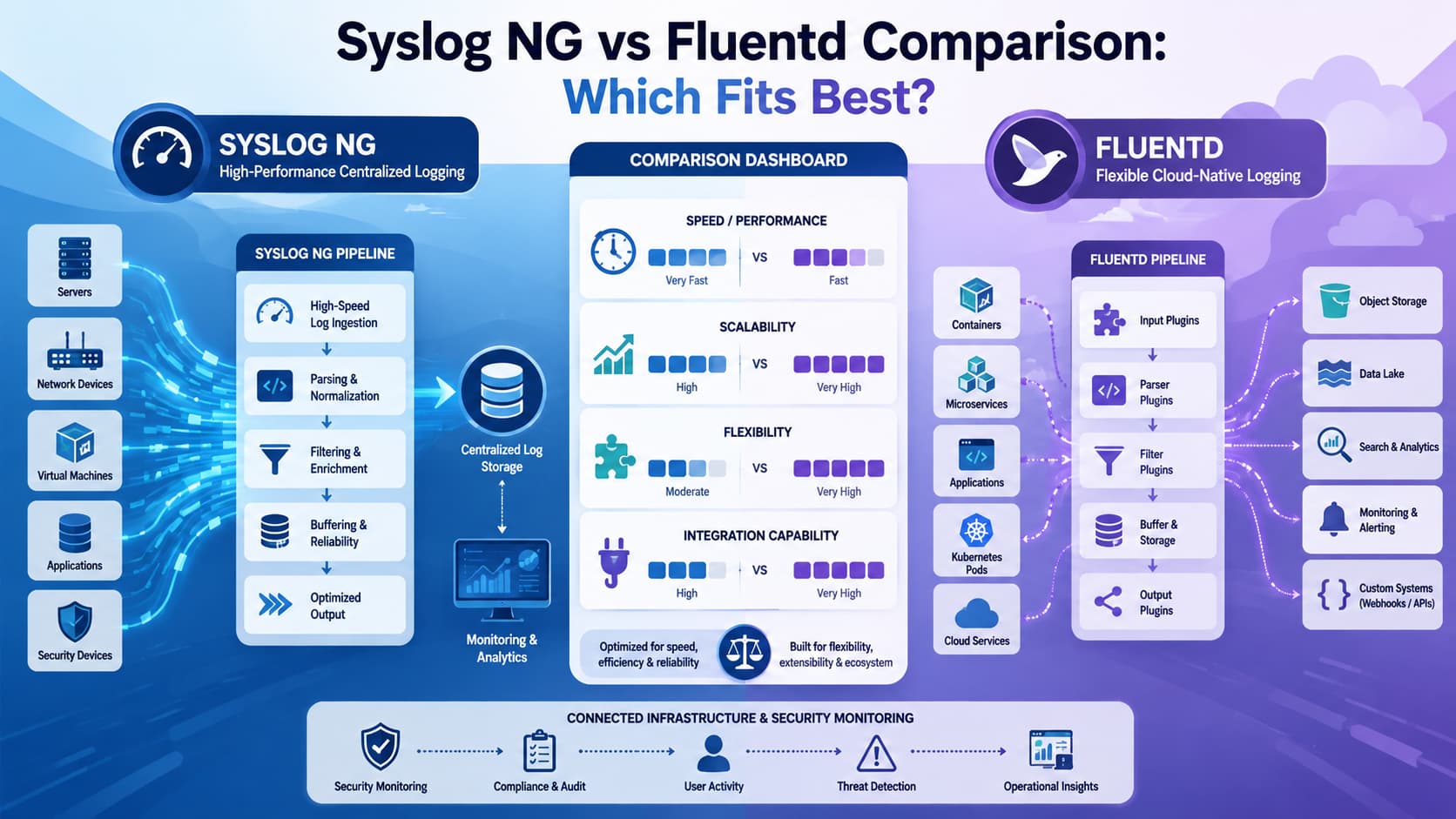
The right logging platform depends on your infrastructure goals, not just performance numbers. Optimized syslog-ng deployments can deliver high throughput for centralized logging workloads, while Fluentd is widely used in cloud-native environments because of its flexible plugin ecosystem and broad integrations.
Performance, routing capabilities, scalability, and operational needs all play a role. At MSSP Security, we have worked with different logging environments and focus on choosing solutions that fit each organization’s requirements.
Keep reading to compare syslog-ng and Fluentd and find the best option for your deployment.
Logging Decision Checklist: Choosing the Right Platform
A syslog-ng vs Fluentd comparison depends on matching each tool with the needs of your logging environment.
- Use syslog-ng for high-volume security logs Best for centralized syslog collection, network devices, and advanced routing with reliable performance.
- Use Fluentd for flexible cloud pipelines Ideal for Kubernetes, application logs, and environments needing broad integrations.
- Combine both for scalable logging A hybrid approach balances fast collection, flexible processing, and long-term scalability.
What Is the Core Difference Between syslog-ng and Fluentd?
The biggest difference comes down to purpose. syslog-ng uses a routing-focused architecture built around sources, destinations, filters, and flow control.
Fluentd uses an event pipeline architecture based on input, filtering, buffering, transformation, and output plugins. That difference influences nearly every recommendation we make when auditing logging platforms for MSSPs.
From the beginning, syslog-ng centered on the syslog protocol, supporting both RFC 5424 and RFC 3164. These capabilities help security teams maintain consistent event formats, reduce parsing failures, and preserve reliable delivery during high-volume ingestion.
During infrastructure reviews, we’ve found those capabilities are often the deciding factors for organizations that need stable log delivery and straightforward operations. Fluentd was built as a unified logging layer that collects, filters, buffers, and outputs logs across multiple sources and destinations.
According to Fluentd documentation, its ecosystem includes more than 1,000 plugins that extend collection, filtering, transformation, and output capabilities. That flexibility makes it appealing for teams running modern cloud environments with many different data sources.
Working with MSSPs has shown us that the decision rarely comes down to feature lists. Security operations teams usually look for consistent routing, centralized log collection, and dependable delivery under load.
Development and platform teams often care more about connecting services and extending pipelines as new applications are introduced. Both priorities are valid, but they solve different operational problems.
The architectural differences become easier to compare side by side.
| Feature | syslog-ng | Fluentd |
| Primary focus | Syslog routing | Unified log pipeline |
| Typical fit | Firewalls, routers, UNIX servers, security appliances | Kubernetes clusters, microservices, application platforms. |
| Configuration | Rule-based | Plugin pipeline |
| Primary strength | High-throughput logging and routing | Integrations and extensibility |
Before looking at performance, it helps to understand why these platforms were built so differently.
Why were these projects designed differently?
Their architectures reflect different engineering priorities, not different levels of capability. syslog-ng is a native logging application designed for efficient, low-latency log handling.
It performs parsing, transformations, rewrite rules, and flow control without introducing unnecessary processing layers.
We’ve reviewed deployments where that efficiency became noticeable as log volume increased, especially in security monitoring environments where predictable throughput mattered every day. Fluentd approaches the problem from another angle.
Every log moves through a structured event pipeline where plugins handle parsing, enrichment, filtering, buffering, and forwarding before sending data to its destination.
That design fits organizations collecting information from many applications, cloud platforms, and containerized workloads, where different sources often require different processing steps.
After auditing both platforms across enterprise and MSSP environments, we’ve never treated one architecture as the universal winner. Traditional networks often benefit from syslog-ng’s direct routing model and operational consistency.
Environments built around cloud services and fast-changing applications usually gain more from Fluentd’s extensible pipeline. The architecture chosen at the beginning often shapes day-to-day administration long after deployment.
Which architectural philosophy affects operations most?
Daily operations often reflect the design philosophy behind each platform more than the feature list. With syslog-ng, administrators build routing around sources, destinations, parsers, and message rules.
The result is a routing-first model that keeps log flow predictable and easier to troubleshoot. We’ve recommended this approach during product audits where reliability and clear routing paths mattered more than supporting dozens of changing data sources.
Fluentd takes a pipeline-first approach. Logs move through modular plugins for ingestion, filtering, enrichment, buffering, and forwarding before reaching their destination.
That makes it easier to integrate new applications, cloud services, and analytics platforms without redesigning the entire pipeline.
In practice, the choice usually reflects operational priorities. Organizations that rely on centralized logging and deterministic routing often lean toward syslog-ng.
Teams supporting rapidly changing cloud environments frequently prefer Fluentd because it adapts more easily as infrastructure grows. Those architectural decisions also have a direct impact on performance once log volume starts climbing.
Which Tool Delivers Better Performance Under Heavy Load?
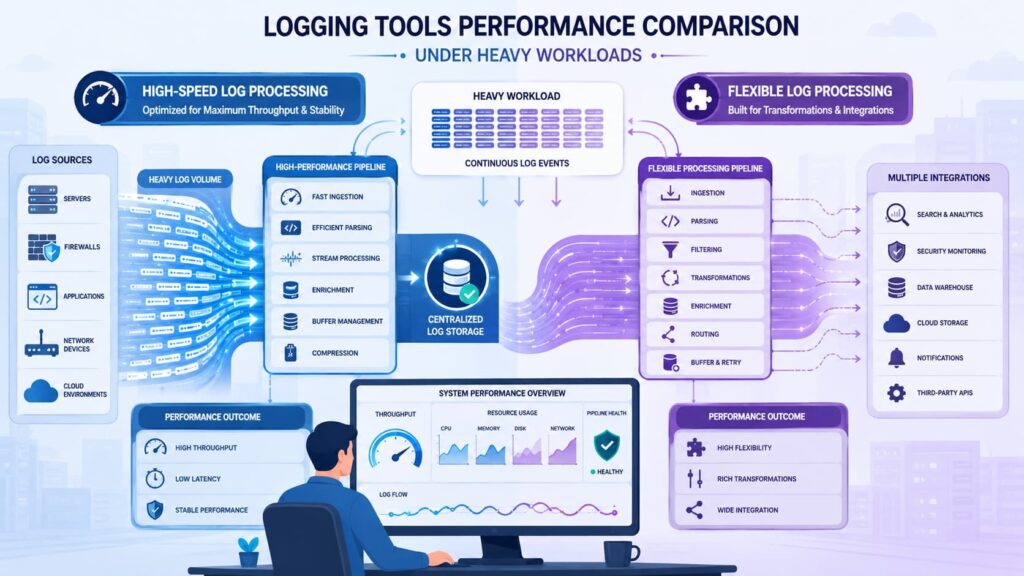
When raw throughput is the main priority, syslog-ng usually performs better than Fluentd. Optimized deployments have shown syslog-ng reaching around 650,000 events per second, making it suitable for high-volume centralized logging environments.
Its performance advantage comes from:
- Native compiled architecture with lower processing overhead
- Multi-threaded processing for handling parallel workloads
- Efficient routing for firewall logs, audit records, and security telemetry
- Flow control features that improve delivery reliability
Fluentd approaches performance differently. Its plugin-based pipeline supports parsing, filtering, enrichment, transformation, and forwarding. These additional stages increase CPU and memory usage but provide stronger flexibility for cloud services, applications, and analytics platforms.
However, throughput alone does not determine deployment success. Real-world performance also depends on:
- SIEM ingestion capacity
- Storage performance
- Network bandwidth
- Message queue configuration
- Overall pipeline design
For MSSPs and security teams, the right choice depends on operational priorities. syslog-ng is often better for predictable high-speed log routing, while Fluentd is better suited for environments that need broader integrations and customization.
Why does syslog-ng process logs faster?
A large part of the answer comes from its architecture. syslog-ng runs as native compiled code, allowing message parsing and forwarding to happen with relatively little processing overhead.
Combined with multi-threaded scheduling, it scales efficiently across thousands of concurrent TCP logging sessions without introducing unnecessary processing stages.
One Identity’s performance guidance highlights another lesson we’ve encountered during infrastructure assessments.
In syslog-ng deployments, inefficient regex-based filtering can reduce throughput by roughly 40–45%, making structured parsing rules preferable for high-volume environments. We regularly recommend replacing expensive regex filters with structured parsing rules where possible.
In several customer environments, that change alone improved processing speed without adding servers or increasing hardware resources. Of course, not every deployment is designed around maximum throughput.
When does Fluentd’s processing overhead become acceptable?
Cloud-native environments are usually where Fluentd’s design makes the most sense. Kubernetes clusters, container platforms, and distributed applications generate structured JSON logs, telemetry, container events, and application logs from many independent services.
Fluentd’s event pipeline makes it easier to normalize that information before sending it to downstream analytics or monitoring platforms. We’ve seen development teams accept the additional CPU and memory usage because the operational benefits outweigh the cost.
Plugin-based enrichment, flexible routing, and broad integration options often reduce the effort required to support growing microservice environments. In those cases, a small performance tradeoff can simplify operations over the long term.
Insights from Outshift by Cisco Blog indicate:
“We got an interesting case from a Logging operator user. They have relatively big clusters with an application set-up that requires around 100-150 flows. Our initial routing implementation for Fluentd has its limitations: It’s a single-threaded Ruby plugin. We managed to triple the performance of the log processing, but it became clear that big clusters produce a lot of log messages. Our optimizations around Fluentd won’t be able to keep up with large-scale production traffic.” – Outshift by Cisco Blog
Performance is only one part of the evaluation, though. As logging environments grow, routing complexity often becomes the next factor that separates one platform from the other.
Which Platform Handles Complex Log Routing Better?
syslog-ng provides more sophisticated routing for traditional syslog infrastructures. Organizations with thousands of firewalls, routers, switches, UNIX servers, and security appliances often rely on centralized log aggregation to maintain visibility, simplify monitoring, and support consistent event management across distributed environments.
syslog-ng was designed for exactly these situations, supporting advanced message routing, rewrite rules, parsing rules, pattern matching, log relaying, secure log transport, centralized logging, and destination-specific processing.
Flow control becomes especially valuable when downstream systems temporarily slow down. Instead of overwhelming storage or analytics platforms, syslog-ng manages backpressure while preserving predictable delivery behavior.
Our engineers at MSSP Security frequently rely on this capability when designing centralized logging architectures for security operations. Large enterprises rarely send every log to every destination.
Instead, firewall logs, audit logging, incident response telemetry, and compliance events often follow entirely different routing paths.
Routing capabilities commonly include:
- Multi-destination log forwarding
- Pattern-based filtering
- Rewrite rules
- Log transformation
- Flow control
- Secure TLS logging
- Central relay deployments
That said, routing efficiency depends heavily on implementation quality. One Identity recommends avoiding unnecessary regular expressions because regex-heavy filtering may reduce throughput by roughly 40–45% in production environments.
Complex routing also benefits from understanding how rule engines differ.
How do routing rules differ?
syslog-ng evaluates messages through rule-based processing. Administrators define source drivers, destination drivers, parsing rules, filters, and rewrite logic that determine exactly where every event travels.
This deterministic model works exceptionally well for infrastructure logs and security monitoring. Fluentd instead chains processing plugins together into sequential pipelines.
Every stage enriches, filters, transforms, or forwards structured events before delivery. Both methods accomplish similar goals, but they encourage different operational habits.
When are relays recommended?
Relays become valuable when connection counts increase dramatically.Large environments may have many simultaneous logging sessions.
Rather than concentrating every connection on one collector, intermediate log relaying tiers distribute incoming traffic while improving scalability and fault tolerance.
We’ve found relay architectures especially useful when combining centralized logging with SIEM integration across geographically distributed environments.
Why Is Fluentd Popular in Kubernetes?
Fluentd commonly runs as a node-level collector in Kubernetes environments, gathering container stdout logs and forwarding structured events to analytics platforms. Selecting the right log collector options becomes important when organizations manage multiple sources, formats, and destinations across containerized environments.
Containerized workloads generate application logs, infrastructure logs, telemetry, and JSON logs from constantly changing services.
Fluentd wraps incoming events into structured records, making log normalization and log transformation easier before forwarding data downstream.
The Fluentd ecosystem, widely adopted within the CNCF cloud-native community, includes extensive plugin support for cloud platforms and observability tools.
That flexibility becomes valuable when applications continuously scale up and down. New services can often join an existing log pipeline without redesigning the overall architecture.
From what we’ve observed while supporting mixed infrastructures at MSSP Security, development teams appreciate how Fluentd adapts to evolving workloads, especially where Kubernetes logging and container logging dominate daily operations.
Infrastructure-centric organizations, however, often continue relying on syslog-ng for perimeter devices while introducing Fluentd deeper in the application stack.
Common integration targets include:
- Elasticsearch integration
- Splunk integration
- Kafka integration
- AWS Kinesis
- Amazon S3
- Cloud logging platforms
Structured logging also simplifies downstream analytics because metadata travels alongside every event instead of requiring repeated parsing after ingestion.
Which cloud integrations matter most?
The most valuable destinations depend on operational objectives. Organizations focused on observability often prioritize log analytics platforms, while security teams typically emphasize SIEM integration and long-term log retention.
Cloud object storage also remains popular for compliance archives and historical investigations.
How does structured logging simplify pipelines?
Structured events reduce ambiguity. Instead of repeatedly parsing unstructured logs, applications generate consistent JSON logs that simplify log enrichment, log correlation, and downstream searches. That consistency becomes increasingly valuable as application counts continue growing.
How Do Configuration and Maintenance Compare?
syslog-ng favors predictable rule-based administration, while Fluentd emphasizes modular plugin management.
This difference affects troubleshooting: syslog-ng issues are often traced through routing rules, while Fluentd issues may require checking multiple plugin stages.
Operational simplicity often matters more than raw feature counts. Effective log source onboarding helps teams maintain consistent configurations, validate incoming events, and reduce troubleshooting challenges as new systems are added.
syslog-ng configurations revolve around source drivers, destination drivers, filters, parsing rules, rewrite rules, and routing logic.
Once administrators become familiar with the syntax, large deployments generally remain stable for years. Fluentd organizes functionality through plugins. Administrators build pipelines by combining input, filtering, buffering, transformation, and output components.
The modular approach accelerates integration but also increases dependency management. We have maintained both styles in production.
At MSSP Security, our experience suggests that infrastructure teams often prefer predictable configuration files because troubleshooting becomes straightforward under pressure.
Development-focused organizations frequently value plugin flexibility despite the additional maintenance effort.
Several operational factors deserve consideration.
- Learning curve for administrators
- Configuration readability
- Plugin lifecycle management
- Upgrade compatibility
- Long-term operational consistency
Plugin availability exceeding 1,000 integrations gives Fluentd tremendous flexibility, but every additional dependency also introduces another component to monitor throughout future upgrades.
Plugin upgrades may introduce compatibility concerns between Fluentd versions, Ruby dependencies, and external destinations.
Which configuration is easier to troubleshoot?
Rule-based configurations generally simplify root-cause analysis. When log routing follows explicit conditions, administrators can isolate problems quickly. Sequential plugin pipelines, while powerful, sometimes require tracing events through multiple transformation stages before identifying the underlying issue.
When do plugins become a maintenance burden?
Large deployments expose this challenge first. Organizations operating hundreds of integrations may spend considerable time validating plugin compatibility after upgrades.
That maintenance effort remains manageable, but it should be included when estimating operational costs.
Which Reliability Features Matter Most?
For both syslog-ng and Fluentd, reliability depends on buffering, queue management, retry behavior, and backpressure handling when destinations become unavailable.
Real-world failures rarely occur because a log collector stops working entirely. More commonly, downstream analytics platforms become unavailable, storage slows, or network links experience interruptions.
Buffering, failover, disk buffering, and backpressure determine whether logs survive these disruptions. Academic research comparing log delivery mechanisms found meaningful differences in packet-loss behavior under failure conditions.
Meanwhile, operational guidance consistently recommends identifying the actual bottleneck before attempting performance tuning.
As highlighted by TalTech University:
“After enabling flow-control almost all message loss was removed. It seems that the journal deleted some of the log messages before syslog-ng was able to send them. This could be prevented with configuring when journal deletes old log messages.” – TalTech University
| Scenario | Better Fit |
| Network outage | Fluentd buffering |
| Heavy TCP logging | syslog-ng flow control |
| Security relay | syslog-ng |
| Cloud pipelines | Fluentd |
During incident response engagements, we have repeatedly seen storage latency create more problems than ingestion speed.
Increasing collector performance rarely solves downstream congestion if destination systems remain saturated.
A resilient deployment should include:
- Disk buffering
- Flow control
- Backpressure management
- Failover planning
- Log retention policies
- Reliable data forwarding
Strong reliability practices support both centralized logging and regulatory audit logging without sacrificing operational performance.
What happens when downstream systems fail?
Proper buffering prevents unnecessary data loss. Buffered events remain queued until destinations become available again.
Without adequate buffering policies, dropped messages become increasingly likely during prolonged outages.
Which deployment minimizes data loss?
Balanced architectures perform best. Reliable source buffering, destination buffering, controlled message routing, and carefully sized storage queues consistently outperform configurations focused only on maximum throughput.
When Should Security Teams Choose syslog-ng?
Security operations usually benefit from syslog-ng when collecting logs from firewalls, network appliances, authentication systems, UNIX servers, and other RFC-compliant syslog sources.
Firewalls, routers, switches, UNIX servers, authentication systems, and security appliances primarily communicate using the syslog protocol. syslog-ng naturally centralizes these events while supporting secure log transport, message routing, log normalization, and SIEM integration.
At MSSP Security, we frequently recommend evaluating syslog-ng first for organizations building centralized security monitoring environments.
That recommendation comes from operational experience rather than product preference. Predictable routing, efficient log shipping, and strong scalability simplify day-to-day monitoring across infrastructure-heavy deployments.
Typical environments include:
- Firewall logs
- Network device logs
- UNIX/Linux infrastructure logs
- Audit logging Incident response pipelines
- SIEM forwarding
Performance guidance also emphasizes planning for connection scaling. As simultaneous sources increase, relay architectures improve both scalability and fault tolerance.
Why is centralized syslog still important?
Infrastructure remains heavily dependent on standardized logging. Many security devices continue using RFC-compliant syslog messages, making centralized collection essential for compliance reporting, threat detection, and forensic investigations.
Which environments benefit most?
Enterprise security teams and managed security providers gain the greatest advantages. Organizations handling thousands of network assets often prioritize deterministic routing, reliable log aggregation, and secure log transport over broad application integrations.
When Is Fluentd the Better Long-Term Investment?
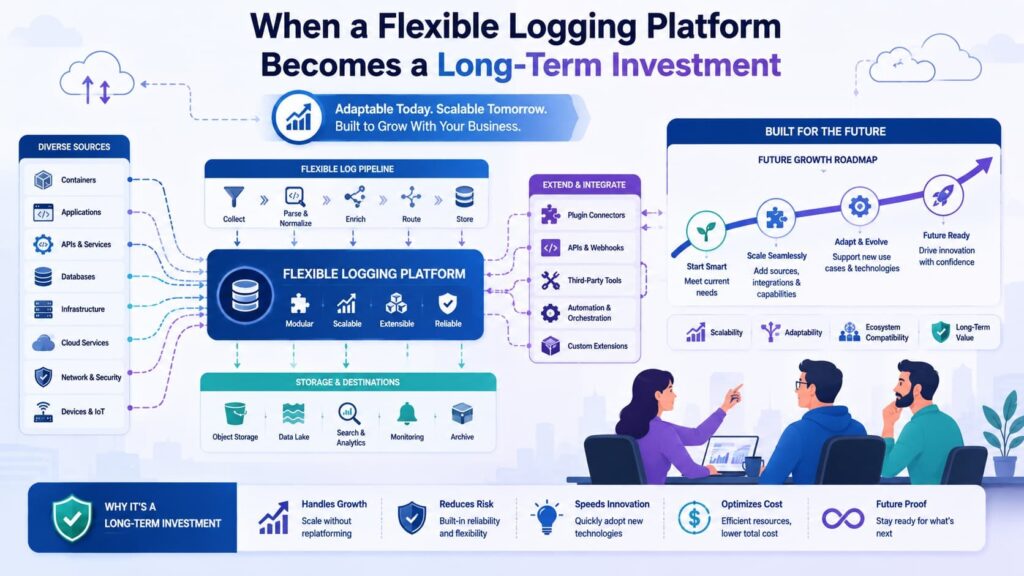
Fluentd is especially valuable when teams manage dozens of application sources, container workloads, and cloud services that require different parsing and forwarding rules Hybrid cloud deployments, microservices, distributed applications, and container platforms continuously introduce new log formats.
Fluentd’s plugin architecture allows organizations to expand data pipelines without redesigning their entire ingestion layer.
That flexibility supports cloud logging, structured logging, log enrichment, and observability initiatives that evolve alongside application development.
From our perspective, rapidly growing software environments benefit most from extensibility because integration requirements rarely remain static for long.
Key strengths include:
- Hybrid cloud support
- Microservices compatibility
- Multi-cloud integration
- Diverse application stacks
- Extensive plugin ecosystem
Organizations emphasizing developer productivity generally accept additional operational complexity in exchange for easier expansion.
Why does extensibility matter?
Business requirements change. New cloud services, analytics platforms, compliance tools, and operational workflows appear regularly. Flexible integration reduces future migration effort.
Which teams gain the biggest advantage?
Developer platform teams and cloud engineering groups often realize the greatest long-term value because application diversity continuously increases.
Can You Use syslog-ng and Fluentd Together?
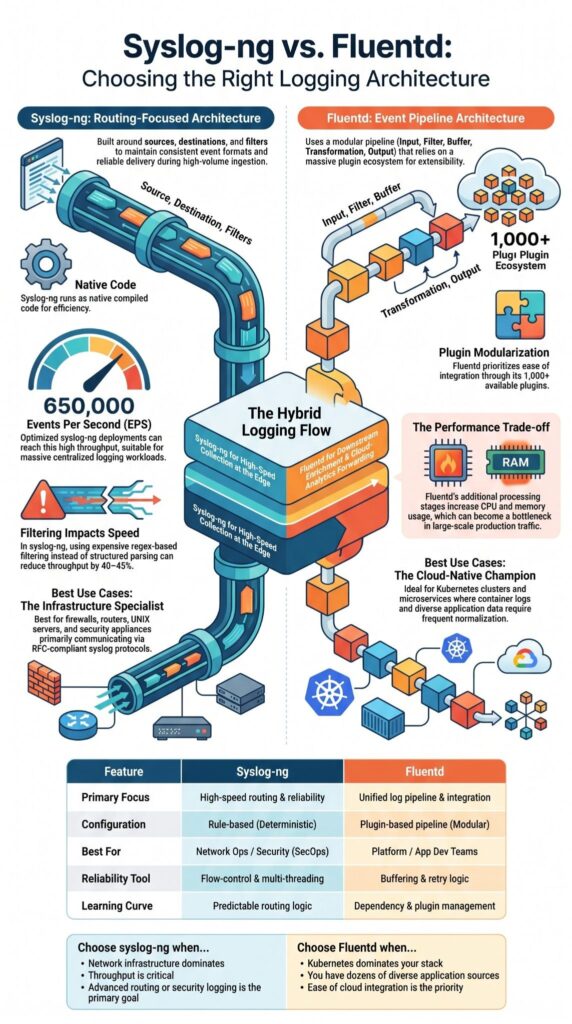
Yes. Many organizations combine both technologies to separate collection from enrichment.
Rather than treating the decision as mutually exclusive, enterprises frequently build layered log pipelines. syslog-ng handles secure log transport, centralized logging, log relaying, and high-volume ingestion, while Fluentd performs downstream enrichment and specialized forwarding.
We have implemented similar architectures at MSSP Security because specialization often improves scalability without increasing operational complexity.
A common deployment flow looks like this:
- Network devices
- syslog-ng (collection and routing)
- Fluentd (enrichment and transformation)
- Kafka (stream buffering)
- Elasticsearch (search and analytics)
- SIEM (security detection)
Separating responsibilities reduces collector specialization trade-offs while allowing each platform to focus on its strongest capabilities.
Why split responsibilities?
Each platform performs different tasks exceptionally well. High-speed ingestion remains close to the network edge, while transformation, enrichment, and cloud integrations occur later within the processing pipeline.
Which architecture scales best?
Layered architectures generally scale more predictably because ingestion, routing, buffering, analytics, and storage can grow independently as demand increases.
Which Tool Should You Choose?
The right choice depends on three measurable factors: log source type, daily event volume, and required processing complexity.
Organizations dominated by network infrastructure, security appliances, audit logging, and traditional syslog sources usually achieve better operational efficiency with syslog-ng.
Academic benchmarking demonstrating approximately 650,000 events per second reinforces its suitability for demanding centralized logging deployments.
Conversely, environments driven by cloud-native applications, Kubernetes logging, structured logging, and diverse integration requirements frequently benefit from Fluentd’s extensible event-processing model.
| Choose syslog-ng when… | Choose Fluentd when… |
| Network infrastructure dominates | Kubernetes dominates |
| Throughput is critical | Integrations matter most |
| Advanced routing is required | Multiple application sources exist |
| Security logging is primary | Cloud-native workloads lead |
Before selecting a platform, every organization should evaluate:
- Primary log sources
- Expected daily log volume
- Routing complexity
- Integration requirements
- Long-term scalability
- Operational expertise
Migration mistakes often occur when teams optimize for popularity instead of operational fit. Benchmarking against real production workloads consistently produces better long-term outcomes than relying solely on feature comparisons.
Maximizing Efficiency with Lightweight Logging Agents
credits: OSS Community
According to the open-source community, optimizing security data pipelines requires selecting log collection agents that balance capability with low hardware overhead.
In modern enterprise infrastructures, standardizing log aggregation across distributed endpoints can quickly drain host resources if the engine is too heavy.
To prevent performance degradation, security operations must prioritize lightweight, C-based forwarders designed specifically to minimize CPU and memory footprints.
By capturing, filtering, and buffering security telemetry directly at the edge with high efficiency, organizations can seamlessly stream logs to central analytical layers without compromising the performance of critical host systems.
FAQ
What is the role of a log collector in centralized logging?
A log collector gathers events from multiple sources and sends them to a central platform for analysis. It supports centralized logging by improving log aggregation, log ingestion, and data forwarding across environments. This makes infrastructure logs, application logs, and security events easier to monitor, search, and manage.
How does log parsing improve log management accuracy?
Log parsing converts raw log messages into structured data that systems can understand and analyze. Using parsing rules, organizations can process JSON logs, multiline logs, and unstructured logs more accurately. This improves log normalization, log enrichment, and log analytics by making important event details easier to identify.
Why is secure log transport important for log shipping?
Secure log transport protects log data while it moves between systems during log shipping. Encrypted connections, such as TLS logging, help prevent unauthorized access and maintain data integrity. This is important for security monitoring, audit logging, and protecting telemetry collected from applications, servers, and network devices.
How does log buffering improve logging reliability?
Log buffering temporarily stores log events when a destination cannot receive data immediately. Techniques such as disk buffering, backpressure, and flow control help prevent data loss during traffic spikes or system failures. This improves reliability, fault tolerance, and failover performance in high-volume logging environments.
What factors determine log pipeline scalability?
Log pipeline scalability depends on how efficiently a system handles event processing, message routing, and increasing data volumes. Key factors include log filtering, log transformation, performance tuning, and processing capacity. Key factors include events per second (EPS), storage throughput, queue capacity, parsing complexity, network bandwidth, and downstream SIEM ingestion limits. A scalable pipeline can support growing telemetry, cloud logging requirements, and security monitoring operations without reducing performance.
Choose Logging That Fits Your Infrastructure
When your infrastructure grows, managing scattered logs can become frustrating. You need a logging setup that keeps data moving without adding extra complexity. The right choice depends on how your environment works today and where it needs to go next.
A balanced approach can help you build a reliable logging process with room to adapt as your needs change.
For MSSPs looking to optimize their logging strategy, expert consulting can help reduce tool sprawl, improve integration, and select the right solutions for long-term growth.
With experience across vendor evaluation, audits, PoC support, and technology optimization, the right guidance can help build a stronger and more efficient security stack. Learn how MSSP-focused consulting can support your next step with MSSP Security consulting services.
References
- https://outshift.cisco.com/blog/in-depth-tech/logging-operator-4-0-release
- https://digikogu.taltech.ee/en/Download/cf17ba97-4850-4fde-a64f-3c61713c9a35/Logideusaldusvrseedastamisejaterviklusetaga.pdf