


Automated vulnerability scanning helps organizations identify security weaknesses faster, maintain consistent assessments, and reduce exposure to cyber threats. As IT environments become more complex, manual scanning alone often cannot keep pace with evolving risks.
At MSSP Security, we’ve seen automated scanning improve visibility and support more efficient vulnerability management. Keep reading to discover the key automated vulnerability scanning benefits and learn how they can help organizations strengthen their security posture.
Why Should Organizations Use Automated Vulnerability Scanning?
Automated vulnerability scanning delivers the most value when combined with continuous monitoring, risk-based remediation, and expert oversight.
- Improves security posture with continuous monitoring, faster detection, and reduced attack surface.
- Accelerates vulnerability management by reducing manual effort and speeding remediation.
- Supports compliance, DevSecOps, and centralized reporting for better visibility and scalable security operations.
What Are the Benefits of Automated Vulnerability Scanning?
The main automated vulnerability scanning benefits are faster vulnerability detection, continuous visibility, and more consistent security assessments.
Instead of relying only on manual reviews, organizations can schedule scans or run them continuously to identify known vulnerabilities, missing patches, insecure configurations, and newly disclosed CVEs across networks, cloud environments, web applications, and endpoints.
For a deeper understanding of how these tools work, see our Vulnerability Scanner Technology Explained guide.
As environments grow, keeping track of every asset manually becomes more difficult. Automated scanning helps organizations:
- Detect vulnerabilities earlier before they become larger security issues.
- Improve comprehensive asset coverage across on-premises, cloud, and hybrid environments.
- Reduce human error by following consistent scanning policies.
- Save time by automating routine tasks such as scheduling scans, collecting results, and generating reports.
In our work at MSSP Security, we regularly help MSSPs evaluate and audit security products as their environments evolve.
We’ve found that organizations using continuous vulnerability scanning often have a clearer view of their risk exposure because security teams spend less time managing repetitive processes and more time reviewing findings, validating results, and planning remediation.
Automation doesn’t replace security expertise, but it gives teams more reliable information to make informed decisions.
How Does Automated Vulnerability Scanning Improve Security Posture?
Building a strong security posture starts with understanding where vulnerabilities exist before attackers have a chance to exploit them.
One of the biggest automated vulnerability scanning benefits is continuous visibility, enabling organizations to identify newly disclosed CVEs, missing patches, insecure configurations, and other security gaps as their environments evolve.
Instead of waiting for the next scheduled assessment, security teams can monitor changes as they happen and respond more quickly.
The importance of continuous monitoring is also reflected in guidance from the Cybersecurity and Infrastructure Security Agency (CISA):
“This service continuously monitors and assesses internet-accessible network assets (public, static IPv4 addresses) to evaluate their host and vulnerability status.” – CISA
This guidance highlights why continuous scanning has become a core part of modern vulnerability management. By identifying changes sooner, organizations can reduce the time vulnerabilities remain exposed and begin remediation before risks escalate.
Automated scanning helps strengthen security by:
- Detecting vulnerabilities earlier across cloud, hybrid, and on-premises environments.
- Reducing the attack surface by identifying outdated software, exposed services, and weak configurations.
- Improving risk visibility through centralized dashboards that support risk-based remediation.
- Responding faster to newly disclosed vulnerabilities before they become larger security issues.
Working with MSSP Security, we’ve helped MSSPs evaluate and audit security products for a wide range of customer environments.
One thing we’ve learned is that better visibility alone isn’t enough. It needs to lead to better decisions.
When routine detection is automated, security teams can spend more time validating findings, assessing business impact, and selecting the solutions that best support long-term vulnerability management.
Why Is Automated Scanning Better Than Manual Vulnerability Assessments?
When evaluating automated scan vs manual scan benefits, the two approaches should be viewed as complementary rather than competing.
Automated vulnerability scanning is ideal for recurring assessments because it delivers consistent results, scales across large environments, and identifies issues much faster than manual reviews.
Manual assessments remain valuable when security teams need to validate complex findings, assess business-specific risks, or investigate issues that require human judgment.
The comparison below highlights where each approach delivers the greatest value:
| Feature | Automated Vulnerability Scanning | Manual Vulnerability Assessment |
| Scan Frequency | Scheduled or continuous | Periodic or on demand |
| Detection Speed | Fast, with automated notifications | Slower, depends on analyst availability |
| Coverage | Broad coverage across cloud, hybrid, and on-premises assets | Usually limited to the defined assessment scope |
| Consistency | Standardized policies and repeatable results | May vary by analyst and methodology |
| Scalability | Easily scales to large environments | Requires additional time and resources |
| Human Expertise | Supports routine detection | Essential for validation, business context, and complex testing |
| Best Use Case | Continuous vulnerability management | Deep investigation and validation |
For most organizations, automation provides the foundation for a consistent vulnerability management program because it can:
- Perform consistent assessments using predefined policies and standardized detection logic.
- Reduce manual effort by automating scan scheduling, reporting, and remediation tracking.
- Improve comprehensive asset coverage across cloud, hybrid, and on-premises environments.
- Minimize human error by applying the same security baselines during every scan.
Through our work at MSSP Security, we’ve helped MSSPs evaluate and audit security products across a wide range of customer environments.
One pattern we’ve consistently observed is that organizations achieve better results when automation handles routine assessments while experienced analysts focus on validating findings and managing false positives scanners.
This balance allows security teams to prioritize genuine risks, make more informed product decisions, and ensure the selected solutions align with both operational requirements and long-term security objectives.
How Does Automation Speed Up Vulnerability Management?
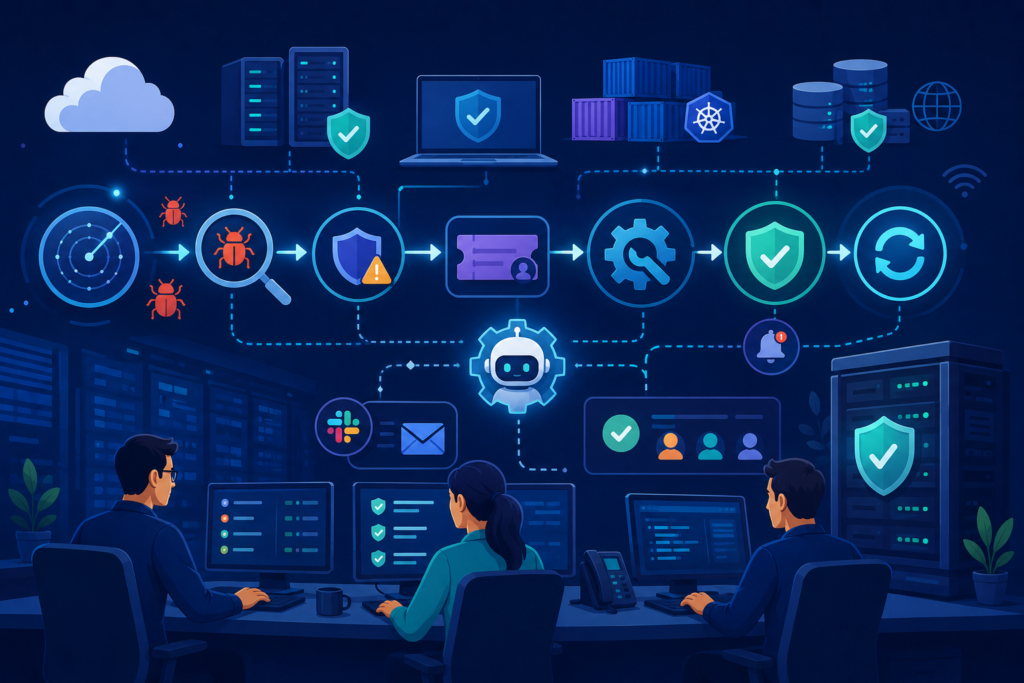
Speed matters in vulnerability management because finding a security issue is only the first step. One of the biggest automated vulnerability management benefits is reducing the time between detection and remediation.
Automated scanning helps lower Mean Time to Detect (MTTD) by identifying newly disclosed CVEs, missing patches, and configuration issues as environments change. It also supports a faster Mean Time to Remediate (MTTR) by keeping remediation activities organized and visible.
Automation helps organizations streamline the remediation process by:
- Detecting new vulnerabilities through continuous or scheduled scans.
- Prioritizing findings based on risk, asset criticality, and business impact.
- Automating notifications, remediation tickets, and progress tracking.
- Confirming fixes with automatic rescans after patches are deployed.
As we work with MSSP Security clients to evaluate and audit security products, we’ve seen how risk-based automated vulnerability management helps teams focus on the vulnerabilities that matter most.
Once findings are prioritized, security teams should also understand the importance of interpreting vulnerability scan results correctly to determine business impact and remediation priorities.
Instead of spending valuable time sorting reports or coordinating manual follow-ups, security teams can review prioritized findings, validate remediation, and make decisions based on current risk data.
That combination of automation and expert oversight leads to a more efficient and sustainable vulnerability management process.
How Does Automated Scanning Improve Visibility Across Modern IT Environments?

Maintaining visibility becomes increasingly difficult as organizations expand across on-premises infrastructure, cloud platforms, containers, web applications, remote endpoints, and hybrid environments.
One of the biggest automated vulnerability scanning benefits is continuous visibility, allowing security teams to identify new assets and security gaps as their environments evolve instead of discovering them during periodic reviews.
This approach is also reflected in guidance from the Cybersecurity and Infrastructure Security Agency (CISA):
“Establish Routine Assessments. Regularly review and monitor your internet-accessible assets. As your organization’s IT environment evolves, continuous assessments help maintain a secure posture and quickly identify new exposures.” – Cybersecurity and Infrastructure Security Agency (CISA)
Continuous assessments make it easier for organizations to keep pace with infrastructure changes while reducing blind spots that attackers could exploit. Automated scanning helps security teams:
- Increase comprehensive asset coverage across cloud, hybrid, and on-premises environments.
- Discover newly deployed assets, exposed services, and shadow IT before they are overlooked.
- Support unified scanning across hybrid environments with consistent security policies.
- Use centralized dashboards to monitor vulnerability trends, remediation progress, and high-risk assets.
At MSSP Security, we’ve helped MSSPs evaluate and audit security products built for complex environments.
One thing we’ve consistently seen is that centralized visibility changes how teams prioritize risk. Instead of spending hours consolidating reports from different tools, they can focus on understanding the findings, selecting the right products for their environment, and making faster, more informed remediation decisions.
What Operational Benefits Can Organizations Expect from Automated Vulnerability Scanning?
The automated vulnerability scanning benefits extend beyond stronger security. Automation also helps organizations simplify day-to-day operations by reducing the time spent on repetitive vulnerability management tasks.
As environments grow, handling assessments manually becomes more difficult, making consistent workflows harder to maintain.
Organizations often use automation to:
- Save time by automating scan scheduling, reporting, remediation tracking, and notifications.
- Reduce operational costs by limiting repetitive manual work.
- Support enterprise-wide vulnerability scanning automation with consistent policies across large environments.
- Enable continuous security monitoring so new vulnerabilities can be identified throughout the day.
As we work with MSSP Security clients, helping MSSPs evaluate and audit security products, we’ve seen operational efficiency become a major factor in product selection.
Teams that automate routine assessments spend less time managing scan operations and more time reviewing results, validating risks, and deciding whether a solution fits their long-term security strategy.
In many cases, automation allows organizations to scale their vulnerability management program without adding the same level of manual effort.
How Does Automated Vulnerability Scanning Support Compliance?
Meeting compliance requirements is much easier when vulnerability management follows a consistent process.
One of the practical automated vulnerability scanning benefits is that it helps organizations maintain the records needed for audits without relying on manual documentation.
Regular scans, automated reporting, and documented remediation activities create a clearer picture of how security risks are being managed over time.
Organizations commonly use automation to:
- Generate standardized reports with scan history, remediation status, and patch verification.
- Maintain detailed audit trails that improve governance and accountability.
- Document ongoing vulnerability monitoring and remediation activities throughout the year.
- Support compliance with PCI DSS, ISO 27001, CIS Controls, and NIST-based security programs.
Through our work at MSSP Security, we’ve helped MSSPs evaluate and audit security products where reporting and audit capabilities are just as important as detection accuracy.
We’ve found that solutions with reliable documentation make compliance reviews much smoother because security teams can quickly demonstrate that assessments, remediation efforts, and ongoing monitoring have been performed consistently rather than assembling evidence at the last minute.
How Does Automated Scanning Fit Into Modern Security Operations?
Modern security programs work best when security tools exchange information instead of operating in isolation.
One of the key automated vulnerability scanning benefits is that it fits naturally into existing workflows, helping organizations identify vulnerabilities earlier and move remediation forward with fewer manual steps.
Organizations often integrate automated scanning to:
- Connect with CI/CD pipelines and support shift-left security during software development.
- Strengthen DevSecOps by continuously scanning code, container images, cloud workloads, and web applications.
- Sync with ticketing systems to automate remediation assignments and track progress.
- Work alongside SOAR platforms to trigger automated playbooks based on vulnerability severity.
As we help MSSP Security clients evaluate and audit security products, integration is one of the areas we review most closely.
We’ve seen that tools delivering the best results are those that fit smoothly into existing security operations rather than adding another disconnected process.
When scan results move directly into development, IT, and security workflows, teams spend less time coordinating tasks and more time resolving vulnerabilities before they affect production systems.
Where Does Automated Vulnerability Scanning Deliver the Most Value?
Credit: YouAccel
The automated vulnerability scanning benefits are most noticeable in environments where infrastructure changes regularly.
As organizations adopt cloud services, hybrid architectures, remote work, and modern application platforms, keeping track of every asset manually becomes increasingly difficult.
Automated scanning helps maintain continuous visibility so security teams can identify new risks as environments evolve.
Organizations commonly use automated scanning for:
- Cloud infrastructure vulnerability scanning to monitor dynamic cloud resources.
- Container vulnerability scanning throughout application development and deployment.
- Web application vulnerability scanning to identify security weaknesses before they reach production.
- Internal networks, remote work environments, and hybrid infrastructure with constantly changing assets.
- Large enterprise environments that require consistent vulnerability assessments at scale.
Working with MSSP Security, we regularly help MSSPs evaluate and audit products for different customer environments. One thing we’ve consistently observed is that no single solution fits every deployment model.
Organizations see better results when they choose scanning tools that match how their infrastructure operates, making it easier to maintain visibility, support consistent vulnerability management, and adapt as their environments continue to grow.
How Can Organizations Maximize the Benefits of Automated Vulnerability Scanning?
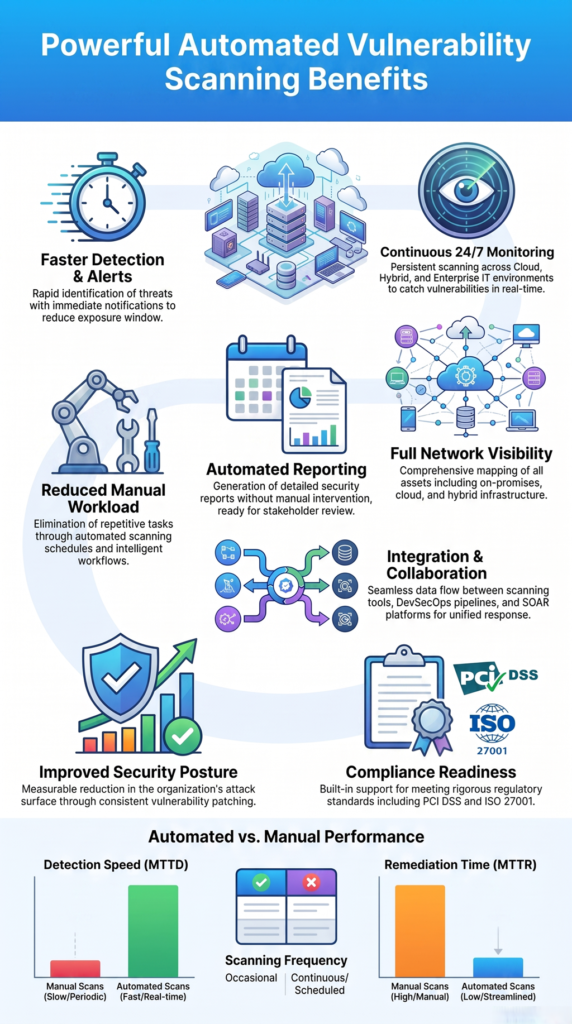
Organizations achieve the greatest automated vulnerability scanning benefits when automation is supported by clear security processes and regular oversight.
While automated scanning improves efficiency and visibility, long-term success depends on how scan results are reviewed, prioritized, and integrated into the overall vulnerability management program.
To maximize the value of automated scanning, organizations should:
- Run vulnerability scans on a consistent schedule.
- Keep vulnerability signatures and detection feeds up to date.
- Prioritize remediation based on business risk, not severity scores alone.
- Validate fixes through automatic rescans and review recurring findings.
- Monitor long-term trends using centralized dashboards.
- Combine automated detection with expert analysis for high-risk vulnerabilities.
At MSSP Security, we help MSSPs evaluate and audit security products that align with operational and business requirements.
We’ve found that automation delivers the best results when it supports experienced security teams, providing reliable data while leaving risk evaluation, product selection, and remediation decisions to security professionals.
FAQ
What are the main benefits of automated vulnerability scanning?
The primary benefits include faster vulnerability detection, continuous monitoring, improved asset visibility, reduced manual effort, standardized assessments, better compliance support, and more efficient vulnerability remediation.
Is automated vulnerability scanning better than manual scanning?
Automation is generally better for routine and continuous assessments because it provides greater consistency, scalability, and speed. Manual assessments remain valuable for validating findings, investigating complex scenarios, and performing advanced security testing. Most organizations benefit from using both approaches together.
How often should automated vulnerability scans run?
The ideal frequency depends on the organization’s risk profile, compliance requirements, and infrastructure changes. Critical internet-facing assets often benefit from continuous or frequent scanning, while lower-risk systems may follow scheduled assessment cycles.
Can automated vulnerability scanning improve compliance?
Yes. Automated scanning supports compliance by generating consistent reports, maintaining audit trails, documenting remediation activities, and helping organizations demonstrate ongoing vulnerability management practices for frameworks such as PCI DSS and ISO 27001.
Can automated vulnerability scanning detect newly published CVEs?
Yes. Once vulnerability detection signatures are updated, automated scanners can identify affected systems during scheduled or continuous assessments, enabling organizations to begin remediation more quickly.
Why Should Organizations Invest in Automated Vulnerability Scanning?
The automated vulnerability scanning benefits include stronger visibility, faster detection, improved compliance, and more efficient vulnerability management across modern IT environments.
At MSSP Security, we’ve helped MSSPs evaluate and audit security products that align with their operational and business goals. Our experience shows that automation delivers the most value when combined with expert guidance.
To learn how we help MSSPs select the right security tools, optimize their technology stack, and improve long-term security operations.
References
- https://www.cisa.gov/cyber-hygiene-services
- https://www.cisa.gov/resources-tools/resources/exposure-reduction