


Open source SIEM alternatives MSSP teams choose can reduce licensing costs and provide greater flexibility, but they also require careful planning, ongoing maintenance, and the right architecture. Success depends less on the software itself and more on how well the platform supports multiple clients, growing data volumes, and daily security operations.
At MSSP Security, we help providers evaluate and audit security platforms based on long-term operational fit, not marketing claims or feature counts. The right choice should support reliable service today while remaining practical to scale tomorrow. Keep reading to see what matters most before making your next platform decision.
Before You Build: The Essentials
Building an open-source SIEM for an MSSP is less about finding free software and more about creating an architecture that remains secure, scalable, and manageable as your client base grows.
- Total cost shifts from licensing to engineering and infrastructure, making staffing and scaling the true long-term expenses.
- Multi-tenancy is an architectural challenge, not a feature, often solved with per-client instances or complex data partitioning.
- Wazuh provides the fastest path to production, while Elastic/OpenSearch offers maximum control for teams ready to build their own platform.
What Do MSSPs Really Need From an Open Source SIEM?

Choosing an open-source SIEM is about much more than downloading software. We’ve worked with providers who expected open source to cut costs right away. Instead, they found their teams spending more time maintaining the platform than supporting clients. It simply means success depends on planning for the work that comes with it.
From our experience auditing security platforms, the strongest MSSPs focus on operations first and features second. A SIEM should support the way analysts work instead of creating extra tasks. Every client also expects the service to stay secure, organized, and reliable as the business grows.
A solid platform should provide:
- Separate and secure customer environments
- Clear reporting and useful dashboards
- Reliable alerts with fewer false positives
- Flexible retention settings for different compliance needs
- Simple workflows that help analysts respond faster
We’ve seen providers grow steadily because they treated the SIEM as one part of a larger security service, not the entire solution. Our role is helping MSSPs review products before they invest. The best SIEM platforms for MSSPs have shown that long-term operational fit almost always matters more than an extensive feature list.
What Is the Hidden Price of a “Free” SIEM?
A free SIEM can lower software costs, but it does not remove the cost of running the platform. Some MSSPs expect savings right away, but the biggest expenses often appear after deployment. As clients grow, so do storage needs, computing resources, and the time required to keep everything running smoothly.
People are usually the biggest long-term investment. From our experience, security teams spend far more time maintaining the platform than many expect. Daily work often includes tuning detection rules, reducing false positives, updating integrations, and troubleshooting issues. These tasks become part of normal operations, not one-time projects.
Research from Kaspersky shows
“While the upfront implementation cost of an OSS SIEM might be lower due to the absence of license fees, this difference often erodes during the maintenance phase. This is because of the continuous, additional expense of qualified staff dedicated solely to SIEM development. Over the long term, the total cost of ownership (TCO) for an OSS SIEM often turns out to be higher.” – Kaspersky Official Blog
Before choosing a platform, we encourage providers to look beyond the initial setup.
Key cost areas include:
| Cost Area | Long-Term Impact |
| Infrastructure | More storage and compute as data grows |
| Detection Engineering | Ongoing rule tuning and testing |
| Platform Maintenance | Updates, patches, and integrations |
| Operations | Daily monitoring and troubleshooting |
| Staff | Skilled engineers to manage the platform |
We’ve found that the strongest MSSPs plan for these ongoing costs early. Realistic budgeting leads to better product decisions, fewer surprises, and a security service that stays reliable as the business grows.
How Can You Build a Platform That Grows With Your MSSP?
Credits: Taylor Walton
Growth is great until the platform starts falling behind. We’ve seen this happen during product reviews for growing MSSPs. A setup that runs smoothly for a handful of clients can struggle once log volume increases and new customers are added. That’s why we always encourage providers to think about scalability before it becomes a problem.
As noted by Todyl
“As environments scale and security expectations rise, however, certain challenges tend to emerge. These challenges that aren’t always obvious at the start and can end up leading to unexpected costs later…What starts as a ‘free’ SIEM can quietly become a significant operational burden, especially for teams without dedicated security engineering resources.” – Todyl Blog
A strong foundation should support both current needs and future growth. From our experience auditing security platforms, the best environments are designed to expand without major changes. They can handle higher workloads while keeping operations stable.
We usually look for capabilities such as:
- Storage that grows with log volume
- Processing power that scales with demand
- Reporting that stays fast as data increases
- Automation that reduces manual work
- Flexible support for new security and compliance requirements
It also helps to think beyond a single product. We’ve found that MSSPs with a flexible architecture can add new tools, complete upgrades, and pass audits with far less disruption. Planning for growth from the beginning almost always saves time, lowers costs, and prevents expensive redesigns later as the business continues to expand.
Why Does Multi-Tenancy Matter So Much for MSSPs?
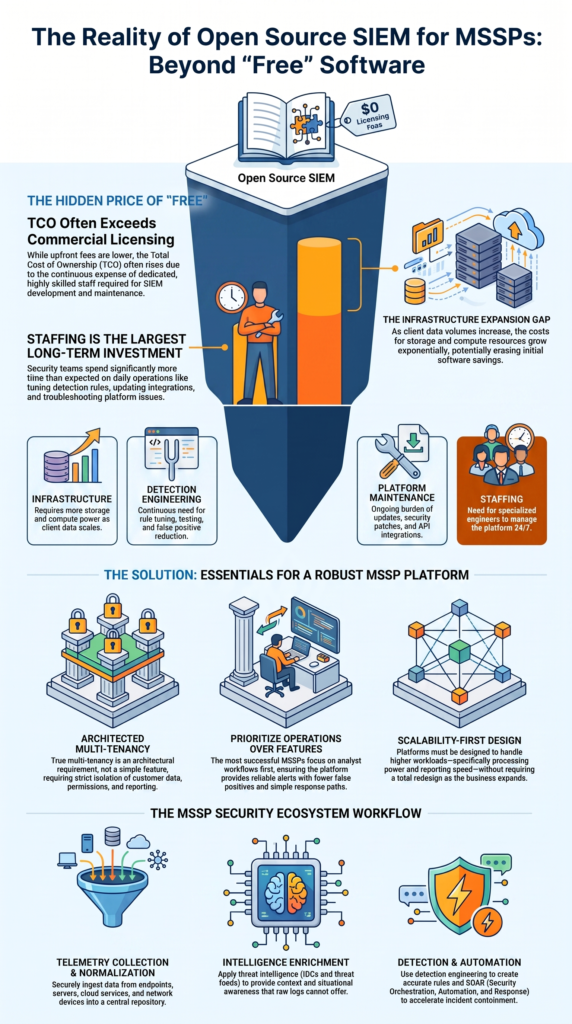
Multi-tenancy is often the point where an MSSP learns if its platform can handle real customer workloads. Sharing one environment may sound simple, but it rarely stays that way as more clients come onboard. We’ve reviewed many deployments where customer data, permissions, and reports became difficult to manage over time.
Fixing those problems later usually takes far more effort than building the environment correctly from the start. This is also where comparing SIEM platforms MSSPs use becomes valuable, since differences in tenant isolation, access controls, and data management often have a much bigger operational impact than feature lists alone.
Each client should have the experience of using a dedicated environment, even when the infrastructure is shared. In our audits, we look for a few key areas that protect both the provider and its customers:
- Clear separation between customer data
- Role-based access for analysts and administrators
- Client-specific alert rules and policies
- Flexible data retention to meet compliance needs
- Reporting that only shows the right customer information
We’ve found that a well-planned multi-tenant environment lowers operational risk, helps analysts work faster, and gives customers greater confidence that their data stays protected as the service expands.
How Do You Build a Complete MSSP Security Platform?
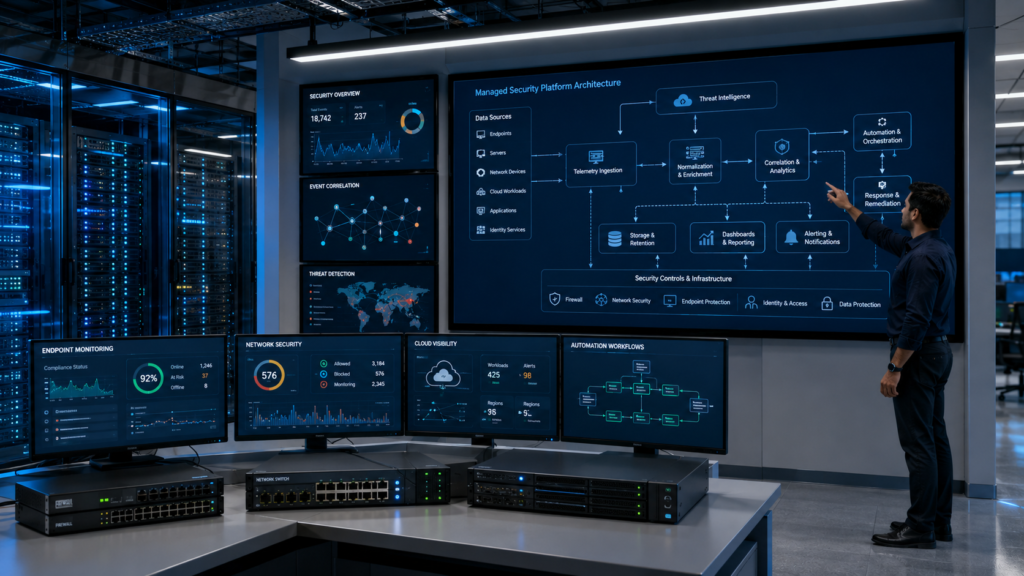
No single product solves every security problem. That’s something we’ve learned after reviewing many MSSP environments over the years. Strong providers build an ecosystem instead of depending on one platform to handle everything. The SIEM becomes the center, while other security tools contribute valuable information that strengthens detection and response.
A typical workflow starts with collecting telemetry from endpoints, servers, cloud services, and network devices. That information is normalized, enriched with threat intelligence, analyzed against detection rules, and then passed into automated workflows where appropriate. High-confidence alerts reach analysts quickly, while routine actions can often be automated to reduce workload.
In many environments, integrating different SIEM platforms can improve visibility across diverse customer infrastructures.
A complete platform should support:
- Secure data collection
- Reliable alerting
- Threat intelligence enrichment
- Detection rule management
- Automation where it adds value
- Clear reporting for clients
Our role at MSSP Security is helping providers audit these platforms before major investments are made. The goal isn’t to chase the newest technology. It’s to build an environment that remains dependable as customers, data volume, and security demands continue growing.
FAQ
How does threat intelligence improve an open source SIEM?
Threat intelligence adds valuable context to security data that raw logs alone cannot provide. By using threat indicators, IOC enrichment, and threat feed ingestion, organizations can improve SIEM correlation and strengthen analytics-driven defense.
These capabilities support better alert prioritization, improve situational awareness, reduce investigation time, and help analysts focus on the security events that present the highest risk.
Why is detection engineering important for an open source SIEM?
Detection engineering helps security teams create accurate detection rules that reflect real attack techniques instead of relying only on default content. It improves log enrichment, supports anomaly detection, strengthens malware detection, and reduces unnecessary alerts through false positive reduction.
Regular rule tuning also keeps detections effective as threats and business environments continue to change.
How can organizations strengthen security controls around an open source SIEM?
Strong security controls require more than collecting and storing logs. Organizations should combine preventive controls, detective controls, corrective controls, access control, and control hardening with regular control validation. Reviewing control mapping and measuring control effectiveness also help identify security gaps, improve governance compliance, and maintain audit readiness over time.
What role does security automation play in an open source SIEM?
Security automation reduces manual work and helps security teams respond more quickly to threats. Well-designed SOAR workflow processes support incident response, incident containment, response playbooks, and response acceleration.
When combined with telemetry correlation and decision support, automation improves response consistency, shortens investigation time, and allows analysts to focus on higher-priority incidents.
How does an intelligence-led security strategy reduce cyber risk?
An intelligence-led security strategy uses actionable intelligence, strategic intelligence, operational intelligence, and tactical intelligence to guide security decisions. It also supports threat hunting, MITRE ATT&CK mapping, kill chain analysis, threat attribution, risk-based security, and risk mitigation.
Together, these practices strengthen threat-driven defense, improve cyber resilience, and help organizations respond more effectively to evolving cyber threats.
Choose the Right Platform for Long Term Success
Open source SIEM platforms offer flexibility, but lasting success depends on operational readiness rather than software alone. Organizations that evaluate engineering capabilities, scalability, and ongoing maintenance before investing are better prepared to build reliable security services that grow with their business.
Making the right platform decision starts with understanding your operational needs and long-term goals. Connect with MSSP Security to evaluate security technologies with confidence and reduce deployment risk.
References
- https://www.kaspersky.co.uk/blog/open-source-siem-hidden-costs/29039/
- https://www.todyl.com/blog/evaluating-free-open-source-siem-tools-2026