

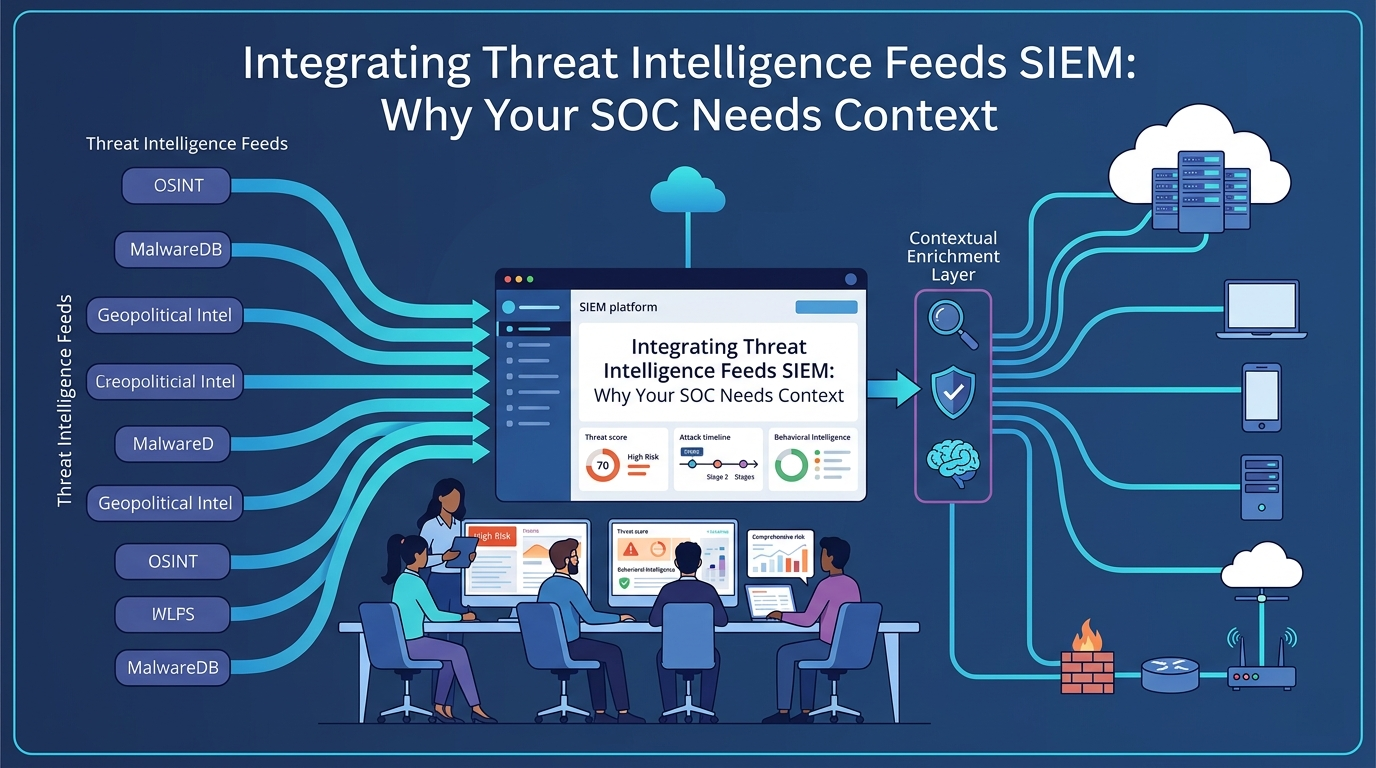
Integrating Threat Intelligence Feeds SIEM helps reduce alert fatigue and improve SOC accuracy. Learn how to filter, enrich, and optimize threat intelligence before it overwhelms your SIEM.
Connecting your SIEM to external threat intelligence feeds changes everything. Raw logs become specific alerts. Your analysts get the full picture: who is attacking, how they’re doing it, and why you should care. Skip this, and you’re just watching meaningless blips, trying to guess. This bridge turns observation into action. It’s the key to moving from passive monitoring to proactive defense. Ready to make that shift? Keep reading.
SIEM-CTI Reality Check
Building an effective SIEM-CTI strategy is less about collecting more data and more about filtering, prioritizing, and correlating the right intelligence before it overwhelms your SOC.
- Unfiltered threat feeds create alert fatigue and skyrocket cloud SIEM costs, not security.
- A Threat Intelligence Platform (TIP) as middleware is crucial for normalizing and scoring data before your SIEM sees it.
- Behavioral correlation using frameworks like MITRE ATT&CK is more valuable than static blocklists of IPs and domains.
Understanding Integrating Threat Intelligence Feeds Into a SIEM
Your SIEM logs everything, but it’s just a record of events. Adding threat intelligence feeds changes that. It’s like having a team cross-reference your logs against a live database of known criminals and their tools.
Suddenly, a generic alert becomes specific. For example, we’ve seen generic alerts become specific like ‘suspicious outbound connection’ to ‘connection to C2 server used by FIN7. That context is critical. It moves your team from guessing to knowing.
The feeds work with two kinds of data. Simple Indicators of Compromise (IoCs) like bad IPs, and more valuable Tactics, Techniques, and Procedures (TTPs) that map out attacker behavior.
Without this layer, you’re only seeing half the story. You see the action, but not the actor or their intent. For an MSSP, this integration is what separates basic monitoring from true defensive hunting through integrating threat intel SIEM workflows. We help make that shift.
SIEM-CTI Architectures That Actually Scale
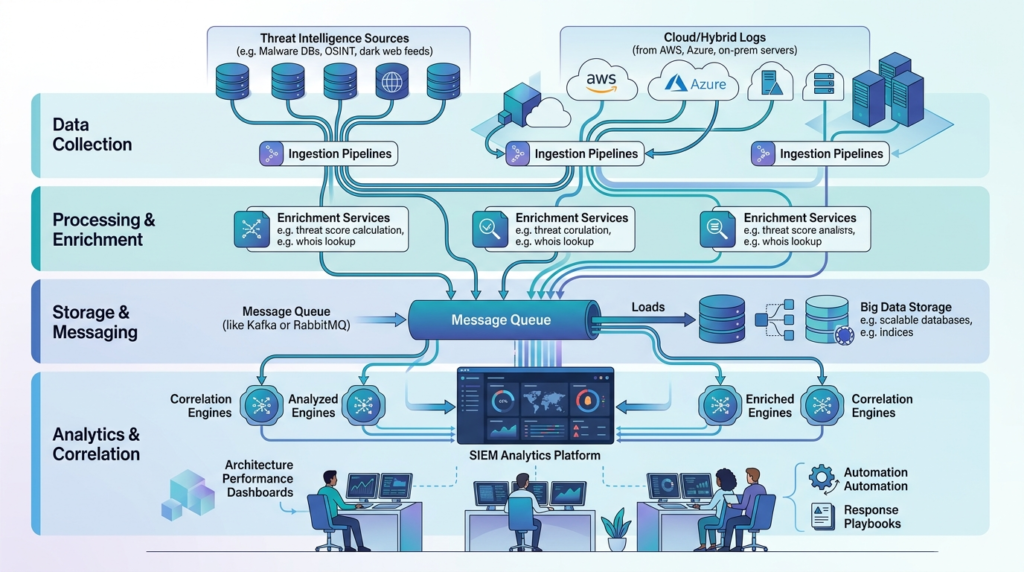
When scaling a SIEM, you face a basic choice: feed data directly in or filter it first. The direct method is simple. Connect the API and go. But it leads to a bloated database full of expired or irrelevant indicators, creating overwhelming noise and cost.
Our experience shows a middle layer is critical. A Threat Intelligence Platform (TIP) acts as a filter. It ingests all your feeds, normalizes the messy formats, and removes duplicates. It passes only high-confidence, relevant threats to your SIEM as part of a broader threat intelligence service strategy.
This cuts costs and boosts performance. Your SIEM correlates against a refined list, not a raw dump, which prevents slowdowns. For MSSPs, this architecture is non-negotiable for efficient operations.
Understanding Threat Intelligence Correlation Inside a SIEM
Inside a SIEM, correlation rules are always running. Adding threat intel gives those rules a new dictionary. A basic rule might alert on any connection to a known bad IP from your feed.
But the real power is in behavioral correlation. We design rules that look for attack patterns, not just single indicators. For example, a process launching from a temp folder that then calls out to a suspicious domain. That’s a story, not just an event.
Here’s the practical trade-off we see:
| Detection Type | Best Use Case | Performance Impact |
| Static IoC Matching | Blocking known bad IPs, domains, hashes | Low to Moderate |
| Behavioral Correlation | Detecting multi-stage attacks, advanced threats | High |
Attackers constantly change their tools. IPs go dead, domains get taken down. Their core behavior, however, stays more consistent. That’s why we push MSSPs to build rules around Tactics and Techniques, using frameworks like MITRE ATT&CK as a guide. It creates resilient detection that doesn’t break when a blocked IP gets reassigned to a normal business a week later.
Why “Real-Time” Threat Feeds Break Mid-Sized SOCs
Real-time threat feeds sound great in theory. They promise immediate awareness. In reality, they often drown SOCs in false positives. An IP gets flagged, your SIEM alerts, but the activity might have been a brief, already-resolved event on a temporary server. You’re left chasing phantoms.
In a recent analysis by AIS eLibrary
“Analysts in Security Operation Centers (SOCs) face numerous alerts daily, with 50% to 90% being false positives, leading to alert fatigue, a state of desensitization and cognitive overload that raises the risk of successful cyberattacks.” – AIS eLibrary
The problem is a lack of context. Many feeds don’t specify if an indicator is dangerous as a source, destination, or only in a specific scenario. This forces generic rules that fire constantly, creating alert fatigue.
For cloud-based SIEMs, this is also a financial drain. Ingesting and storing every raw indicator, much of it obsolete in days, is unsustainable. The goal should be filtering for only what’s relevant and high-confidence, which is a core part of our work with MSSPs.
Managing Indicator Lifecycles Inside the SOC
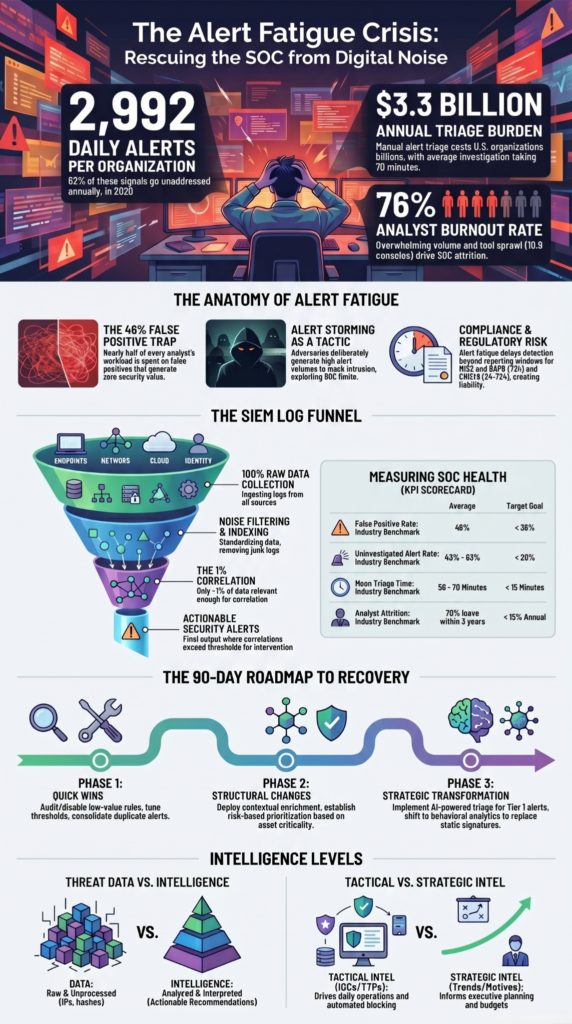
A true SOC moves from collecting indicators to curating them. Each one has a different lifespan. A malicious IP might be active for only 48 hours before it’s cleaned. A file hash, however, is permanent. Treating them the same floods your system with stale data.
As noted by arXiv
“By facilitating the exchange of IOCs and sightings among stakeholders, such platforms allow SOC employees to prioritize which IOCs must be monitored and which alerts require immediate attention.” – arXiv
We enforce strict Time-To-Live policies. Volatile indicators get short expirations, while stable ones persist. This is managed in your TIP.
A critical, often overlooked, step is hash normalization. Many feeds still provide MD5 hashes, but modern EDR tools and SIEMs use SHA256. Without translating an MD5 hash to its SHA256 equivalent, your system can’t match it to what your endpoints actually see. This gap renders indicators useless. We build the translation logic to close it.
Reducing CTI Noise Before It Reaches the SIEM
The fix is to filter the data before it reaches your costly SIEM. Tools like Cribl or your TIP can act as this cleansing layer. The workflow is simple but essential.
- Aggregate: Pull in all your selected feeds.
- Deduplicate: Remove duplicate entries across feeds.
- Score: Apply confidence scores; filter out low-confidence indicators.
- Normalize: Transform all data into a consistent schema (e.g., all IPs in one field, all hashes as SHA256).
- Forward: Send only the processed, high-value data to the SIEM.
Confidence scores are key. An indicator from a premium feed with 95% confidence is reliable. One from an unvetted source with 40% confidence is suspect. We set rules to alert only on high-confidence data, especially in industry-specific threat intelligence environments where false positives can disrupt operations. This stops the firehose of noise and lets analysts focus on actual threats.
The Biggest Technical Edge Cases in SIEM-CTI Integration
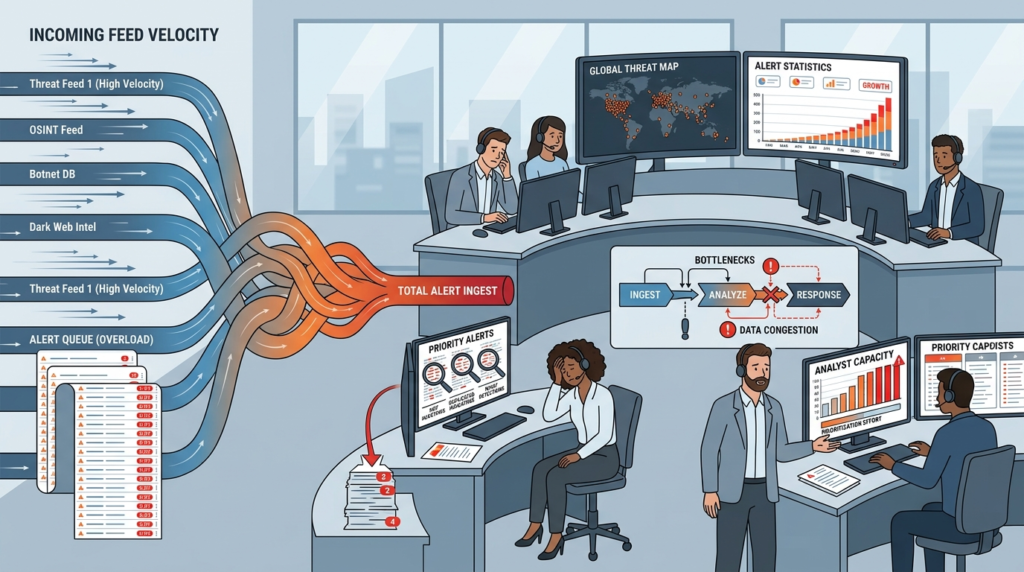
Real-world integrations break in subtle ways. Some cloud SIEMs have performance limitations like a 14-day query horizon for correlation rules. For performance, correlation rules might only check the last two weeks of threat intel data. If a valid indicator is older, your automation misses it. You need workarounds like custom tables.
Schema mismatches are another headache. One feed uses “source_ip,” another uses “origin_address.” Your SIEM needs a single, common field name to correlate properly. Hash format mismatches (like MD5 vs. SHA256) also silently break detection. This normalization is usually manual scripting work.
Vendor licensing creates its own traps. Some SIEMs charge extra for official threat intel connectors or limit feed counts on lower plans. We’ve built API scripts that pull data directly into a custom SIEM table, bypassing the paywalled module entirely.
How CTI Improves Automated SOC Response Workflows
Credits: Cortex by Palo Alto Networks
A SIEM alert with threat intelligence isn’t just a notification. It’s a validated incident with a dossier attached. This context lets your SOAR platform act intelligently. A playbook can trigger a rule like: “If the alert is confirmed and linked to a known ransomware group, isolate the host and block the IPs at the firewall.”
That automation loop slashes remediation time from hours to seconds. For the analyst, triage is faster. They don’t start from zero. They see the threat actor, the campaign, and likely next steps immediately. This is the shift we help build: moving a SOC from reactive firefighting to a team that can proactively contain threats.
FAQs
How Does SIEM Threat Intel Scoring Reduce False Positives?
SIEM threat intel scoring helps analysts identify high-confidence threats instead of investigating every alert equally. Combined with SIEM threat intel filtering, it reduces alert fatigue, improves detection accuracy, and supports faster incident response workflows.
Why Are Threat Intel Pipelines Important for SIEM Operations?
Threat intel pipelines organize and process data from multiple indicators of compromise feeds before ingestion into the SIEM. SIEM threat intel parsers and normalization rules improve correlation accuracy, data consistency, and operational efficiency across SOC workflows.
How Does STIX TAXII Integration Improve SIEM Threat Intelligence Workflows?
STIX TAXII integration SIEM workflows automate the exchange of external threat intelligence in SIEM environments. Automated sharing keeps IOCs in SIEM platforms updated continuously and reduces delays caused by manual threat intelligence imports.
How Does SIEM Enrichment Using Threat Feeds Improve Security Investigations?
SIEM enrichment using threat feeds adds context such as domain reputation, malware associations, and network indicators to security alerts. This additional context improves SIEM incident prioritization using threat intel and accelerates analyst investigations.
Which Metrics Matter Most During SIEM Threat Intelligence Integration Monitoring?
SIEM threat intel integration metrics should measure false-positive rates, alert accuracy, ingestion latency, and detection coverage. Monitoring SIEM correlation rules with threat intel helps teams improve real-time threat detection SIEM performance over time.
Sustainable SIEM-CTI Integration Starts With Better Filtering
Too much threat intelligence creates the exact problem your SOC is trying to solve. Analysts get buried in alerts, storage costs climb fast, and low-value indicators waste time during investigations. That’s the reality. A SIEM only works well when the intelligence feeding it actually matches your environment and supports faster response without adding constant noise.
If you’re trying to simplify CTI operations, reduce alert fatigue, or clean up an overloaded security stack, MSSP Security can help make that process easier. Their consulting services focus on practical SIEM tuning, smarter automation, and vendor-neutral guidance that fits your operational needs instead of forcing unnecessary complexity into your workflow.
References
- https://aisel.aisnet.org/amcis2025/sig_sec/sig_sec/19/
- https://arxiv.org/abs/2307.16852?context=cs.CR