


Managed Security Service Providers depend on skilled analysts to monitor threats, investigate incidents, and support client security operations. MSSP analyst training certification programs help cybersecurity teams build technical knowledge, improve operational consistency, and strengthen incident response readiness.
These programs combine practical experience, security frameworks, and tool-based learning to prepare analysts for real-world cybersecurity environments. As threats become more advanced, ongoing analyst development becomes essential for maintaining effective and scalable MSSP operations. Keep reading.
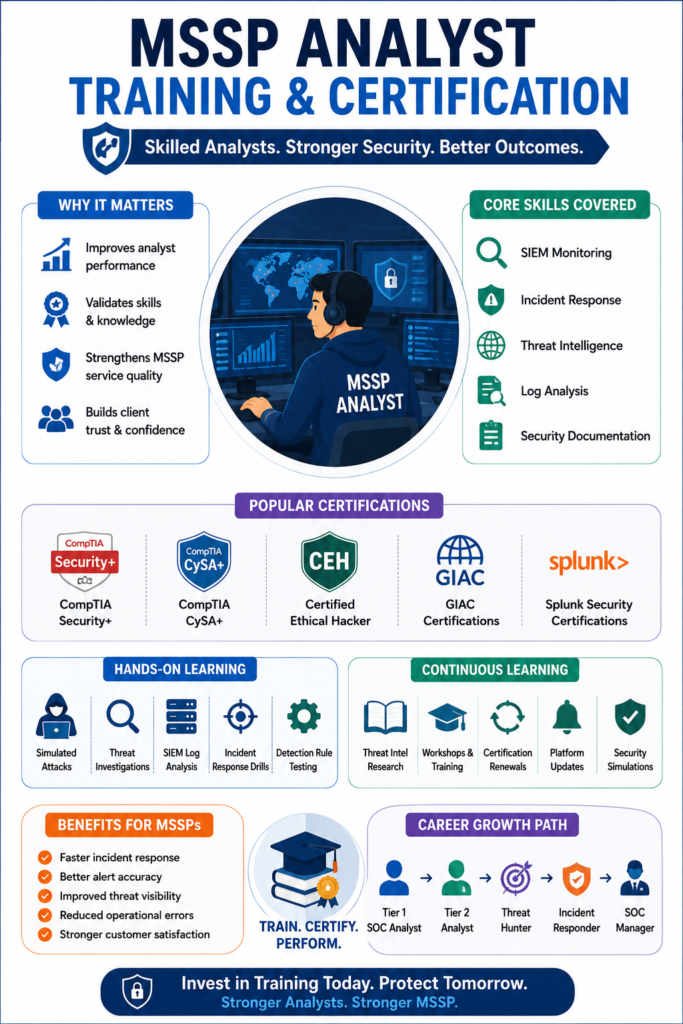
Why Analyst Training Matters in MSSP Operations
MSSP environments move quickly and require analysts to manage multiple clients, tools, and incidents efficiently.
- Training improves analyst performance and operational consistency.
- Certifications help validate cybersecurity knowledge and skills.
- Continuous learning strengthens long-term MSSP service quality.
What Is MSSP Analyst Training Certification?

MSSP analyst training certification refers to cybersecurity education programs designed to prepare analysts for security operations center responsibilities inside managed security service environments.
“The demand for cyber-skilled personnel has increased… because of the rapid changing nature of cybersecurity threats. Continuous development is key in addressing cybersecurity skills gaps to ensure robust and dynamic measures keep up with an increasingly sophisticated range of threats.” – Sajim
Training often focuses on:
- Threat detection and monitoring
- Security engineer responsibilities in the SOC environment
- SIEM and EDR platforms
- Threat intelligence analysis
- Security operations workflows
Certification programs help analysts validate their knowledge while improving confidence in real-world security operations.
Core Skills Covered in Training Programs
MSSP analyst training programs focus on both technical and operational cybersecurity skills.
| Skill Area | Purpose |
| SIEM Monitoring | Improve event analysis and visibility |
| Incident Response | Strengthen investigation workflows |
| Threat Intelligence | Detect emerging attack patterns |
| Log Analysis | Support threat investigations |
| Security Documentation | Improve reporting consistency |
Common training topics include:
- Alert investigation
- Endpoint monitoring
- Network traffic analysis
- Threat-hunting basics
- Escalation procedures
These skills help analysts respond faster and improve overall SOC efficiency, specifically regarding security analyst roles and their unique contributions to the team.
Popular Certifications for MSSP Analysts
Credits: The Social Dork | Cyber Security
Many organizations encourage analysts to earn certifications that support career growth and operational readiness.
Common certifications include:
- CompTIA Security+
- CompTIA CySA+
- Certified Ethical Hacker (CEH)
- GIAC Security Certifications
- Splunk Security Certifications
These certifications help validate technical skills and strengthen analyst credibility in cybersecurity environments.
Hands-On Experience and Lab Training
Practical experience is one of the most important parts of MSSP analyst training certification programs. Analysts learn best when working with realistic cybersecurity scenarios.
Hands-on learning may include:
- Simulated cyberattacks
- Threat investigation exercises
- SIEM log analysis
- Incident response drills
- Detection rule testing
Lab-based training helps analysts improve decision-making and operational confidence under pressure.
Importance of Continuous Learning
Cybersecurity threats constantly evolve, making continuous learning essential for MSSP analysts. Ongoing education helps teams stay updated on attack techniques, tools, and detection strategies.
“Cybersecurity education cannot be a one-time milestone… The gap between what was learned and what is required widens over time, unless it is actively closed through continuous education and professional certifications.” – Eccu.Edu
Continuous learning often involves:
- Threat intelligence research
- Security workshops
- Certification renewals
- Vendor platform updates
- Security simulation exercises
Organizations that invest in continuous analyst development often improve service quality and reduce operational risks.
Benefits of Training for MSSPs
Strong analyst training programs support both operational performance and client trust.
Benefits include:
- Faster incident response
- Better alert accuracy
- Improved threat visibility
- Reduced operational errors
- Stronger customer confidence
Well-trained analysts help MSSPs deliver more reliable and scalable cybersecurity services across multiple client environments.
Career Growth for MSSP Analysts

Training and certification programs also support long-term cybersecurity career development.
Common career progression includes:
- Tier 1 SOC Analyst
- Tier 2 Analyst
- Threat Hunter
- Incident responder skills are vital for those looking to specialize in mitigation.
- SOC Manager
Practical experience combined with certifications creates stronger opportunities for advancement within cybersecurity operations.
FAQ
What is MSSP analyst training certification?
It refers to cybersecurity training and certification programs designed to prepare analysts for MSSP security operations roles.
Are certifications important for MSSP analysts?
Yes. Certifications help validate technical knowledge and improve career opportunities in cybersecurity operations.
What skills are taught in MSSP analyst training?
Programs commonly cover SIEM monitoring, incident response, log analysis, threat intelligence, and endpoint security investigations.
Why is hands-on training important?
Practical experience helps analysts build confidence, improve investigation skills, and respond more effectively during real incidents.
Strengthening MSSP Operations Through Analyst Development
MSSP analyst training certification programs play a major role in building skilled cybersecurity teams capable of handling modern threats and complex environments. Strong training improves operational consistency, strengthens threat detection, and supports better client outcomes.
At MSSP Security, we help MSSPs improve operations, optimize security tools, strengthen visibility, and support long-term cybersecurity growth through expert consulting backed by more than 15 years of real-world security operations experience.
References
- https://sajim.co.za/index.php/sajim/article/view/2075/3501
- https://www.eccu.edu/blog/why-continuous-learning-in-cybersecurity-is-important/