

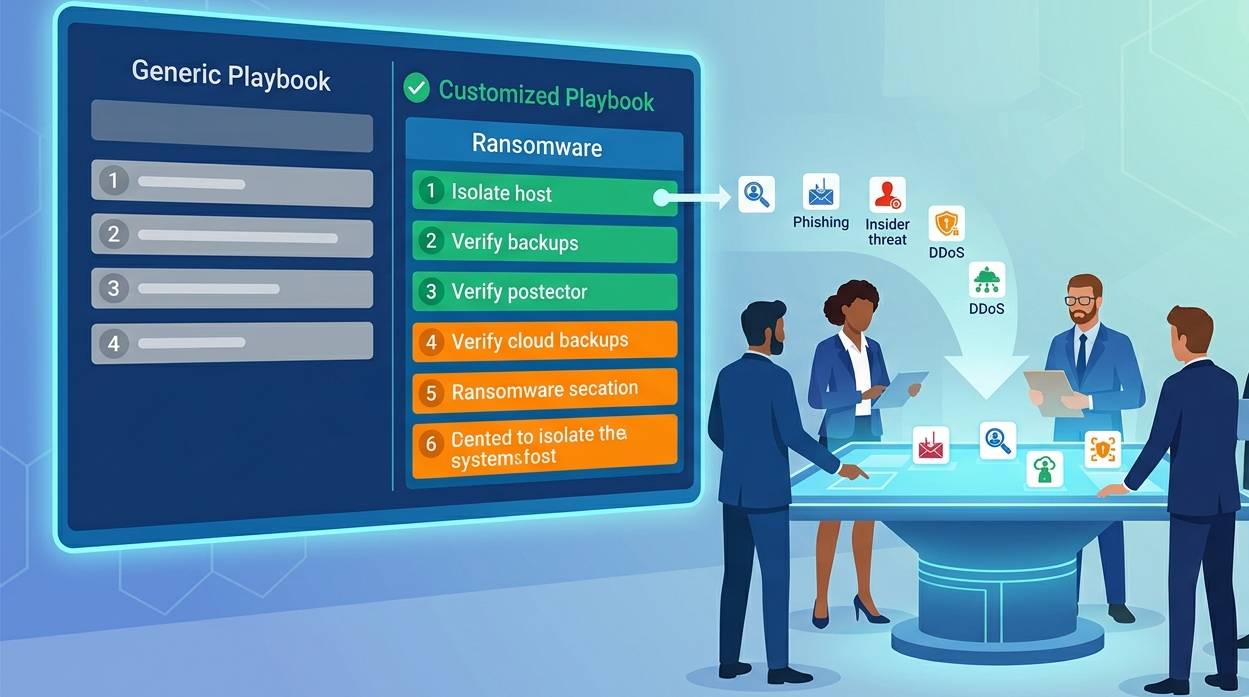
Every organization faces unique cyber risks, yet many still rely on generic response procedures. From our experience, this often leads to slower decisions and inconsistent handling during incidents. Customizing playbooks specific threats helps teams respond with clarity, speed, and confidence.
Instead of reacting broadly, we align actions with actual attack patterns and operational realities. This approach not only improves efficiency but also strengthens resilience against evolving threats. Let’s explore how to build and refine these targeted playbooks, keep reading.
Key Insights: Customizing Playbooks Specific Threats
Before we dive deeper, here are the essentials:
- Generic playbooks limit response effectiveness
- Threat-specific customization improves precision
- Clear structure reduces confusion during incidents
Why Customizing Playbooks Specific Threats Matters
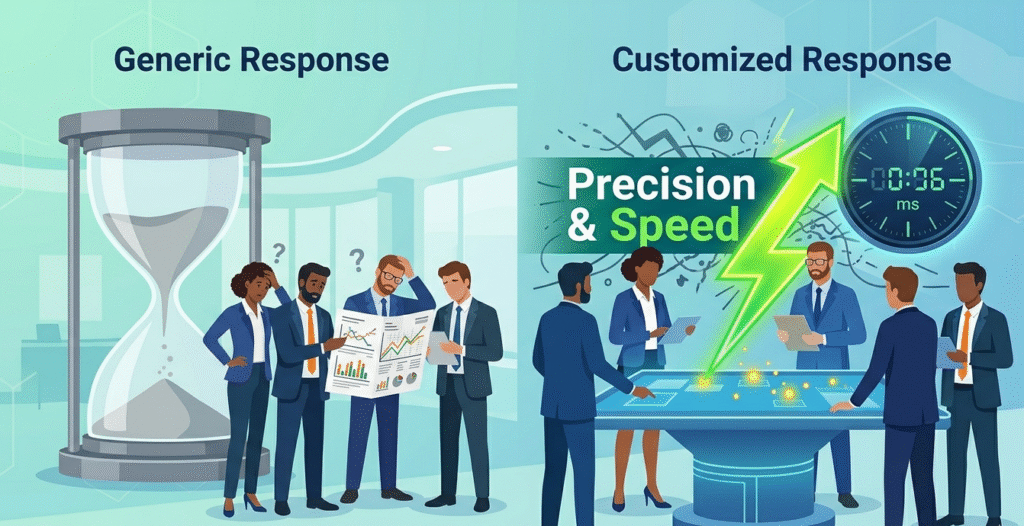
No two cyber threats behave the same. A phishing incident requires a very different response compared to ransomware or insider misuse. When we tailor playbooks, we remove guesswork and enable faster action.
- Faster detection-to-response time
- Reduced operational errors
- Better coordination across teams
- Improved incident containment
In practice, MSSP Security often sees organizations gain immediate clarity once they implement security response playbook examples that reflect actual threat scenarios rather than generic assumptions.
Identifying Threat Profiles Before Customization
Effective customization starts with understanding the threat landscape.
Common threat profiles:
- Phishing and credential theft
- Ransomware attacks
- Insider threats
- DDoS attacks
- Zero-day exploits
“A computer security incident is a violation or imminent threat of violation of computer security policies.” – Wikipedia
Mapping these threats helps prioritize which data breach response playbook template or customized framework needs deeper focus first.
Structuring Customized Playbooks Specific Threats
Credits: Optiv
Each playbook should follow a consistent structure while adapting to threat behavior.
| Section | Description |
| Detection | Identify indicators of the specific threat |
| Analysis | Validate and assess the threat impact |
| Containment | Limit spread based on threat characteristics |
| Eradication | Remove threat completely |
| Recovery | Restore affected systems |
| Lessons Learned | Improve future response |
We’ve learned that consistent structure combined with tailored actions creates both clarity and flexibility.
Integrating Automation into Customized Playbooks
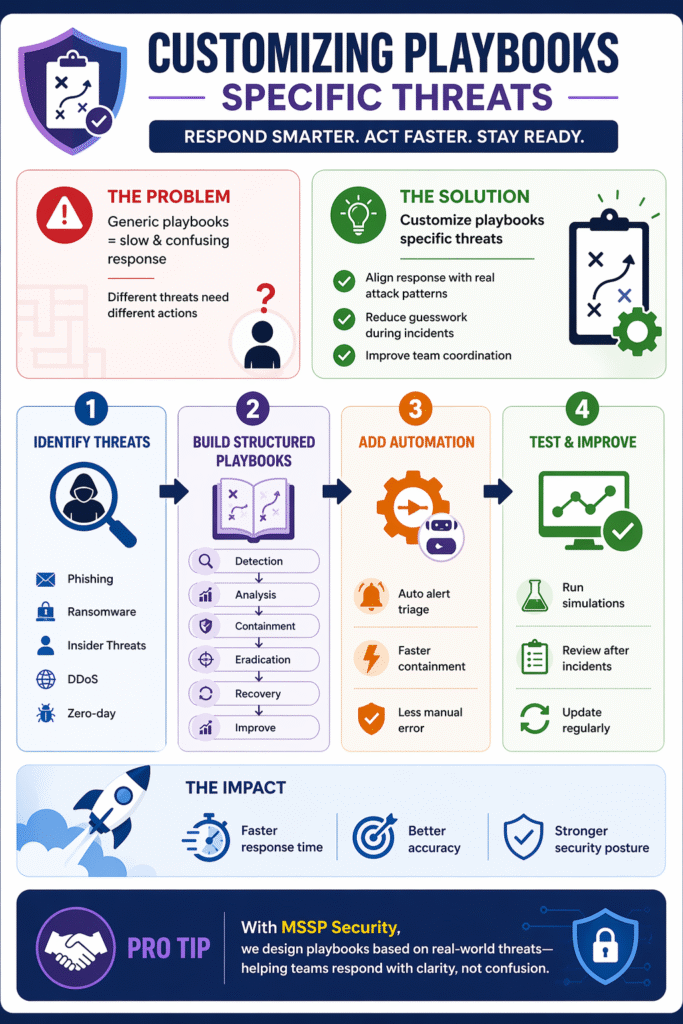
Automation helps turn playbooks into real-time execution tools.
- Automate alert classification
- Trigger predefined containment steps
- Integrate with security tools
- Reduce manual response delays
“Automation in cybersecurity improves efficiency and reduces human error in repetitive tasks.” – ResearchGate
At MSSP Security, we typically introduce automation step by step to maintain visibility while improving response speed.
Testing and Refining Customized Playbooks

Customization must evolve alongside threats.
- Conduct regular tabletop exercises
- Simulate realistic attack scenarios
- Gather feedback from responders
- Update based on new threat intelligence
From our experience, testing incident response playbooks frequently ensures they remain practical, not just theoretical documents.
FAQ
What is customizing playbooks specific threats?
Customizing playbooks specific threats refers to designing incident response procedures that directly reflect how particular threats behave in real environments. Instead of relying on broad guidelines, teams define detailed actions, decision paths, and escalation criteria tailored to each threat type.
This includes mapping indicators of compromise, identifying affected systems, and aligning response steps with business priorities. The result is a more precise and efficient response process that reduces uncertainty and improves coordination during high-pressure incidents.
How often should customized playbooks be reviewed?
Customized playbooks should be reviewed on a regular cycle, typically quarterly, but more importantly after any significant incident or emerging threat trend. Reviews should include technical validation, feedback from incident responders, and updates based on new intelligence or system changes.
In our experience, organizations that integrate playbook reviews into their security operations lifecycle maintain higher readiness and adapt faster to evolving attack techniques.
Do all threats need separate playbooks?
Not every threat requires a completely separate playbook, but critical or high-frequency threats should have clearly defined, dedicated procedures. In many cases, organizations can build modular playbooks where a core structure is reused, and specific actions are customized per threat type.
This approach balances efficiency with precision, allowing teams to maintain consistency while still addressing the unique characteristics of each threat.
Is automation required in customized playbooks?
Automation is not strictly required, but it plays a significant role in scaling and improving response efficiency. Automated actions such as alert triage, enrichment, and containment can reduce manual workload and accelerate response times.
However, automation should be implemented thoughtfully, ensuring that teams retain oversight and control. At MSSP Security, we often recommend a phased approach where automation supports, rather than replaces, human decision-making.
Customizing Playbooks Specific Threats for Stronger Security
Customizing playbooks for specific threats enables faster, clearer, and more effective incident response. By aligning actions with real-world attack patterns, organizations reduce confusion and improve outcomes. Structured customization, combined with automation and continuous testing, significantly strengthens security operations.
Ready to refine your playbooks and response strategy with practical, experience-driven solutions tailored to your environment? Join the MSSP Security Consulting Program to optimize your tech stack and streamline your operations today.
References
- https://en.wikipedia.org/wiki/Computer_security_incident
- https://www.researchgate.net/publication/Automation_in_Cybersecurity