

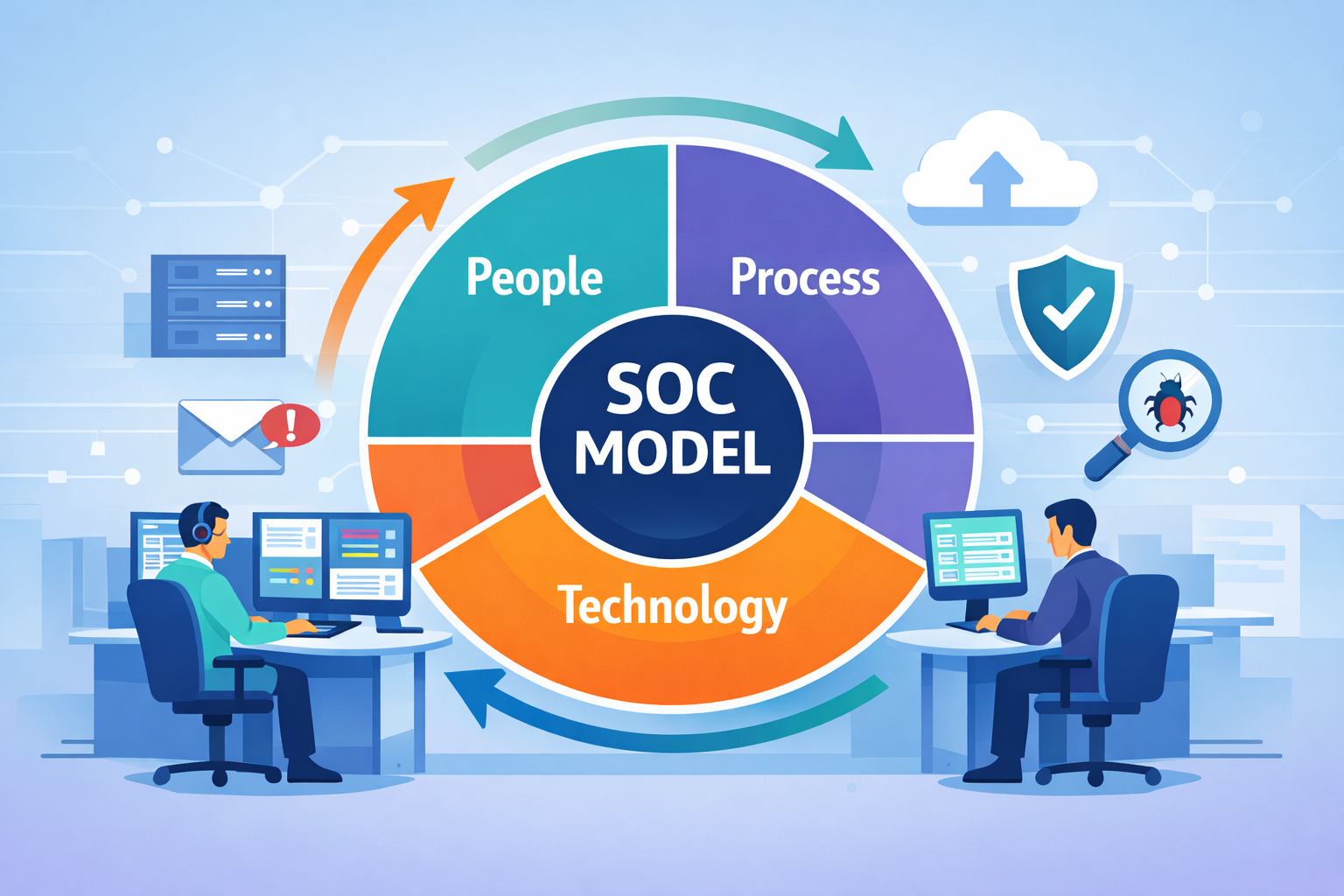
Understanding SOC operations model starts with one idea: structure decides outcomes. A SOC model defines how people, process, and technology work together against threats. Cybercrime keeps rising, but tools alone don’t solve it. We’ve seen environments packed with modern platforms where alerts still piled up because ownership was unclear.
That gap is common, and it’s exactly what a solid model prevents. It creates clarity, speeds decisions, and aligns daily operations with real risk. This guide walks through the main SOC models and how teams choose the right fit based on pressure, scale, and maturity. Keep reading to see what works in practice.
SOC Operations Model Quick Takeaways
These points summarize how SOC models shape structure, coverage, and long-term resilience.
- A SOC operations model aligns staffing, workflows, and detection tools to reduce operational risk and attacker dwell time.
- The right model depends on geography, regulatory exposure, and maturity level, not just budget.
- Hybrid approaches that combine internal oversight with MSSP Security support often improve resilience without increasing burnout.
What is a SOC Operations Model and Why Does It Matter?

A SOC operations model is both a rulebook and a playbook. It defines who owns what, how incidents move, and how tools actually support the mission. Frameworks like NIST outline the lifecycle from preparation through recovery. But on the ground it only works when the model is written in plain, usable terms.
We’ve seen mature teams treat this as living documentation, not shelfware. When it’s clear, decisions get faster and handoffs feel natural instead of forced.
In our work helping MSSPs evaluate and audit new tools, the gaps show up quickly when the model is weak. Even strong platforms turn into noise without structure. We’ve walked into environments where alerts piled up because no one defined escalation after hours. A solid model fixes that by anchoring three things:
- Clear ownership across shifts and tiers
- Repeatable workflows for detection and response
- KPIs that prove whether changes actually work
It also creates confidence during audits or industry spikes. When pressure rises, structure absorbs the chaos. Teams don’t scramble for process, they execute what’s already agreed and tested.
What are the Core Components of a SOC Model?
Every SOC model rests on three things: the people, the processes they follow, and the technology that enables them. IBM’s latest report says the average data breach now costs $4.45 million. That number tells you why getting this structure right isn’t an IT project, it’s a financial imperative.
Credits: Mohd Maaz
People: Who’s on the Team?
Most SOCs use a three-tier system for their analysts. Tier 1 does the initial triage, sorting through alerts. Tier 2 investigates the serious ones. Tier 3 are your experts, doing forensics and building new detection methods.
Running a 24/7 operation with this team is hard. We consistently see alert fatigue set in when more than half of all alerts are false positives, which is common in systems that haven’t been tuned properly. It burns people out.
Processes: The Incident Workflow
An incident should follow a clear path: monitoring, triage, escalation, containment, and finally, a review to learn from it. This structure mirrors a typical security operations center workflow that mature SOCs refine over time.
The key is having playbooks, and actually updating them. We find knowledge gaps most often happen during shift changes or handoffs between teams, so a good process defines that handover tightly.
Technology: The Tools of the Trade
Technology lets you scale, but it doesn’t think for you. You need a SIEM to collect logs, EDR for endpoint visibility, and network tools like IDS. SOAR platforms, such as Microsoft Sentinel, help automate responses.
New AI tools can help with enrichment and spotting anomalies, especially in cloud environments. But if these tools aren’t integrated with your people and processes, they just create more noise, faster.
Which SOC Model Should You Use?
Most SOC structures fall into five common models. The choice usually comes down to how much control you want, how global you are, and what level of complexity you can manage. In our work advising MSSPs, the model often shapes tooling decisions just as much as budget does.
| Model | Structure | Best For | Trade-Off |
| Centralized | Single location | Mid-to-large enterprises | Single point of failure |
| Distributed | Regional hubs | Global operations | Coordination overhead |
| Federated | Semi-autonomous units | Multinationals | Policy inconsistency |
| Virtual | Cloud-based remote teams | Flexible enterprises | Cultural cohesion risk |
| Follow-the-Sun | Global handoffs | High-risk sectors | Handoff gaps |
A centralized setup offers tight oversight and simpler governance. Distributed models handle regional nuance better but demand stronger coordination.
Federated environments show up often in large multinationals, though they rely heavily on audits to stay aligned. Virtual SOCs lean on cloud platforms and remote analysts, while follow-the-sun models rotate coverage across time zones.
Lately, we’re seeing more hybrids. Many teams keep a small internal SOC for oversight and partner outward for 24/7 coverage. When we help MSSPs evaluate tooling and delivery models, this balance tends to stick. It preserves control without stretching staffing to unsustainable levels.
A Day in the Life of a SOC

SOC actually revolves around the alert queue. L1 analysts start their shift by processing the batch of alerts that came in overnight. A constant struggle, one we see in many audits, is reducing false positives even with automation.
For a closer operational view, the rhythm often resembles what teams describe when explaining how does a SOC operate daily in real environments.
In a recent analysis by SANS Institute Blog
“The core of SOC operations lies in the ability to move from reactive alert handling to proactive threat hunting, turning a flood of data into prioritized, actionable security intelligence.” – SANS Institute Blog
The ideal cycle has five stages: prepare and tune tools, monitor for anomalies, triage and investigate, contain the threat, and finally review what happened. The reality can be messier. Common gaps we find are teams that think a green dashboard means they’re secure, playbooks that are out of date, and new AI triage tools that misclassify alerts.
Research review that, underscores the burnout risk in these high-stress roles, which directly leads to staff turnover and knowledge loss. The effective SOCs we work with treat their playbooks as living documents. They update them after every major incident.
8×5 vs 24×7 Coverage: What’s the Real Risk?
The question of 24/7 coverage comes up in almost every SOC conversation. Round-the-clock monitoring sounds ideal, but the reality depends on staffing, risk profile, and operational maturity.
We’ve seen teams overcommit to full coverage before they’re ready, then struggle to sustain quality. Others stay 8×5 and accept blind spots they didn’t fully model.
| Coverage | Strength | Risk |
| 8×5 Internal | Deep context and ownership | Off-hours exposure |
| 24/7 In-House | Continuous monitoring | Staffing strain |
| MSSP 24/7 | Predictable cost | Escalation delays |
| Hybrid | Shared coverage | Integration friction |
In practice, staffing becomes the deciding factor. Building a true follow-the-sun model means coordinating multiple global teams, which adds cost and management overhead. During our audits with MSSPs, we often see burnout creep in long before tooling fails.
The reality becomes clearer when looking inside an MSSP SOC workflow where coverage models are tested under real pressure.That’s why many organizations land on a hybrid approach. Internal analysts focus on complex investigations during core hours, while external coverage handles overnight monitoring.
When we help MSSPs assess delivery models and tools, this setup tends to hold up. It keeps oversight close while extending coverage in a way most teams can actually sustain.
Is AI Helping or Complicating the SOC?
AI has a real place in SOC operations, but it’s not a silver bullet. The strongest use cases today are practical and narrow. In our work evaluating tools for MSSPs, we see AI perform best when it supports analysts, not replaces them. It’s helpful for speeding up repetitive tasks and surfacing patterns humans might miss, especially in high-volume environments.
Where it delivers value right now is fairly consistent:
- Adding context and enrichment to alerts
- Grouping related events into cleaner investigations
- Automating simple, low-risk containment steps
At the same time, limits show up quickly when expectations get ahead of reality. Unsupervised automation can create more problems than it solves. We’ve reviewed deployments where AI misunderstood business context or pushed overly confident anomaly calls that wasted analyst time.
- Autonomous actions without validation
- Weak understanding of environment nuance
- Overconfidence in anomaly scoring
When introduced carefully, AI can trim manual workload in a meaningful way. The keyword is gradual rollout. We usually recommend phased automation with tight validation loops. Each step earns trust before expanding scope, which helps ensure the tooling reduces noise instead of amplifying it.
How Do You Measure a Good SOC?

Metrics are what separate a busy SOC from an improving one. Without clear numbers, it’s hard to tell if changes are helping or just adding noise. In many engagements, we find teams collecting data but not using it to guide decisions. The strongest SOCs pick a few meaningful measures and track them consistently over time.
The core set tends to stay the same across environments:
- Mean Time to Detect (MTTD)
- Mean Time to Respond (MTTR)
- Escalation accuracy
- Cases handled per analyst per shift
These metrics reveal both speed and quality. A fast response means little if escalations are sloppy or analysts are overloaded. We often see mature teams aiming to keep critical MTTR under an hour, though the exact target depends on risk profile and staffing reality.
During tool audits with MSSPs, dashboards come up often. The best ones are simple and operational, not flashy. We usually map metrics back to business risk and response goals. When numbers tie directly to outcomes, improvements feel grounded, and teams know exactly what to fix next.
Choosing the Right Model for You
Selecting your SOC model depends on your risk profile, the regulations you face, the maturity of your team, and how big you need to scale. Budgets for security operations typically run between 5% and 15% of total IT spend.
Insights from ISACA Now Blog indicate
“Selecting the optimal SOC delivery model, be it in-house, a managed security service provider (MSSP), or a hybrid approach, is a strategic decision that hinges on balancing operational control with resource scalability.” – ISACA Now Blog
Ask yourself:
- How risky is our industry?
- What compliance audits do we face?
- How large and complex is our organization?
- How experienced is our current team?
Frameworks like ITIL can offer guiding principles for service management. Our advice is to start with clarity, not complexity. A centralized model offers control. A federated one supports global autonomy. A hybrid structure provides scalability.
For a lot of the MSSPs we advise, the practical path is a partnership. Use an MSSP as your first line of monitoring to ensure 24/7 coverage. While your own team keeps strategic control and handles deep investigations. You’re not outsourcing your problem; you’re building a more resilient system.
FAQ
How do I choose the right SOC operations model for my organization size?
Choosing a SOC operations model depends on your size, risk level, and team capacity. Smaller organizations often use hybrid SOC or outsourced monitoring for flexibility. Larger enterprises may prefer a dedicated SOC or federated SOC for stronger control.
You should weigh scalability, regulatory compliance, and operational resilience. The best choice balances visibility, cost, and contextual awareness across your environment.
What roles do Tier 1, Tier 2, and Tier 3 analysts actually play daily?
A tiered security operations center assigns clear responsibilities. A tier 1 analyst handles alert triage and basic L1 triage tasks. A tier 2 analyst performs deeper L2 investigation and correlation. A tier 3 analyst leads L3 forensics, threat hunting, and detection tuning.
This structure supports proactive hunting while keeping reactive response organized and sustainable over long shifts.
When does a hybrid SOC make more sense than a fully in-house team?
A hybrid SOC makes sense when an in-house team needs broader coverage without losing control. Organizations facing staffing shortages often combine internal analysts with MSSP services or outsourced monitoring.
This co-managed SOC approach improves 24×7 coverage while maintaining strong escalation procedures. It also supports burnout prevention because internal teams focus on higher-value investigations and decisions.
How does automation change incident response workflow in modern SOCs?
Automation speeds up the incident response workflow by handling repetitive steps. Playbook automation and AI driven triage help with alert triage, anomaly detection, and case management. However, automation discrepancies can appear without proper oversight.
Teams must validate automated actions regularly. Strong escalation procedures and post-incident review help ensure automation supports real-world threat intelligence and risk priorities.
What metrics matter most when improving long-term SOC maturity?
Improving a SOC maturity model requires tracking practical security metrics. Many teams focus on false positive reduction, response speed, and analyst workload using a metrics dashboard.
Post-incident review findings and playbook update frequency also provide useful signals. These metrics guide resilience planning and risk assessment updates, and they show whether changes actually strengthen operational resilience over time.
Final Thoughts on the SOC Operations Model
A strong SOC is not a static diagram, it is a living system where people, process, and technology evolve with every threat. Structure strengthens tools, clarifies governance, and builds resilience that compounds over time. The best teams refine their model continuously. Ask yourself, is your SOC designed to adapt or simply to react?
Do not let drift define your defense. With MSSP Security, refine your model, strengthen operations, and scale with confidence. Start strengthening your SOC today.
References
- https://www.sans.org/blog/soc-modernization-and-the-role-of-ai/
- https://www.isaca.org/resources/news-and-trends/isaca-now-blog/2021/key-considerations-for-the-modern-soc