


Identity Access Management (IAM) support matters because identity is now the main path attackers use to get in. Cloud services, remote work, and vendor access have stretched credentials beyond old network borders, often faster than internal teams can keep up.
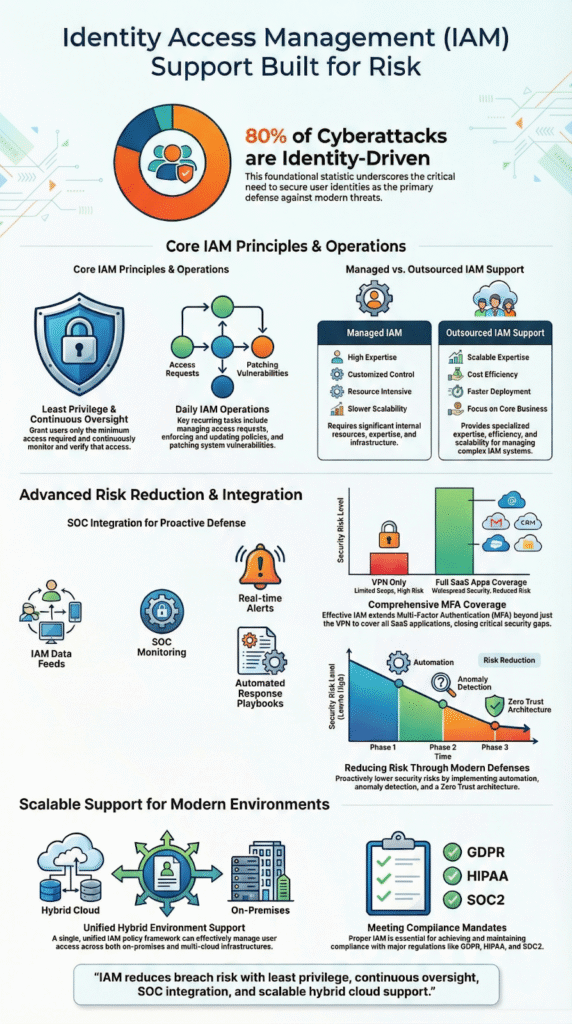
In fact, approximately 80% of all cyberattacks are identity-driven, exploiting compromised credentials as the primary route into systems [1]. When it works well, organizations see fewer access-driven incidents, cleaner audits, and access that matches how the business actually runs. Keep reading to see how effective IAM support works day to day.
Key Takeaways
- Identity access management support reduces breach risk by enforcing least privilege and continuous oversight.
- Managed and outsourced IAM services close skill gaps while integrating security operations.
- Strong IAM support scales across cloud and on-prem without slowing the business.
Managed IAM Support Services
We’ve seen many MSSPs burn out their teams trying to “own” every IAM platform by themselves. Tickets pile up, policies drift, and no one has time to step back and ask, “Is this still the right model?”
That’s where managed IAM support services come in.
For MSSPs, these services keep identity platforms healthy and consistent so the SOC is not fighting access chaos on top of real threats.
Managed IAM support services usually cover:
- Daily operations
- Handling access requests and updates
- Managing policies, rules, and groups
- Keeping identity tools patched and stable
- Automation and workflows
- IAM provisioning and deprovisioning automation
- Role based access control (RBAC IAM) design and updates
- Standardized joiner/mover/leaver flows for every client
- Oversight and governance
- IAM auditing, reporting, and compliance alignment
- Regular checks that roles still match job functions
- Cross-environment consistency for hybrid clients
When complexity grows, multiple clouds, legacy on-prem apps, remote users, this kind of managed support keeps identity from turning into a long list of exceptions.
At MSSP Security, we help MSSPs review and compare managed IAM offerings, test how they behave under real pressure, and audit whether they actually enforce least privilege, not just promise it in a slide deck.
Outsourced Identity Access Management
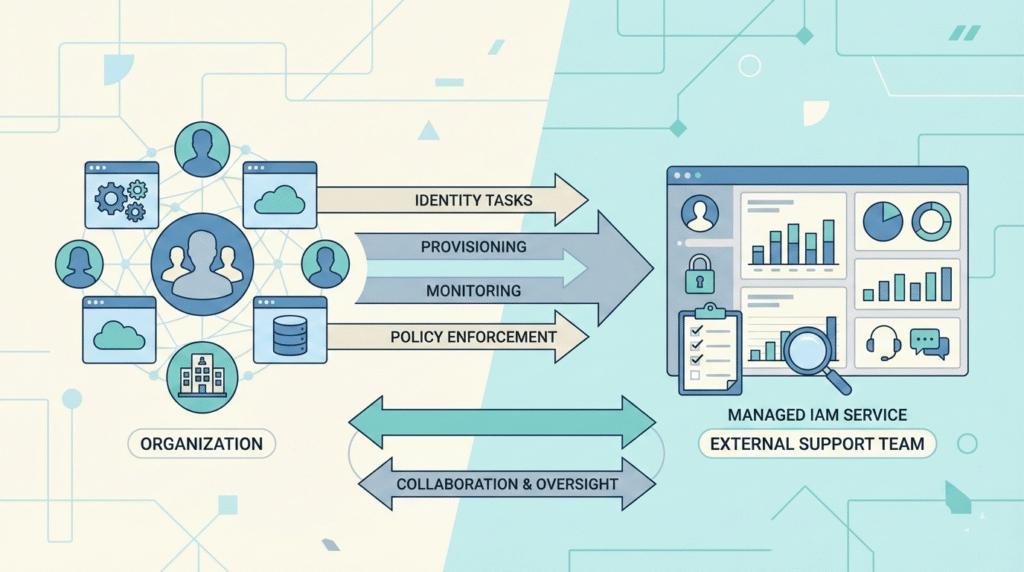
Some MSSPs decide they don’t want to run identity operations at all. They want to design, oversee, and own the client relationship, but let someone else handle daily identity execution.
We’ve seen this work well when:
- The MSSP wants to shift from “button clicking” to higher-value advisory work
- IAM tools are getting more complex than the current team can safely manage
- Zero Trust IAM expectations and compliance demands are rising faster than hiring
Outsourced IAM usually includes:
- User lifecycle management
- Joiner mover leaver workflows baked into process
- Timely removal of access when people leave
- Clean role changes when people move teams
- Least privilege and just-in-time access
- Just in time access for high-risk tasks
- Time-bound elevation instead of permanent admin rights
- Regular removal of unused privileged access
- Identity threat detection
- Monitoring for odd login times, devices, or locations
- Linking identity events to attack patterns the MSSP already sees in the SOC
We’ve helped MSSPs audit outsourced IAM providers and learned something pretty clear: the best setup is when governance stays with the MSSP and its client, while daily execution is handled externally under tight rules and transparent reporting.
Integrating IAM with MSSP SOC

Identity gets much stronger when IAM and the SOC stop acting like separate worlds.
We’ve watched this shift happen first-hand. When integrating iam with mssp soc, strong setups usually include:
- SOC IAM integration with identity analytics
- Identity data flowing into SIEM
- Risk scores on users, not just devices
- Correlation between account behavior and attack activity
- Session monitoring tied to SIEM and SOAR workflows
- High-risk sessions flagged or cut off automatically
- Playbooks that respond based on user role and risk level
- Coordinated action across IAM, EDR, and network controls
- Identity-first security response playbooks
- Runbooks for credential theft and account takeover
- Standard steps for forced password reset and MFA re-enrollment
- Business-approved flows for locking or limiting key accounts
As identity-centric security research notes, “Zero Trust Architecture shifts the security paradigm by assuming that no user, device, or system can be trusted by default, requires continuous verification and the enforcement of least privilege access for all entities” [2].
Credential misuse keeps showing up as a top breach vector in major reports. In our work, the MSSPs that do best are the ones that treat identity events as first-class SOC signals, not an afterthought.
Monitoring Privileged Access Management (PAM)
The accounts that scare us most are not regular users. They’re the ones that can touch domain controllers, core databases, payment systems, privileged accounts.
From what we’ve seen across many MSSPs, effective PAM focuses on:
- Session control and visibility
- Session monitoring with anomaly detection PAM
- Recorded or shadowed sessions for high-risk actions
- Alerts on unusual commands or access attempts
- Policy and metrics
- KPI PAM tracking such as access frequency and duration
- Identifying which accounts are “always on” and shouldn’t be
- Regular reports to security and business owners
- Privileged access reviews
- Privileged access reviews tied to business justification
- Removal of stale admin rights
- Strong approval paths before someone becomes privileged
We regularly help MSSPs review PAM platforms and validate if the monitoring is real or just basic logging. The goal is simple: limit the blast radius if a privileged account is ever compromised, and make sure there’s a clear trail when something goes wrong.
Identity Governance Administration (IGA) Support
- Who has access?
- Why do they have it?
- Do they still need it?
Identity governance administration (IGA) support is what keeps those questions answered and documented over time.
When IGA is missing, we usually see:
- Quiet access sprawl across shared folders and SaaS apps
- Confusing entitlement names no one understands
- Panic before audits because no one can prove who should have what
Strong IGA support for MSSPs and their clients usually includes:
- Automated user access reviews and access certification
- Segregation of duties (SoD IAM) checks baked into access requests
- IAM policy enforcement mapped to compliance frameworks
We help MSSPs compare IGA tools and check whether they fit into the existing tech stack, reporting needs, and client size. The better the IGA support, the easier it is to say “yes” or “no” to access with a straight face and clean record.
Multi Factor Authentication (MFA) Management
Most MSSPs already know they need multi factor authentication. The real gap is in multi factor authentication (mfa) management, actually enforcing it, tuning it, and making it workable for users.
- It’s only on VPN, not on key SaaS apps
- Admin accounts can bypass it in “emergencies” that never end
- Third parties log in without strong checks
Effective MFA management usually covers:
- Policies and risk-based controls
- Adaptive MFA policies using contextual signals
- Stricter rules for admins and remote access
- Exceptions tracked and time-limited
- Methods and user experience
- Support for passwordless authentication and biometrics MFA
- Hardware tokens MFA and push notifications MFA
- Clear fallback options for lost devices
- Governance and coverage
- Mapping MFA requirements to risk and compliance needs
- Ensuring third parties, contractors, and partners are covered
- Regular reviews of where MFA is required, and where it still isn’t
At MSSP Security, we often help MSSPs evaluate MFA and access control tools, not just for security strength but for how they impact user friction. The goal is high adoption and strong enforcement, not angry users bypassing controls.
Choosing IAM Support Provider
Picking an IAM support provider doesn’t just affect this quarter. It shapes how identity, risk, and compliance will feel for years.
We’ve helped MSSPs evaluate providers and have learned that slideware looks similar, but real capability does not. When choosing iam support provider options, we usually walk MSSPs through questions like:
- Technical fit
- Experience with hybrid IAM solutions and cloud IAM security
- Ability to work across on-prem directories and modern SaaS
- Real integrations with the MSSP’s SIEM, SOAR, and ticketing
- Compliance and reporting
- Support for IAM compliance like GDPR IAM, HIPAA access controls, SOC2 IAM
- Clear evidence trails for audits
- Reporting that security, audit, and business teams can all read
- Operations and partnership
- Ability to integrate IAM with existing security operations
- Response times for incidents and urgent access changes
- Willingness to be audited and tested, not just trusted
We position MSSP Security as a first stop for many MSSPs who want an honest, experience-based view of the tools and providers they’re considering. Our focus is on matching real needs with real capabilities, not chasing the newest buzzword.
User Access Review Support
User access review support turns that idea into a regular, repeatable process.
In our work, effective access reviews look like this:
- Automated review campaigns tied to IGA administration
- Clear reviewer workflows and escalation paths
- IAM reporting aligned with regulatory expectations
We’ve watched MSSPs move from “yearly panic before audit” to smooth, quarterly or continuous reviews. When done well, these reviews:
- Catch excessive entitlements early
- Remove access for ex-employees and old vendors
- Provide clean, exportable records for auditors
Access reviews are one of the lowest-cost ways to cut identity risk. They don’t require new hardware or huge change, they require discipline, good tooling, and clear ownership.
Securing Identities Cloud On Prem
Securing identities cloud on prem means unifying how access is granted, used, and monitored across very different systems.
Common focus areas for MSSPs and their clients include:
- AWS IAM support and policy hardening with Amazon Web Services
- Azure AD management with Microsoft Azure identity services
- Federation using SAML IAM, OAuth IAM, and OpenID Connect
When we help MSSPs audit or select tools here, we’re usually looking at questions like:
- Are policies understandable and reusable across environments?
- Does the team have clear visibility into who can access what, and from where?
- Are on-prem accounts drifting away from cloud policies, or are they aligned?
A simple hybrid IAM comparison often looks like this:
| Capability | Cloud IAM Security | On Premises IAM |
| Visibility | High, API-driven | Moderate, directory-based |
| Scalability | Elastic | Hardware-bound |
| Compliance | Shared responsibility | Full organizational control |
| Risk Exposure | Misconfiguration | Legacy privilege sprawl |
This is why hybrid IAM support demands real experience. At MSSP Security, we work with MSSPs to review and test tools that can handle both sides without turning operations into chaos.
Reducing Identity Related Risks
Identity isn’t a “set it and forget it” control. It’s a moving target.
Reducing identity related risks means treating IAM as a continuous practice, watching behavior, tightening access, and responding fast when something feels off.
From our time in the field with MSSPs, strong programs usually rely on:
- Detection and analytics
- Identity threat detection and anomaly analysis
- Behavior-based alerts instead of only static rules
- Correlation between identity events and broader attack chains
- Automation and self-service
- IAM automation and self service IAM workflows
- Fast, controlled access requests and approvals
- Automatic cleanup when roles change or users leave
- Zero Trust-aligned controls
- Breach prevention identities tied to Zero Trust models
- “Never trust, always verify” for high-value systems
- Continuous checks instead of one-time approvals
MSSP Security often steps in as the quiet partner in the background, helping MSSPs select, test, and audit the IAM, MFA, PAM, and IGA tools that fit their clients’ risk and growth plans.
When IAM support is done right, you get fewer surprises, smoother audits, and a security posture that actually keeps up with how people work. That’s where identity stops being just a problem to manage and starts becoming a way to run the business with more confidence.
For MSSPs that need deeper validation, design review, or pressure testing beyond day-to-day operations, this work often extends into advanced & specialized services, covering complex IAM integrations, high-risk environments, and situations where standard managed support is not enough.
FAQ
What does Identity Access Management (IAM) support handle each day?
Identity Access Management (IAM) support handles who can access systems and data every day. This includes setting up new users, removing access when people leave, and changing access when roles change. Teams manage MFA, role based access control, and user access reviews. They also handle audits and reports to reduce identity risk without slowing work.
When should a company use managed or outsourced IAM services?
Companies use managed IAM services or outsourced IAM when access grows too complex. This often happens with cloud use, remote work, or many vendors and contractors. Outsourced IAM helps control access, apply least privilege, and keep reviews on track. It lets internal teams focus on business while IAM experts manage daily identity tasks.
How does IAM support work with SOC monitoring?
IAM support connects identity activity to SOC monitoring. SOC IAM integration helps track privileged access, session activity, and unusual behavior. These signals support identity threat detection and faster incident response. When identity data reaches the SOC early, teams can stop misuse faster and reduce the chance of a larger security incident.
How does IAM support help with compliance and audits?
IAM support keeps access clean and easy to review. Identity governance support manages access checks, separation of duties, and approval workflows. IAM reporting helps meet GDPR, HIPAA, PCI DSS, and SOC2 needs. Strong IAM auditing reduces audit stress and prevents last-minute access fixes before compliance reviews start.
What should teams check when choosing an IAM support provider?
IAM provider selection should focus on real experience, not tools alone. Teams should look for support with hybrid IAM, cloud identity security, and on premises IAM. The provider should handle IAM automation, MFA management, and growth over time. Clear reporting, simple processes, and identity risk reduction matter most.
Identity Access Management (IAM) Support That Drives the Business
Identity Access Management (IAM) support now drives both security and business outcomes. It helps organizations grow safely, meet compliance needs, and stay resilient as identity replaces the network perimeter. Managed and outsourced IAM bring clearer access control, faster decisions, and lower identity risk across cloud and on-prem environments.
Work with us to build IAM support that scales with your business, backed by deep MSSP consulting experience, practical stack optimization, and clear guidance that turns identity strategy into daily operations.
References
- https://zerolabs.rubrik.com/blog/the-rise-of-identity-based-cyberattacks-a-critical-threat-to-organizations
- https://arxiv.org/abs/2410.18291
References
- https://msspsecurity.com/managed-iam-support-services/
- https://msspsecurity.com/outsourced-identity-access-management/
- https://msspsecurity.com/integrating-iam-with-mssp-soc/
- https://msspsecurity.com/monitoring-privileged-access-management-pam/
- https://msspsecurity.com/identity-governance-administration-iga-support/
- https://msspsecurity.com/multi-factor-authentication-mfa-management/
- https://msspsecurity.com/choosing-iam-support-provider/
- https://msspsecurity.com/user-access-review-support/
- https://msspsecurity.com/securing-identities-cloud-on-prem/
- https://msspsecurity.com/reducing-identity-related-risk/