


Benefits MSSP DFIR support matters more now because most internal teams just can’t match the speed or volume of modern attacks. Alert queues grow, analysts burn out, and small gaps in coverage turn into big losses fast.
With the average data breach at $9.48M, slow or messy response isn’t just stressful, it’s expensive. We’ve watched teams stabilize once they hand off evidence management, root cause analysis, and coordinated response to specialists who do this every day.
If you’re looking for faster containment, lower impact, and DFIR that feels under control, keep reading.
Key Takeaway
- DFIR support from an MSSP cuts MTTR and strengthens every phase of incident response.
- It fills expertise gaps while reducing costs that usually overwhelm internal teams.
- Forensic readiness and compliance become easier, cleaner, and more consistent.
The Growing Need for Strong DFIR Support

Every year, attacks feel sharper and less forgiving. They move fast, change tactics mid-stream, and hit gaps that teams didn’t even know they had. Most security groups know this feeling well: long queues, shallow benches, and a real shortage of people who can do deep forensics under pressure.
For many MSSPs, trying to build and maintain full-scope DFIR in-house turns heavy quickly, high-end tools, ongoing training, shifting threat patterns, and compliance demands that never really slow down.
From what we’ve seen working with MSSPs, this is where strong DFIR support, backed by the right product choices, really starts to matter. MSSPs that rely on well-matched platforms can link proactive monitoring with responsive forensics instead of treating them as separate tracks. That connection is what internal teams often miss.
When SOC tools and DFIR tooling truly work together, escalation paths tighten and cases move faster, which lines up with what industry studies keep showing: integrated DFIR reduces impact and cuts downtime by stripping out handoff friction.
We’ve watched this play out up close while helping MSSPs evaluate, select, and audit their DFIR and monitoring stacks. The pattern is usually the same. These organizations don’t fall short because they lack effort or care, they burn out because they lack capacity and clear fit between tools and workflows.
Once an MSSP has the right products in place for forensic readiness, playbooks, and evidence retention, the whole response cycle steadies. Analysts know what gets captured, where it’s stored, and which steps follow next, so they aren’t improvising process in the middle of an active incident.
This aligns with how strong teams approach digital forensics during high-pressure investigations. [1]
Key DFIR Tasks Handled by MSSPs
Most people hear “DFIR” and think it’s mysterious or overly technical, but the value is pretty direct: it explains what happened, how the incident moved through the environment, and what to change so it doesn’t repeat. For MSSPs, that work usually centers on a set of core tasks that have to be done with care and consistency:
- Incident detection and triage
- Evidence collection & preservation
- Malware analysis & reverse engineering
- Root cause analysis
- Containment & remediation
- Reporting & compliance
From where we sit, helping MSSPs select and audit products, these tasks only work well when the right tooling and process meet in the same place. They demand trained analysts, reliable platforms, and a clean chain of custody.
We often walk into environments where logs live in ten different systems, collected “just in case,” but nothing lines up cleanly for investigations. When an MSSP pairs a solid SIEM with the right EDR and thoughtful retention policies, suddenly the data is actually usable, aligned, searchable, and ready when an incident hits.
Our clients tell us they feel the difference once workflows are tuned around the tools they actually have, not the ones they wish they had. MSSPs begin to refine how alerts become cases, how evidence is tagged and stored, how reports map to compliance requirements. We’ve watched evidence get cleaner, timelines tighter, and analysis less speculative.
That’s when leadership starts making decisions based on clear findings instead of hunches. The combination of monitoring plus well-supported DFIR isn’t just a feature upgrade, it’s usually the point where an MSSP’s response maturity takes a real step forward.
Benefit 1: 24/7 Access to DFIR Expertise

Most organizations don’t have forensic specialists on staff, let alone around the clock. The benefits MSSP DFIR support include immediate access to certified analysts who know how to preserve evidence, track malware behavior, and attribute attacks correctly.
A single DFIR analyst can cost as much as an entire outsourced service. Add tools like EnCase, Volatility, and forensic labs, and the cost becomes unreachable for smaller teams. We’ve seen companies freeze during incidents simply because no one knew how to capture volatile data without corrupting it.
MSSPs solve this by providing a tiered escalation path: SOC → Threat Analyst → DFIR Specialist. This ensures that root cause analysis begins early, not days later. Proper chain-of-custody handling means the organization stays safe for legal and compliance needs too.
When teams rely on 24/7 MSSP support, they don’t panic. They respond with clarity and expert backup.
Benefit 2: Cost Efficiency and Predictable Spending
One of the strongest benefits MSSP DFIR support offers is cost efficiency. Building an in-house SOC with DFIR capabilities requires salaries, training, labs, and tools, and these costs rise every year. MSSPs operate on a shared model, allowing organizations to access enterprise-grade DFIR without paying enterprise-grade prices.
We’ve worked with teams that previously spent heavily on tools they barely used. When we stepped in, we consolidated their tech stack, removed tool sprawl, and optimized licensing so every dollar contributed to capability, not clutter.
Predictable subscription fees also make budgeting easier. Instead of episodic emergency spending, teams know their costs monthly or annually. They avoid expensive one-off forensic engagements that often start at tens of thousands per incident.
This is cost savings paired with smarter planning, something CFOs appreciate just as much as security leads.
Benefit 3: Faster Incident Response and Reduced Downtime
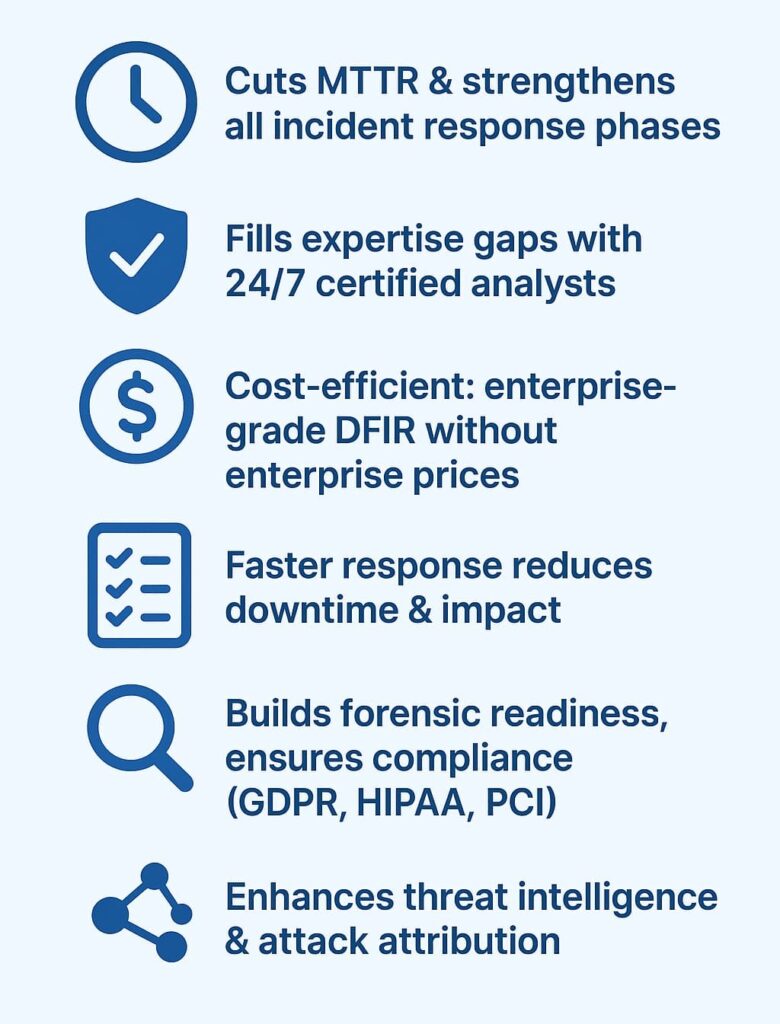
Speed matters. A strong MSSP shortens both MTTD and MTTR, helping organizations contain threats in minutes instead of hours. When DFIR integrates with SIEM and EDR monitoring, the workflow becomes seamless. Alerts move quickly from detection to triage to evidence capture.
In our work, we’ve seen clients cut response time by half simply because they had the right escalation and forensic workflow already in place. Memory dumps, disk images, and logs are captured early, before attackers wipe traces or move laterally.
The faster the response, the smaller the impact. That means less downtime, fewer compromised systems, and quicker recovery. MSSPs also provide complete recovery reports that help organizations meet regulatory requirements and reassure stakeholders that the incident was handled correctly.
This is where DFIR proves its true value: turning chaos into structured, actionable investigation.
Benefit 4: Improved Forensic Readiness and Compliance
Many organizations think they’re ready for an incident, until it happens. Logs aren’t aligned. Retention settings are inconsistent. Playbooks are outdated. And evidence disappears before anyone collects it.
The benefits MSSP DFIR support include building forensic readiness long before an incident occurs. MSSPs pre-configure:
- Log retention
- Playbooks
- Evidence mapping
- Escalation paths
- Reporting structures
This allows teams to maintain legal-grade evidence even during high-pressure moments like ransomware attacks or APT intrusions.
We’ve helped organizations meet regulations like GDPR, HIPAA, and PCI DSS simply by tightening log strategy and improving reporting workflows. Automated compliance reports also reduce workload and stress for internal teams.
When forensic readiness improves, the whole response improves. Evidence becomes reliable. Investigations become accurate. And compliance stops feeling overwhelming.
This foundation supports long-term forensic readiness planning that keeps evidence usable even during high-stress events.
Benefit 5: Enhanced Threat Intelligence and Attribution
Threat intelligence is not just a list of indicators, it’s context. When MSSPs provide DFIR support, they combine real-time monitoring with intel from global threat feeds, giving analysts a fuller picture of who attacked, how, and why.
Attribution matters because it helps teams understand risk. Many incidents share patterns, and MSSP Security often identifies MITRE ATT&CK techniques that point to known threat groups or malware families.
This strengthens:
- Future prevention
- Patch strategy
- Awareness training
- Playbook updates
We’ve seen clients dramatically reduce repeat incidents after implementing recommendations based on DFIR insights. When organizations understand attacker behavior, they stop focusing on symptoms and start eliminating root causes.
This is long-term maturity, not short-term firefighting. [2]
Is MSSP-Provided DFIR Right for You?
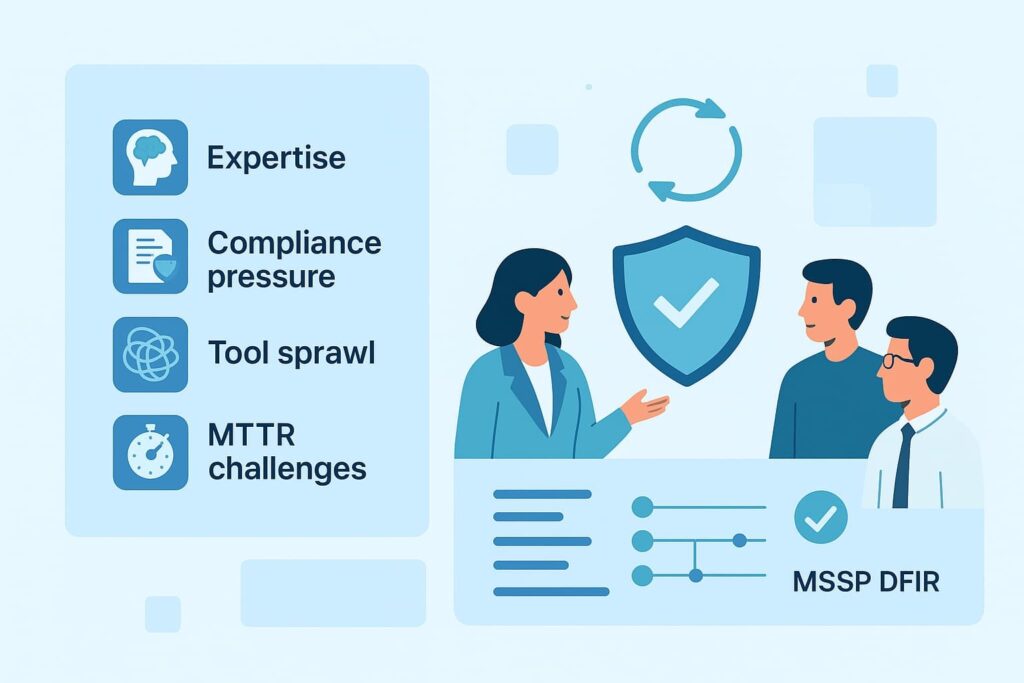
Some teams wonder if outsourcing DFIR is the right move. A simple checklist helps:
- Do you have enough in-house expertise to manage complex cyber incidents?
- Are compliance requirements getting heavier every year?
- Is tool sprawl creating confusion or extra cost?
- Are you struggling to reduce MTTR?
- Do you need predictable spending instead of emergency invoices?
- Are you aiming for stronger forensic readiness and clean evidence handling?
If even one of these feels familiar, outsourcing DFIR becomes a practical step, especially when an MSSP provides structured support similar to a DFIR retainer that ensures always-available escalation and investigation help.
At MSSP Security, we’ve guided clients through thousands of investigations. We don’t oversell tools. We focus on clarity, readiness, and long-term maturity, because security works best when it feels manageable, not overwhelming.
FAQ
1. How can the benefits MSSP DFIR support help a small team during a serious incident?
A small team often struggles with fast triage and evidence work. The benefits MSSP DFIR support give them DFIR expertise on demand, DFIR triage support, and MSSP continuous monitoring that keeps alerts from piling up.
Teams also gain DFIR services benefits like reduced MTTR DFIR, DFIR investigation support, and MSSP unified security support without hiring a full in-house crew.
2. What DFIR services benefits matter most when trying to lower downtime after an attack?
Many teams need faster incident containment MSSP can provide. Good support gives DFIR workflow efficiency, MSSP threat intelligence support, and DFIR remediation support. These pieces work together to cut delays. They also help with MSSP alert analysis support and MSSP root cause analysis help, which lets a team fix issues before they spread.
3. How does MSSP incident response support improve evidence handling during a breach?
During a breach, teams need DFIR evidence handling support and DFIR evidence preservation benefits. MSSP incident response support guides them through safe steps so nothing is lost.
It pairs with digital forensics support, DFIR memory forensics support, and DFIR log analysis benefits. These parts help confirm what happened and keep the record clean for legal or audit needs.
4. What role does managed DFIR advantages play in long-term security planning?
Managed DFIR advantages help teams think ahead. They improve MSSP forensic readiness and DFIR readiness planning so evidence stays useful. Teams also gain MSSP security posture improvement, DFIR operational maturity benefits, and DFIR service continuity.
These points support safer decisions, better planning, and smoother work across cloud systems with MSSP cloud security support.
Why MSSP DFIR Support Delivers Real Security Gains
The benefits MSSP DFIR support brings to organizations go beyond incident response. It delivers peace of mind. It fills expertise gaps. It lowers costs, strengthens forensic readiness, and speeds up containment.
With an experienced partner like MSSP Security, teams gain the confidence to handle incidents calmly. DFIR becomes a daily strength, not a scramble. If you want smarter response and cleaner investigations, our door is open, join us here.
References
- https://en.wikipedia.org/wiki/Managed_security_service
- https://medium.com/@SearchInform/mssp-benefits-c22d6a60b3f1