

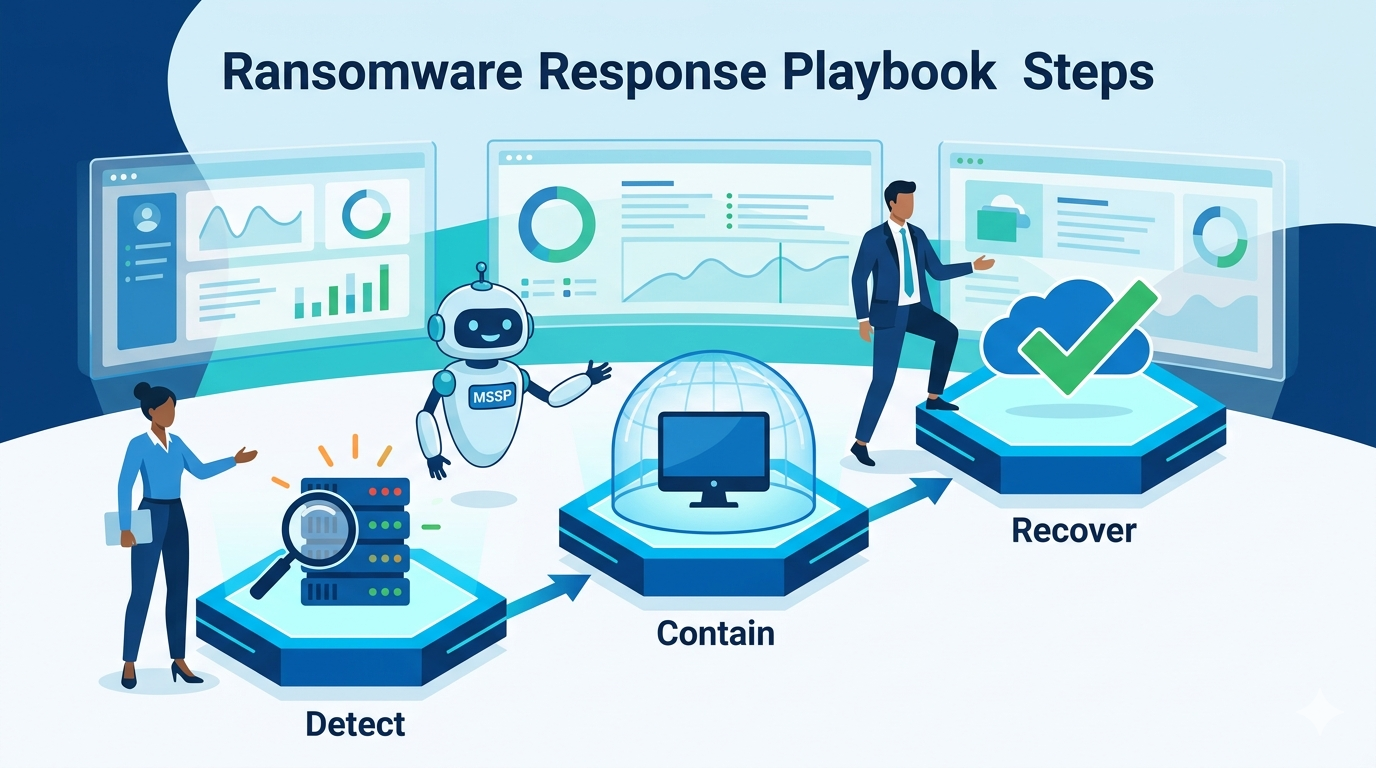
Ransomware incidents escalate quickly, leaving little room for hesitation. When organizations lack a structured response, decisions become reactive and costly. A clear playbook changes that. From our experience in MSSP Security, we’ve seen how preparation turns high-pressure situations into controlled actions.
Teams that follow defined steps can contain threats faster, protect critical systems, and recover with less disruption. This guide combines practical insight and proven response steps to help organizations respond with confidence instead of panic. Keep reading to see ransomware response playbook steps.
Key Insights
A ransomware response playbook ensures teams act quickly, consistently, and effectively under pressure.
- Confirm and contain threats immediately
- Protect evidence before taking action
- Balance technical response with communication
What Is a Ransomware Response Playbook?
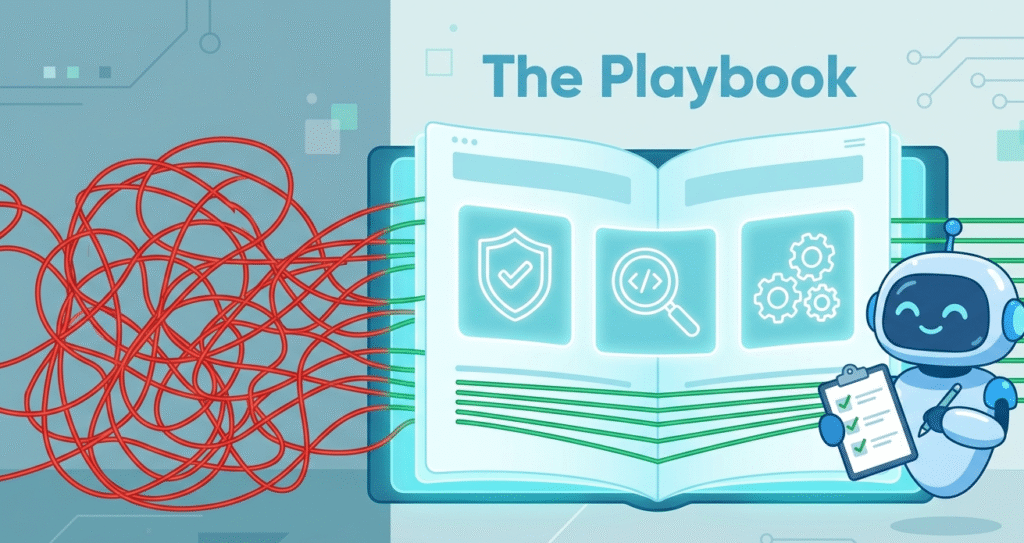
A ransomware response playbook is a structured workflow that guides teams through detecting, containing, and recovering from an attack.
“A Ransomware Response Playbook is a structured guide designed to help organizations prepare for, respond to, and recover from ransomware attacks.” – Zindagi Technologies
Organizations rely on it to reduce uncertainty during critical moments. From our perspective in MSSP Security, we design these security response playbook examples not just for technical execution, but for real-world usability, where timing, clarity, and coordination matter as much as the tools themselves.
Why a Structured Response Matters
Ransomware doesn’t just encrypt files, it disrupts operations, communication, and decision-making.
We’ve observed that organizations without a playbook often:
- Delay containment
- Misjudge the scale of the attack
- Struggle with internal coordination
- Extend downtime unnecessarily
In contrast, those supported by MSSP Security or structured incident response playbooks tend to respond faster and more consistently, even under pressure.
“An ounce of prevention is worth a pound of cure.” – Wikipedia
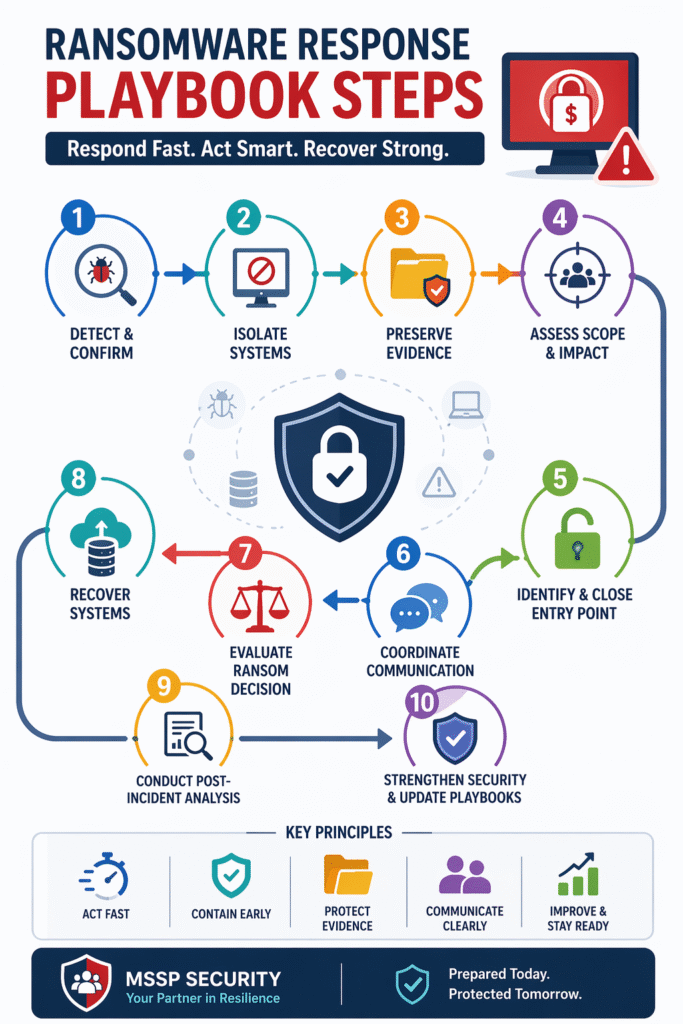
Ransomware Response Playbook: Step-by-Step
Credits: Prabh Nair
1. Detect and Confirm the Incident
The first step is validating that ransomware activity is actually occurring.
This may include:
- Sudden file encryption
- Ransom messages appearing
- Security alerts from monitoring tools
From our experience, early confirmation reduces both false alarms and delayed responses. In MSSP Security operations, we prioritize rapid validation to ensure the right actions are taken immediately.
2. Isolate Affected Systems Immediately
Containment is critical. The faster systems are isolated, the less damage spreads.
Typical actions include:
- Disconnecting infected endpoints
- Disabling network access
- Blocking suspicious connections
We’ve seen that even a few minutes of delay can allow ransomware to move laterally across environments.
3. Preserve Evidence Before Changes
In the urgency to fix the issue, teams often overlook evidence preservation.
Important data includes:
- System and access logs
- Memory snapshots
- Ransom notes and affected files
From both organizational and MSSP Security perspectives, this step is essential for understanding the attack and preventing recurrence.
4. Assess Scope and Business Impact
Once contained, teams need to understand the full impact.
This involves:
- Identifying affected systems and users
- Checking backup integrity
- Determining if sensitive data is involved
We’ve found that clear visibility at this stage helps avoid both overreaction and underestimation.
5. Identify and Close the Entry Point
Stopping the attack source is crucial to prevent reinfection.
Common entry vectors:
- Phishing emails
- Weak or stolen credentials
- Unpatched vulnerabilities
In MSSP Security workflows, we treat this step as a priority alongside containment, not after it.
6. Coordinate Communication Carefully
Ransomware incidents are not just technical—they are organizational.
Teams should:
- Inform leadership and stakeholders
- Align messaging internally
- Prepare external communication if required
From experience, structured communication reduces confusion and maintains trust during the incident.
7. Evaluate the Ransom Decision
This is often the most sensitive step.
Organizations must consider:
- Legal implications
- Business continuity needs
- Availability of backups
We’ve seen that decisions made without proper assessment can lead to long-term consequences, which is why MSSP Security teams often support structured evaluation rather than rushed choices.
8. Recover Systems in a Controlled Way
Recovery should be deliberate, not rushed.
Steps include:
- Restoring from verified clean backups
- Rebuilding compromised systems
- Validating system integrity before going live
From our experience, controlled recovery prevents repeated incidents and ensures stability.
9. Conduct Post-Incident Analysis
After recovery, the focus shifts to learning.
Organizations should review:
- What caused the attack
- How effective the response was
- Where improvements are needed
This is where both internal teams and MSSP Security providers turn incidents into actionable improvements.
10. Strengthen Security and Update Playbooks
Finally, organizations must adapt.
This may include:
- Enhancing monitoring capabilities, Improving access controls, and implementing automated SOAR playbooks to update response workflows and train teams on new threats.
- Improving access controls
- Updating response workflows
- Training teams on new threats
We’ve consistently seen that organizations that evolve after incidents become significantly more resilient.
Common Mistakes to Avoid
Delayed Isolation
Even small delays can significantly increase damage.
Skipping Evidence Collection
This limits the ability to understand and prevent future attacks.
Disorganized Communication
Poor coordination slows response and increases confusion.
Rushed Recovery
Recovering too quickly without validation often leads to reinfection.
Best Practices for Long-Term Readiness
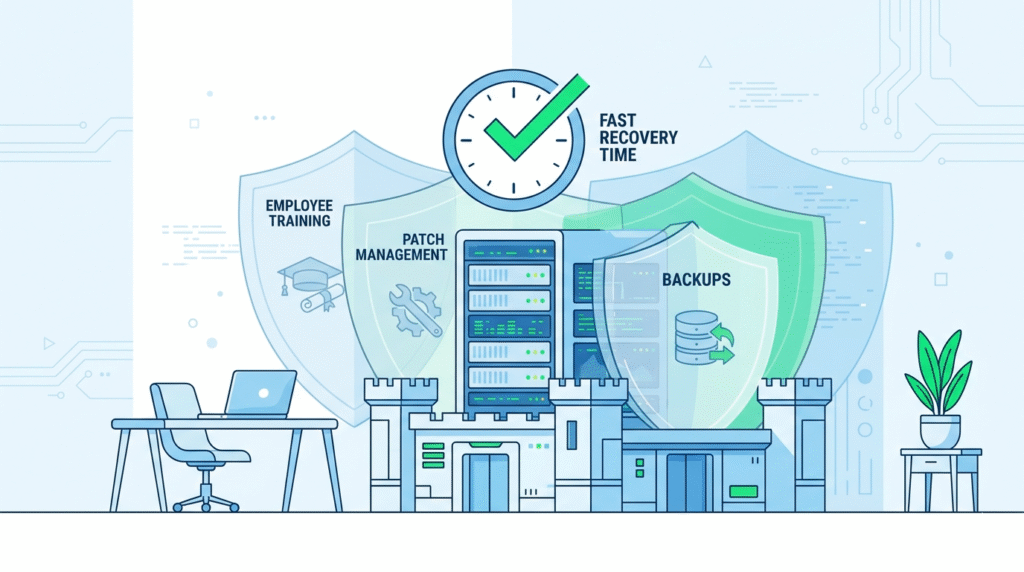
- Test ransomware scenarios regularly
- Maintain secure, offline backups
- Educate users on phishing risks
- Keep systems updated and monitored
- Use MSSP Security as an extension of your team for continuous support
From our perspective, readiness is what transforms ransomware from a crisis into a manageable incident.
FAQ
What should we do immediately after detecting ransomware?
We should isolate affected systems right away to prevent the ransomware from spreading further across the network while confirming the scope of the incident.
How can organizations ensure backups are safe during an attack?
Backups should be stored offline or in secure, segmented environments. Regular testing is also important to ensure they can be restored without issues.
Is it possible to fully recover without paying the ransom?
Yes, many organizations recover using clean backups and proper response steps. However, success depends on preparation and how quickly the incident is contained.
How does MSSP Security improve ransomware response readiness?
MSSP Security helps organizations design, test, and optimize response playbooks using real-world experience, enabling faster detection, better coordination, and more reliable recovery outcomes.
Responding with Clarity and Control
Ransomware incidents demand fast, coordinated action, but speed without structure leads to mistakes. A well-designed playbook allows organizations to respond with clarity, not panic. From our experience in MSSP Security, the most successful responses come from preparation and continuous improvement.
We offer expert consulting to help you streamline operations and enhance visibility. Build a tech stack that aligns with your business goals by leveraging our experience in stack optimization and actionable security recommendations.
References
- https://zindagitech.com/blog/ransomware-response-playbook-step-by-step-guide-cisos
- https://en.wikipedia.org/wiki/Prevention