Address
304 North Cardinal St.
Dorchester Center, MA 02124
Work Hours
Monday to Friday: 7AM - 7PM
Weekend: 10AM - 5PM
Address
304 North Cardinal St.
Dorchester Center, MA 02124
Work Hours
Monday to Friday: 7AM - 7PM
Weekend: 10AM - 5PM


Bad actors hide in networks for months without getting caught. By the time alerts go off, they’ve already stolen data or planted backdoors. Proactive threat hunting works differently, security teams manually search through your systems looking for footprints of compromise before attackers cause real harm.
Off-the-shelf security tools miss the careful attacks designed to avoid detection. People doing the hunting use real intelligence about attacker behavior to find what automated systems can’t. The payoff: shorter time before you catch intruders, knowledge of their actual methods, and a network that’s genuinely tougher to break into.
Find out how proactive threat hunting services actually protects you.
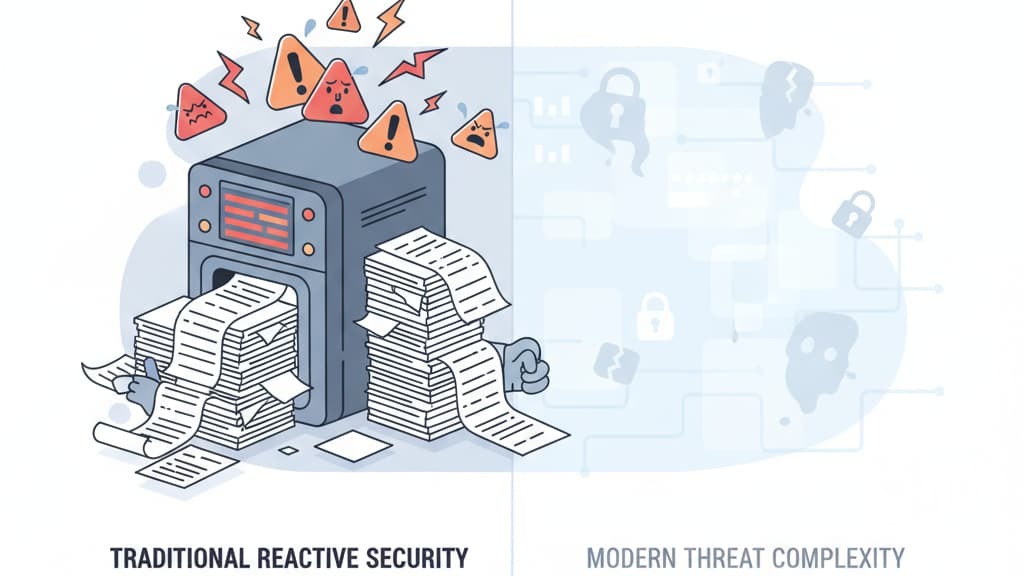
Most organizations we work with lean on the same defensive playbook: firewalls, antivirus software, SIEM systems pumping out alerts. They’re reliable tools for what they’re built to do. The problem is the threat environment shifted while those defenses stayed mostly the same.
Attackers now use zero-day exploits, living-off-the-land binaries (legitimate system tools turned into weapons), and lateral movement tactics designed specifically to slip past traditional controls.
We’ve watched this pattern repeat across client networks. Reactive alerts create their own mess, security teams drown in notifications, most of them false positives, which means actual threats get buried in the noise.
Response times drag. Attackers stay hidden for months because nobody’s actively looking for them. The gaps between detection and response grow wider.
Traditional security systems excel at catching known threats. They falter against novel attacks or sophisticated ones designed to stay invisible. Our experience shows that automated alerts alone become a liability when they’re too numerous to act on quickly. It’s reactive by design, which means you’re always one step behind.
We’ve learned the hard way: waiting for alerts feels like locking the barn door after the horse left. Proactive threat hunting reverses this entirely. Rather than hoping your tools catch something, our teams search your network systematically, finding threats before they inflict damage.
Credits: RTX
At its core, proactive threat hunting is a manual search for hidden threats inside a network. Hunters don’t sit around waiting for alerts to light up, instead they start with educated guesses about how attackers move and what they’re after (security professionals call these TTPs, tactics, techniques, procedures).
Threat intelligence and behavioral patterns guide these hypotheses. The hunters then move through telemetry data from endpoints, networks, and cloud systems, looking for the small signs of compromise that automated tools typically miss.
We’ve found the most effective hunting follows a repeating cycle. A hypothesis gets formed, data gets collected and analyzed, anomalies surface and get investigated, findings get validated, threats get removed, and then the whole operation feeds what was learned back into detection rules.
This isn’t a one-time exercise, it’s a rhythm that tightens your security defenses over time, turning individual discoveries into systemic improvements.
Security environments today are too complicated for pure reaction. Our work with MSSPs shows that assuming attackers already have access somewhere in your infrastructure isn’t paranoid, it’s realistic.
The real win comes from finding them early and disrupting their operations before they achieve their goals. That shift from waiting for breaches to actively hunting them changes everything about how an organization actually defends itself. [1]
Early threat detection is critical to reducing attacker dwell time, the window during which adversaries operate undetected. The longer they remain hidden, the greater the chance for data exfiltration, ransomware deployment, or system disruption.
By continuously hunting for threats, we help you reduce dwell time dramatically, often discovering malicious actors days or weeks before traditional methods would catch them. This approach aligns closely with the need for truly proactive defenses, similar to the mindset behind proactive threat hunting that focuses on identifying issues before attackers escalate their operations.
This not only limits damage but provides your incident response teams with richer context to act swiftly and decisively.
Moreover, proactive threat hunting enhances your overall cyber resilience. Each hunt generates actionable intelligence that improves detection engineering and fills gaps in visibility. This iterative feedback loop strengthens defenses and empowers your security operations center (SOC) to respond faster and smarter.
We’ve seen firsthand how organizations that integrate threat hunting into their cybersecurity fabric gain a competitive advantage, they build stakeholder trust, reduce risk exposure, and maintain business continuity in the face of ever-evolving threats.
Our hunters don’t just look at data, they think like attackers. With deep knowledge of attacker tactics, malware behavior, and system internals, our team includes threat intelligence analysts, incident responders, and security engineers working collaboratively.
This blend of expertise is crucial for hypothesis-driven investigations and rapid validation of suspicious activity.
We follow a rigorous threat hunting framework:
Proactive threat hunting relies on a layered tech stack:

We establish baselines of normal network and user behavior, then hunt for statistical anomalies that deviate from these norms. This helps identify unusual login patterns, data flows, or process executions that may signal compromise.
Based on threat intelligence or emerging attack trends, we formulate testable hypotheses, for example, “Is there evidence of credential dumping in our environment?” We then target data sources most likely to reveal these activities.
We leverage latest threat intelligence feeds to search for known malicious hashes, IPs, domains, or attack patterns. This intelligence is continuously updated and contextualized to your environment, reflecting how threat hunting intelligence helps sharpen insights and narrow in on the behaviors that matter most.
Advanced analytics and automation accelerate routine data processing, surface anomalies, and propose hunting leads. While these tools enhance efficiency, our experts provide the critical human judgment needed to validate findings.
We simulate adversary behaviors to test detection capabilities and identify blind spots. This enables us to refine hunting techniques and improve your overall security posture.
When suspicious events arise, we conduct deep forensic investigations to reconstruct attack chains and understand adversary objectives.
Cloud environments bring unique challenges: dynamic workloads, ephemeral resources, and shared responsibility models increase complexity. Misconfigured storage buckets, excessive permissions, exposed APIs, and container escapes are common attack vectors.
Traditional security tools often fall short in cloud contexts due to scale and volatility. That’s why our threat hunting service incorporates cloud-native logging (AWS CloudTrail, Azure Activity Logs, GCP Audit Logs) and specialized detection platforms to maintain visibility.
We also emphasize identifying misconfigurations and risky identity behaviors to reduce attack surfaces unique to cloud deployments.
Our approach combines foundational visibility with advanced analytics:
Together, these tools empower our team to perform efficient, accurate hunts while continuously improving detection maturity. [2]

AI and advanced analytics enable large-scale data processing and faster insights. Cloud and container environments demand specialized hunting techniques. Zero Trust architectures shift focus to identity-centric detection.
Collaboration on cyber threat intelligence enhances collective defense. We embrace a human-AI partnership model, where automation handles data triage, and skilled hunters focus on strategic investigations.
From my experience working alongside security teams, partnering with an MSSP Security provider is often the smartest first step. We offer continuous, expert-led threat hunting that integrates seamlessly with your existing security stack and reinforces the managed threat hunting benefits organizations increasingly depend on today.
By entrusting threat hunting to a dedicated MSSP Security team, you gain round-the-clock vigilance, accelerated detection, and actionable intelligence, all without the heavy overhead of building an in-house program. We understand attacker tactics deeply, use proven hunting frameworks, and continuously refine our methodology to keep you ahead.
Proactive threat hunting gives you a close look at your risk by mixing threat hunting services, cyber threat hunting, threat intelligence, and active threat detection.
Teams study threat actor behavior, use anomaly detection, run network threat analysis, and review SIEM integration. This early view helps shape incident response and supports a simple threat hunting methodology you can grow over time.
A threat hunting framework breaks big problems into smaller steps. Hunters look at endpoint detection, behavioral analytics, and log correlation to see patterns linked to attacker tactics. They match findings with MITRE ATT&CK and watch for lateral movement detection.
This approach supports continuous threat monitoring and gives you a clearer picture of how threats move inside your network.
You can check SOC readiness by studying telemetry analysis, detection engineering, and the hunting process your team already uses. Look at threat hunting models, threat detection maturity, and hunting team skills.
You should also check security visibility, threat hunting data sources, and how well the team handles compromise hypothesis work. These steps show where gaps remain.
Threat hunting automation helps teams scan wide areas fast, including attack surface monitoring and early threat discovery. It supports risk mitigation by giving steady signals on threat actor behavior.
Automation also helps keep the threat hunt cycle simple, supports threat hunting validation, and speeds IOC validation. This allows hunters to focus more on careful anomaly investigation.
Proactive threat hunting services are no longer a luxury, they’re a necessity in today’s rapidly evolving threat landscape. They help you uncover hidden adversaries early, reduce dwell time, accelerate incident response, and strengthen your overall security posture against emerging threats.
Whether you’re beginning your threat hunting journey or enhancing existing capabilities, partnering with an MSSP Security provider can make a measurable difference. Our hands-on expertise, comprehensive technology stack, and iterative hunting methodologies help transform security operations from reactive to proactive.
If you want to explore how proactive threat hunting can fit into your broader cyber defense strategy, our team is ready to assist.
Get started with us

