

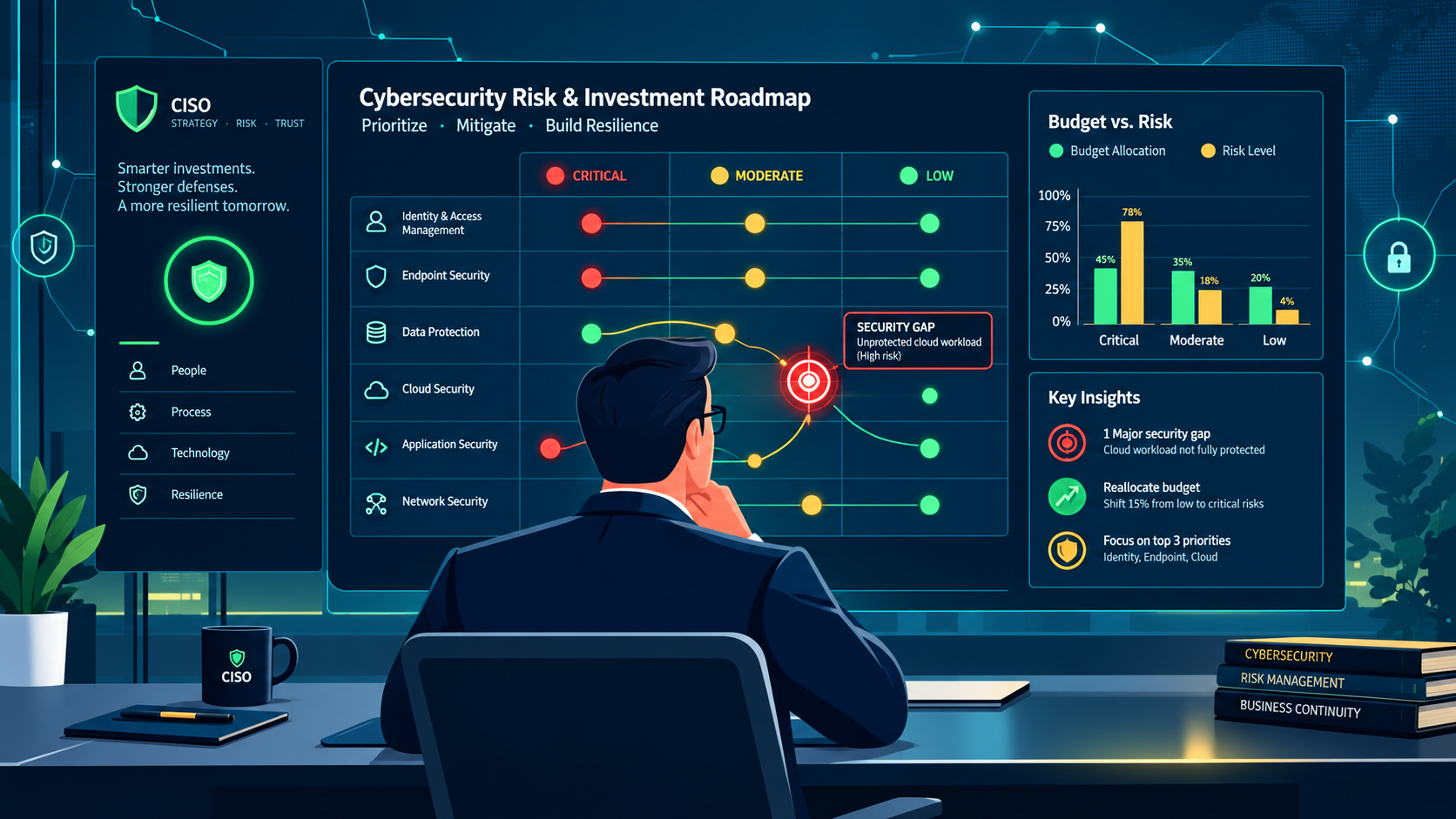
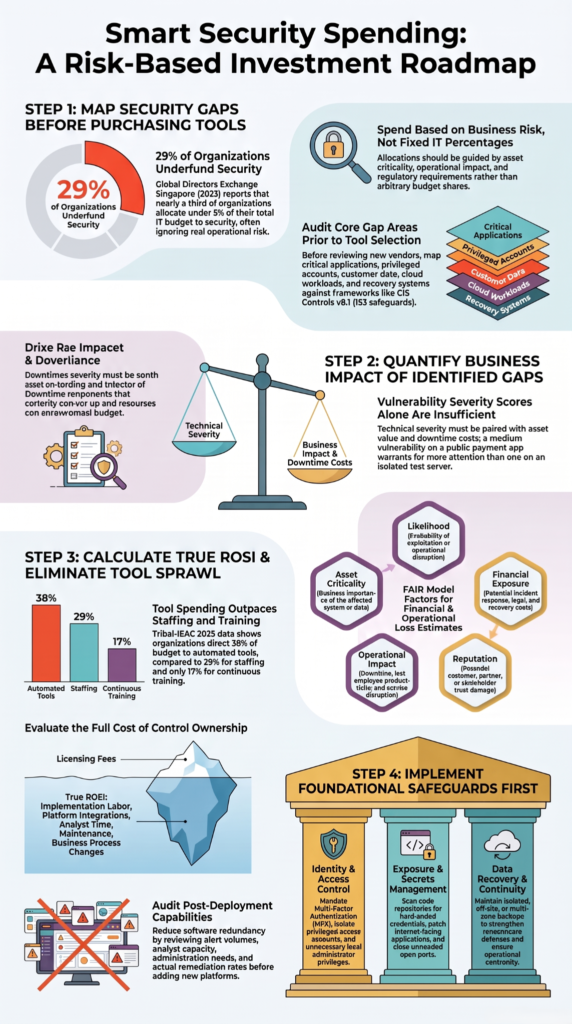
Prioritizing security investment gaps helps businesses address costly security risks before they become bigger problems. Prioritizing the gaps causes exposure when organizations overlook critical vulnerabilities. Security spending should be based on business risk, not a fixed share of the IT budget. Laws, daily operations, critical assets, and potential threats should guide investment decisions. A 2025 report from the Global Directors Exchange Singapore found that 29% of organizations spend under 5% of their IT budget on security.
Look at where exposure exists and what each investment can reduce. MSSP Security can help when internal teams don’t have enough capacity.
Security Investment Priorities: The Quick Read
Smart security spending puts resources where they matter most. This helps reduce the biggest business and online risks.
- Security spending should focus on real business risks rather than fixed budget percentages. Base your spending on your most important assets. Look at the impact on daily operations and the risk of breaking rules. Finally, invest in clear ways to lower threats.
- Before buying new tools, review your security gaps. Map out your key assets, current defenses, and possible attack paths. Also, identify compliance issues, costs, team needs, and project timelines.
- Good spending decisions weigh the total cost of each defense against the risk it removes. Avoid using duplicate tools. Keep your team’s workload in mind. Also, maintain basic security controls.
Security Investment Prioritization: What Should Security Teams Prioritize When Investment Gaps Exist?
Security teams should focus first on security program gaps that put critical assets at risk, could disrupt operations, or leave required obligations unmet. We use this risk-based view to give cybersecurity spending a clear business purpose.
The National Institute of Standards and Technology (NIST) Cybersecurity Framework 2.0 helps teams assess, prioritize, and communicate security work. In our consulting work, we use frameworks like NIST CSF, ISO 27001, and CIS Controls when reviewing security products and audit requirements for MSSPs.
We map critical systems, sensitive data, identities, cloud services, and third-party dependencies. Then we compare current controls against likely attack paths and business impact. That often shows which gaps need funding now.
Our work also helps MSSPs assess whether new products address real gaps or add unnecessary overlap. Reassess priorities as exposure changes. Keep reading to build a practical security investment roadmap.
How Can You Map Security Gaps Before Buying More Tools?
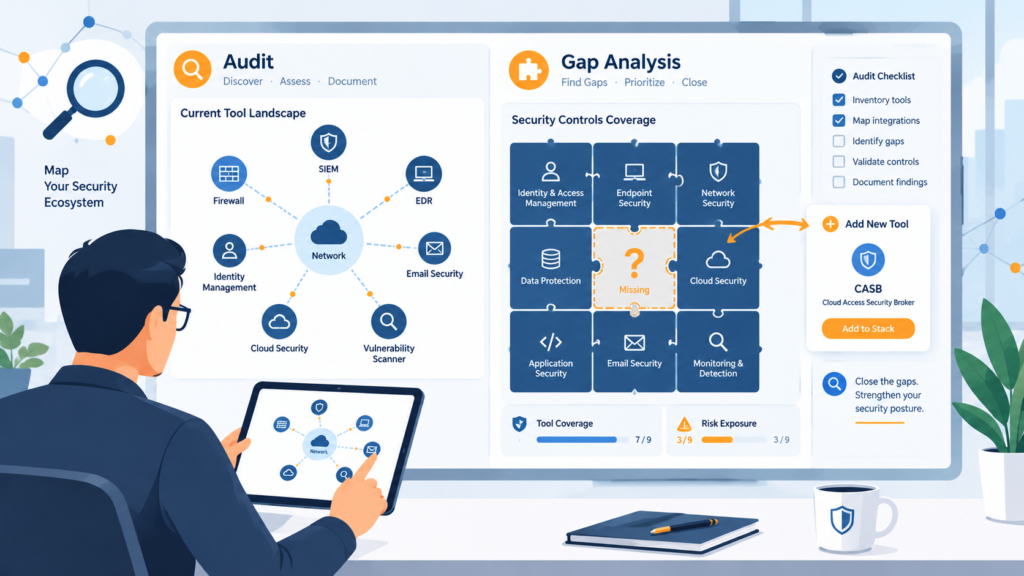
Security gap analysis should come before another product purchase. We first look at critical assets, existing controls, attack paths, and who owns each area.
In our work with MSSPs, the same issue comes up often: teams know they have gaps, but they aren’t sure which product will close them. We map critical applications, privileged accounts, customer data, cloud workloads, and recovery systems before reviewing new tools.
The Center for Internet Security (CIS) lists 153 safeguards in CIS Controls v8.1. We use these controls as a reference, not a shopping list.
A practical review covers:
- Critical assets and owners.
- Current security controls.
- Exposed attack paths.
- Compliance gaps and exceptions.
- Cost, staffing, and timelines.
That process helps our clients audit products against real needs, not sales claims. It also separates genuine security gaps from documentation issues. Get the map right first, then decide what deserves new spending.
How Do You Quantify the Business Impact of Each Gap?
Cyber risk quantification turns technical findings into estimates of financial loss, operational disruption, and recovery exposure.
A vulnerability severity score alone rarely tells an executive how much a particular gap matters. We need to connect likelihood with asset value, downtime, recovery costs, regulatory consequences, and other loss factors.
As highlighted by FAIR Institute
“The FAIR Model describes the underlying factors that comprise risk and can be quantified to estimate it. Traditionally, risk analysts have performed this quantification based on subject matter estimates. Analysts can work at different levels of the model depending on the availability of data.” –FAIR Institute
| Factor | What to assess |
| Likelihood | Probability of exploitation or disruption |
| Asset criticality | Business importance of affected systems |
| Financial exposure | Potential incident and recovery costs |
| Operational impact | Downtime, lost productivity, and service disruption |
| Reputation | Potential customer or stakeholder damage |
For example, a medium-severity vulnerability on an isolated test server may have limited business exposure. The same weakness on an internet-facing payment application could warrant substantially more attention.
The numbers do not need to be perfectly precise. They need to make assumptions visible, comparable, and useful for decision-making.
How Can You Measure Security ROI Before Funding a Control?
Security gap analysis consulting should compare the full cost of a control with the amount and type of risk it is expected to reduce.
We consider more than licensing. A security investment can require implementation labor, integrations, analyst time, maintenance, training, renewal costs, and changes to business processes.
A simple ROSI-style comparison can examine:
- Implementation and licensing costs.
- Staffing and maintenance requirements.
- Expected reduction in business risk.
- Time required to realize the benefit.
- Existing capabilities that may overlap.
- Residual risk after implementation.
As noted by Federal Reserve
“Control deficiencies and other concerns identified through these methods are evaluated using FAIR so that they can be appropriately prioritized. Cost-benefit analysis is then performed on risk mitigation options to help ensure that the organizations are optimizing their resource utilization, and so that management understands the value proposition of these investments.” –Federal Reserve
Why Does Tool Sprawl Leave Critical Security Gaps Open?
Tool sprawl can leave security gaps open when organizations buy products faster than teams can run, connect, and measure them.
We’ve seen this with MSSPs that manage SIEM, XDR, endpoint, identity, cloud security, and vulnerability platforms at the same time. The issue isn’t always missing technology. Sometimes it’s too much of it, with unclear ownership and overlapping features.
The supplied Tribal-ISAC 2025 Digital Resilience & Cybersecurity Capacity Survey reports that 38% of surveyed organizations put their largest cybersecurity funding share into automated tools and technology. Staffing accounted for 29%, while continuous training represented 17%.
In product audits, our team checks what happens after deployment. Who handles alerts? Which findings get remediated? Are two platforms doing the same job?
Before buying another tool, review:
- Existing capabilities and overlap.
- Alert volume and analyst capacity.
- Integration and administration needs.
- Remediation rates.
- Useful security metrics.
Sometimes the right investment isn’t another platform. It’s getting more value from what’s already deployed.
Which Security Controls Should Come Before Expensive Technology?
Credit: CYBRIXEN
Organizations should implement foundational controls first. These can reduce significant exposure before the company expands its technology stack.
The CIS Controls provide prioritized safeguards against common attack paths. These include vulnerability management, account management, logging, and penetration testing. Implementation groups help organizations sequence these controls based on risk and available resources.
In practice, organizations should first examine identity, privileged access, exposed services, secrets, patching, and recovery. These areas strengthen ransomware defense, prevent data breaches, and ensure business continuity. They also reduce threat exposure without requiring major platform purchases.
- Identity: Mandate MFA and isolate privileged access.
- Secrets: Scan repositories for hard-coded credentials.
- Exposure: Update internet-facing applications and close unnecessary ports.
- Recovery: Maintain isolated, off-site, or multi-zone backups.
- Access: Remove unnecessary local administrator privileges.
Of course, these actions are not universally sufficient. Their value depends on the organization’s architecture, threat model, and existing controls.
The best resource allocation decisions combine quick wins with thorough analysis. A low-cost control is valuable if it blocks a credible attack path. Conversely, expensive platforms require evidence that they will improve overall security effectiveness.
FAQs
What is security investment prioritization?
Prioritizing investments helps close critical security spending gaps. This approach addresses the risks that pose the greatest threat to the business.
How can organizations identify security spending gaps?
Security gap analyses and posture assessments help identify weaknesses. These tools allow companies to prioritize urgent risks and allocate resources effectively.
How should companies align security spending with business risk?
Companies should align their security funding with their risk appetite. This ensures investment targets threats that could disrupt business operations.
How can organizations measure cybersecurity ROI?
Organizations can measure cybersecurity ROI by tracking key performance indicators. They should also monitor security performance and reductions in threat incidents.
What should a security investment roadmap include?
A security investment roadmap should define clear priorities. It must outline funding needs, timelines, and measurable outcomes. These should be based on cyber risk quantification and program maturity.
Prioritize Security Investment by Business Risk
When security gaps put critical assets or daily operations at risk, simply spending more isn’t enough. You need to know where investment can reduce meaningful risk. That’s the reality.
A risk-based approach helps you focus resources on the gaps that matter most while getting more value from your existing security stack. MSSP Security can help you assess needs, reduce tool sprawl, and choose solutions that fit your business goals.
References
- https://www.federalreserve.gov/SECRS/2017/February/20170221/R-1550/R-1550_011217_131715_412912783216_1.pdf#1#1
- https://www.fairinstitute.org/hubfs/A%20FAIR%20Framework%20for%20E%EF%AC%80ective