


A gap analysis presentation should show management where performance falls short, why it matters, and which decisions are needed. MSSP Security ties findings to business priorities, risks, and practical next steps. This guide covers executive briefings, supporting evidence, and remediation approval. Keep reading to learn how to present findings clearly.
Quick Insights: What Makes a Gap Analysis Presentation Effective?
When presenting gap analysis findings to management, focus on three points:
- Lead with impact: Explain how each gap affects objectives, operations, or risk.
- Set priorities with evidence: Compare current and target performance, then rank gaps.
- Clarify decisions: Identify specific actions, owners, deadlines, resources, and required approvals for management.
What Should You Include When Presenting Gap Analysis Findings to Management?
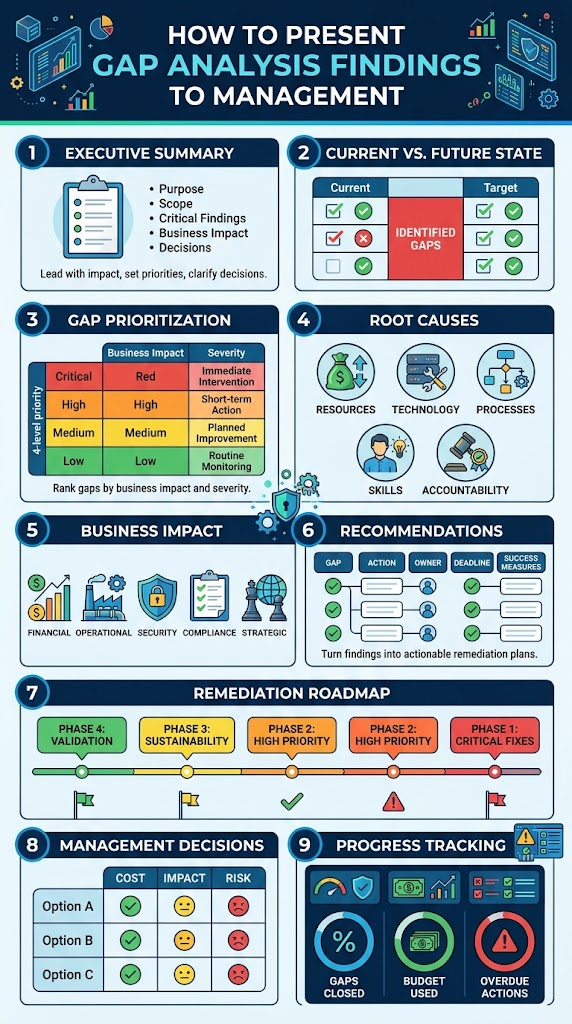
When presenting gap analysis findings management, focus on eight key areas: executive summary, assessment scope, current versus desired state, critical findings, business impact, prioritized recommendations, remediation roadmap, and management decisions. This structure helps executives understand product gaps, associated risks, and required actions without getting lost in technical details.
For MSSPs evaluating security products, assess access management, incident response, monitoring, integration, reporting, and compliance. The NIST Cybersecurity Framework 2.0 provides six useful reference functions: Govern, Identify, Protect, Detect, Respond, and Recover.
Keep the presentation concise, ideally around 10 to 15 slides, depending on assessment complexity. Place detailed test results, product specifications, and assessment methods in an appendix. A well-prepared MSSP gap analysis report can support the presentation by documenting product deficiencies and linking findings to business requirements. Reserve time for management questions about costs, vendor dependencies, security risks, and remediation priorities.
What Should an Executive Summary for Gap Analysis Communicate?

An executive summary should highlight the main gaps, explain their business impact, and identify the management decisions required. When presenting gap analysis findings management, MSSPs should connect each finding to specific business or service requirements, particularly those involving integration, access control, reporting, and daily operations.
A strong executive summary should cover six essential components:
- Assessment purpose: Why was the product or process reviewed?
- Assessment scope: Which systems, teams, products, or controls were assessed?
- Overall results: How well do current capabilities meet requirements?
- Critical findings: Which deficiencies need attention?
- Business implications: What financial, operational, or security risks could arise?
- Recommended actions: What remediation steps or approvals are needed?
Use a comparison table to show the current state, desired state, critical gaps, business impact, recommended actions, and management decisions. Support findings with relevant evidence and explain whether each gap requires configuration changes, additional processes, or product replacement. Keep technical terminology minimal so executives can understand the results and make informed decisions.
How Do You Compare the Current State Against the Desired Future State?
A current-versus-future-state comparison identifies where an existing product, process, or capability falls short of business requirements. It helps management evaluate product suitability and understand what needs to change before adoption.
A useful assessment should examine existing capabilities, required standards, identified deficiencies, expected improvements, and supporting evidence.
For example, an MSSP may find that access reviews rely on manual checks and inconsistent records, while the desired state requires scheduled reviews, assigned approval responsibilities, and complete audit documentation.
The following table illustrates how to organize these differences:
| Assessment area | Current state | Desired state | Identified gap |
| Processes | Manual procedures | Documented workflows | Process deficiency |
| Skills | Limited technical training | Defined competency requirements | Skills shortage |
| Security | Inconsistent access reviews | Scheduled access reviews | Control deficiency |
| Compliance | Incomplete documentation | Complete audit records | Compliance gap |
| Monitoring | Reactive reporting | Continuous monitoring | Visibility deficiency |
For cybersecurity assessments, the six NIST CSF 2.0 functions can also help organize findings across governance, identification, protection, detection, response, and recovery.
Make sure the desired state reflects actual business requirements, customer commitments, regulatory obligations, available resources, and technical dependencies. This helps MSSPs develop realistic gap assessments and actionable remediation plans.
Which Gap Analysis Findings Should Management Prioritize?

Management should prioritize gaps by considering their business impact, severity, risk exposure, urgency, and the effort required to resolve them. In cybersecurity assessments, human error also deserves attention because it can create significant security risks.
“Over 74% of cybersecurity breaches involve human error.” – DeepStrike
This highlights why staff training and organizational gap analysis should be part of an effective cybersecurity strategy.
A vulnerability assessment gap analysis can help MSSPs identify security weaknesses, understand their potential impact, and determine which vulnerabilities require immediate attention.
When evaluating findings, management should consider potential disruptions to service delivery, financial consequences, regulatory or contractual exposure, existing security weaknesses, and gaps between current capabilities and business requirements.
A four-level gap prioritization matrix can then help classify findings as critical, high, medium, or low, giving management a consistent basis for determining remediation priorities and allocating resources.
Use a four-level gap prioritization matrix to guide management decisions:
| Priority | Characteristics | Management response |
| Critical | Significant business exposure | Immediate intervention |
| High | Major operational impact | Short-term remediation |
| Medium | Manageable deficiencies | Planned improvement |
| Low | Limited immediate consequences | Routine monitoring |
The NIST CSF 2.0 framework can support risk management decisions. Document consistent rating criteria and consider remediation dependencies when setting priorities.
How Can You Explain the Root Causes Behind Identified Gaps?
Credit: SANS Institute
Root cause analysis helps MSSPs understand why a product, process, or capability fails to meet business requirements. Identifying the underlying cause prevents management from approving solutions that only address visible problems.
Common causes of organizational performance gaps include:
- Insufficient resources or funding.
- Outdated or unsuitable technology.
- Ineffective processes.
- Skills and knowledge deficiencies.
- Unclear accountability.
- Inadequate policies or controls.
The GAO Green Book provides a useful reference for examining internal control weaknesses through risk assessment, information and communication, and monitoring.
When presenting root cause analysis findings, document four key elements:
- Observed problem: Which requirement is not being met?
- Supporting evidence: What assessment results, records, or interviews confirm the issue?
- Underlying cause: Is the problem related to technology, configuration, processes, resources, or ownership?
- Potential consequence: What happens if the gap remains unresolved?
For example, incomplete incident reporting may result from product limitations and unclear staff responsibilities. Separating these causes helps management choose appropriate remediation actions, such as additional integration, improved reporting procedures, or clearer ownership.
How Do You Demonstrate the Business Impact of Identified Gaps?
When presenting gap analysis findings management, explain how each significant deficiency affects the business rather than focusing only on technical requirements. For MSSPs, connect product gaps to customer commitments, service delivery, and operational performance. Consider financial consequences such as additional costs and potential losses, operational issues such as reduced productivity and service disruptions, security risks involving unauthorized access or data loss, compliance concerns, and strategic setbacks that may delay business objectives or service expansion.
“A structured, flexible, and comprehensive approach to managing and mitigating cybersecurity risks.” – Qualysec
Its six functions offer a useful reference for explaining how security gaps affect governance, protection, detection, response, and recovery.
To demonstrate the cost of inaction, compare estimated remediation expenses with the potential costs of leaving gaps unresolved. For example, an MSSP might estimate a $40,000 investment to improve access controls. Explain the calculation method and assumptions clearly so management can weigh the investment against potential operational and security consequences without treating estimates as confirmed losses.
How Should You Present Evidence to Support Gap Analysis Findings?
When presenting gap analysis findings management, support every major finding with traceable evidence, measurable indicators, and a clear comparison against business requirements. This helps executives understand how the assessment reached its conclusions before approving purchases or remediation budgets.
Useful evidence sources include KPI performance data, audit results, product documentation, benchmark comparisons, stakeholder interviews, and compliance assessment records. For example, a finding about inadequate security monitoring should reference relevant system configurations, monitoring records, incident logs, or control requirements.
Visuals can also make assessment results easier to understand. Bar charts compare current performance against target KPIs, heat maps highlight gap severity, trend lines track performance over time, and dashboards show remediation progress. Comparison tables help evaluate product capabilities against specific requirements.
Choose visuals based on the information management needs. For each finding, include the assessment date, measurement criteria, and data source. This makes the evidence easier to verify and helps executives evaluate product suitability, security risks, and outstanding remediation priorities.
How Do You Turn Gap Analysis Findings Into Actionable Recommendations?
When presenting gap analysis findings management, translate each identified deficiency into a practical recommendation with a clear objective and measurable outcome. Management should understand whether a gap requires product configuration, vendor changes, additional tools, staff training, or product replacement.
Each recommendation should include the identified gap, proposed corrective action, expected outcome, required resources, responsible stakeholder, completion deadline, and success measurement.
For example, if a security product cannot support the required access review process, an MSSP could evaluate an integration or consider an alternative solution. The expected outcome might be completing quarterly access reviews across all designated systems with documented approval records.
Separate recommendations into three implementation categories:
| Initiative | Purpose |
| Quick wins | Address immediate deficiencies |
| Medium-term improvements | Strengthen existing capabilities |
| Long-term initiatives | Meet broader organizational requirements |
Link every proposed improvement to its original assessment finding. This helps management track remediation progress, allocate resources, and verify whether corrective actions resolve the identified gaps. Ensure recommendations also reflect operational requirements, available resources, and product limitations.
What Should a Gap Analysis Remediation Roadmap Include?
A remediation roadmap translates approved recommendations into actionable tasks with defined phases, milestones, resources, deadlines, and responsible stakeholders. When presenting gap analysis findings management, MSSPs should show how each identified deficiency will be addressed before a new product becomes operational. This may involve configuration, integration, staff training, testing, documentation, and operational handover.
A practical remediation roadmap can follow four phases:
- Address critical gaps: Resolve immediate security, financial, compliance, or operational risks.
- Implement high-priority improvements: Fix significant deficiencies requiring coordinated action.
- Strengthen processes: Improve documentation, training, technology, and internal controls.
- Validate results: Confirm corrective actions meet requirements and monitor progress.
A RACI matrix can clarify ownership by identifying who is Responsible, Accountable, Consulted, and Informed for each task. The roadmap should also outline budget requirements, staffing needs, and implementation dependencies.
Set realistic deadlines and measurable milestones based on available resources. This helps management track remediation progress, allocate resources, and determine when the product is ready for operational use. See our guide to developing remediation plans for gaps for additional guidance.
How Can You Secure Management Approval for Gap Remediation?
When presenting gap analysis findings management, provide clear remediation options, estimated costs, expected outcomes, and the consequences of each decision. Executives need to understand what requires approval, who will be responsible, and what risks remain if action is delayed.
Focus on five key management decisions: which gaps need immediate attention, the available remediation budget, responsibility for corrective actions, implementation priorities, and acceptable timelines.
When comparing remediation approaches, consider their business impact, financial requirements, implementation complexity, risk reduction, and resource availability.
A decision table can help management evaluate three common approaches:
| Option | Main consideration | Management implication |
| Immediate remediation | Addresses urgent exposure | Faster resource allocation |
| Phased remediation | Spreads implementation effort | Requires milestone oversight |
| Deferred remediation | Delays corrective action | Requires documented risk acceptance |
For MSSPs evaluating new products, connect each recommendation to the original assessment findings. This helps executives make informed decisions about product purchases, vendor negotiations, additional testing, and remediation investments.
How Should You Track Progress After Presenting Gap Analysis Findings?
After presenting gap analysis findings management, track remediation through measurable KPIs, milestone reviews, and regular progress reports. Management approval does not mean a gap is resolved. MSSPs must verify that corrective actions meet the original product, security, and operational requirements.
Six useful metrics help monitor progress: percentage of critical gaps closed, remediation completion rate, KPI improvement, outstanding high-risk findings, budget utilization, and milestone completion.
A remediation dashboard can show completed actions alongside unresolved issues, delayed tasks, and remaining risk exposure. This helps management understand whether implementation is progressing as planned or requires further attention.
Set reporting frequency according to risk severity, project complexity, and management requirements. Progress reports can include dashboards, milestone tracking, outstanding issue registers, escalation procedures, and updated risk assessments. The GAO Green Book also identifies monitoring as a key component of internal control.
Finally, verify every closed gap with supporting evidence, such as test results, updated documentation, or configuration records. This ensures remediation delivers measurable improvements rather than simply completing assigned tasks.
How Should You Handle Management Questions and Feedback?
How Should You Handle Management Questions During a Gap Analysis Presentation?
When presenting gap analysis findings management, be prepared to answer questions about assessment evidence, risk severity, remediation costs, and product suitability. Executives may challenge a critical rating, question the proposed budget, or ask whether an alternative configuration could meet business requirements.
Prepare for six common questions: Why is the gap classified as critical? What evidence supports the finding? What happens if remediation is delayed? How much will corrective action cost? Can existing resources address the issue? How will success be measured?
When responding, refer to relevant assessment evidence, explain assumptions and limitations, present alternative solutions where appropriate, and clarify resource requirements and implementation timelines. For product reviews, connect each deficiency to the specific MSSP requirement it fails to meet.
If further investigation is needed, acknowledge what remains uncertain and establish a follow-up deadline rather than making unsupported claims. Finally, document management decisions, outstanding questions, and agreed actions to keep remediation aligned with business requirements.
FAQ
What Is the Best Way to Present Gap Analysis Findings to Management?
The best approach is to summarize the key findings, compare current performance with target requirements, and explain the business impact of each gap. Prioritize issues based on risk and supporting evidence, then provide actionable recommendations with clear owners, deadlines, and required management decisions.
What Should an Executive Summary for a Gap Analysis Include?
An executive summary should include the assessment purpose, scope, overall results, critical findings, business implications, and recommended actions. It should give executives enough context to understand the main deficiencies and determine which actions require approval.
How Do You Prioritize Gap Analysis Findings?
Prioritize findings based on severity, business impact, risk exposure, urgency, and remediation effort. Critical gaps that threaten security, compliance, or service delivery should receive immediate attention, while less urgent deficiencies can be addressed through planned improvements.
What Evidence Should Support Gap Analysis Findings?
Supporting evidence may include KPI data, audit results, product documentation, benchmark comparisons, stakeholder interviews, and compliance assessment records. Each finding should connect the evidence to a specific requirement so management can understand how the assessment reached its conclusions.
How Do You Turn Gap Analysis Findings Into an Actionable Remediation Plan?
Translate each finding into a corrective action with a defined objective, responsible stakeholder, required resources, completion deadline, and success measurement. Organize actions by priority, establish implementation milestones, and monitor progress through regular management reports.
How Can Gap Analysis Findings Be Turned Into Management Decisions?
A successful gap analysis presentation helps management understand product deficiencies, business risks, and the actions needed to address them. MSSP Security provides vendor-neutral consulting to help MSSPs evaluate security products, reduce tool sprawl, optimize technology stacks, and improve service quality.
With over 15 years of experience and 48,000+ projects completed, our services include needs analysis, vendor shortlisting, PoC support, and actionable recommendations. Contact MSSP Security to build a technology stack aligned with your business goals and operational maturity.
References
- Mohamed, Abdalla.“Human Error Cybersecurity Statistics 2026: 35+ Facts.” DeepStrike, October 4, 2026. Updated October 22, 2026. Accessed November 4, 2026.
- Sahoo, Chandan.“NIST Cybersecurity Framework 2.0: Everything CISOs and Tech Leads Need to Know.” Qualysec, October 6, 2026. Accessed November 4, 2026.