Address
304 North Cardinal St.
Dorchester Center, MA 02124
Work Hours
Monday to Friday: 7AM - 7PM
Weekend: 10AM - 5PM
Address
304 North Cardinal St.
Dorchester Center, MA 02124
Work Hours
Monday to Friday: 7AM - 7PM
Weekend: 10AM - 5PM


Outsourced web application security is when you bring in outside experts to handle the testing and monitoring, but the big decisions and final responsibility stay with your company. It’s not a magic fix. A lot of mid-sized firms use it now, because keeping up with new cloud threats is a full-time job on its own.
It works, but only if you treat it like a real partnership. If you just hand it off and forget about it, things fall apart. We’ll walk through the practical details, what it really covers, the common pitfalls, and how to set it up so it actually makes you more secure. Stick around to see how to get it right.
What is outsourced web app security? You bring in a specialized third-party team to handle the technical security work, like vulnerability scanning, penetration testing, and 24/7 monitoring, so your own people can focus elsewhere. The responsibility for risk, however, stays with you.
As the NIST blog emphasizes regarding accountability:
“Recognize that even when you outsource some of your cybersecurity needs, you do not transfer your liability for protecting your business and your customers’ information. You are ultimately responsible for protecting your systems and data.” – NIST Cybersecurity Insights [1]
From our view, it usually starts with an external assessment aligned to frameworks like the OWASP Top 10. Those common flaws, think injection attacks or broken access controls, are still causing most of the incidents out there.
A typical program includes:
This setup turns security from an abstract worry into something you can actually measure and manage.

Why do they do it? In our work with MSSPs, we see three big reasons companies outsource their web app security: expertise, speed, and cost, often delivered through advanced security services that are difficult to replicate in-house. It’s hard to build a deep bench of AppSec talent internally.
We’ve watched internal teams chase a single qualified candidate for months, only to have that person burn out when the workload inevitably spikes. Outsourcing plugs that hole with established processes and mature technology from day one.
It also gets you specialized skills faster. Think about API security, container scanning, or locking down Kubernetes, these are niches that change almost weekly. An outside provider lives in that world; an internal team is often playing catch-up.
The typical triggers we see?
Sure, saving money is part of the calculation. But in our experience, the real driver is usually the need for consistent, expert coverage right now, not six months from now.
What gets handed off to an outside team? In our work, it’s usually the jobs that need deep specialization or non-stop attention. We see it split into two clear areas.
The first is testing and assessment. Think scheduled penetration tests, maybe once a quarter, and more regular vulnerability scans. It’s about proactively finding weaknesses.
The second bucket is operations and compliance. This is the always-on work that keeps the lights on:
The most effective setups we audit don’t treat these as separate items. The real magic happens when your testing team and your monitoring team are connected. The context they share, knowing what ‘normal’ looks like on your network, makes every alert and every test sharper and more actionable.
A vendor serving dozens of clients becomes a very attractive target itself, which raises serious supply chain concerns. Highlighting this shift toward transparency, recently noted:
“The CycloneDX specification, an OWASP flagship project, is supported by a community that… focuses primarily on enhancing security and transparency within the supply chain. Nevertheless, there remains a critical need to strengthen the broader security of the overall supply chain by providing open-source projects and maintainers with substantial funding, essential tools, [and] ongoing support.” – the OWASP Foundation [2]
From our audits, the key risk categories usually look like this:
These aren’t deal-breakers. But they will become problems if you don’t name them and build your process to manage them from the start.
How do you actually manage the risks? It comes down to tight controls, strong encryption, and clear rules that everyone follows. Encryption isn’t optional. Data needs TLS protection when it’s moving and something like AES-256 when it’s stored. And access? It has to be locked down with multi-factor authentication and strict role-based controls.
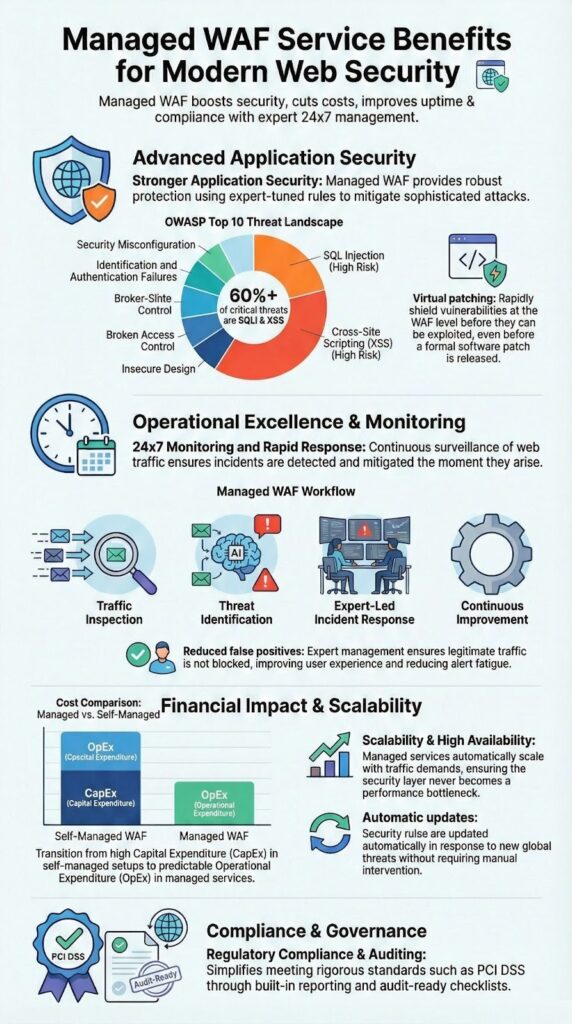
In our audits, we push for a few specific technical measures. Many teams pair least-privilege access with managed WAF services to curb automated abuse, credential stuffing, and privilege probing at scale. The principle of least privilege is key, people should only get the access they absolutely need to do a specific task, and only for as long as they need it.
A solid mitigation plan usually includes:
When this governance is robust, an outsourced model often becomes more consistent and reliable than a patchwork of internal efforts. The structure forces clarity and accountability that internal teams sometimes lack.

MSSPs ask us this all the time: build a team or buy the service? It’s rarely one or the other. The smart move is usually a blend.
Think about it in terms of control versus scale.
Scalability is the other big divider. Growing an internal team is slow. Scaling an outsourced service can happen next week.
What we see work is a hybrid model. Keep a small internal team for strategy, architecture, and client relationships, the core of your business. Then, partner with a specialized firm for the volume work: the constant scanning, testing, and monitoring.
| Dimension | In-House | Outsourced |
| Expertise | Limited hiring pool | Global specialists |
| Cost | High fixed cost | 20–40% lower |
| Control | Full | Shared via SLAs |
| Scalability | Slow | Rapid |
| Compliance | Direct ownership | Shared responsibility under PCI-DSS |
We often advise starting with outsourced testing and monitoring, then building internal ownership over time as risk tolerance and maturity increase.
Credits: Cloudflare
So, when is it the right time to outsource web app security? From what we see with MSSP clients, the answer comes down to a few clear pressure points.
This is for the fast-growing company, often under 500 employees, that can’t wait. A SaaS firm handling regulated data needs a compliant security program now, not after a year-long hiring spree. Outsourcing is the fastest route to being audit-ready for SOC 2, HIPAA, or GDPR.
Think mergers, cloud migrations, or platform rewrites. These events create massive, temporary risk spikes that swamp an internal team. Bringing in external experts acts as surge capacity, keeping the core business secure.
Specific Scenarios We See Often:
In these moments, outsourcing isn’t a failure. It’s a pragmatic tool. It buys you immediate expertise and lets your business keep moving forward without a dangerous pause. For an MSSP, spotting these triggers in a client is key to recommending the right support at the right time.
Outsourced web application security includes testing, monitoring, and protection delivered by external security teams. Services usually cover web application security outsourcing, third-party appsec services, and managed web security.
You receive external vulnerability assessment, delegated penetration testing, and structured risk assessment services. This model supports cloud-based app protection, SaaS security outsourcing, and security as a service without building an internal security department.
Web application security outsourcing provides immediate access to appsec managed services without long recruitment cycles. Companies use SAST outsourcing, outsourced DAST scanning, and IAST external providers as needed.
In-house teams require higher fixed costs and ongoing training. Outsourcing supports secure SDLC outsourcing, threat modeling external, and code review services with predictable scope and measurable SLA security metrics.
Outsourced web application security directly supports compliance as a service. Providers assist with PCI-DSS outsourcing, GDPR app security, HIPAA web compliance, and SOC2 outsourced audits.
Security audit contractors manage ISO 27001 external certification activities and regulatory reporting services. This approach reduces internal audit effort and improves accuracy through automated compliance checks and consistent security KPI tracking.
Third-party appsec services secure modern architectures through API security outsourcing, container security scanning, Kubernetes appsec, and serverless security outsourcing. Teams also manage cloud security posture CSPM and infrastructure as code IaC security.
These services support AWS appsec outsourcing, Azure web security, and hybrid cloud appsec while enforcing isolation, access controls, and configuration standards.
After initial testing, organizations receive continuous protection through security operations center SOC outsourcing. This includes SIEM outsourcing, log management external, and anomaly detection services.
Providers handle web firewall WAF management, DDoS mitigation services, and vulnerability prioritization. Regular patch management services and breach detection services reduce attack dwell time and limit operational impact.
Outsourcing web app security works when it’s a governed partnership, not a hand-off. The successful MSSPs we advise use it as a force multiplier. They keep internal strategy and context, then layer on external scale and deep expertise. Clear metrics, access controls, and shared accountability make it sustainable. It’s about deliberate blending.
If you’re structuring this for your MSSP or auditing a provider, we can help.
Let’s Build Your Perfect Tech Stack

