Address
304 North Cardinal St.
Dorchester Center, MA 02124
Work Hours
Monday to Friday: 7AM - 7PM
Weekend: 10AM - 5PM
Address
304 North Cardinal St.
Dorchester Center, MA 02124
Work Hours
Monday to Friday: 7AM - 7PM
Weekend: 10AM - 5PM

![Visual representation of outsourced cybersecurity threat hunting [city], showcasing threat detection and analytics.](https://msspsecurity.com/wp-content/uploads/2025/11/image-71.jpeg)
Outsourced cybersecurity threat hunting in Fullerton, California helps teams that already know they’re stretched and don’t want to gamble with blind spots. Attackers move faster than most in-house teams can track, jumping between systems, hiding in normal traffic, waiting.
Studies keep showing the same pattern: advanced threats can sit inside a network for weeks before anyone notices. As one expert said, “Proactive hunting cuts dwell time dramatically,” which is exactly what we see during real incident work. That’s why many organizations lean on us at MSSP Security when they want actual protection.
Keep reading to see how we do it..

Some teams in Fullerton don’t ask, “Is outsourced cybersecurity threat hunting right for us?” until something feels slightly wrong, like a hum in the background they can’t trace. Consider whether proactive measures, like proactive managed threat hunting, can illuminate those unseen risks.
Maybe odd login times show up in reports, maybe a “harmless” email turns into strange behavior on one endpoint, or maybe the security team is just worn down from trying to piece together alerts that never quite add up.
We see this a lot when we work with MSSPs that are trying to pick or audit threat hunting tools for their own clients. They’re not just asking if a product “works,” they’re asking if it helps them see what’s really happening across their customers’ networks. Threat hunting does that, it brings structure and clarity to what can feel like guesswork.
From our side, outsourcing isn’t just about extra hands, it’s about bringing in people who’ve sat in enough investigations to recognize quiet attacker behavior hiding in normal-looking traffic.
More than once, we’ve helped an MSSP evaluate a “good on paper” product, only to find it missed footholds sitting in their test environments. That’s usually the moment they realize they weren’t “too small” or “too simple” for real threats, they were just flying with limited instruments.
Credits: Prabh Nair
Most Fullerton organizations feel the pressure before they can name it. Attack counts go up, incident reports get longer, and the numbers on breach costs keep climbing.
Public data shows what we see up close: a single breach can run into millions once you add response, lost business, and the hit to trust. Often, the real pain isn’t just stolen data, it’s the downtime that follows.
From the outside, it can look like chaos. But attackers aren’t chaotic, they’re patient. They move slowly, test defenses, and blend into normal traffic. We’ve watched, during product audits for MSSPs, how simulated attackers slip through basic controls and stay hidden in environments that already have firewalls, endpoint tools, and log collectors in place.
Many Fullerton teams simply don’t have the coverage to watch every endpoint and every log source, especially overnight and on weekends, and that visibility gap gets dangerous much faster than people expect. [1]
On paper, a stack of firewalls, antivirus, and signature-based intrusion detection feels reassuring. In practice, those tools tend to wake up only after something obvious triggers them.
They struggle with advanced persistent threats, slow-moving lateral movement, or zero-day behavior that doesn’t match old patterns. When we test tools for MSSPs, we often see “clean” dashboards while controlled attacker activity is still running in the background, that disconnect matters.
There’s another layer: the people problem. Skilled analysts are rare, expensive, and often overloaded. Internal security teams in Fullerton are usually small, juggling projects, alerts, and reports all at once. Threat hunting, true, proactive, methodical hunting, demands focus and time they rarely have.
In our own reviews, even strong teams with good budgets miss quieter indicators of compromise because the tools aren’t tuned for it, or the volume of alerts wears them down. That’s usually when MSSPs come to us for help choosing and auditing products that can actually support real hunting, not just react to the loudest alarms.
Understanding the role of MSSP threat hunting can help fill those gaps, ensuring that nuanced threats aren’t overlooked.
Threat hunting is a proactive, iterative search for hidden cyber threats. It focuses on finding Indicators of Compromise (IoCs) and Indicators of Attack (IoAs) that blend into everyday operations.
A threat hunter looks for odd behavior, unexpected connections, and patterns that automated tools overlook. Instead of waiting for alarms, hunters build hypotheses, test them, and expose threats early, before any data breach, malware activation, or lateral movement succeeds.
Outsourcing brings specialized skills, advanced tools, and nonstop monitoring. Providers combine threat intelligence, behavioral analytics, SIEM data, EDR telemetry, and forensic techniques into a streamlined process. This means threats get spotted faster. Response becomes sharper. And executives don’t have to worry about hiring a full team.
When organizations work with us at MSSP Security, they gain analysts who’ve spent years studying adversary behavior and uncovering hidden attack vectors across industries, insights no single internal team could build overnight.
These approaches often highlight how threat hunting works in real-world environments, making them invaluable to security operations.
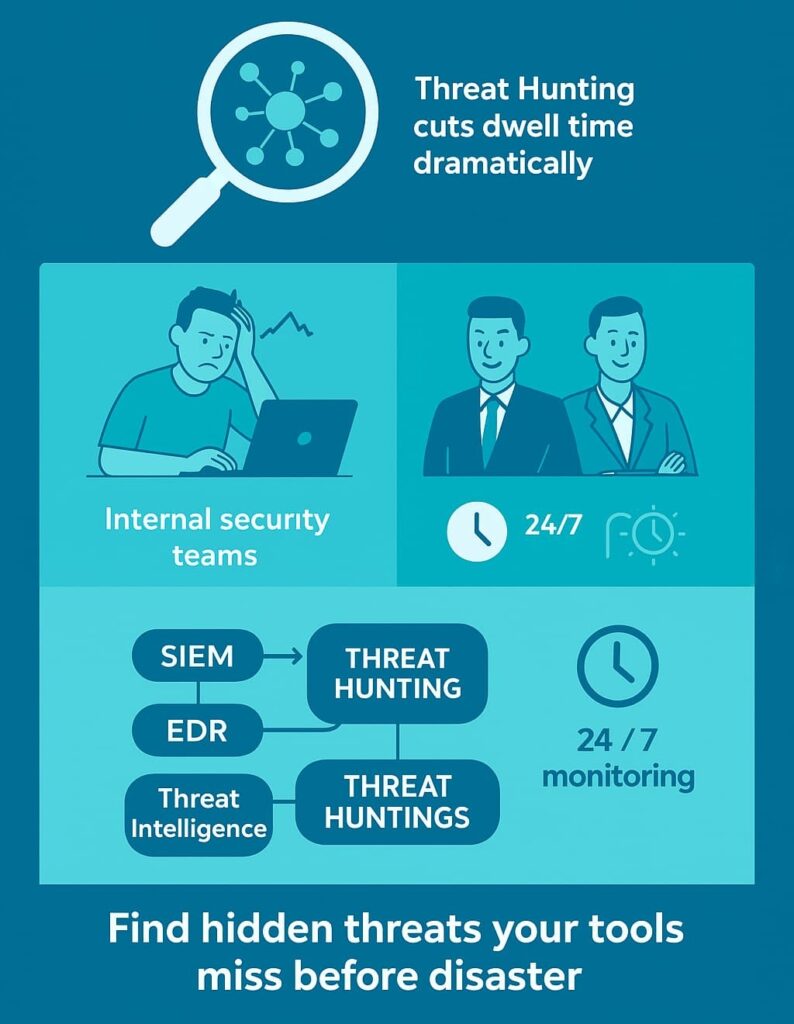
Threat hunting requires knowledge of adversary tactics, forensic investigation, malware analysis, and incident response. Most Fullerton organizations can’t maintain that level of expertise internally.
Outsourced teams bring seasoned professionals who know how attackers think. They recognize subtle anomalies and indicators long before incidents escalate. We’ve seen situations where clients misread a security alert as “system noise”, when it was actually early-stage exploitation.
Hiring, training, and retaining a full internal cyber defense team is expensive. Outsourcing gives Fullerton businesses access to enterprise-grade detection tools and threat intelligence feeds at a manageable monthly cost.
It cuts long-term spending by removing overhead and licensing complexity. Many clients tell us they finally feel “in control” of security budgets without losing capability.
Round-the-clock Security Operations Centers (SOCs) provide continuous visibility. Attackers don’t keep office hours, and neither do threat hunters. Continuous monitoring reduces dwell time, the period attackers hide inside networks.
Faster response means less damage, less downtime, and fewer headaches. Many Fullerton organizations depend on this constant oversight because internal teams simply can’t staff nights and weekends.
External providers use powerful tools: SIEM platforms, EDR agents, machine learning analytics, security orchestration systems, and global threat intelligence sources. Automation reduces false positives and helps analysts focus on what matters.
These technologies often exceed what Fullerton organizations can afford alone. At MSSP Security, we blend automation with human decision-making because no algorithm catches everything.
Outsourcing shifts teams from reacting to attacks to preventing them. Threat hunters identify adversary tactics early, map the cyber kill chain, and stop intrusions before they become breaches.
This improves cyber resilience, tightens cyber hygiene, and strengthens risk management across the board. Fullerton organizations often feel a sense of relief when they finally operate ahead of threats instead of behind them.
![Visual representation of outsourced cybersecurity threat hunting [city], featuring monitoring, hunting, intelligence, and reporting.](https://msspsecurity.com/wp-content/uploads/2025/11/image-73.jpeg)
Providers examine SIEM logs, EDR alerts, endpoint behavior, network traffic, and user patterns. This gives real-time visibility into cyber intrusions, malware detection, and suspicious activity. Continuous monitoring forms the backbone of modern cyber defense for many Fullerton organizations.
Threat hunters use global threat feeds, APIs, and cyber intelligence databases to understand threat actor behavior. Integrating this intelligence reveals context, why something is suspicious, how dangerous it is, and what attack vector it matches. This dramatically improves threat detection accuracy.
Every organization has unique risks. Providers build custom hypotheses based on threat actor tactics, vulnerabilities, and industry-specific risks. Tailored hunts uncover threats that automated tools cannot.
We often begin by examining a client’s most critical assets, their lifeblood, and working outward.
Automation speeds up data processing. Manual investigation provides judgment, context, and intuition. Combining both reduces false positives and highlights truly dangerous anomalies. This hybrid approach is what many Fullerton organizations rely on to balance speed with precision.
Reports summarize attack vectors, compromised assets, incident timelines, and remediation steps. Clear recommendations help IT teams resolve issues fast. This documentation also supports audits, risk assessment reviews, and board-level reporting.
Threat hunting helps Fullerton organizations meet the demands of regulations requiring strong security controls. Audit trails, forensic evidence, and documented incident detection strengthen compliance across sectors like finance, retail, and healthcare.
Before outsourcing, identify key assets, existing vulnerabilities, and skill gaps. Understand what your internal team can handle and where outside expertise is needed. Many Fullerton organizations find they already have most of the tools, but lack the time and expertise to use them well. [2]
When choosing a provider, focus on expertise, tooling, and how well they integrate with your environment. You want a partner who strengthens, not complicates, your operations.
Key things to evaluate:
Also confirm that their technology stack aligns with yours, their pricing remains flexible, and they hold certifications backed by consistent processes.
Outsourced cybersecurity threat hunting in Fullerton looks past basic security monitoring and digs into hidden cyber threat activity. Teams use threat hunting tools, threat intelligence, SIEM data, and behavioral analytics to find issues that slip past intrusion detection. It helps reduce cyber risk and gives a clearer view of the attack surface before a cyber incident grows.
Threat hunting helps teams spot early signs of a data breach by tracking an indicator of compromise, odd network traffic analysis, or malware detection. Analysts look for attacker tactics, check endpoint detection alerts, and use log analysis to spot a cyber intrusion. This early work supports fast incident response and lowers long-term cyber risk.
Small teams often rely on managed detection and response, but threat hunting adds deeper checks for an advanced persistent threat or insider threat. It uses cyber intelligence, anomaly detection, and security analytics to track a threat actor already in the network. The mix strengthens cyber resilience and supports better attack detection.
Threat hunting supports zero trust security by testing every access point and checking for exploit detection, phishing detection, or gaps in endpoint security. It helps verify cloud security settings, reviews network security logs, and studies adversary tactics. This steady work reduces the attack vector and builds stronger cyber defense for daily operations.
Outsourced cybersecurity threat hunting Fullerton gives organizations the expertise, speed, and resilience needed to stay ahead of modern attackers. It helps teams of all sizes reduce costs, improve detection, and operate with confidence. For many Fullerton businesses, outsourcing is the most realistic path toward strong protection.
Start by reviewing your internal capabilities, identifying gaps, and deciding whether partnering with an expert like MSSP Security brings the right balance of support, insight, and long-term security.
Ready to strengthen your security? Join us here.

