Address
304 North Cardinal St.
Dorchester Center, MA 02124
Work Hours
Monday to Friday: 7AM - 7PM
Weekend: 10AM - 5PM
Address
304 North Cardinal St.
Dorchester Center, MA 02124
Work Hours
Monday to Friday: 7AM - 7PM
Weekend: 10AM - 5PM


A managed WAF service strengthens application security, cuts operational load, and speeds up protection against new attack patterns. By handing monitoring, tuning, and incident response to specialists, your team can secure web apps and APIs without becoming WAF experts.
OWASP still lists application-layer attacks as a major source of breaches, and we regularly see teams fall behind on rule updates while trying to keep products stable and online. This article walks through what managed WAF is, how it improves both security and workflows, and why many organizations now see it as a standard control, keep reading to see how it pays off.
A managed Web Application Firewall (WAF) service is when you hand off web application and API protection to a provider that watches, tunes, and blocks threats for you. Instead of your own team managing every rule and alert, the provider focuses on stopping attacks like SQL injection and cross-site scripting (XSS) before they ever reach your applications.
A WAF sits at the application layer and inspects HTTP and HTTPS traffic. It understands URLs, headers, cookies, and payloads, which is very different from a traditional network firewall that mainly sees IPs and ports.
In practice, it typically works like this:
At MSSP Security, we see the biggest change in operations: clients move from chasing noisy alerts to relying on 24×7 monitoring and ongoing tuning by a dedicated security team, while keeping applications available and protected.

Managed WAF services reduce security workload, improve threat response, and lower operational burden by handling deployment, tuning, and continuous monitoring.
First, there is a clear improvement in managed waf operational efficiency. Internal teams no longer need to maintain rule sets or watch dashboards overnight. Providers deliver managed waf 24×7 monitoring backed by analysts who see attack patterns across many environments.
Second, organizations gain stronger protection without complexity. A fully managed waf service applies best practices consistently, including automatic updates, signature management, and virtual patching. This helps stop exploits even before developers can deploy fixes.
Third, cost control improves. Many teams underestimate the staffing and tooling required for self-managed WAFs. Managed services shift spend from capital expense to predictable operating expense, supporting managed waf cost savings and TCO reduction.
Core advantages typically include:
We often see these benefits resonate most with e commerce, SaaS, and API-driven platforms where uptime and user experience directly affect revenue.
It blocks common and emerging web attacks at the entry point using continuously updated rules and behavior-based detection.
A managed WAF sits in front of applications and inspects every request. This position allows it to enforce controls before traffic ever touches backend code. Protection typically aligns with the OWASP Top 10, which includes injection, broken authentication, and security misconfiguration risks.
Security improvement comes from depth. Managed services combine signature-based detection with anomaly detection and, in some platforms, machine learning rules. This supports managed waf zero day protection and reduces reliance on static patterns.
From our operational view, the most impactful security features include:
According to OWASP, virtual patching is critical when immediate code changes are not possible. Managed teams can deploy compensating controls within hours, not weeks. That speed directly reduces risk exposure, especially for legacy applications and third-party components.

Providers manage configuration, tuning, and incident response, allowing internal teams to focus on product and infrastructure priorities.
Operational efficiency improves because WAF management is specialized work. Rule tuning, log analysis, and attack response require context and repetition. A managed model centralizes this expertise.
We have seen organizations reclaim dozens of engineering hours per month after moving away from self-managed deployments. Instead of chasing false positives, teams receive curated alerts and actionable reports.
Efficiency gains typically come from:
A managed WAF also integrates cleanly with SOC and SIEM workflows. Managed waf soc integration and managed waf siem integration ensure events feed into existing security operations without manual effort. The result is faster response and fewer blind spots, which supports uptime protection and brand reputation.
Cost cuts from a managed WAF become clear once you compare it to running a WAF by yourself. A managed WAF turns big upfront hardware and project costs into a predictable subscription, which tends to fit how finance teams already plan budgets. The real gap shows up in operations, not just in license price.
From what we see when we help MSSPs evaluate and audit WAF products, self-managed WAFs quietly pull in far more resources than expected:
Those hours come straight out of the MSSP’s margin.
Industry analysts like Gartner have long argued that managed security models cut overhead by centralizing tools and expertise. Our field work supports that: managed WAFs usually align better with capex-to-opex shifts and clearer cost forecasting for MSSPs.
Then there are indirect costs. When managed WAFs reduce outages, misconfigurations, and breach likelihood, MSSPs and their customers avoid revenue loss, emergency response fees, and long cleanup cycles.
| Cost Area | Managed WAF | Self-Managed WAF |
| Deployment | Provider-handled, rapid | In-house projects |
| Maintenance | Included in service | Ongoing internal effort |
| Staffing | Minimal internal oversight | Dedicated WAF specialists |
| Scaling | Automatic | Manual provisioning |
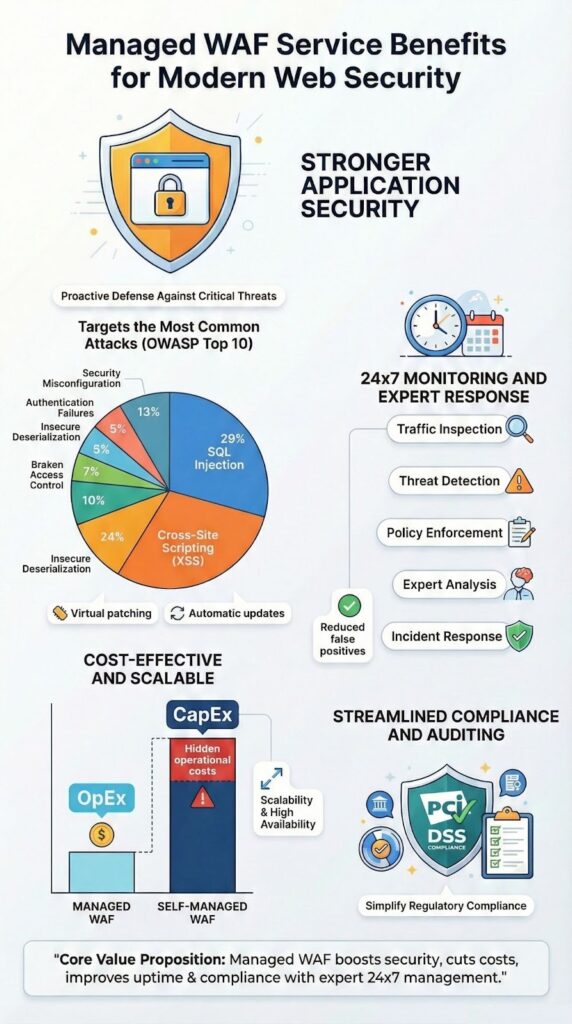
Compliance work usually feels less like a checkbox and more like a constant audit rehearsal, and that’s where managed WAF services help MSSPs most. A managed WAF enforces application-layer controls, keeps detailed traffic logs, and protects sensitive data in ways that can be mapped cleanly to formal requirements, not just internal policies.
Many frameworks now expect clear web application protection. PCI DSS is the clearest case: it requires controls to protect cardholder data from web-based attacks such as injection and XSS. When we help MSSPs select and audit WAF products, we pay close attention to how they support:
These are usually the first elements auditors ask MSSPs to prove. The PCI Security Standards Council stresses layered defenses for payment systems, and from what we see in the field, a well-implemented managed WAF becomes a visible, defensible control inside that layered model that MSSPs can point to with confidence during reviews.
Credits : Tech Forum
Organizations usually reach for a managed WAF when they’re short on security time, their applications change a lot, or traffic is too large and spiky for a small team to handle alone. In those conditions, running a WAF in-house often turns into constant rule changes, late-night alerts, and missed edge cases.
From our work advising MSSPs on product selection, we see managed WAFs work especially well in environments where apps scale and move quickly, cloud and hybrid setups, multi-region rollouts, and multi-cloud deployments. In those cases, managed WAF multi-cloud support and consistent policies across platforms matter more than any single feature.
We most often see strong results with:
Smaller organizations use managed WAFs to reach a higher level of security maturity without building a full security team. Larger enterprises use them to standardize controls across regions and business units. In both groups, managed WAF rapid deployment and short time to value are usually the deciding factors.
Managed web application firewall benefits help businesses protect applications without maintaining in-house security teams. A fully managed WAF service provides 24×7 monitoring, automatic updates, and expert support. Companies gain outsourced WAF security, stronger threat protection, improved uptime protection, and compliance benefits while allowing internal teams to focus on core business operations.
Managed WAF threat protection uses signature management, virtual patching, and zero-day protection to stop real attacks. Continuous rule tuning and false positive reduction prevent unnecessary blocking of legitimate traffic. Protection against SQL injection, XSS attacks, bots, and credential stuffing improves accuracy while anomaly detection and threat intelligence enhance overall security visibility.
The choice between managed WAF vs self managed WAF often depends on expertise, resources, and long-term costs. Managed WAF security outsourcing increases operational efficiency through centralized management, SOC integration, and SIEM integration. Organizations receive professional incident response, detailed reporting, and log management without hiring or training specialized security staff.
A cloud managed WAF supports scalability and high availability across multi-site and multi-cloud environments. It enables rapid deployment, consistent performance optimization, and latency reduction during traffic spikes. With SLA guarantees and built-in business continuity support, organizations maintain uptime protection while operating across hybrid cloud deployments.
Managed WAF compliance benefits support regulatory compliance, including managed WAF PCI DSS requirements. Continuous tuning, security analytics, and structured reporting simplify audit preparation. Industries such as e-commerce, fintech, healthcare, SaaS providers, and small businesses receive OWASP Top 10 protection, measurable risk reduction, and improved brand reputation protection through enforced security best practices.
Managed WAF service benefits for long-term protection show up most clearly over time, not just in blocked requests. Beyond stopping attacks at the edge, they improve resilience, operational efficiency, and overall confidence in how applications are defended. If you’re an MSSP looking to choose or audit managed WAF offerings as part of a larger stack strategy, explore how our consulting services can help you align tools, integration, and visibility with your business model: Work with MSSP Security Consulting.

