Address
304 North Cardinal St.
Dorchester Center, MA 02124
Work Hours
Monday to Friday: 7AM - 7PM
Weekend: 10AM - 5PM
Address
304 North Cardinal St.
Dorchester Center, MA 02124
Work Hours
Monday to Friday: 7AM - 7PM
Weekend: 10AM - 5PM


Expert threat hunter services matter because attackers don’t wait for alerts or line up neatly with your rules. Many slip in quietly, sit still for months, then move across systems in slow, careful steps.
Some attacks stay hidden for half a year or more, which is plenty of time to steal data, study defenses, and set up a larger breach. That’s why organizations lean on human hunters who look at behavior, patterns, and context, not just alarms. This article breaks down how expert hunting really works, why it matters, and how it closes gaps your tools leave open.
Keep reading.
The gap we see most often isn’t a missing tool, it’s a blind spot. Traditional security stacks wait for something loud enough to trip an alert. They lean on signatures, fixed rules, and dashboards that do well with known malware but struggle when an attacker changes one command, one path, or one technique and slides past the pattern.
From our side of the table, working with MSSPs that serve dozens or even hundreds of clients, the problem shows up the same way: long dwell time.
Public reports put undetected threats anywhere from 100 to over 200 days inside an environment, which is a long window for data theft, quiet lateral movement, or planting a backdoor in a tool everyone trusts. Meanwhile, analysts drown in noisy alerts, patchy visibility across on-prem and cloud, and limited time to sift through it all.
This is where expert threat hunter services earn their place. Instead of waiting for a rule to match, they assume something has already slipped through and start from that mindset. We look across endpoints, networks, identity systems, and cloud workloads, tying together tiny, out-of-place traces that traditional monitoring either hides or ignores.
In our product audits for MSSPs, we’ve watched how one odd logon at 3 a.m. in a quiet tenant, a short-lived spike to an unusual domain, or a single suspicious PowerShell command can be the thread that unravels an entire intrusion.
When we evaluate and select tools for our clients, we test for that: can this product surface those small anomalies, and can a human hunter actually work with the data, or does it bury the signal under noise? That’s the difference between a stack that just alerts, and a stack that lets real hunters do their job.
Credits: Heimdal®
Expert threat hunter services take a proactive approach. Instead of waiting for the system to complain, hunters look for what shouldn’t be there: strange behavior, quiet footprints, suspicious patterns, and subtle signals.
SERP research shows that these services combine human expertise, advanced analytics, behavioral detection, and threat intelligence to expose threats like insider attacks, ransomware staging, persistence mechanisms, and APTs. Threat hunters assume attackers are already inside. This assumption changes everything.
It creates a mindset of searching instead of reacting. It leads to hunting hypotheses, telemetry investigation, and correlation across identities, cloud workloads, endpoint detection data, and network traffic.
In our own work at MSSP Security, we often build entire narratives from scraps of data, tracking a threat actor’s early movement, testing theories, validating suspicious traces, and escalating incidents before real harm occurs.
Most real hunting starts where the alerts stop. Threat hunters don’t just sit in front of a console waiting for something to turn red.
They move through network traffic, cloud logs, endpoint records, and identity systems much like teams that focus on proactive approaches found in proactive managed threat hunting practices, looking for behavior that doesn’t quite fit the pattern.
On a good day, that means discovering indicators of compromise, early exploitation attempts, command-and-control traffic, or a strange file execution chain that never should have happened in the first place.
From what we’ve seen in the field and in public research, teams that hunt this way cut dwell time sharply because they catch attacks before they turn into an incident report.
The work often comes down to tracing lateral movement, persistence tricks, odd PowerShell behavior, or login paths that don’t line up with how people really work. Hunters aren’t waiting for the platform to say “critical”, they’re looking for the first quiet signal that something is wrong.
When we audit products for MSSPs, this is exactly what we test against. We ask whether a platform makes it easier or harder for a hunter to see that “off” pattern: the strange service account logon, the quiet beacon in proxy logs, the process chain that almost looks normal.
There have been plenty of times where we’re the ones telling a provider, and then their MSSP client, “there’s something here you don’t see yet,” while every built‑in dashboard still shows a clean bill of health. [1]
Automation helps, but humans see patterns machines ignore. SERP information emphasizes that expert hunters rely on deep knowledge of attacker tactics (TTPs), incident response, and behavioral analysis.
Analysts review telemetry in ways similar to how strong threat hunting platform workflows support deeper platform management visibility, letting hunters validate suspicious findings and reduce false positives.
Analysts interpret subtle signals, validate suspicious findings, and reduce false positives, something even the best SIEM rules struggle with. This includes mapping attacker behavior to frameworks like MITRE ATT&CK, building hypotheses, and reviewing telemetry line-by-line.
Threat hunters use intuition shaped by countless investigations. I’ve watched our own team at MSSP Security find threats hidden behind layers of normal logs, simply because something “felt off.” That’s the value of experience. Machines detect noise. Humans understand context.
Attackers rarely behave like normal users. Behavioral analytics helps threat hunters spot unusual deviations, an identity suddenly logging in at odd hours, a machine connecting to an unfamiliar server, or a file executing commands that don’t match baseline behavior.
SERP sources highlight the role of machine learning, anomaly detection, and pattern deviation analysis. Instead of relying on signatures, hunters monitor patterns, user behavior, traffic flow, and application access. They blend analytics with real-world threat understanding.
When we run investigations, we often build baselines first, how users usually work, how systems usually behave, and then track anything that breaks the pattern. Most advanced threats announce themselves quietly, in whispers. Behavioral hunting teaches teams to listen.
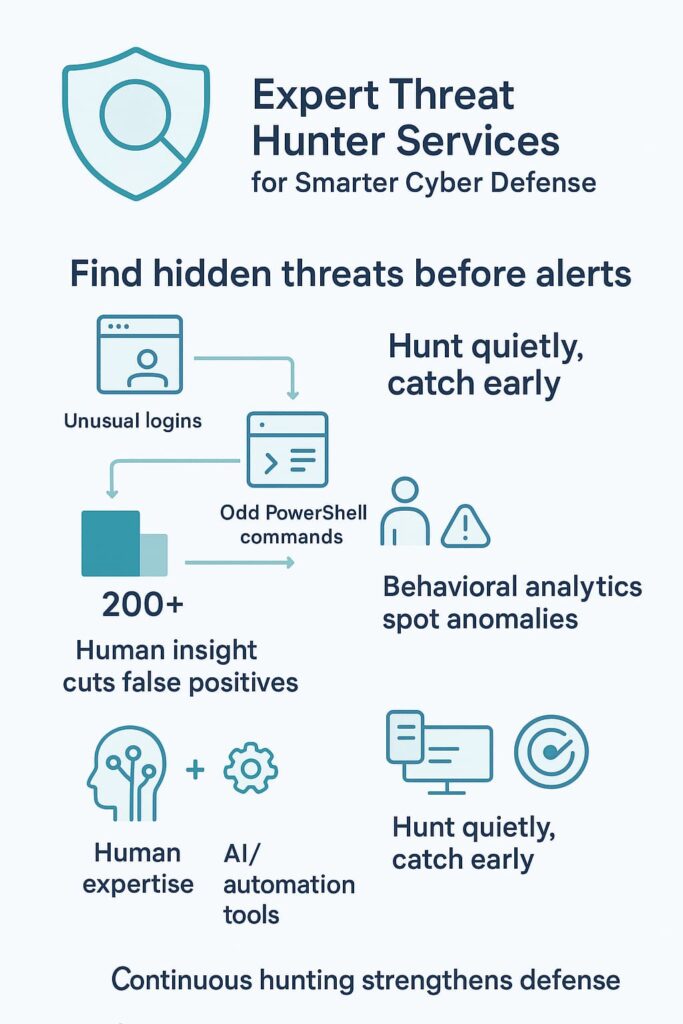
Threat hunters build hypotheses: “If this adversary targets this industry, what would they try first?” SERP details show that hunters combine threat intelligence, industry patterns, and known attacker profiles to test their theories against real telemetry.
Hunters study threat actor profiling, APT behavior, phishing campaigns, exploit trends, and cloud security gaps. They analyze hunting telemetry, logs, endpoint traces, and network flows to validate or disprove hypotheses.
In our experience at MSSP Security, we often begin with a single hypothesis: “If someone were inside right now, what would that look like?” This mindset uncovers compromises long before they turn into incidents.
Threats don’t sleep, and neither do good hunters. Many services provide 24/7 threat hunting cycles that continuously scan for anomalies across the attack surface. This mirrors how proactive security monitoring and broader security monitoring techniques help teams catch early lateral movement or persistence long before it grows into a full attack.
Continuous threat hunting means checking identity access, endpoint behavior, cloud configurations, and network flows day and night. This reduces risk, improves response time, and keeps organizations one step ahead.
At MSSP Security, continuous hunting lets us catch emerging behavior patterns, the early signs of lateral movement or persistence, long before they explode into full-blown attacks.
When hunters find a real threat, speed matters. Expert threat hunting services include detailed investigation summaries, risk-level assessments, and step-by-step containment recommendations.
SERP sources note that hunters often assist with incident response, working closely with internal teams to isolate systems, remove malware, and shut down the attacker’s path.
Reports include anomaly patterns, affected assets, TTP mapping, and remediation priorities. In our work, we’ve guided organizations through rapid containment, sometimes neutralizing threats before they even touched sensitive systems. That’s the strength of early detection.
Threat hunting offers concrete results:
Threat hunters strengthen endpoint detection, network threat hunting, and cloud security workflows. They bring clarity to noisy environments and uncover the unknown threats hidden between log lines. When organizations partner with teams like MSSP Security, they add human experience to automated tools, turning raw telemetry into meaningful insight.
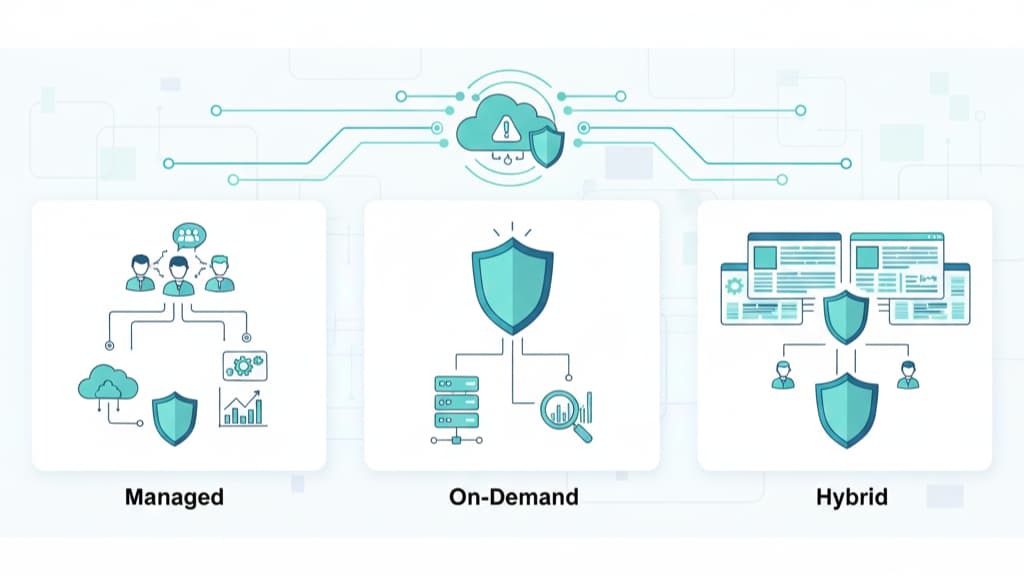
This is the most common model. In managed threat hunting, experts act as extensions of the internal team. They perform active hunting, periodic reviews, threat hunting analytics, and ongoing communication.
SERP sources indicate this model works best for organizations that lack a full-time threat hunting team. At MSSP Security, we often support clients this way, working closely with their SOC, reviewing telemetry, and providing ongoing high-fidelity investigations.
Some organizations only need help during major incidents, forensic investigations, or specific hunting tasks. On-demand hunting gives access to expert hunters without ongoing contracts. It’s ideal for targeted needs, hunting for ransomware, tracing a suspicious file, or evaluating a potential compromise.
Threat hunting consultancy often starts here: a single investigation that expands into long-term partnership when organizations see the value. [2]
Many companies combine internal SOC staff with external experts to scale their capacity. Hybrid models help organizations with existing teams who want deeper expertise or additional hands during peak periods. They merge internal context with external experience, building stronger workflows and advanced detection capabilities.
Organizations should look for providers with strong threat intelligence sources, cloud expertise, proven hunting methodologies, and a track record of validated incidents.
Providers must show they understand advanced persistent threats, insider threat detection, hunting TTPs, and behavioral analytics. They should also demonstrate consistent knowledge updates and provide clear case studies.
Effective hunting requires seamless integration with SIEM, SOAR, EDR, XDR, and network monitoring tools. Teams must collaborate clearly, share updates efficiently, and maintain open communication. Threat hunting platforms work best when they blend into existing workflows.
Good hunters provide:
With MSSP Security, we focus on clarity, plain language, real evidence, and reports that make sense even to non-technical leaders.
Expert threat hunter services look beyond alerts. They mix threat hunting, behavioral analytics, anomaly detection, and hunting for indicators of compromise. They study patterns in endpoint detection, network threat hunting data, and cloud logs. This helps them spot hidden risks that slip past automated tools and early signs of advanced persistent threats.
A managed threat hunting team studies new threat intelligence, checks hunting telemetry, and reviews suspicious activities. They build hunting hypotheses and look for malware, ransomware, or strange user behavior. They follow a clear threat hunting workflow, use threat hunter tools, and share updates when they see something that needs a closer look.
Threat hunting methodologies guide analysts through each step of finding advanced persistent threats. They use a threat hunting framework, threat hunting strategies, and threat actor profiling to track slow, quiet attacks.
Analysts check endpoint security, network traffic, and cloud logs to spot lateral movement, persistence mechanisms, or command-and-control activity.
A strong threat hunting career needs curiosity, clear thinking, and good problem-solving. People learn threat hunting techniques, threat hunting analytics, and how to use threat hunting SIEM tools. They practice hunting unknown threats, hunting with EDR or XDR, and writing threat hunting reports. Training helps them build real threat hunting expertise.
Expert threat hunter services give organizations a sharper, proactive way to uncover hidden threats before they grow. They pair human skill with behavioral analytics and strong threat intelligence, cutting response time and improving resilience against advanced attacks.
Teams like MSSP Security bring real-world experience to read subtle signals, validate threats, and guide faster containment.
If you’re ready to strengthen your operations and refine your security stack with expert support, you can join us here.

