


Compliance paperwork sucks. For MSSPs handling multiple clients, it’s a special kind of headache, think tangled webs of security logs, scattered incident reports, and endless policy documents. Losing track of one tiny detail can snowball into failed audits and awkward client conversations.
Nobody wants that mess. But some MSSPs have cracked the code on evidence collection compliance MSSP without losing their minds.
Stick around to see their actual methods for staying on top of compliance without drowning in paperwork.
Key Takeaways
- Evidence collection is essential for MSSPs to prove compliance and maintain security posture.
- Automating evidence collection improves accuracy, scalability, and audit readiness.
- Maintaining chain of custody and secure repositories preserves evidence integrity.
The High Stakes of Compliance: Why Evidence Collection Matters

Compliance is a brutal game of consequences. Every MSSP knows the weight of regulations like GDPR, HIPAA, SOC 2, and PCI DSS crushing down on their shoulders. Each one demands hard proof that security measures actually work, not just empty promises.
We’ve watched too many MSSPs crash and burn during audits. Their mistake? Treating evidence collection like a last-minute fire drill. Rushing to gather logs and documentation under pressure leads to sloppy work and missing pieces. Our audit team has seen it happen dozens of times.
That’s why having basic compliance reporting built directly into the workflow helps MSSPs keep data consistent and audit-ready at all times. It transforms compliance from a reactive task into a continuous discipline.
The fallout from failed compliance hits hard. Financial penalties can cripple operations, but the real killer is lost trust. When an MSSP fumbles compliance, they don’t just damage their own reputation, they put their clients’ necks on the line too.
Having guided countless providers through product selection and audits, we know only systematic, ongoing evidence collection keeps these risks at bay.
Defining Evidence Collection for MSSPs
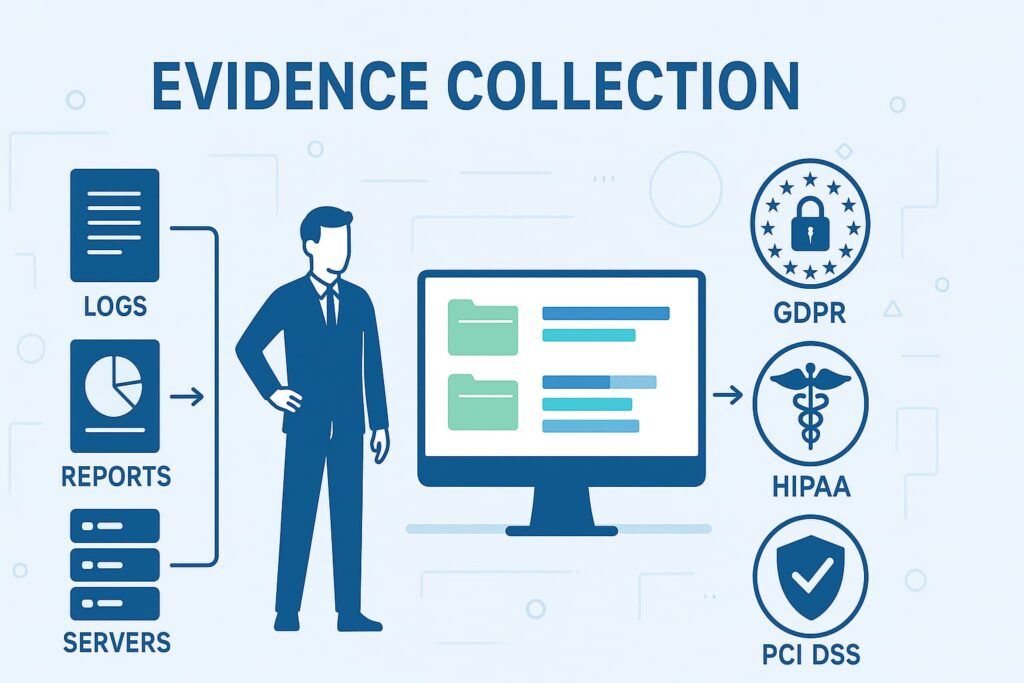
What counts as evidence in the MSSP world? More than most providers think. Sure, there’s the obvious stuff, system logs and security alerts. But real evidence runs deeper: screenshots proving exact configurations, detailed write-ups of every security incident, regular vulnerability scans, and stacks of compliance paperwork.
Our team digs into the nitty-gritty with MSSPs daily. We’ve found that treating evidence collection like a last-minute homework assignment leads to disaster. The providers who nail their audits? They’re gathering proof 24/7, weaving it into their daily operations.
After reviewing hundreds of MSSP setups, we’ve learned that solid evidence doesn’t just satisfy auditors, it builds a bulletproof security program. [1]
Step-by-Step Guide to Effective Evidence Collection
1. Identify Applicable Compliance Frameworks
First, understand which regulations apply to both your organization and your clients. Whether it’s GDPR, HIPAA, PCI DSS, SOC 2, or NIST, each has unique evidence requirements. We’ve found that documenting these upfront saves headaches later.
2. Define Your Scope
Outline the systems, networks, and data that fall under compliance. This clarity helps focus evidence collection efforts where they matter most.
3. Implement Security Controls
Put in place the technical and administrative controls required by your frameworks, access controls, encryption, logging, monitoring, and incident response plans are typical. These controls generate the evidence you’ll collect.
4. Automate Evidence Collection
Automation is a game changer. We use tools that continuously gather and validate evidence, logs, configurations, certificates, and more, in real time. Automation reduces human error, speeds up reporting, and scales across multiple client environments with ease.
Many MSSPs now rely on compliance reporting services to simplify these steps. Automating log collection and documentation ensures nothing falls through the cracks and each compliance control remains verifiable and current.
5. Types of Evidence to Collect
- Configuration Snapshots: Firewall rules, system settings, network configurations.
- Audit Logs and Reports: User activity, security event logs, system alerts.
- Certificates and Access Logs: MFA enforcement records, SSL/TLS certificates, access control lists.
- Incident and Activity Records: Incident reports, investigation logs, remediation steps.
- Policy Documentation: Security policies, training certificates, compliance reports.
6. Establish a Secure Repository
We keep all evidence in a centralized, secure repository with strict access controls to prevent tampering or unauthorized viewing.
7. Maintain a Chain of Custody
Documenting who collected the evidence, when, and how ensures integrity. This chain of custody is critical for legal and regulatory audit acceptance.
8. Regularly Validate Evidence
Periodic reviews to check evidence completeness and accuracy help us catch gaps early and maintain audit readiness.
9. Implement Version Control
Tracking changes to logs and documents prevents confusion and supports forensic investigations.
10. Integrate with Security Tools
Connecting evidence collection to SIEMs, vulnerability scanners, and GRC platforms streamlines workflows and ensures no data falls through the cracks.
Manual vs. Automated Evidence Collection: What We’ve Learned
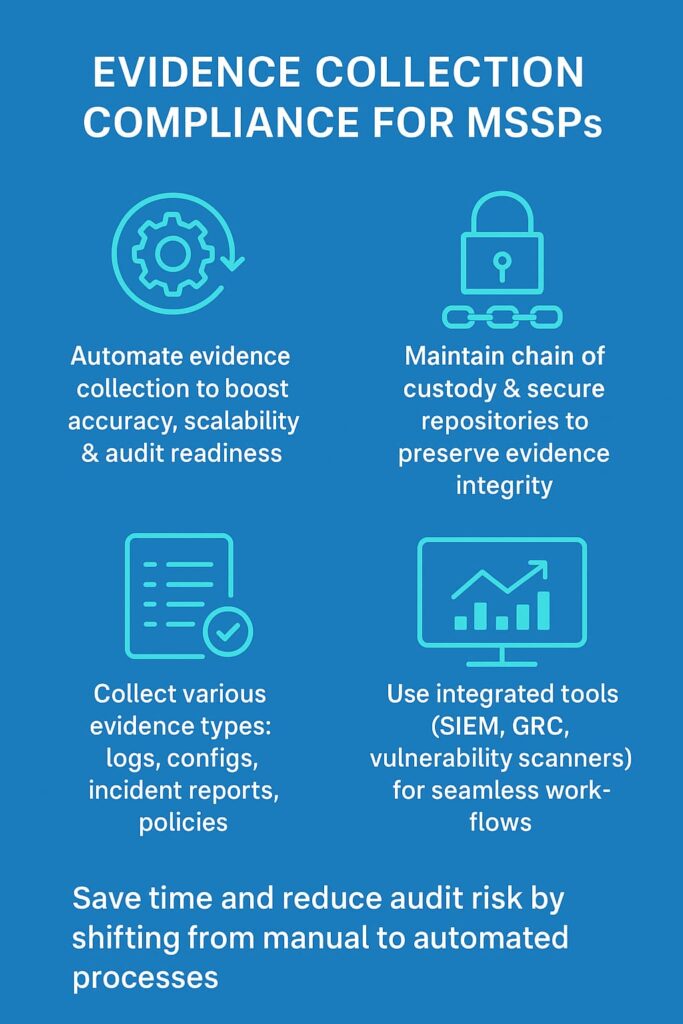
Manual evidence collection, reviewing logs, taking screenshots, compiling reports, might seem cheaper initially but quickly becomes unmanageable as scale grows. We’ve seen how manual processes lead to inconsistent data, missed evidence, and audit delays.
Automation brings efficiency, accuracy, real-time visibility, and scalability. Although it requires upfront investment and technical know-how, the payoff is huge. MSSP Security strongly recommends automating as much as possible while maintaining human oversight for validation.
Best Practices for MSSP Evidence Collection
From our frontline experience, these practices make the biggest difference:
- Develop a comprehensive, documented evidence collection plan.
- Use automation for continuous data gathering and validation.
- Centralize evidence storage with strict access controls.
- Maintain detailed chain-of-custody records.
- Conduct regular audits of collected evidence.
- Use version control rigorously.
- Ensure integration with your security ecosystem.
- Train staff on procedures and compliance requirements.
Common Challenges in Evidence Collection for MSSPs
We’ve faced and overcome many challenges in evidence collection, such as:
- Managing vast amounts of logs and documentation.
- Maintaining evidence integrity with rigorous chain-of-custody.
- Automating collection across diverse client environments.
- Keeping pace with evolving compliance requirements.
- Handling alert fatigue and talent shortages.
- Navigating complex vendor toolsets and fragmented systems.
Addressing these requires a combination of skilled personnel, smart automation tools, and a culture of continuous improvement.
Tools and Technologies That Help Us Excel

At MSSP Security, we rely on:
- Security Information and Event Management (SIEM) for log aggregation and analysis.
- Governance, Risk, and Compliance (GRC) platforms to track and report compliance status.
- Configuration management and vulnerability scanning tools.
- Data loss prevention (DLP) and identity access management (IAM) solutions.
- Automated evidence verification and audit-ready reporting systems.
Leveraging these tools enables us to deliver reliable, transparent, and audit-ready evidence for our clients. [2]
Wrapping Up: Why Evidence Collection Compliance Is Non-Negotiable for MSSPs
Evidence collection isn’t just a regulatory checkbox; it’s the foundation of trust and operational excellence for Managed Security Service Providers. We’ve learned that integrating automated processes with rigorous policies and expert oversight ensures compliance, reduces audit stress, and enhances security posture.
For MSSPs seeking consistent performance, implementing audit-ready reports keeps them aligned with evolving frameworks while cutting down on manual review time and reducing risk exposure during audits.
MSSP Security approaches evidence collection as a continuous journey, one that evolves with regulations, technology, and threats. Investing in automation and best practices empowers MSSPs to provide clients with peace of mind and a competitive edge.
For anyone in the MSSP space, mastering evidence collection compliance is the ticket to sustained success.
FAQ
1. How does an MSSP manage evidence collection for compliance audits?
An MSSP evidence collection process includes gathering digital evidence, maintaining chain of custody evidence, and storing compliance documentation MSSP securely.
By using automated audit evidence tools, providers ensure every data point supports regulatory compliance evidence requirements, making audit-ready evidence MSSP reporting faster and more reliable.
2. What’s the role of automation in compliance evidence management?
Compliance evidence automation helps MSSPs simplify audit preparation MSSP tasks. It automates evidence validation MSSP, audit trail MSSP, and compliance evidence workflow, reducing manual work.
Automated audit evidence systems also help maintain consistent compliance proof MSSP, enabling continuous evidence collection and stronger regulatory compliance evidence control.
3. Why is digital and forensic evidence collection important for MSSPs?
Digital evidence collection and forensic evidence MSSP practices ensure data integrity evidence during incidents. These methods support forensic investigation MSSP and evidence preservation MSSP, protecting against tampering.
They also help gather incident evidence collection that becomes critical for compliance monitoring evidence and legal evidence MSSP needs during audits.
4. How do MSSPs track and store audit and incident evidence?
MSSP evidence collection relies on evidence tracking MSSP and compliance evidence repository systems. These evidence management frameworks capture security event logs, vulnerability assessment evidence, and incident documentation MSSP.
Secure storage and audit evidence consolidation keep compliance audit reports accurate and available for MSSP compliance audits anytime.
Conclusion
Strengthening your evidence collection and compliance processes is essential for any organization aiming to stay audit-ready and meet evolving regulatory demands. With MSSP Security, you can build an efficient, integrated, and reliable evidence collection strategy.
As a trusted partner with over 15 years of experience and 48,000+ successful projects, MSSP Security helps you enhance visibility, streamline operations, and ensure every compliance process runs optimally.
To explore how we can support your compliance journey, visit MSSP Security.
References
- https://swimlane.com/news/grc-audit-research/
- https://secureframe.com/blog/compliance-outsourcing