


An azure sentinel managed security service helps organizations improve cloud security through expert monitoring, threat detection, incident response, and continuous Microsoft Sentinel optimization.
At MSSP Security, we’ve helped organizations strengthen security operations by refining analytics, automation, and response workflows while reducing operational complexity.
Choosing the right managed service can improve visibility and help security teams respond more effectively to evolving threats. Keep reading to learn how MSSP Security helps organizations maximize Microsoft Sentinel for long-term security operations.
Before You Go: Azure Sentinel Essentials
If you only remember a few things from this guide, these are the key points worth keeping in mind about choosing an azure sentinel managed security service.
- An azure sentinel managed security service enhances Microsoft Sentinel with expert monitoring, incident response, and ongoing platform management.
- SIEM, SOAR, automation, and threat hunting improve threat detection, investigations, and response efficiency.
- MSSP Security helps organizations strengthen Microsoft Sentinel through 24/7 monitoring, platform optimization, and governance support while reducing the burden on internal teams.
How Does an Azure Sentinel Managed Security Service Support Security Operations?
An azure sentinel managed security service combines Microsoft Sentinel’s cloud-native SIEM and SOAR capabilities with expert support to help organizations strengthen day-to-day security operations. Instead of managing the platform alone, organizations receive ongoing guidance that keeps Microsoft Sentinel aligned with changing threats, business needs, and cloud environments.
A managed service typically includes:
- Continuous security monitoring
- Threat detection and incident investigation
- Analytics rule optimization
- Threat hunting
- Automation and playbook maintenance
- Platform health monitoring
- Regular reporting
Microsoft Sentinel collects security data from Azure resources, Microsoft 365, endpoints, identity platforms, firewalls, network devices, third-party security tools, and cloud applications. It brings this data together in one place, making it easier to investigate alerts and identify suspicious activity.
Built-in Sentinel managed SIEM and SOAR capabilities also automate routine tasks, such as alert enrichment, incident assignment, and predefined response actions, allowing security teams to focus on higher-priority work.
From our experience at MSSP Security, choosing Microsoft Sentinel is only part of the process. We help MSSPs evaluate supporting security products, audit integrations, and confirm that Microsoft Sentinel fits their existing technology stack and service goals.
With the right planning and ongoing support, an azure sentinel managed security service helps organizations improve visibility, simplify security operations, and get more long-term value from the platform.
Why Should Organizations Choose an Azure Sentinel Managed Security Service?

An azure sentinel managed security service offers more than day-to-day platform management. It helps organizations and MSSPs make better technology decisions, improve Microsoft Sentinel performance, and build a security stack that supports long-term growth. The goal is not simply to add more tools, but to ensure the right tools work well together.
At MSSP Security, we help MSSPs evaluate new security products, review Microsoft Sentinel deployments, and audit integrations before expanding their technology stack. During these assessments, we often identify:
- Redundant security tools
- Underused Microsoft Sentinel capabilities
- Integration gaps between products
- Opportunities to improve automation and detection coverage
For MSSPs managing multi-cloud environments, selecting complementary security platforms is also an important consideration. Approaches such as leveraging aws security hub mssp can help organizations evaluate AWS security visibility alongside Microsoft Sentinel and build a more consistent cloud security strategy across different cloud environments.
Our consulting approach focuses on practical results rather than product recommendations alone. By selecting technologies that fit existing workflows and service goals, MSSPs can reduce unnecessary complexity while improving operational efficiency.
A well-planned Sentinel managed SIEM and SOAR environment helps organizations strengthen threat detection, streamline security operations, and get greater long-term value from their azure sentinel managed security service.
How Does Azure Sentinel Improve Threat Detection and Security Analytics?
Credit: Paul Grant
An azure sentinel managed security service helps organizations improve Sentinel threat detection by combining Microsoft Sentinel’s cloud-native security analytics with AI-driven correlation and threat intelligence integration. Instead of reviewing security events one at a time, the platform connects activity across cloud resources, identities, endpoints, applications, and networks to identify patterns that may signal malicious behavior.
Microsoft notes:
“Microsoft Sentinel is a cloud-native SIEM solution that delivers scalable, cost-efficient security across multicloud and multiplatform environments. It combines AI, automation, and threat intelligence to support threat detection, investigation, response, and proactive hunting.” – Microsoft Learn
Microsoft Sentinel strengthens detection through:
- AI-driven analytics and machine learning correlation
- Threat intelligence feeds with known indicators of compromise (IOCs)
- Custom analytics rules for organization-specific risks
- Sentinel hunting query design with KQL
- Centralized telemetry from Azure, Microsoft 365, Microsoft Defender, and third-party security tools
Effective threat detection also depends on how well Microsoft Sentinel integrates with the broader security ecosystem. Many MSSPs combine SIEM capabilities with Cloud Native Security Tools MSSP solutions to improve visibility across cloud workloads, identities, applications, and infrastructure.
This approach helps security teams uncover suspicious activity that might otherwise be overlooked. Events that appear unrelated on their own, such as unusual sign-in activity, privilege changes, or unexpected resource access, can be correlated into a single detection with greater context and confidence.
From our experience at MSSP Security, effective threat detection depends on more than enabling Microsoft Sentinel. We help MSSPs evaluate complementary security products, audit data integrations, and confirm that telemetry from connected tools supports meaningful analytics.
During these assessments, we often identify opportunities to improve data quality, eliminate redundant log sources, and strengthen detection coverage. With the right technology stack and configuration, an azure sentinel managed security service provides more accurate security analytics and a stronger foundation for identifying emerging threats.
How Do SIEM and SOAR Strengthen an Azure Sentinel Managed Security Service?
An azure sentinel managed security service delivers greater value when Sentinel managed SIEM and SOAR work together. Microsoft Sentinel collects and correlates security data from multiple sources, while SOAR automates routine tasks that help security teams work more efficiently. Instead of handling repetitive processes manually, organizations can standardize common workflows and spend more time on higher-value security activities.
Key automation capabilities include:
- Alert enrichment with additional security context
- Incident creation and assignment
- Threat intelligence lookups
- Stakeholder notifications
- Automated response workflows using Sentinel automation rules and Logic App playbooks
A practical example is a suspicious account login. Microsoft Sentinel can automatically gather user information, review recent sign-in activity, enrich the alert with threat intelligence, and open an investigation case before an analyst begins reviewing the event. This provides better context while reducing manual effort.
At MSSP Security, we help MSSPs assess whether Microsoft Sentinel’s automation capabilities align with their existing security products and operational processes. During technology reviews, we often identify integration improvements that simplify workflows and support long-term service delivery.
A well-planned azure sentinel managed security service helps organizations automate routine tasks without adding unnecessary complexity to their security stack.
How Does 24/7 Monitoring Improve an Azure Sentinel Managed Security Service?
An azure sentinel managed security service helps organizations maintain continuous visibility through Sentinel 24/7 monitoring, ensuring security operations continue beyond standard business hours. Effective monitoring depends on more than technology. It also requires reliable SOC processes, consistent analyst coverage, and well-defined operational standards that keep cloud environments protected around the clock.
A mature monitoring service typically includes:
- Continuous analyst availability
- Shift-based SOC operations
- Structured analyst handoffs
- Follow-the-sun monitoring
- Service level objectives (SLOs) for response times
- Ongoing platform health reviews
From our experience at MSSP Security, we help MSSPs evaluate Microsoft Sentinel alongside supporting security products to ensure they can support reliable SOC operations. Our technology assessments often focus on integration quality, operational continuity, and long-term scalability rather than platform features alone.
With the right operational model, an azure sentinel managed security service provides dependable monitoring that supports consistent security operations as cloud environments continue to grow.
Why Is a Structured Deployment Important for an Azure Sentinel Managed Security Service?
A successful azure sentinel managed security service begins with a structured deployment that aligns Microsoft Sentinel with an organization’s security goals, cloud environment, and operational workflows. Rather than enabling every feature at once, a phased approach helps improve detection quality while keeping the platform easier to manage.
Key deployment activities typically follow these phases:
| Deployment Phase | Key Activities | Business Value |
| Assessment and Planning | Review security goals, identify security use cases, and evaluate existing security tools | Ensures Microsoft Sentinel aligns with business requirements and operational objectives |
| Data Connector Setup | Configure integrations with Azure services, Microsoft 365, endpoints, firewalls, and third-party security platforms | Improves security visibility by collecting relevant telemetry across the environment |
| Workspace Configuration | Plan Log Analytics workspace design, data collection settings, and retention requirements | Creates a scalable foundation for Microsoft Sentinel operations |
| Detection and Automation Setup | Configure analytics rules, automation rules, and Logic App playbooks | Strengthens threat detection and helps accelerate incident response workflows |
| Validation and Review | Test integrations, review detection coverage, and refine security workflows | Ensures the deployment continues to support long-term security goals |
Organizations often achieve better results by prioritizing high-value telemetry, such as identity services, endpoint protection, Azure activity logs, and firewall data before adding additional data sources. This approach improves visibility without creating unnecessary complexity.
From our experience at MSSP Security, we help MSSPs assess Microsoft Sentinel deployments before recommending new security products. Our technology audits focus on integration quality, workspace design, and data collection to ensure Microsoft Sentinel supports long-term operational goals.
A well-planned azure sentinel managed security service provides a stronger foundation for scalable and effective security operations while helping MSSPs build security environments that remain adaptable as customer requirements evolve.
How Can Azure Sentinel Managed Security Service Be Optimized After Deployment?

An azure sentinel managed security service requires ongoing optimization to remain effective as cloud environments, users, and security tools continue to change. After Microsoft Sentinel is deployed, regular reviews help ensure detection rules, integrations, and reporting continue to support business and security needs.
Key areas that often require optimization include:
- Analytics rule tuning to reduce unnecessary alerts and improve detection accuracy
- Custom KQL queries to identify threats that standard rules may miss
- Dashboard and workbook improvements to provide clearer security insights
- Connector and platform health reviews to maintain reliable data visibility
From our consulting experience, we often see MSSPs dealing with alert fatigue caused by default Microsoft Sentinel rules. Instead of removing these detections, we help refine thresholds, exclusions, and logic to make alerts more meaningful.
We also review how Microsoft Sentinel works with existing security products and identify ways to improve integrations and reporting. Through technology audits, we help MSSPs optimize their security stack, evaluate new solutions, and maintain a scalable azure sentinel managed security service that continues to deliver value over time.
As organizations expand their security stack, understanding the benefits cloud native security tools provide can help MSSPs identify solutions that improve scalability, integration, and operational efficiency without adding unnecessary complexity.
How Does Azure Lighthouse Support an Azure Sentinel Managed Security Service?
An azure sentinel managed security service helps MSSPs manage multiple customer environments, but scaling operations requires the right management approach. Azure Lighthouse provides a secure layer that allows authorized analysts to monitor and manage multiple Azure tenants without creating separate administrator accounts for each customer.
From our consulting experience, we often see MSSPs struggle with operational complexity as their customer base grows. Azure Lighthouse helps simplify workflows by enabling centralized visibility while maintaining customer ownership and access boundaries.
Microsoft highlights:
“Azure Lighthouse helps service providers simplify customer engagement and onboarding experiences, while managing delegated resources at scale with agility and precision.” – Microsoft Learn / Microsoft Azure
This capability supports MSSPs that need to manage multiple customer environments efficiently while maintaining structured access controls and governance.
Key benefits of Azure Lighthouse Sentinel MSSP capabilities include:
- Secure access to multiple customer environments
- Centralized Microsoft Sentinel monitoring
- Faster incident investigation across tenants
- Improved automation and platform management
We help MSSPs evaluate whether Azure Lighthouse and other security technologies fit their operational needs. Through product audits and technology assessments, we focus on improving visibility, reducing complexity, and building a scalable azure sentinel managed security service that supports long-term growth.
How Does Azure Sentinel Support Compliance and Long-Term Data Management?
An azure sentinel managed security service helps organizations improve compliance readiness by managing security data, supporting audits, and maintaining long-term visibility into security activities. Microsoft Sentinel enables MSSPs to collect and retain security logs based on business needs, regulatory requirements, and investigation priorities.
Key compliance areas supported by Microsoft Sentinel include:
- Security log retention for audits, investigations, and forensic analysis
- Access monitoring to maintain accountability
- Incident records to demonstrate detection and response activities
- Compliance evidence collection for regulatory reviews
From our consulting experience, we often help MSSPs audit Microsoft Sentinel configurations to identify gaps in retention policies, security controls, and compliance alignment. For organizations following standards such as ISO 27001, SOC 2, PCI DSS, HIPAA, or NIST CSF, the right data management strategy is essential.
By combining Microsoft Sentinel with structured compliance practices, MSSPs can deliver an azure sentinel managed security service that supports audit requirements, reduces compliance risks, and provides stronger long-term security assurance.
What Should Organizations Look for in an Azure Sentinel Managed Security Service Provider?
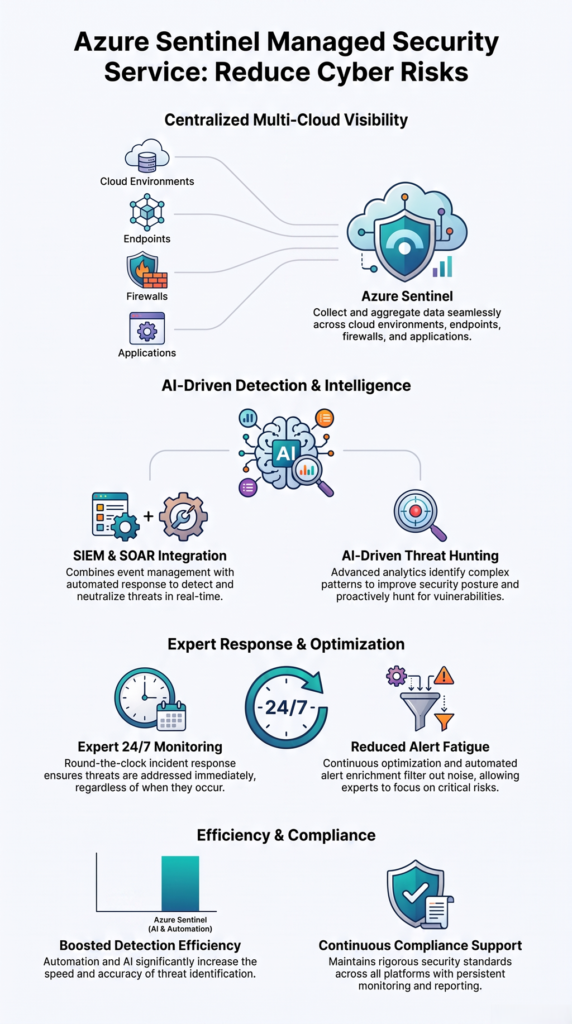
Selecting the right azure sentinel managed security service provider requires evaluating more than pricing or features. Organizations should choose a partner that can continuously improve Microsoft Sentinel performance, strengthen detection, and support evolving security needs.
Key capabilities to evaluate include:
- 24/7 monitoring and incident response support
- Analytics rule tuning to reduce false positives and improve detection quality
- Threat hunting for proactive security investigations
- Custom KQL optimization to improve detection logic
- Automation playbook reviews to maintain efficient response workflows
- Connector health checks to ensure reliable security visibility
From our experience helping MSSPs audit and evaluate security technologies, we see that effective providers focus on continuous improvement rather than one-time deployment. The right azure sentinel managed security service should help organizations optimize Microsoft Sentinel, improve security operations, and adapt as their cloud environments continue to grow.
FAQ
What Is an Azure Sentinel Managed Security Service?
An azure sentinel managed security service combines Microsoft Sentinel’s cloud-native SIEM and SOAR capabilities with expert security operations support. It helps organizations improve threat detection, incident response, monitoring, and platform optimization without requiring internal teams to manage every aspect of Microsoft Sentinel alone.
How Does an Azure Sentinel Managed Security Service Improve Security Operations?
An azure sentinel managed security service improves security operations by providing continuous monitoring, threat investigation, analytics tuning, automation management, and proactive threat hunting. By combining Microsoft Sentinel capabilities with experienced security expertise, organizations can reduce alert fatigue, improve visibility, and respond faster to potential threats.
Can an Azure Sentinel Managed Security Service Support Multi-Cloud Security Environments?
Yes. An azure sentinel managed security service can support multi-cloud environments by integrating Microsoft Sentinel with other security platforms, cloud services, and third-party tools. This allows MSSPs to create a more unified security strategy while improving visibility across different cloud infrastructures.
What Should MSSPs Consider When Selecting an Azure Sentinel Managed Security Service Provider?
MSSPs should evaluate more than Microsoft Sentinel experience alone. Important factors include expertise in security product evaluation, integration auditing, analytics optimization, threat detection improvement, and the ability to recommend technologies that align with operational goals. A strong provider should help MSSPs build a scalable security stack rather than simply deploy another tool.
How Often Should Microsoft Sentinel Be Optimized After Deployment?
Microsoft Sentinel should be reviewed and optimized regularly as security environments, users, and threats continue to change. Ongoing optimization may include analytics rule tuning, KQL query improvements, connector reviews, automation adjustments, and security stack assessments to ensure the azure sentinel managed security service continues delivering accurate detection and operational value.
How Can Organizations Maximize the Value of an Azure Sentinel Managed Security Service?
An Azure Sentinel managed security service delivers greater value when Microsoft Sentinel aligns with security goals, detection strategies, and operational needs. Organizations can strengthen protection by refining analytics rules, automating workflows, and using proactive threat hunting.
Our vendor-neutral consulting helps MSSPs evaluate security technologies, reduce complexity, identify gaps, and optimize their security stack. Through MSSP Security, organizations can develop a structured Microsoft Sentinel strategy that supports scalable, efficient, and long-term cloud security operations.
References
- https://learn.microsoft.com/en-us/azure/lighthouse/concepts/architecture
- https://learn.microsoft.com/en-us/azure/sentinel/overview?tabs=defender-portal