

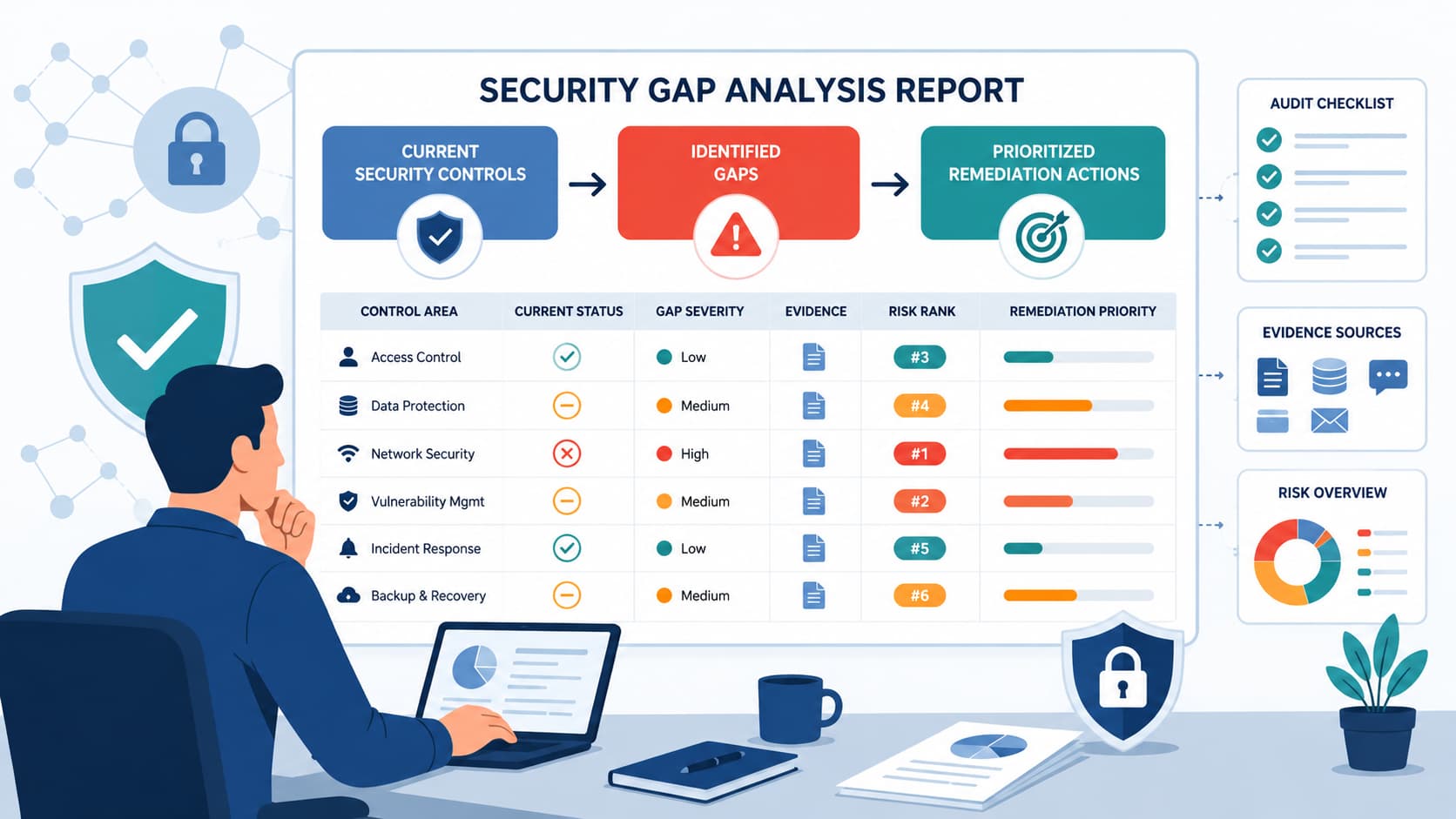
A security gap analysis compares an organization’s existing security controls with a chosen target, such as NIST CSF 2.0. It shows where controls fall short and what needs attention first.
At MSSP Security, our approach goes beyond listing missing controls. We review the evidence behind each control, confirm ownership, and identify gaps in implementation or documentation.
Findings are then ranked by risk, effort, and business impact, giving security teams a clear view of what to address next. Keep reading to see what a useful security gap analysis service should deliver.
Security Gap Analysis: 3 Priorities
A strong report shows where security stands, what needs fixing, and how to move forward.
- Assess the gaps. Compare current controls with the target and verify them with evidence.
- Prioritize risks. Rank gaps by business impact, exposure, urgency, and remediation effort.
- Plan remediation. Assign owners, set deadlines, and turn findings into clear next steps.
What does a security gap analysis report service actually assess?
A security gap analysis compares an organization’s current security posture with a defined framework, risk threshold, or compliance requirement.
NIST uses Current and Target Profiles to help identify cybersecurity gaps. In our work with MSSPs, we’ve found that the value of an assessment depends heavily on how clearly its scope is defined.
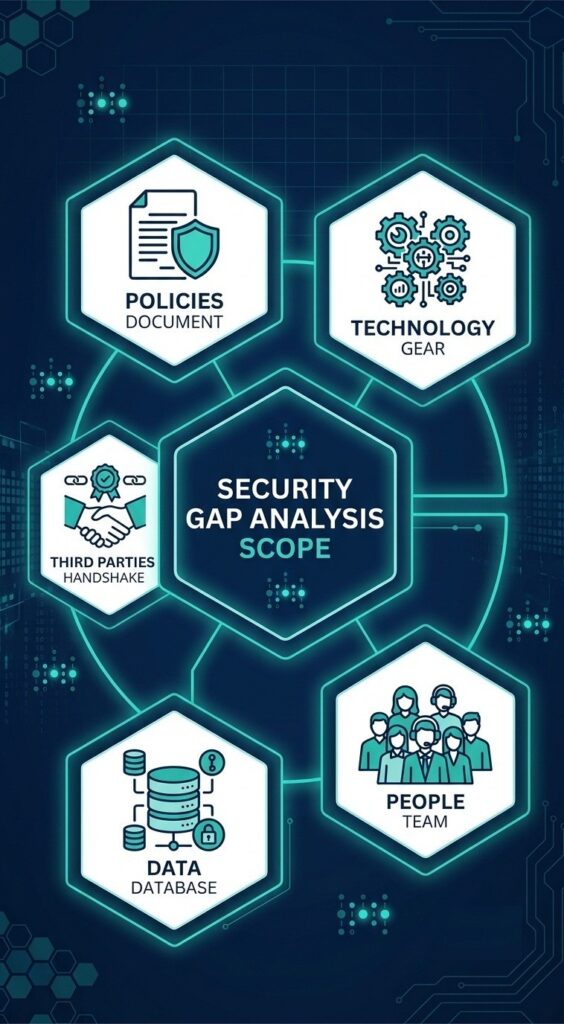
Before assessing a product or control, we need to know what is in scope, including systems, data, people, processes, and third parties. A checklist alone may miss issues that only appear when controls are tested in practice.
A typical security gap analysis reviews policies, procedures, technology, evidence, and day-to-day operations. For MSSPs selecting or auditing security products, it can also show whether a product fits existing controls, meets service requirements, and supports audit evidence.
The target state may follow NIST CSF 2.0, ISO 27001, SOC 2, HIPAA, PCI DSS, or another applicable benchmark.
- What should exist? Define target requirements.
- What exists today? Document current controls.
- What is missing or unproven? Identify control and evidence gaps.
- What comes first? Prioritize remediation.
A useful assessment goes beyond checking boxes. It evaluates whether controls are properly designed, implemented, and supported by evidence, giving MSSPs a clearer basis for product selection, audits, and remediation planning.
Which frameworks can a security gap analysis cover?
A security gap analysis can focus on one framework or compare requirements across several, based on an organization’s regulatory, contractual, audit, and business needs.
For MSSPs, that choice often depends on what the client is trying to prove and which security products need to support it. For example, an organization preparing for ISO 27001 may need an ISO 27001 gap analysis centered on its information security management system.
A healthcare client may need a HIPAA security gap analysis, while a payment environment may call for a PCI DSS review. We’ve found that the framework itself is only part of the work.
The real question is how well the controls and products support the requirements in practice. In our product reviews, overlapping requirements come up often. Rather than building separate compliance workstreams, we look for a common control structure where it makes sense.
One control may support evidence across several frameworks, which can reduce duplicate testing and give the MSSP a clearer view of what a product actually covers.
| Framework | Typical use | Common assessment focus |
| NIST CSF 2.0 | Enterprise cybersecurity | Security outcomes and maturity |
| ISO 27001 | ISMS and certification | Governance and controls |
| SOC 2 | Customer assurance | Control design and evidence |
| HIPAA | Healthcare | Administrative, physical, technical safeguards |
| PCI DSS | Payment environments | Cardholder-data protection |
| CMMC / NIST 800-171 | Defense supply chain | CUI protection |
NIST 800-171 gap analysis, for instance, can place more attention on controlled unclassified information. A CMMC gap assessment may put more weight on whether required practices are in place and whether the MSSP can produce the evidence an assessor will expect.
CIS Controls, NIST CSF, and ISO 27001 can also provide a useful base for broader security framework assessments. We’ve seen teams get into trouble when they score an environment before agreeing on the target.
The numbers may look precise, but they don’t mean much if nobody first defined what the organization is trying to meet. So we define the target first, then assess the current environment against it.
For MSSPs, that approach also makes it easier to compare security products against actual control requirements instead of relying on vendor claims alone.
How should evidence collection work before findings are scored?
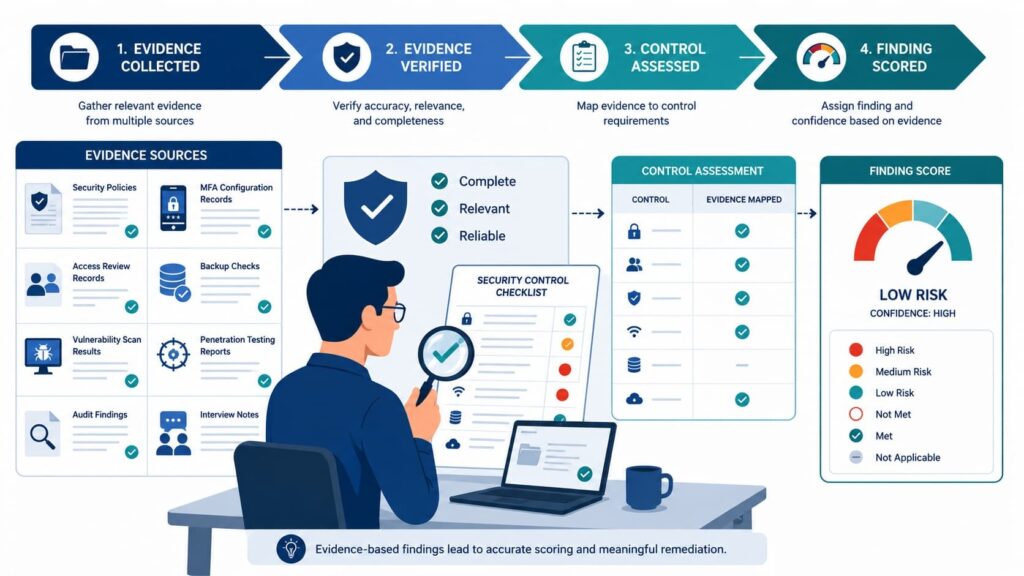
There’s often a big difference between what a policy says and what actually happens. To understand if controls really work, evidence must come from many places papers, interviews, technical checks, and day-to-day operations.
A policy shows what an organization wants, but it doesn’t prove they’re following it. When doing an evidence gap check, the goal is to find proof that controls work over time, not just on paper.
As noted by ScienceDirect:
“This triangulated methodology provides objective evidence to assess the accuracy of SMEs’ self-perceptions, an area largely unexplored in prior cybersecurity literature. The use of direct observation and technical scans offers a unique insight into the operational realities of SME cybersecurity, uncovering systemic issues such as unpatched systems, missing asset inventories, and absent monitoring controls.” – ScienceDirect
In practice, this means looking at things like policies, procedures, system diagrams, lists of assets, reports about weaknesses, support tickets, logs, training records, access checks, incident reports, and past audits. Talking to the right people helps too.
Sometimes security teams say one thing, but the people who run the systems do something else. Legal or compliance teams know about contracts that tech teams might not have added into their work.
NIST CSF 2.0 examples include policies, audit findings, penetration tests, vulnerability scans, and interview notes as inputs for mapping to outcomes.
Usually, the process goes like this:
- Ask for evidence, like policies, procedures, settings, logs, tickets, inventories, and reports
- Interview people from security, IT, compliance, HR, legal, finance, and business areas
- Check if things are set up and working as they should
- Write down any guesses or assumptions so managers’ words don’t get mixed up with real proof
- Sort out any differences between what papers say, what people say, and what’s actually happening
Some of the best kinds of evidence include:
- Multi-factor authentication settings
- Access review records
- Backup checks
- Reports on vulnerabilities
- Incident response drills
- Security training records
- Vendor reviews
- Asset lists
- Risk registers
That shows why documents alone aren’t enough to rate a control.
Why can identity gaps undermine an otherwise strong report?
Identity checks shouldn’t just tick off boxes like “MFA is set up” or “there’s an identity platform.” They need to dig deeper looking at how well access is contained, how privileges get assigned, how non-human identities are managed, and how identities are handled throughout their lifecycle.
This matters more now than ever, since today’s systems aren’t just about employees. There are contractors, service accounts, app identities, API keys, and automated agents all mingling in the mix.
Research from Orchid Security shows:
“Traditional IAM was built to govern people. It was not built for autonomous systems that inherit credentials, act without human oversight, and often operate within the blind spot that identity dark matter creates.” – Cybersecurity Insiders
A solid IAM (Identity and Access Management) gap check needs to look at both tech and how teams respond on the ground.
It should cover:
- Human and non-human identity lists
- How privileged accounts get managed through their life
- Who’s responsible for service accounts
- Rotation of API keys and credentials
- Enforcement of MFA
- Token revocation processes
- Time between detection and containment
- Authorization and tracking of automated agents
Identity problems often hide behind tools that seem polished and ready to go. A company might have centralized identity management but no clear owner for service accounts or automated credentials. That’s a problem not only for evidence it points to a weak control.
If no one can say who owns a credential, why it exists, when it was last rotated, or what systems it can access, that uncertainty itself is a red flag.
This applies to non-human identity security, privileged access, conditional access, identity threat response, and app authentication alike. Just installing tools isn’t enough to prove controls work.
What happens when security controls stop following the data?
There’s a hidden danger when security assessments focus just on systems and forget to track how sensitive data travels between them. ISACA has looked closely at this kind of governance issue, especially as data drifts away from its original home.
Picture a sensitive dataset locked down tight in a main repository with strong encryption, access limits, and rules about how long it sticks around.
But then that same data moves into a SaaS app, an analytics tool, an outside processor, or an AI service where protections might be weaker. This shows why a data protection gap check has to follow the data’s journey, not just draw lines around systems.
A hands-on assessment tries to trace:
- Data flowing between key systems
- Destinations like
- SaaS and cloud services
- AI and automation tools
- Third-party data handlers
- How data is classified
- Rules for how long data’s kept
- Who owns access
- Controls around exporting and sharing
This issue affects many types of security checks privacy gaps, third-party risk, cloud security, SaaS security, and data governance gaps.
ISACA stresses that governance can’t overlook what happens when data crosses company lines or tech boundaries. That changes how you set the assessment scope and look for proof.
Mapping key controls directly to how data moves can reveal gaps that vanish if you stop investigating at a system’s edge. For groups building modern security architecture gap reports, this makes real sense.
The question is no longer just, “Is this system protected?” It’s also, “Does that protection hold up as data, identities, and permissions flow through the bigger network?”
How should a report distinguish missing controls from weak controls?
Sometimes, a security control isn’t just missing it’s there but not doing its job. A good security control gap analysis knows the difference.
It shows which controls don’t exist at all, and which ones exist but don’t work well because they aren’t enforced right, lack proof, have no clear owner, or just don’t perform well. That difference helps identify security program gaps and weaknesses and changes what you have to fix.
For example, if there’s no incident-response plan, you need to make one. But if the plan exists but no one tests it, the fix is something different.
The best findings in an assessment say four things: what was expected, what was actually found, what evidence supports that, and what needs to change. This way, tech teams and bosses both get the full story.
For example, a company might have endpoint protection on 95% of its managed devices. Sounds good until you realize the 5% left out might be very important, like privileged workstations or critical servers. That means risk is still high.
That’s why you have to consider NIST, CIS Controls, asset management, endpoint and network security, and vulnerability management all together when needed.
Here’s how different problems and fixes look:
- Missing: No formal incident-response plan. Create and approve one.
- Partial: MFA covers administrators but not all users. Expand coverage.
- Ineffective: Alerts exist but are ignored. Improve alert handling.
- Evidence gap: A control exists but has no supporting proof. Start retaining evidence.
- Ownership gap: No one owns the control. Assign a responsible owner.
Just having a security tool doesn’t mean the control works. CISA shows over and over that people, processes, how it’s set up, and how teams respond all affect if the security tech actually helps.
This applies too to logging, monitoring, SIEM checks, incident response, security operations, and security training reviews.
A solid report checks design, setup, operation, proof, and ownership. That way, you get a better sense of real security not just what looks good on paper.
How should findings be prioritized beyond simple severity scores?
You can’t just rank security gaps by severity and call it a day. Sometimes a “medium” risk opens the door to a much bigger problem.
The real danger lies in how weaknesses connect how one small hole lets an attacker crawl toward a critical system. That’s why findings need to be sorted by more than just a number.
You have to consider things like:
- Business impact: What happens if this gap gets exploited?
- Exposure: How easy is it to reach the affected system?
- Attack path: Does this weakness let someone move toward the most sensitive assets?
- Regulatory urgency: Are there deadlines pushing fixes?
- Remediation effort: How hard will it be to fix?
- Dependencies: Does another control need changing first?
That fits perfectly with modern vulnerability gap assessments. Fix what breaks the attack path, not just the highest severity item on a list. Security debt adds another twist.
New rules, contracts with clients, and internal risk attitudes mean organizations now face more pressure to show how fast they’ll close big security holes. An internet-facing app without patches might need more urgent attention than a severe flaw on a computer no one uses much.
The context shifts what gets fixed first. A good remediation plan points out quick wins, longer projects, risks the company is willing to accept, what depends on what, and what resources are needed.
It also highlights which fixes cut down the most exposure. That way, the report doesn’t just create a list of problems it helps leaders decide where to spend money and effort.
What should a security gap analysis report include?
There’s something about a good report that strikes you right away it doesn’t just pile on facts, it tells a story that matters. You start with the big picture: which parts of the company got looked at, what systems, data, even what third parties came under the microscope.
That upfront clarity on scope and methods keeps readers from wandering in the dark. From there, it drills down. Each requirement gets tied to its status, backed by evidence. No guesswork there observations sit beside risks and recommended fixes.
The gap register, far from being just an appendix tossed aside, should actually become the team’s to-do list after the report lands on their desks.
Usually, core parts include:
| Report component | Purpose |
| Executive summary | Shows the most important risks |
| Scope and methodology | Explains what was assessed and how |
| Framework mapping matrix | Links findings to requirements |
| Control-status register | Shows the state of each control |
| Risk-ranked findings | Identifies the most important gaps |
| Remediation roadmap | Turns findings into prioritized actions |
If you’ve ever grappled with the NIST CSF 2.0, you know it helps frame where you stand and where you want to be without forcing every company into the same mold. Its Functions, Categories, and Profiles offer a flexible way to organize a gap assessment.
Then there’s what each finding should lay out. It’s got to have everything someone needs to act no flipping back to a different section needed.
That includes:
- Finding title
- Reference to the control or requirement
- Current situation
- Evidence examined
- Risk involved
- Severity or priority
- What should be done
- Who owns it
- Target deadline
This setup doesn’t just make control mapping cleaner, it helps spot missing evidence and checks on compliance. Plus, it turns dry technical notes into real-world consequences.
Saying “MFA is incomplete” doesn’t cut it it’s better to say which privileged users are slipping through, what systems they can get into, and the steps that fix it. A report like this works two ways.
Executives get the biggest risks in minutes. Engineers get enough detail to dive into fixes right away, no guesswork. That balance is what changes a report from just a boardroom slide deck into an actual tool for keeping things secure.
When should a company choose an outsourced gap analysis service?
Outsourcing often feels like the sensible choice when a company needs a fresh pair of eyes someone outside the daily grind who can cut through bias and spot hidden issues. A security gap analysis consulting service can also provide specialized framework expertise or independent validation when internal resources are limited.
Sometimes, it’s about tapping into specific framework know-how or just getting extra hands for a big assessment push. Internal teams usually know the lay of the land better, they’re closer to projects already in motion, and that background matters.
But that closeness sometimes blurs the lines, making it tougher to question problems that have lingered too long.
Industry reports note that many mid‑sized firms engage external GRC/security specialists when internal skills or bandwidth are insufficient; Trustmarque, for example, offers tailored GRC consultancy services.
It’s a sign of how many teams can’t stretch their skills or bandwidth any farther. When deciding who should take the lead on assessments, these points guide the way:
Choose internal assessment when:
- Requirements are clear and well understood
- Evidence is easy to gather
- The team already knows assessment inside-out
- Independence isn’t a deal-breaker
Choose external service when:
- Frameworks get complicated, needing deep interpretation
- Evidence’s all over the place, fragmented and hard to track
- Specialized skills are missing in-house
- Independent validation really matters
For groups thinking about vendors, starting with a Managed Security Service Provider (MSSP) can be a smart move especially if the assessment might connect to ongoing security monitoring, vulnerability checks, or compliance tracking.
The best providers see the assessment as a foundation, not an excuse to push extra tech. They get the balance between governance, risk, compliance (GRC), security tech, and business needs. Otherwise, you risk ending up with a technically perfect report that doesn’t go anywhere.
Here’s what buyers really should gauge before picking a provider:
- Framework expertise
- Experience in the industry
- How they gather and verify evidence
- Depth of their technical validation
- Reporting clarity and usefulness
- Support for fixing issues afterward
- Independence from conflicts
- How they handle sensitive data
The best provider relationship doesn’t stop at delivery. Findings turn into springboards for security planning, monitoring what matters, updating policies, and setting up future checks. It’s a partnership, not a one-and-done.
How much does a security gap analysis report service cost?
Pricing isn’t simple because it changes depending on what’s included.
It depends on things like how many frameworks you check, how deep the technical work is, how complex the environment is, and if you want help fixing problems afterwardFor example, NonaSec lists security assessments starting at $15,000, with a lighter ‘Lite’ tier from $7,500; actual pricing varies by scope, frameworks, and environment complexity.
That price is just one example not what everyone charges. A small, focused review might cost a lot less. But if you’re looking at many frameworks, cloud systems, lots of business units, and third-party tools, the price goes up a lot.
Here’s what usually makes prices higher:
- Number of frameworks looked at
- Number of systems and business units checked
- Cloud or hybrid setups
- How deep the technical checks go
- Dependence on third parties
- How detailed the report must be
- Whether you get help fixing issues
It’s better to compare what’s included, not just the price. A cheap check that only looks at policies might not tell you much. But a wider and deeper check that looks at real settings and operations can give a better picture.
For instance, an IT governance review might not need much technical work. But checking security architecture means looking closely at cloud, user access, network setup, devices, apps, and how you handle security problems.
Still, no one should pay for more than they need. The right kind of review depends on the company’s risk, size, rules they must follow, and what they want to do with the report. Paying extra for stuff you don’t need makes no sense.
How can organizations avoid buying a report that changes nothing?
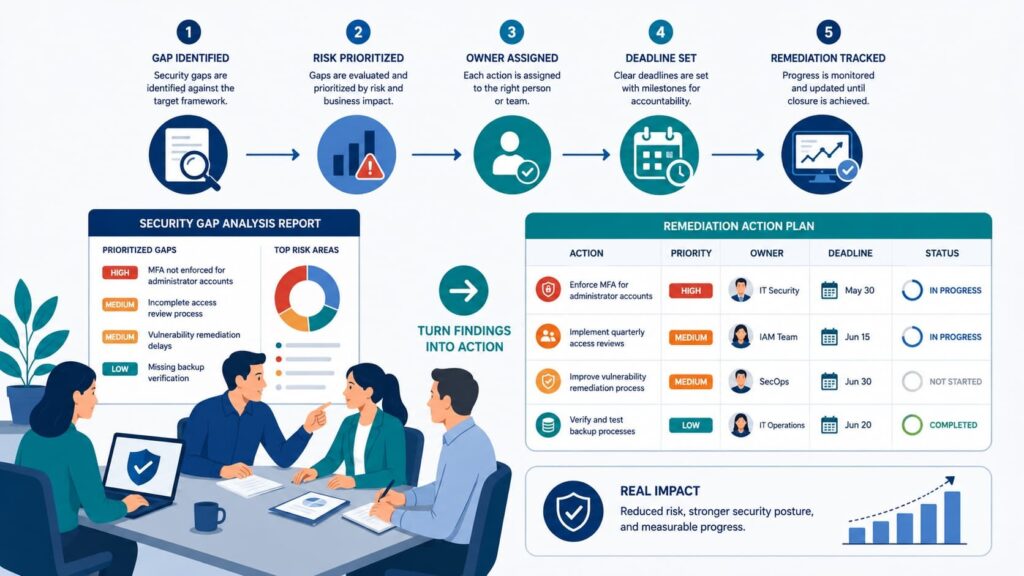
There’s a quiet problem with many assessment reports they pile up findings, get leadership’s okay, then vanish into spreadsheets no one revisits.
That’s where momentum dies out. Each big gap needs to link back to someone responsible, spell out its impact, list what needs fixing, set a target date, and have a way to check if the fix really worked. Without that, reports just sit on shelves.
A good report isn’t the end. It should kick-start a plan for real security improvements. Every gap gets folded into whatever project or risk management system the company already uses.
Some common ways these reports fall short:
- Treating policies like they prove everything’s done
- Forgetting about SaaS services and third-party data flows
- Counting tools instead of looking at actual results
- Skipping non-human users like service accounts
- Ranking risks with broad, generic labels
- Listing issues without naming who owns them
- Missing how fixes depend on one another
- Not checking if fixes really work after they’re done
Doing regular gap checks helps stop the cycle of repeating assessments that don’t show progress. For example, running reviews every few months to see if critical issues get closed on time keeps things alive.
An easy workflow after the report might look like this:
- Confirm findings with the people in charge of the controls
- Assign who will fix each gap
- Set deadlines for those fixes
- Keep track of what depends on what
- Measure the risk that’s still there
- Reassess the big gaps that matter most
- Update the profile of the company’s current state
When management can see clear metrics like how old each fix is, how much of the controls are in place, how complete evidence is, coverage of privileged accounts, and testing of incident response they can actually watch improvement happen.
The goal isn’t to chase a perfect score. It’s to make risks clearer, easier to manage, and less likely to sneak up later.
What is changing in security gap analysis in 2026?
Security checks have changed a lot recently. Now, they need to cover things like AI tools, non-human accounts, how data moves around, automation, and making sure systems keep working even when problems hit.
At the same time, companies are doing more detailed reviews looking at app security, DevSecOps, cloud safety, and automation because technology changes faster than once-a-year checkups.
Here’s a quick list of what’s new and what it means:
- AI tools: Check access, credentials, and audit trails.
- Data movement: Follow controls as data moves between systems.
- Identity problems: Assess containment and response, not just account creation.
- AI-assisted assessments: Document assumptions and require human review.
- Fast-changing environments: Update the current-state assessment more often.
One big issue is identity. Research from SANS shows more companies have automated accounts and non-human users, but they don’t always keep up with rotating passwords or stopping those accounts when needed.
That means security checks can’t only look at employee accounts anymore. They have to check service accounts, API keys, automation setups, AI tools, and their logs.
AI can help speed up some parts, like reviewing evidence or matching controls, but it can’t replace human judgment. NIST says AI-based analysis isn’t a full guarantee.
Experts still need to decide if the evidence really supports the findings and if fixes make business sense. So, even as tools get smarter, people still play the key role in real security checks.
What should buyers look for in a security gap analysis report service?
Security checks aren’t just about ticking boxes, but too often that’s all they feel like. Buyers should look for a service that shows real proof, tracks every requirement, and focuses on what the business needs, not just the rules.
They also want a clear plan that lays out the steps to fix problems, not just a list of what’s wrong. Before starting, the service has to explain what they’ll look at: what systems, data, and people are involved, how they’ll test things, and how they’ll score problems.
Not everything is urgent, and that needs to be clear. Some risks are bigger, some smaller. Deadlines matter, and sometimes the company’s already working on fixes.
Here’s what to watch for:
- Capability means the service has a strong, proven track record.
- Scope must clearly cover systems, data, people, and where boundaries are.
- Methodology should be the same every time and based on facts.
- Framework mapping means every requirement links back to a real test.
- Validation uses talks with people and technical checks that really matter.
- Findings have to be clear, about real risks, and someone should own each one.
- Roadmap gives a step-by-step plan with priorities.
- Reporting needs to make sense to both leaders and tech teams.
- Follow-up means checking if fixes work or offering help to fix them.
Before signing up, buyers should ask what proof the service will look at and which controls get tested technically. They need to know how the service decides what’s most important, based on business impact, how risks depend on each other, and how hard fixes will be.
The provider should also explain how they handle third-party risks, cloud security, identity management, responding to incidents, protecting data, and governance if those are part of the review.
MSSP Security fits this kind of work well when a company wants a gap check that leads to working on long-term security. This isn’t about selling more tools, but about setting real priorities that help teams fix what counts.
The best assessments give fewer questions after they’re done. Leaders know what really matters, tech teams know what to fix, and those in charge know what proof shows they’re improving.
Navigating Information Security: A Practical Guide to ISO 27001 Gap Analysis
Credits: Always Secured Automation
This video by Always Secured Automation explains that an ISO 27001 gap analysis evaluates how well an organization’s current information security management system aligns with formal standards. It helps identify security loopholes, control deficiencies, and priority areas for improvement prior to an official certification audit.
By using a structured approach, you can assess the maturity level of technical and administrative controls, map existing risks, and establish a clear remediation roadmap. Ultimately, the process delivers actionable guidance to strengthen data protection and achieve full compliance efficiently.
FAQ
What should I prepare before requesting a security gap analysis?
Prepare your current security policies, recent audit findings, known security incidents, asset inventory, and applicable compliance requirements. These materials give the assessor the context needed for an effective IT security gap assessment. If some documents are missing, identify them before the assessment so an evidence gap analysis can account for those missing records.
How does a cybersecurity gap analysis differ from a cybersecurity risk assessment?
A cybersecurity gap analysis compares your current security controls and practices with a defined security target. A cybersecurity risk assessment identifies threats, evaluates their likelihood and potential impact, and determines which risks require attention. Using both assessments helps you identify control gaps and prioritize risks that could affect your organization.
When should a company conduct a compliance gap analysis?
A company should conduct a compliance gap analysis before an audit, certification effort, regulatory change, or contractual review. An audit readiness gap analysis can help verify that required controls are implemented and that sufficient evidence exists to demonstrate compliance. Conducting the assessment early also gives teams time to address deficiencies before an external review.
How often should a security posture assessment be repeated?
An organization should repeat a security posture assessment at least annually and after significant changes to its technology, operations, or regulatory obligations. Organizations with frequent changes may need more frequent reviews. A continuous compliance gap analysis can also help identify changes between formal assessments and prevent previously resolved gaps from becoming issues again.
What should I do after receiving a gap assessment report?
Review each finding, assign an accountable owner, establish a target completion date, and prioritize remediation based on security risk and business impact. Use the gap assessment report to create a remediation roadmap and maintain a gap register that tracks outstanding issues. Regular progress reviews can show whether remediation work is actually reducing the identified gaps.
How Should a Security Gap Analysis Report Drive the Next Decision?
A security gap analysis should make it easier to see what needs attention, not leave you with another document to file away. You need clear evidence of where security stands, which gaps matter most, and what needs to happen next.
Turn findings into actions with clear owners, priorities, and timelines. Keep the report updated as systems, vendors, people, and risks change.
For expert guidance on security needs, technology stack optimization, vendor selection, and actionable recommendations, work with MSSP Security’s consulting team. A useful security gap analysis gives your team a clear view of the current state and a practical roadmap for closing important gaps.
References
- https://www.sciencedirect.com/science/article/pii/S0167404826000155#1
- https://www.cybersecurity-insiders.com/two-thirds-of-nonhuman-accounts-are-unseen-and-unmanaged-according-to-orchid-securitys-identity-gap-report/