

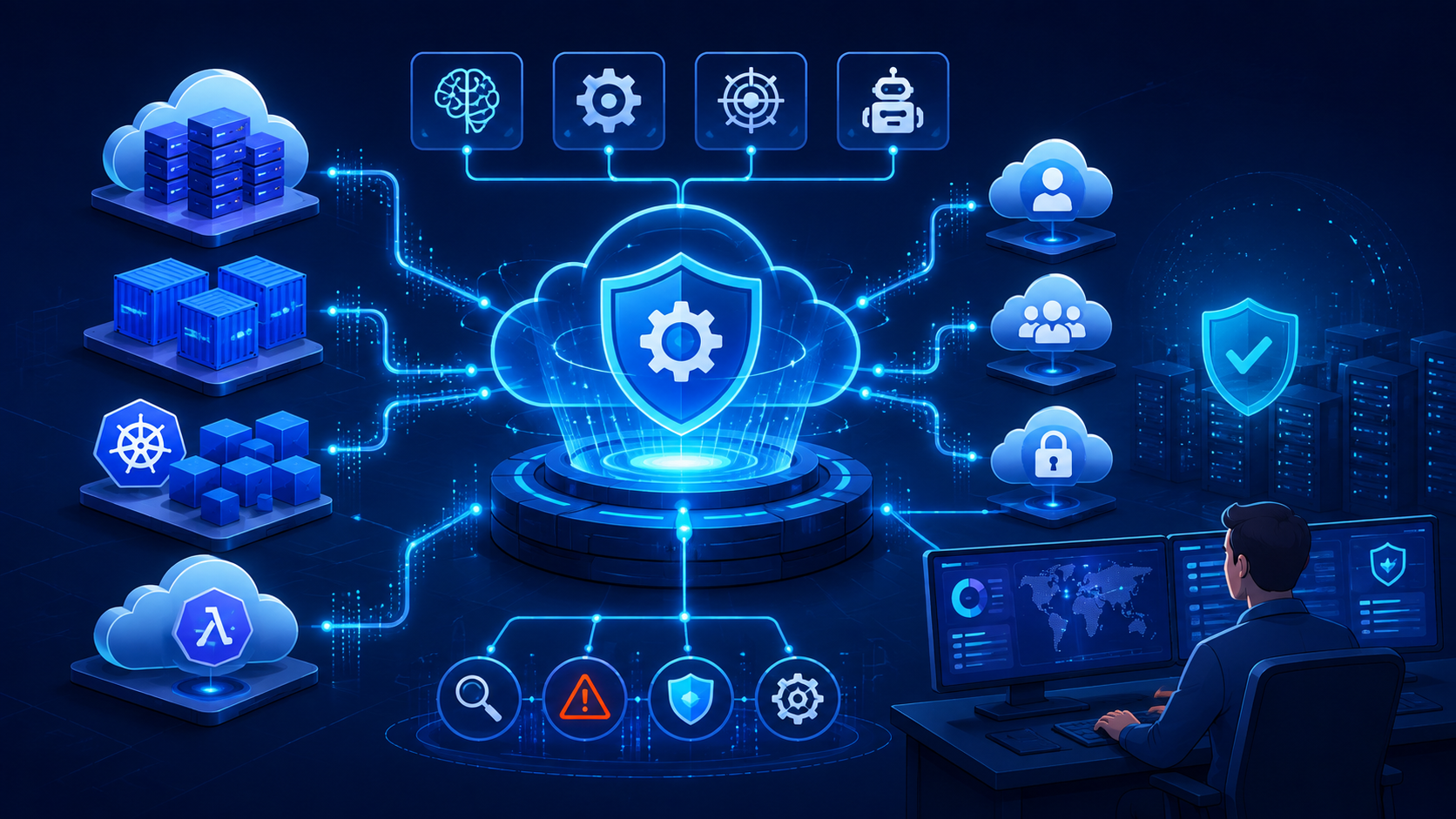
Automating cloud security monitoring helps organizations detect threats faster, improve cloud visibility, and reduce the manual effort required to monitor security events. As cloud environments become more dynamic, maintaining consistent security across workloads, identities, and configurations grows increasingly challenging.
From our experience at MSSP Security, automation enables security teams to spend less time on repetitive tasks and more time investigating critical risks. Keep reading to learn how MSSP Security helps organizations strengthen cloud security monitoring through smarter automation and proactive defense strategies.
What You Should Know Before Getting Started
Before exploring the details, here are the main points to keep in mind about automating cloud security monitoring:
- Automating cloud security monitoring enables faster threat detection and incident response while reducing manual monitoring efforts.
- Combining continuous monitoring, event correlation, and compliance automation strengthens security across multi-cloud and hybrid environments.
- The best results come from pairing automation with experienced security expertise to improve efficiency and prioritize high-risk threats.
Why Does Automating Cloud Security Monitoring Matter for Modern Cloud Environments?
Automating cloud security monitoring helps organizations collect, analyze, and respond to security events with less manual effort. Instead of reviewing every alert one by one, automated workflows identify suspicious activity, prioritize risks, and support faster incident response. This allows security teams to spend more time investigating real threats instead of handling repetitive tasks.
As cloud environments continue to grow, keeping security consistent becomes more difficult. Organizations often manage a mix of cloud resources, including:
- Virtual machines
- Containers
- Kubernetes clusters
- Serverless applications
- Cloud identities
Each of these generates security events that require ongoing visibility and analysis. Relying on manual monitoring alone can make it harder to keep up as environments expand.
As organizations expand their cloud footprint, understanding the cloud security shared responsibility model also becomes essential to ensure security responsibilities are clearly divided between cloud providers and customers.
From our experience working with MSSPs, we’ve found that automation delivers the best results when combined with experienced security professionals. We help MSSPs evaluate and audit security products that fit their operational needs and existing security workflows. The right combination of automation, well-chosen tools, and human expertise helps organizations improve operational efficiency, strengthen cloud security, and build a more scalable defense.
How Does Automating Cloud Security Monitoring Improve Real-Time Threat Detection?
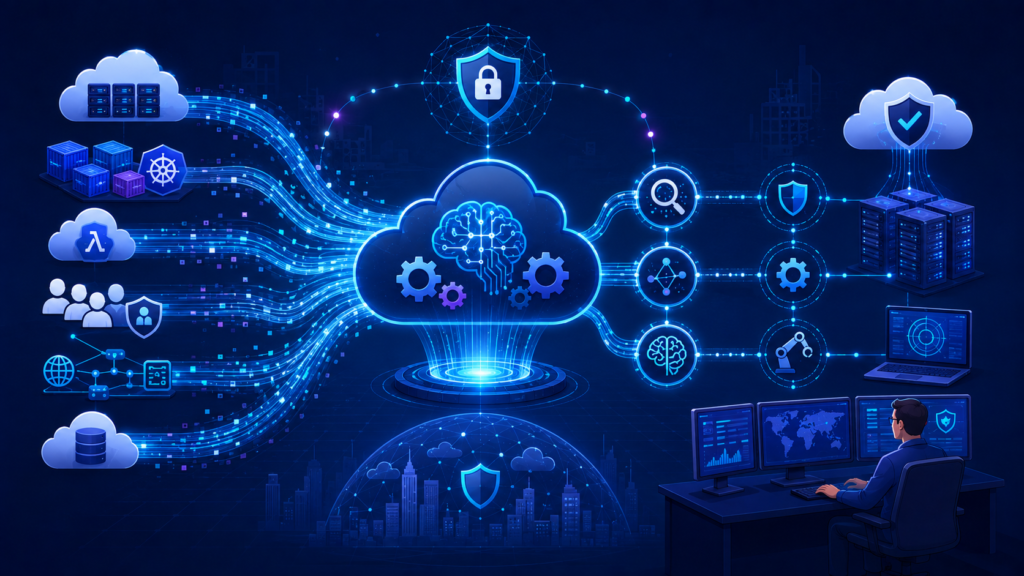
Automating cloud security monitoring strengthens real-time threat detection by analyzing security events as they occur and helping organizations identify risks before they become larger incidents. Instead of relying on manual log reviews, automation combines automated threat detection, machine learning, and behavior analytics to prioritize the alerts that need immediate attention.
Google Cloud highlights the importance of modern security operations, stating that:
“Security operations (SecOps) , adopt a modern SecOps platform and set of practices, for effective incident management, threat detection, and response processes. Monitor systems and applications continuously for security events.” – Google Cloud Documentation
These capabilities work together to improve detection by:
- Correlating related security events into a single investigation.
- Learning normal activity patterns to identify emerging threats.
- Detecting anomalies such as unusual access requests, unexpected data transfers, or unfamiliar login locations.
From our experience working with MSSPs, we’ve found that effective detection depends on more than automation alone. We help MSSPs evaluate and audit security products that improve detection accuracy, integrate with existing security operations, and reduce unnecessary alerts.
When combined with experienced analysts, automating cloud security monitoring helps lower Mean Time to Detect (MTTD), improve investigation quality, and support faster, more informed incident response.
How Does an Automating Cloud Security Monitoring Framework Work?
An effective automating cloud security monitoring framework follows a connected process that turns raw cloud activity into actionable security insights. Instead of relying on isolated tools, each stage builds on the previous one to improve detection and response.
Cloud Security Alliance highlights the importance of collecting relevant cloud security data by emphasizing the role of “cloud telemetry, management plane logs, service and resource logs, and advanced monitoring tools” in modern cloud security monitoring.
These data sources provide the visibility required for automation to analyze activity, identify risks, and support faster security decisions.
| Framework Stage | Primary Function | Outcome |
| Cloud Logging and Telemetry | Collect security events from cloud workloads, identities, networks, and cloud services | Creates a centralized source of monitoring data |
| Log Analysis Automation | Filter noise and identify suspicious activity from large volumes of data | Reduces manual log review and highlights relevant events |
| Event Correlation and Security Analytics | Connect related events, add business context, and prioritize high-risk activity | Improves threat detection accuracy and risk prioritization |
| Security Event Management | Present findings through a centralized dashboard | Supports faster investigation and incident response |
The framework typically includes:
- Cloud logging and telemetry to collect security events from workloads, identities, networks, and cloud services.
- Log analysis automation to filter noise and identify suspicious activity from large volumes of data.
- Event correlation and security analytics automation to connect related events, add business context, and prioritize the highest-risk incidents.
- Security event management to present findings through a centralized dashboard that supports faster investigations and response.
From our experience working with MSSPs, the framework is only as effective as the products behind it. We help MSSPs evaluate and audit security solutions to ensure they integrate with existing operations, produce meaningful insights, and support scalable cloud monitoring. When these components work together, organizations gain clearer visibility, better risk prioritization, and faster incident response without adding unnecessary operational complexity.
How Does Security Orchestration Improve Cloud Incident Response?
Security orchestration helps organizations respond to threats faster by connecting monitoring, analysis, and response into a single process. Instead of relying on manual coordination, automation ensures each stage of an investigation follows a consistent path while allowing analysts to focus on higher-risk decisions. As highlighted by the Cloud Security Alliance:
“Changes occur in the cloud at a high speed. This rapid pace means security processes must be agile, and automated responses are necessary.” – Cloud Security Alliance (CSA)
This reinforces why automated workflows are becoming essential for organizations managing dynamic cloud environments where threats and infrastructure changes can occur rapidly.
A typical orchestration process includes:
- Security automation workflows that define the sequence of tasks after a security event is detected, such as collecting evidence, assessing risk, and notifying the appropriate team.
- Cloud security playbooks that provide standardized rules for handling common scenarios, including compromised accounts, suspicious workloads, or unauthorized administrative activity.
- Automated incident response that executes approved actions, such as isolating workloads, disabling compromised credentials, or opening investigation tickets when predefined conditions are met.
From our experience working with MSSPs, effective orchestration depends on selecting security products that fit existing operational processes. We help MSSPs evaluate and audit these solutions to ensure automated workflows remain consistent, support governance requirements, and improve response efficiency. When combined with experienced analysts, security orchestration enables faster cloud incident response without sacrificing control or oversight.
How Can Automation Strengthen Cloud Compliance and Access Control?
Automation helps organizations maintain cloud compliance and manage access control without relying on time-consuming manual reviews. As cloud environments change rapidly, automated governance keeps security policies aligned with business and regulatory requirements.
A strong compliance strategy typically includes:
- Cloud compliance automation to continuously measure cloud environments against internal policies and regulatory frameworks, giving organizations an ongoing view of their compliance posture instead of relying on periodic audits.
- Automated compliance checks to identify issues such as unencrypted storage, weak identity policies, exposed services, or missing security controls before they become larger risks.
- Policy enforcement automation to apply approved security standards by enforcing encryption, restricting excessive permissions, and preventing unauthorized infrastructure changes.
Automation also improves IAM automation and access control automation by streamlining user provisioning, role management, access reviews, and permission updates. This supports the principle of least privilege while reducing administrative effort.
From our experience working with MSSPs, we help evaluate and audit security products that strengthen governance without adding unnecessary complexity. When compliance, identity management, and policy enforcement work together, organizations can improve security, simplify audits, and maintain stronger control across evolving cloud environments.
How Can Automation Strengthen Cloud Posture Monitoring and Vulnerability Management?
Automation helps organizations identify and reduce cloud security risks before they become incidents. Instead of relying on periodic reviews, automating cloud security monitoring continuously evaluates cloud resources, making it easier to maintain a strong security posture as environments evolve.
Rather than relying on periodic assessments, automation continuously evaluates cloud configurations, workloads, and security controls to identify potential risks in real time.
To support these capabilities, organizations also need security platforms that provide comprehensive visibility and integrate with existing workflows. Our Cloud Native Security Tools MSSP guide explains what to consider when evaluating cloud-native security technologies.
A typical lifecycle includes:
- Discover: Cloud posture monitoring and vulnerability scanning automation continuously assess cloud assets, workloads, and configurations to uncover security weaknesses, missing controls, and known vulnerabilities across virtual machines, containers, Kubernetes, and cloud applications.
- Detect: Automation identifies misconfiguration detection and configuration drift detection by comparing current settings with approved security baselines. This helps security teams quickly spot unauthorized changes, excessive permissions, or insecure configurations.
- Remediate: Remediation automation recommends or applies corrective actions, such as restoring approved configurations, enabling encryption, or removing unnecessary permissions. Organizations can choose guided remediation for analyst approval or auto-remediation for lower-risk issues.
From our experience working with MSSPs, we help evaluate and audit security products that support posture management without disrupting existing operations. When discovery, detection, and remediation work together, organizations can prioritize risks earlier, improve cloud resilience, and maintain stronger security as their environments continue to grow.
Why Is Automation Essential for Multi-Cloud and Hybrid Cloud Monitoring?
As organizations expand across multi-cloud and hybrid cloud environments, maintaining consistent security becomes more challenging. Different cloud platforms use their own services, logging formats, and security controls, making manual monitoring difficult to scale. Automating cloud security monitoring helps unify these environments without requiring separate monitoring processes for each platform.
A practical approach focuses on three key areas:
- Challenges: Automation standardizes monitoring across diverse cloud environments, reducing operational complexity and helping security teams investigate threats more consistently.
- Continuous Discovery: Cloud asset discovery continuously identifies new workloads, containers, identities, storage resources, and other cloud assets as environments change, ensuring monitoring coverage stays current.
- Unified Visibility: By consolidating logs, alerts, and security events into a centralized view, automation supports multi-cloud monitoring and hybrid cloud monitoring while improving policy enforcement, investigations, and reporting across platforms.
From our experience working with MSSPs, the most effective monitoring strategies remain vendor-neutral. We help evaluate and audit security products that integrate across different cloud environments, allowing organizations to scale securely while maintaining consistent visibility and operational control.
How Does Cloud Security Automation Integrate With Modern Security Platforms?
Credit: Mad Hat
Automating cloud security monitoring delivers greater value when it works alongside the tools organizations already use. Instead of operating as a standalone capability, automation shares data across security platforms to improve visibility, investigation, and response.
Key integrations include:
- SIEM integration centralizes cloud logs and security events, making it easier to correlate activity across environments, investigate incidents, and retain historical data for analysis.
- Beyond monitoring, SOAR integration automates repetitive response tasks such as opening cases, collecting evidence, executing playbooks, and tracking remediation, allowing analysts to focus on higher-priority decisions.
- Meanwhile, CSPM and CNAPP integration combine posture management, vulnerability insights, and runtime visibility, giving security teams richer context for prioritizing cloud risks.
- Earlier in the software lifecycle, DevSecOps integration strengthens security by supporting CI/CD security checks and Infrastructure as Code (IaC) security before workloads reach production.
From our experience working with MSSPs, we help evaluate and audit security products that integrate effectively with existing security operations. When these technologies work together, organizations gain a more connected security ecosystem that improves visibility, simplifies investigations, and supports faster cloud incident response.
How Can Advanced Automation Improve Cloud Threat Prevention?
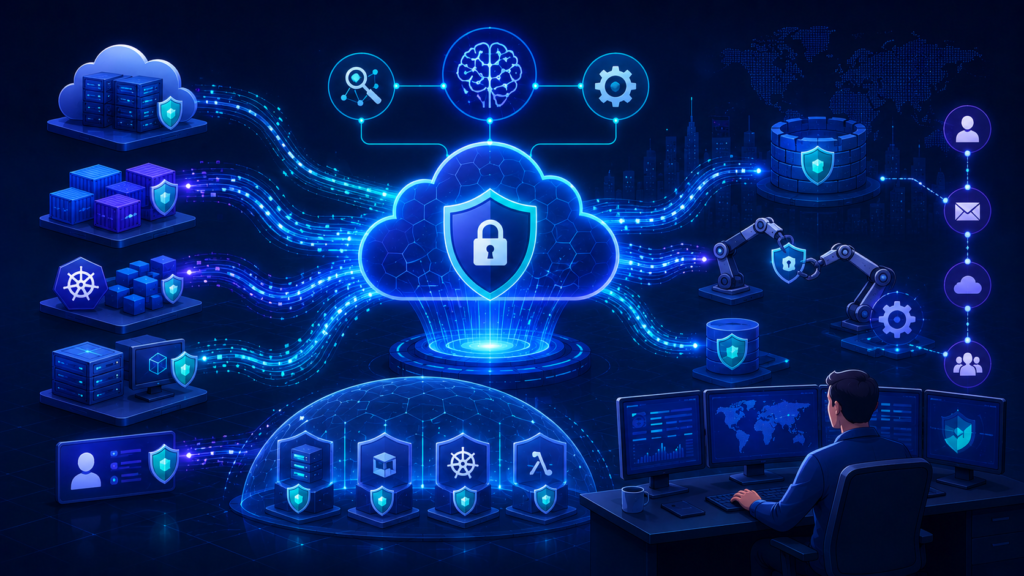
Advanced automation helps organizations move beyond basic alerting by improving detection, accelerating response, and maintaining visibility across dynamic cloud environments. As cloud workloads become more distributed, automating cloud security monitoring provides the context and speed needed to identify and contain threats more effectively.
Advanced capabilities include:
- Threat intelligence enrichment enhances detection by adding context such as known malicious IP addresses, indicators of compromise (IOCs), and attack techniques. This additional intelligence helps analysts prioritize investigations based on risk rather than reviewing every alert equally.
- Automated containment focuses on response by executing predefined actions when high-confidence threats are detected. Depending on organizational policies, automation can isolate workloads, disable compromised accounts, revoke exposed credentials, or restrict access to sensitive cloud resources.
- Runtime monitoring provides continuous visibility into workloads after deployment by monitoring process execution, network activity, API calls, and other runtime behavior. This helps detect attacks that static security scans cannot identify.
- Cloud-native workload monitoring extends protection to containers, Kubernetes, and serverless environments. Because these workloads are highly dynamic, automation continuously monitors their activity, validates security policies, and helps maintain consistent protection as applications scale. As organizations increasingly adopt event-driven architectures, understanding common serverless security monitoring challenges can also help identify potential visibility gaps and strengthen threat detection across serverless environments.
From our experience working with MSSPs, advanced automation delivers the greatest value when organizations select security products that complement their existing operations. We help MSSPs evaluate and audit these solutions to ensure they improve detection accuracy, strengthen cloud-native protection, and scale effectively as cloud environments continue to evolve.
How Can Organizations Successfully Implement Automating Cloud Security Monitoring?
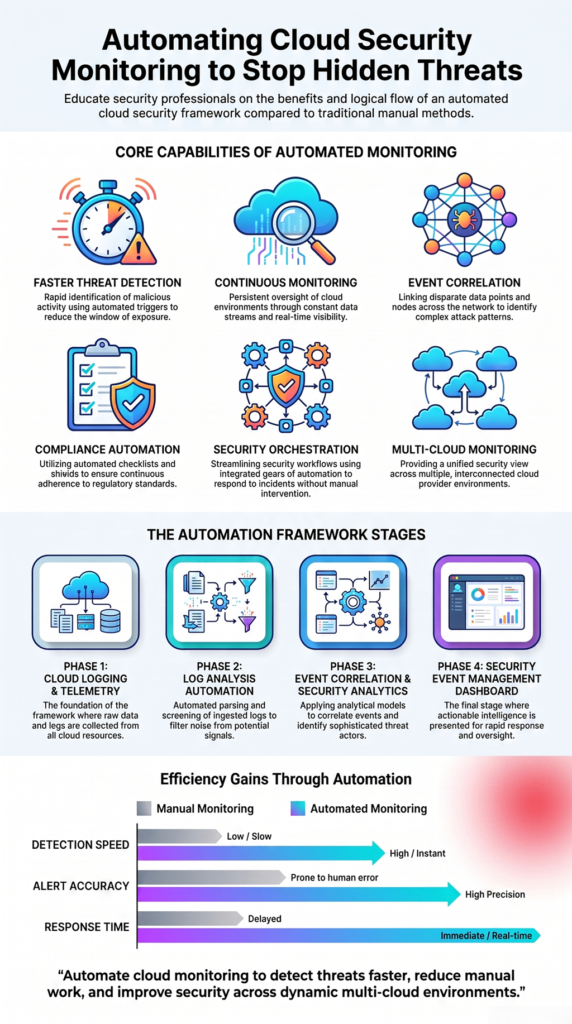
Successfully implementing automating cloud security monitoring requires a structured approach rather than simply deploying new tools. Organizations should first build visibility into cloud assets, identities, workloads, and existing security controls before automating security processes.
Key implementation practices include:
- Prioritize high-risk incidents using asset criticality, threat severity, and business impact.
- Automate repetitive tasks such as alert triage automation, automated alert routing, log collection, and compliance reporting to improve security operations efficiency.
- Reduce false positives through event correlation, behavior analytics, and threat intelligence enrichment so analysts can focus on meaningful threats.
- Measure performance using metrics like Mean Time to Detect (MTTD) and Mean Time to Respond (MTTR), then continuously refine monitoring rules, playbooks, and policies as cloud environments evolve.
From our experience working with MSSPs, successful automation depends on selecting security products that fit existing operations and governance. We help MSSPs evaluate and audit these solutions so organizations can scale cloud security monitoring while improving efficiency, visibility, and long-term resilience.
FAQ
What technologies are commonly used for automating cloud security monitoring?
Organizations often combine multiple technologies to automate cloud security monitoring, including SIEM, SOAR, CSPM, CNAPP, threat intelligence platforms, and security analytics tools. Together, these technologies collect cloud telemetry, correlate events, automate workflows, and provide better visibility across cloud environments.
What tasks can be automated in cloud security monitoring?
Many routine security activities can be automated, such as log collection, alert triage, event correlation, compliance checks, vulnerability scanning, automated alert routing, incident reporting, and predefined response actions. Automating these repetitive tasks allows security teams to spend more time investigating high-risk threats.
Can automating cloud security monitoring support multi-cloud and hybrid cloud environments?
Yes. Automating cloud security monitoring can monitor workloads across multi-cloud and hybrid cloud environments by centralizing security data, correlating events from different cloud platforms, and applying consistent monitoring and security policies. This helps organizations maintain visibility even as their cloud infrastructure grows.
Does cloud security automation replace security analysts?
No. Cloud security automation is designed to support security analysts rather than replace them. While automation handles repetitive monitoring and response tasks, experienced analysts remain responsible for validating complex threats, assessing business impact, and making strategic security decisions.
What should organizations consider when selecting cloud security automation tools?
Organizations should evaluate integration capabilities, scalability, automation features, governance requirements, and compatibility with their existing security stack. Working with an independent consulting partner can also help validate product selection, improve integration, and reduce unnecessary tool overlap before investing in new security technologies.
What Is the Next Step for Strengthening Cloud Security?
Automating cloud security monitoring helps organizations improve visibility, strengthen threat detection, and streamline incident response across modern cloud environments. From our experience working with MSSPs, the best results come from combining automation with the right security strategy, governance, and technology.
If you’re evaluating cloud security solutions or optimizing your existing security stack, MSSP Security offers vendor-neutral consulting to help MSSPs select and audit the right products.
References
- https://cloudsecurityalliance.org/artifacts/security-guidance-v5
- https://docs.cloud.google.com/architecture/framework/security?authuser=3