

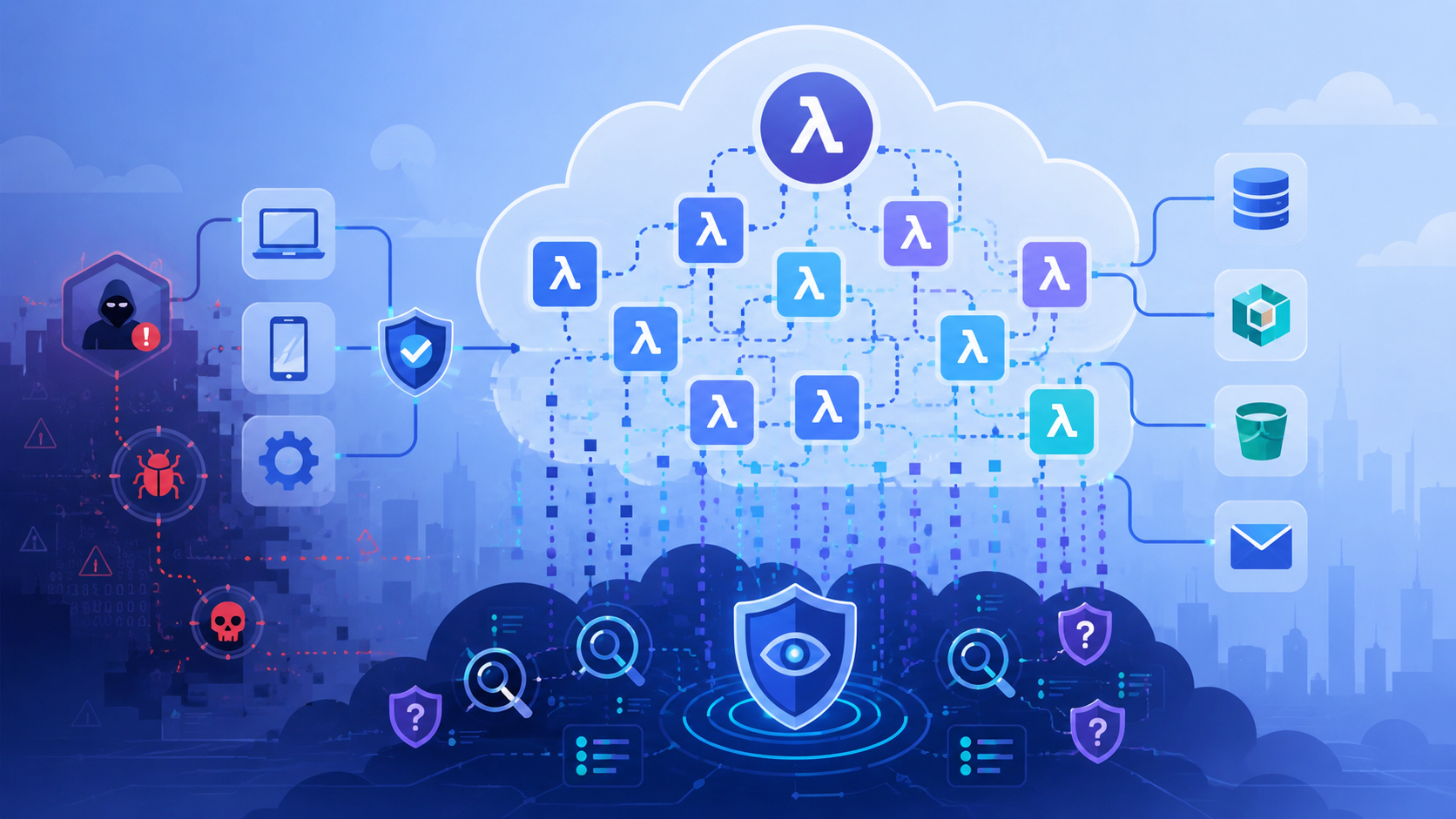
Serverless environments improve scalability but create new security visibility challenges. Short-lived, event-driven functions make it harder to collect runtime data, correlate telemetry, and investigate threats.
Key serverless security monitoring challenges include limited runtime visibility, fragmented telemetry, and incomplete audit trails. During cloud security assessments, we often find teams have logs but lack correlation between function activity, IAM events, and triggers.
At MSSP Security, we help MSSPs evaluate security solutions and improve monitoring strategies. Keep reading to explore serverless security challenges.
What Security Teams Should Know About Serverless Monitoring
Serverless security can become harder to manage as applications grow more distributed. These key points highlight the main areas teams should focus on when improving visibility, detection, and response:
- Limited runtime visibility can slow threat detection. Short-lived functions and distributed workflows make it harder to monitor activity, requiring effective logging, tracing, and telemetry correlation.
- IAM and event risks can increase exposure. Over-privileged functions, insecure triggers, and weak access controls may allow attackers to misuse legitimate serverless workflows.
- Continuous monitoring helps uncover suspicious activity faster. Centralized analytics, anomaly detection, and reliable audit trails give security teams better context for investigation and response.
Why Are Serverless Security Monitoring Challenges Different From Traditional Cloud Monitoring?
Serverless security monitoring challenges are closely tied to how serverless architectures change the way applications are built, managed, and secured. Traditional cloud environments usually provide more direct control over servers, operating systems, and infrastructure layers. Serverless platforms take a different approach by allowing cloud providers to manage provisioning, scaling, and availability behind the scenes.
This changes the shared responsibility model. While providers handle the underlying infrastructure, organizations are still responsible for securing application code, permissions, configurations, and interactions between services.
“Serverless computing (Functions as a Service, FaaS) platforms such as AWS Lambda, Azure Functions, and Google Cloud Functions simplify application development and scaling. However, the execution model (short-lived, event-driven functions running in managed environments) introduces unique security risks compared to traditional architectures.” – OWASP
This difference explains why serverless security monitoring challenges require stronger visibility into application behavior, execution flows, and cloud-native security controls rather than relying only on traditional infrastructure monitoring.
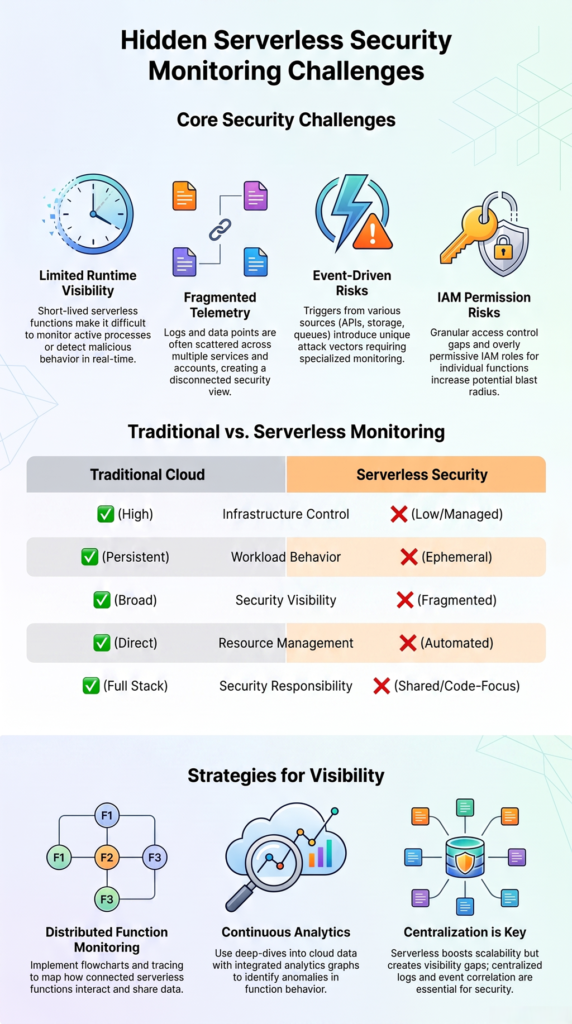
The difference between traditional cloud monitoring and serverless security monitoring can be seen across several key areas:
| Security Area | Traditional Cloud Monitoring | Serverless Security Monitoring |
| Infrastructure Control | Security teams have more direct access to servers, operating systems, and network layers. | Cloud providers manage underlying infrastructure, reducing direct visibility and control. |
| Workload Behavior | Long-running workloads allow continuous monitoring of processes and system activity. | Short-lived functions require monitoring through telemetry, logs, and execution data. |
| Security Visibility | Endpoint agents and infrastructure monitoring tools provide deeper system insights. | Teams rely on cloud-native telemetry, application logs, and identity events. |
| Resource Management | Assets are usually static and easier to inventory. | Functions and resources change dynamically based on events and demand. |
| Security Responsibility | Teams secure both infrastructure and applications. | Providers secure infrastructure while organizations focus on code, permissions, and configurations. |
During cloud security assessments, we often see MSSPs and their customers adjusting their security strategies after moving from traditional workloads to serverless environments. The challenge is not only finding suitable tools but also ensuring security solutions align with how serverless applications are deployed and operated.
Through our consulting work, we help MSSPs evaluate and audit security products to identify whether existing solutions can support modern serverless architectures. Our focus is helping teams make informed technology decisions and build security strategies that match the changing requirements of cloud-native environments.
How Does Limited Runtime Visibility Affect Serverless Security Visibility?
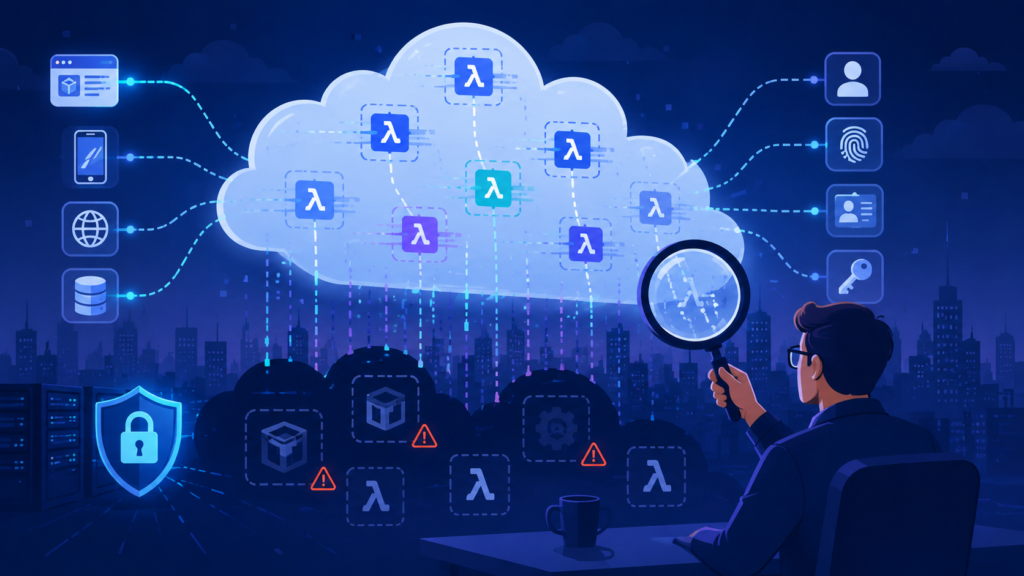
One of the biggest serverless security monitoring challenges is understanding what happens while a function is running. Unlike traditional workloads, serverless functions offer limited runtime visibility, making it harder for security teams to monitor behavior and identify suspicious activity in real time.
Teams may struggle to detect:
- Unexpected function behavior.
- Unusual API interactions.
- Suspicious access patterns.
- Potential misuse of permissions.
The challenge increases when a function connects with multiple services, such as APIs, databases, and identity systems. Without proper monitoring, security teams may see separate events instead of the full activity flow.
During cloud security assessments, we often find that MSSPs and their customers have application logs but lack enough correlation between function activity, IAM events, and connected services. This can make threat investigation more difficult.
Microsoft highlights that effective serverless protection requires a stronger focus on visibility and security posture management.
“Delivers visibility, security, and posture management for serverless workloads across multicloud environments.” – Microsoft Learn / Microsoft Defender for Cloud
This reinforces why limited runtime visibility remains one of the main serverless security monitoring challenges, as organizations need continuous insight across functions, configurations, vulnerabilities, and connected cloud resources.
Improving serverless security visibility requires structured logging, function-level monitoring, identity tracking, and cloud-native security analytics. Through our consulting work, we help MSSPs evaluate and audit security products to identify solutions that improve visibility and support stronger monitoring strategies for modern serverless environments.
Why Is Monitoring Ephemeral Functions So Difficult?
Ephemeral function monitoring is challenging because serverless workloads can change quickly during execution. Unlike traditional applications that run on stable infrastructure, serverless functions rely on temporary execution contexts that are created when needed and removed after completion. This dynamic behavior makes it harder for security teams to maintain consistent visibility across workloads.
As serverless applications grow, function activity can become difficult to track. Multiple executions may run at the same time, and security teams need to distinguish normal scaling behavior from unusual invocation patterns. Key challenges include:
- Tracking concurrent function executions.
- Following function chains across connected services.
- Maintaining distributed tracing IDs between workflows.
- Identifying abnormal invocation patterns.
- Monitoring temporary execution contexts.
Function chaining adds another layer of complexity because a single business process may involve multiple functions, APIs, and cloud services. Without proper correlation, analysts may see individual events without understanding how those activities connect.
During cloud security assessments, we often find that MSSPs and their customers have access to execution logs but lack consistent tracing across serverless workflows. This can slow investigations and make it harder to determine whether unusual activity is expected behavior or a potential security issue.
Through our consulting work, we help MSSPs evaluate and audit security products to identify solutions that provide better visibility into dynamic serverless environments. The right monitoring approach combines execution metadata, reliable tracing practices, and centralized security analytics to support stronger detection and investigation.
How Does a Distributed Serverless Architecture Create Fragmented Security Telemetry?
A distributed serverless architecture creates new serverless security monitoring challenges because security data is generated across multiple functions, APIs, managed services, and cloud platforms. Unlike traditional environments with centralized monitoring points, serverless workflows can produce fragmented telemetry across different sources.
The main challenge is connecting these data points to understand the full security context. Without proper correlation, analysts may struggle to reconstruct attack paths across functions, APIs, and backend services.
Common telemetry challenges include:
- Different log formats across services.
- Function-level logging gaps.
- Inconsistent security event data.
- Limited visibility across multi-function workflows.
During cloud security assessments, we often find that MSSPs and their customers collect logs but lack the correlation needed for effective investigation. Through our consulting work, we help MSSPs evaluate and audit security products to identify solutions that improve telemetry management, strengthen event correlation, and support better security analysis in complex serverless environments.
What Event-Driven Security Risks Make Serverless Applications Harder to Protect?
Credit: AWS Event
The event-driven model improves serverless flexibility but also introduces new event-driven security risks because every event can become a potential entry point for attackers. Unlike traditional applications, security teams must monitor how events move between services and how they trigger functions.
Key risks include:
- Untrusted event sources and unauthorized function invocation.
- Event poisoning and replay attacks.
- Weak event payload validation.
- Excessive permissions between connected services.
During cloud security assessments, we often find that MSSPs and their customers secure individual functions but overlook the relationships between event sources, permissions, and workflows. These gaps can allow attackers to manipulate application behavior or access sensitive resources.
Through our consulting work, we help MSSPs evaluate and audit security products that improve event visibility, strengthen access controls, and support safer serverless architectures. Effective event source validation and continuous monitoring help organizations reduce exposure across dynamic cloud environments.
How Do IAM Permission Misconfigurations Increase Serverless Security Risks?
IAM permission misconfiguration is a major serverless security monitoring challenge because functions often rely on execution roles and service-to-service permissions to access cloud resources. Unlike traditional applications, serverless workflows can create multiple access relationships between functions, APIs, databases, and other services.
Common risks include:
- Over-privileged function execution roles.
- Excessive permissions between connected services.
- Unmonitored temporary credentials.
- Permission changes that create security posture drift.
During cloud security assessments, we often find that MSSPs and their customers understand access control principles but struggle to maintain visibility as serverless environments evolve. New functions and integrations can gradually expand permissions beyond their intended scope.
Through our consulting work, we help MSSPs evaluate and audit security products that improve IAM visibility, permission management, and access monitoring. Applying least privilege, reviewing function permissions, and tracking identity activity help organizations maintain stronger security boundaries across growing serverless architectures.
How Do Dependency Risks and Runtime Protection Gaps Affect Serverless Security?
Third-party libraries and open-source packages help teams develop serverless applications faster, but they also introduce new serverless security monitoring challenges. Because dependencies are often included directly in function deployments, a vulnerable package can affect multiple functions and increase the serverless attack surface.
Key dependency risks include:
- Vulnerable open-source packages and outdated libraries.
- Known CVE exposure.
- Unverified third-party components.
- Malicious dependency injection.
During cloud security assessments, we often find that MSSPs and their customers can identify vulnerable packages but struggle to understand their impact on running functions. Runtime protection adds another challenge because serverless workloads lack traditional endpoints for agent-based monitoring.
Security teams need stronger visibility through:
- Function behavior monitoring.
- Cloud-native security controls.
- Application telemetry analysis.
- Suspicious execution detection.
Through our consulting work, we help MSSPs evaluate and audit security products that improve dependency visibility, runtime monitoring, and cloud-native protection strategies. This enables organizations to reduce security gaps and maintain stronger serverless environments.
How Can Security Teams Detect Attacks Against Serverless Functions?
Detecting attacks against serverless functions requires a different approach because security teams must analyze activity across functions, identities, APIs, and connected services. Instead of relying only on traditional infrastructure monitoring, teams need to identify abnormal behavior within serverless workflows.
During cloud security assessments, we often find that MSSPs and their customers collect security data but struggle to connect events into meaningful detection signals. This creates serverless security monitoring challenges when identifying threats such as:
- Compromised functions: Unusual execution patterns or access to unexpected resources.
- Privilege abuse: Abnormal IAM activity or excessive permission usage.
- Data theft: Unexpected API calls or unusual data movement.
- Malware execution: Suspicious runtime behavior or external communication.
- Cost amplification attacks: Sudden increases in function invocations.
Strong cloud native siem soar capabilities can help security teams correlate security events, automate investigation workflows, and prioritize alerts across complex serverless environments.
Through our consulting work, we help MSSPs evaluate and audit security products that improve threat detection, event correlation, and security analytics. Combining behavior monitoring, centralized visibility, and alert prioritization helps organizations respond faster to serverless threats.
Why Do Compliance, Audit Trails, and Incident Response Become More Challenging in Serverless Environments?
Compliance and incident response become more complex in serverless environments because security teams need to investigate incidents without relying on traditional infrastructure evidence. Rapid changes to functions, permissions, and connected services can make serverless security monitoring challenges harder to manage, especially when preserving evidence and reconstructing timelines.
Maintaining reliable audit trails requires correlation across multiple sources, including:
- User authentication activity.
- Function invocation records.
- API requests and database access.
- Permission changes.
- Application logs.
Having consistent processes for accessing security reports dashboards portal can also help teams review monitoring data, track security findings, and maintain better visibility for compliance and incident response activities.
During cloud security assessments, we often find that MSSPs and their customers collect valuable security data but struggle to connect events into a complete incident picture. This can slow investigations and complicate compliance reporting.
Through our consulting work, we help MSSPs evaluate and audit security products that improve audit visibility, evidence preservation, and incident response workflows. Stronger monitoring processes allow security teams to investigate serverless incidents with better accuracy and confidence.
How Can Organizations Build a Practical Framework for Serverless Security Monitoring?
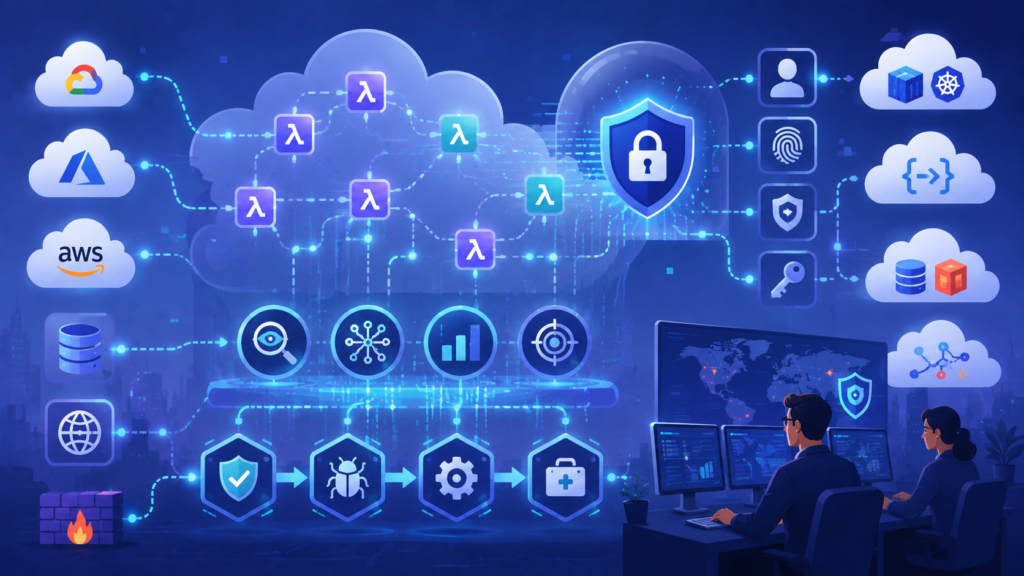
Addressing serverless security monitoring challenges requires a structured approach that improves visibility, access control, threat detection, and incident response. Because serverless workloads are temporary and distributed, organizations need monitoring strategies designed for cloud-native environments.
Choosing the right Cloud Native Security Tools MSSP solutions can help security teams improve visibility across distributed workloads, strengthen monitoring capabilities, and align security controls with modern serverless architectures.
A practical framework should include:
- Visibility Layer: Collect function logs, API activity, application telemetry, configuration changes, and distributed traces.
- Identity Layer: Monitor IAM permissions, function execution roles, and service-to-service access patterns.
- Detection Layer: Correlate security signals to identify unusual function behavior, unexpected access, and suspicious event activity.
- Response Layer: Support investigation through evidence collection, security analytics, and incident workflows.
During cloud security assessments, we often find that MSSPs and their customers have security data available but need better processes to turn it into actionable insights. Through our consulting work, we help MSSPs evaluate and audit security products that improve monitoring capabilities and support stronger serverless security strategies.
FAQ
Why Are Traditional Monitoring Tools Less Effective for Serverless Applications?
Traditional monitoring tools are often designed for persistent workloads such as virtual machines and containers. Serverless applications operate differently because functions are temporary, event-driven, and distributed across multiple cloud services. Without endpoint-based monitoring, security teams must rely on cloud-native telemetry, application logs, identity events, and event tracking to maintain visibility.
What Security Data Should Organizations Monitor in Serverless Environments?
Organizations should monitor security data across function execution, identity activity, API requests, event triggers, application behavior, and configuration changes. Combining these data sources helps security teams correlate events, detect suspicious activity, and investigate incidents more effectively across complex serverless workflows.
How Do Event Triggers Create Security Risks in Serverless Applications?
Event triggers can introduce security risks when unauthorized sources invoke functions or send malicious data through application workflows. Organizations should validate event sources, monitor function invocations, inspect incoming payloads, and ensure permissions are properly configured to reduce exposure from event-driven attacks.
How Do Excessive IAM Permissions Affect Serverless Function Security?
Excessive IAM permissions can increase the impact of a compromised serverless function. When execution roles provide broader access than necessary, attackers may use stolen credentials or exploited functions to access sensitive resources, modify cloud services, or move across connected environments. Regular permission reviews and least privilege controls help reduce these risks.
How Can MSSPs Improve Serverless Security Monitoring Without Adding Tool Complexity?
MSSPs can help organizations evaluate and audit security products, identify visibility gaps, and optimize cloud security stacks without unnecessary tool expansion. Through vendor-neutral assessments, product selection support, PoC evaluation, and architecture reviews, MSSPs can help teams choose solutions that improve monitoring capabilities and align with operational requirements.
How Can Organizations Build Stronger Serverless Security Monitoring Strategies?
The challenge is no longer whether organizations can deploy serverless applications, but whether they can maintain security visibility as these environments continue to evolve. Effective serverless security monitoring requires organizations to move beyond traditional infrastructure-focused approaches and prioritize observability, identity control, telemetry correlation, and continuous security improvement.
Through our consulting work, we help MSSPs evaluate and audit security products, identify monitoring gaps, and optimize security stacks with vendor-neutral recommendations. From product selection and PoC support to architecture reviews and operational improvements, our approach helps MSSPs make informed technology decisions that support scalable cloud security operations.
Learn more about how our consulting services can help strengthen your serverless security strategy and improve security decision-making through MSSP Security Consulting Services.
References
- https://cheatsheetseries.owasp.org/cheatsheets/Serverless_FaaS_Security_Cheat_Sheet.html
- https://learn.microsoft.com/en-us/azure/defender-for-cloud/serverless-protection