

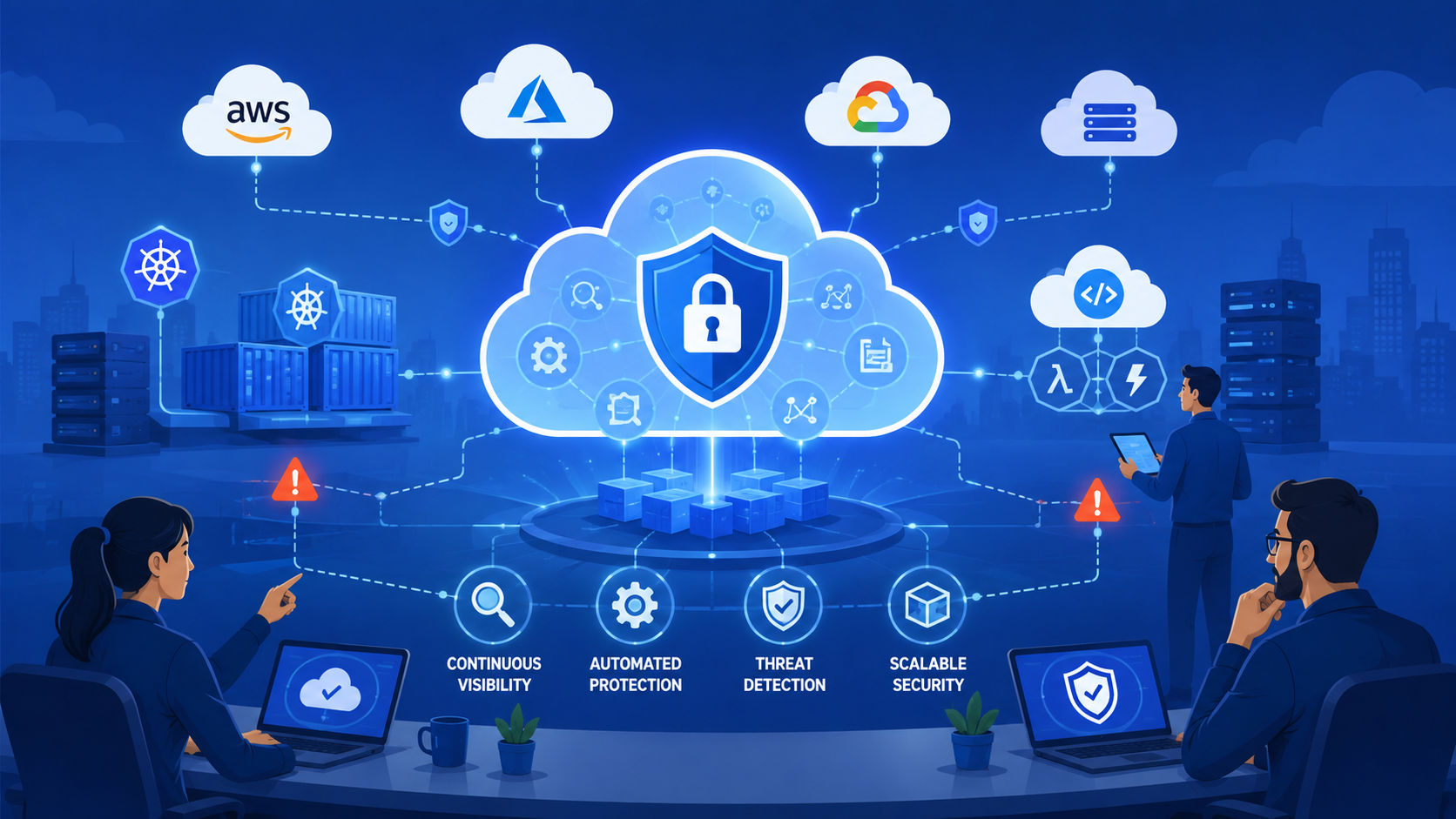
Cloud-native security tools help organizations protect modern cloud environments more effectively than traditional security approaches built for static infrastructure. The benefits cloud native security tools include stronger visibility, better support for dynamic workloads, and security that aligns with cloud operations.
At MSSP Security, we’ve found that the right solution depends on an organization’s architecture, operational priorities, and long-term goals. Keep reading to learn how cloud-native security tools can strengthen security while supporting business growth.
Before You Dive In
Before exploring each section, here’s a quick look at the key outcomes organizations can expect from adopting cloud-native security tools.
- Improve cloud visibility and strengthen cloud security posture across dynamic workloads.
- Reduce operational complexity through automation, centralized security management, and streamlined workflows.
- Support scalable, secure cloud growth by aligning security with business objectives and evolving cloud infrastructure.
Why Are the Benefits of Cloud Native Security Tools Important?
The benefits cloud native security tools become more valuable as organizations adopt containers, Kubernetes, serverless applications, and other cloud-native technologies. Unlike traditional security solutions built for static infrastructure, cloud-native security is designed to support environments that change constantly.
At MSSP Security, we’ve found that successful cloud security is less about choosing the platform with the most features and more about selecting tools that fit an organization’s cloud strategy. As consultants who help MSSPs evaluate and audit security products, we often see stronger results when security aligns with operational needs instead of adding unnecessary complexity. This approach is especially important for organizations evaluating Cloud Native Security Tools MSSP solutions that need to balance security performance, scalability, and operational efficiency.
When assessing cloud-native security solutions, organizations should consider whether they support:
- Dynamic cloud architecture
- Existing operational workflows
- Compliance requirements
- Long-term business objectives
These cloud-native security benefits go beyond protecting workloads. They provide a flexible security foundation that grows with the business and supports modern cloud operations. The following sections explain why use cloud native security, explore key cloud native security advantages, and show how the right approach helps organizations strengthen security over time.
How Can Cloud Native Security Tools Strengthen Cloud Security Posture?
Maintaining a strong cloud security posture requires more than periodic security reviews. As cloud environments evolve, organizations need a way to identify configuration risks before they become security incidents. One of the key benefits cloud native security tools is helping teams continuously assess their cloud environments and address security gaps early.
At MSSP Security, we’ve helped MSSPs evaluate and audit cloud security products, and we’ve found that posture management often starts with understanding what needs attention first. During assessments, it’s common to uncover misconfigured cloud resources, outdated security settings, or workloads that no longer meet internal policies.
Cloud-native security strengthens cloud security posture by helping organizations:
- Discover cloud assets that require security review
- Detect misconfigurations before they increase risk
- Prioritize vulnerabilities based on business impact
- Support proactive vulnerability management throughout the cloud lifecycle
NIST highlights the importance of continuous monitoring strategies to help organizations maintain awareness of security risks and improve risk-based decision-making. As NIST explains:
“The purpose of this guideline is to assist organizations in the development of a continuous monitoring strategy.” – NIST (National Institute of Standards and Technology)
This approach aligns with cloud-native security practices that continuously assess configurations, identify vulnerabilities, and help teams respond to security gaps before they become larger incidents.
Through our experience helping MSSPs evaluate security products, we’ve found that effective posture management depends on matching common cloud security challenges with capabilities that provide continuous assessment, prioritization, and remediation.
| Cloud Security Challenge | How Cloud Native Security Tools Help |
| Misconfigured cloud resources | Continuously identify configuration issues and security gaps across cloud environments |
| Limited asset visibility | Discover cloud assets and workloads that require security assessment |
| Difficulty prioritizing risks | Rank vulnerabilities based on business impact and severity |
| Manual security reviews | Automate posture assessments and support continuous monitoring |
By focusing on posture management instead of reactive fixes, organizations can reduce risk, strengthen data protection and privacy, and build a more secure cloud foundation as their environments continue to grow.
How Do Cloud Native Security Tools Improve Real-Time Threat Detection?

One of the key benefits cloud native security tools is helping organizations detect threats before they escalate into larger security incidents. In cloud environments where workloads change rapidly, delayed detection can give attackers more time to move between systems and access sensitive resources. Early detection allows security teams to respond before the impact becomes more widespread.
At MSSP Security, we’ve learned that effective detection is not measured by the number of alerts a platform generates. As consultants who help MSSPs evaluate and audit security products, we look for solutions that help security teams quickly identify genuine threats and determine which incidents require immediate attention.
This includes evaluating factors such as data collection capabilities, integration requirements, and choosing log collector agent mssp solutions that help collect relevant security data for more accurate threat monitoring.
Strong cloud-native security platforms help organizations:
- Detect suspicious activity earlier
- Prioritize incidents based on business risk
- Reduce dwell time before threats spread
- Accelerate investigation and incident response
When organizations can detect threats sooner and respond with confidence, they reduce unnecessary disruption and strengthen their overall security posture. The next section explores how centralized visibility supports these detection capabilities by giving security teams a broader view of their cloud environments.
How Can Automated Security Controls Simplify Cloud Security?

One of the key benefits cloud native security tools is reducing manual security work through automated security controls. As cloud environments grow, managing policies, workloads, and user permissions manually becomes more difficult and increases the risk of inconsistent security practices.
At MSSP Security, we’ve found that automation is a priority for many organizations evaluating new cloud security solutions. As consultants who help MSSPs select and audit security products, we often see better results when routine security tasks are handled automatically, allowing teams to focus on higher-risk decisions instead of repetitive work.
Cloud-native security platforms help organizations:
- Apply security policies consistently across cloud resources
- Trigger automated remediation workflows when risks are detected
- Prioritize alerts based on business impact
- Reduce alert fatigue by correlating related security findings
Rather than replacing security professionals, automation supports more consistent decision-making and faster responses. Together, these capabilities reduce security complexity while helping organizations maintain stronger protection as their cloud environments continue to evolve.
How Can Cloud Native Security Tools Improve Centralized Cloud Visibility?
One of the key benefits cloud native security tools is providing centralized cloud visibility across complex cloud environments. As organizations expand into multi-cloud and hybrid cloud infrastructures, security information is often spread across multiple platforms, making investigations slower and increasing the risk of missing critical security events.
These challenges managing multi cloud security environments highlight why centralized security platforms are essential for maintaining consistent visibility, improving analysis, and reducing security gaps.
At MSSP Security, we’ve found that organizations make better decisions when security data is connected rather than isolated. As consultants who help MSSPs select and audit security products, we evaluate how effectively a platform delivers a unified view that supports faster analysis instead of forcing teams to switch between multiple tools.
A centralized platform helps organizations:
- Access unified security dashboards from a single interface
- Correlate security findings across multiple cloud environments
- Speed up investigations with shared security insights
- Improve collaboration between security and cloud operations teams
These cloud-native security benefits go beyond convenience. They help organizations investigate incidents more efficiently, reduce blind spots across cloud environments, and make informed security decisions as their infrastructure continues to grow.
Why Are Cloud Native Security Tools Better for Modern Cloud Workloads?
Credit: Cloud Native AI Summit
One of the key benefits cloud native security tools is their ability to protect workloads built for today’s cloud environments. Traditional security solutions were designed for predictable infrastructure, but containers, Kubernetes, serverless applications, and microservices introduce new security challenges as they scale and change over time.
Protecting these workloads often requires capabilities such as:
- Scanning container images before deployment to identify vulnerabilities and configuration issues
- Monitoring container runtime for unexpected processes or privilege escalation (container security benefits)
- Validating Kubernetes policies through admission controls and configuration checks (Kubernetes security tools)
- Applying serverless security controls to event-driven applications
- Securing communication between services in microservices security environments
Through our work at MSSP Security, we’ve learned that protecting modern workloads is not about adding more security products. As consultants who help MSSPs select and audit new security solutions, we focus on whether a platform can secure every stage of the workload lifecycle. We’ve seen organizations reduce deployment risks simply by choosing tools that scan container images before release, enforce Kubernetes policies consistently, and continue protecting workloads after deployment.
These cloud-native security benefits give organizations stronger dynamic infrastructure protection while allowing development teams to release applications faster without losing confidence in their security controls.
How Can Cloud Native Security Tools Support DevSecOps?
One of the key benefits cloud native security tools is helping organizations integrate security into the software development lifecycle instead of treating it as a final checkpoint. As applications are updated more frequently, security needs to fit naturally into development without slowing delivery.
At MSSP Security, we’ve found that organizations gain the most value when security supports developers from the beginning. As consultants who help MSSPs select and audit security products, we evaluate how well a platform works within existing development processes rather than adding extra complexity.
“Cloud native security contrasts with traditional security approaches in that there is a tremendous opportunity to ensure that security is injected throughout these distinct phases instead of book ending the lifecycle with separately managed security informed interventions.” – Cloud Native Computing Foundation (CNCF)
This highlights why cloud-native security tools are valuable for DevSecOps practices, as they allow security controls to become part of the development lifecycle rather than being applied only after applications are deployed.
Cloud-native security helps organizations:
- Integrate security checks into CI/CD pipelines
- Adopt shift-left security by reviewing code and configurations earlier
- Improve early vulnerability detection before deployment
- Apply consistent security standards throughout the development lifecycle
These cloud-native security benefits help development and security teams work toward the same goal. By identifying issues earlier, organizations can release applications more confidently while reducing the risk of vulnerabilities reaching production.
How Can Cloud Native Security Tools Scale as Cloud Environments Grow?
One of the key benefits cloud native security tools is the ability to protect growing cloud environments without sacrificing performance. As organizations expand their applications, workloads, and cloud services, security should scale alongside the infrastructure instead of creating additional management challenges or slowing business operations.
At MSSP Security, we’ve found that scalability is an important factor when helping MSSPs select and audit security products. We evaluate not only how well a platform protects cloud environments today, but also whether it can continue supporting future growth without requiring major architectural changes.
Cloud-native security helps organizations by providing:
- A scalable security architecture that grows with cloud workloads
- Elastic security at cloud scale through automatic resource scaling
- Performance-optimized security with distributed inspection to reduce bottlenecks
- Low-latency threat detection that minimizes the impact on application performance
These cloud-native security benefits enable organizations to expand their cloud infrastructure with confidence, maintaining consistent protection and reliable performance as business needs continue to evolve.
How Can Cloud Native Security Tools Simplify Compliance and Identity Management?
One of the key benefits cloud native security tools is helping organizations maintain compliance and manage user access without relying on time-consuming manual processes. As cloud environments grow, continuous governance becomes more effective than preparing for audits only when deadlines approach.
At MSSP Security, we’ve found that compliance and identity management are common priorities when helping MSSPs select and audit security products. We look for platforms that support ongoing governance while aligning with frameworks such as ISO 27001, SOC 2, PCI DSS, HIPAA, and the NIST Cybersecurity Framework.
Cloud-native security helps organizations:
- Improve compliance alignment through continuous policy validation
- Simplify regulatory reporting with centralized compliance insights
- Strengthen identity governance using fine-grained IAM policies and role-based access control in cloud
- Support simplified encryption and key management to protect sensitive data
These cloud-native security benefits help organizations stay audit-ready, strengthen access controls, and maintain consistent security policies as cloud environments continue to evolve.
How Do Cloud Native Security Tools Create Long-Term Business Value?
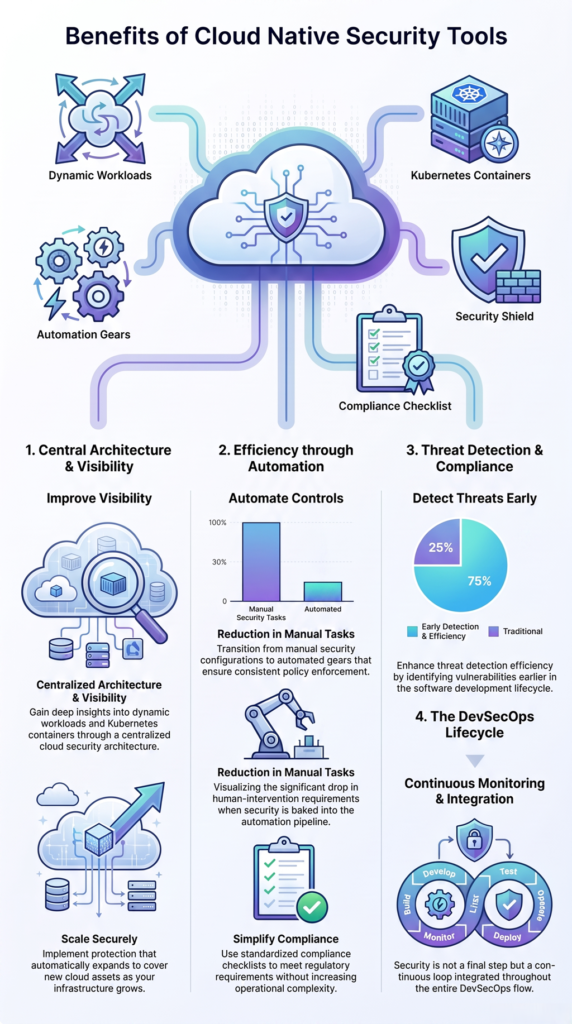
The benefits cloud native security tools extend beyond improving security posture. As organizations scale their cloud environments, they need solutions that support long-term goals, optimize technology investments, and adapt to evolving business needs.
Through our experience at MSSP Security, we help MSSPs evaluate and audit security products based on long-term value, not just features. The right platform should continue delivering benefits as cloud strategies change while reducing unnecessary costs and complexity.
Key cloud-native security benefits include:
- Reducing total cost of ownership (TCO) by minimizing overlapping tools
- Accelerating time to value through easier deployment and adoption
- Supporting secure digital transformation with scalable security solutions
- Building a future-proof security stack that adapts to new cloud requirements
By viewing security as a strategic investment, organizations can improve resilience, increase agility, and create a sustainable cloud security strategy.
FAQ
What Are The Main Benefits Cloud Native Security Tools Provide?
The benefits cloud native security tools include improved cloud visibility, automated security controls, stronger threat detection, simplified compliance, and better protection for modern workloads. These solutions help organizations manage security risks more effectively while supporting scalable cloud growth.
How Do Cloud Native Security Tools Improve Cloud Security Posture?
Cloud-native security tools improve cloud security posture by continuously identifying misconfigurations, assessing vulnerabilities, and prioritizing risks based on business impact. This allows security teams to address weaknesses proactively before they become major security incidents.
Can Cloud Native Security Tools Protect Containers And Kubernetes Environments?
Yes. Cloud-native security tools are designed to support modern workloads such as containers, Kubernetes, serverless applications, and microservices. They help organizations scan vulnerabilities, enforce security policies, and monitor workloads throughout the application lifecycle.
How Do Cloud Native Security Tools Support DevSecOps Practices?
Cloud-native security tools support DevSecOps by integrating security checks into CI/CD pipelines, enabling early vulnerability detection, and helping development teams address security issues before deployment. This creates a faster and more secure software delivery process.
Why Should MSSPs Evaluate Cloud Native Security Tools Carefully?
MSSPs should evaluate cloud-native security tools carefully because the right platform must align with customer environments, operational workflows, and long-term business goals. Vendor-neutral assessment helps MSSPs reduce tool complexity, improve integrations, and deliver stronger security services.
How Can Cloud Native Security Tools Support Long-Term Security Goals?
The benefits cloud native security tools provide go beyond threat protection by improving visibility, automation, compliance, and operational efficiency. These solutions help organizations build a scalable security foundation that adapts to changing cloud requirements while reducing complexity.
At MSSP Security, we help MSSPs evaluate and audit security products through vendor-neutral consulting, stack optimization, and decision support. With 15+ years of experience and 48K+ projects completed, we help businesses select the right tools and create a future-ready security strategy. Explore our MSSP consulting services.
References
- https://csrc.nist.gov/pubs/sp/800/137/final
- https://tag-security.cncf.io/community/resources/security-whitepaper/v2/cloud-native-security-whitepaper/