

Cloud infrastructure vulnerability scanning helps organizations find security weaknesses across cloud workloads, applications, configurations, and network resources before they create exposure. As cloud environments become more complex, security teams need clear visibility into misconfigurations, vulnerable assets, and potential attack paths.
At MSSP Security, we help organizations review their cloud security posture, identify areas of improvement, and prioritize risks based on business impact. A practical security approach combines continuous assessment, proper remediation, and ongoing monitoring to maintain stronger cloud protection.
Keep reading to understand how cloud infrastructure vulnerability scanning works and why it matters for modern environments.
What Should You Know About Cloud Infrastructure Scanning?
Cloud security assessments help organizations identify risks, improve visibility, and maintain better control over modern cloud environments.
- Cloud infrastructure vulnerability scanning helps detect weaknesses across workloads, configurations, applications, and cloud resources before they can be exploited.
- Effective cloud security requires continuous monitoring, risk prioritization, and structured remediation processes.
- MSSP Security helps organizations evaluate cloud risks and develop practical strategies to improve infrastructure security.
What Is Cloud Infrastructure Vulnerability Scanning?
Cloud infrastructure vulnerability scanning helps organizations find and understand security weaknesses across cloud workloads, applications, networks, configurations, and connected resources. As cloud environments become more complex, security teams often need deeper visibility into risks such as exposed services, insecure APIs, misconfigured resources, and vulnerable assets that may be overlooked during daily operations.
A proper assessment goes beyond identifying technical issues. It helps security teams review areas such as:
- Software weaknesses, outdated components, and potential exposure points
- Cloud configurations, access controls, and security settings
- Publicly accessible resources and possible attack paths
- Security requirements and compliance considerations
“The purpose of this document is to assist organizations in planning and conducting technical information security tests and examinations, analyzing findings, and developing mitigation strategies.” – National Institute of Standards and Technology (NIST)
This highlights that effective security assessments should not stop at vulnerability discovery. Organizations also need to analyze findings, understand their impact, and develop practical mitigation strategies to reduce security risks across their cloud environments.
Organizations that want a deeper understanding of Vulnerability Scanner Technology Explained can better evaluate how different scanning technologies identify weaknesses across cloud workloads and infrastructure.
In our experience supporting MSSPs, we have seen that choosing the right security solutions and validating their capabilities can directly impact the quality of cloud assessments delivered to customers. Our consulting approach helps MSSPs evaluate and audit security products, ensuring selected technologies align with operational needs and assessment goals.
Through cloud infrastructure security scanning and structured vulnerability management practices, organizations can improve their cloud security posture assessment, identify security gaps, and prioritize remediation efforts. We work alongside MSSPs to help them make informed technology decisions and strengthen the security services they provide to their clients.
How Cloud Infrastructure Vulnerability Scanning Works Across Modern Cloud Environments?
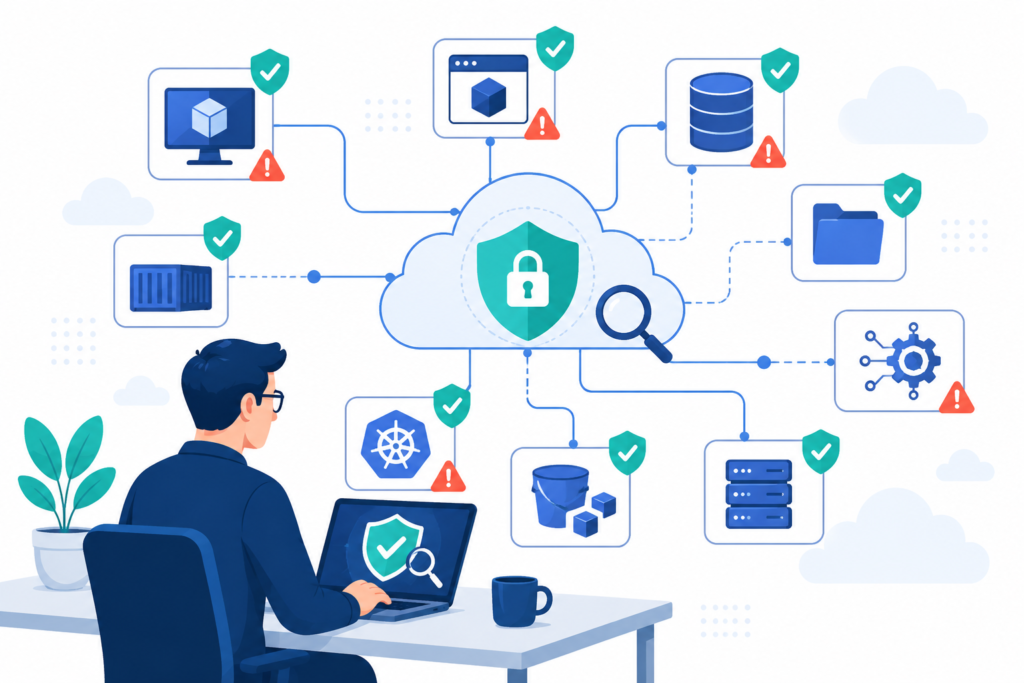
Cloud infrastructure vulnerability scanning helps organizations gain visibility into their cloud assets, identify security weaknesses, evaluate risks, and plan remediation efforts as their environments change. The process typically begins with asset discovery, where security teams map resources such as virtual machines, applications, containers, databases, APIs, and storage services to understand their exposure.
Understanding how vulnerability scanners work helps security teams see how asset discovery, vulnerability detection, risk analysis, and remediation planning work together to support continuous cloud security.
Because modern cloud environments are constantly evolving, security teams need approaches that can adapt to frequent workload and configuration changes. Cloud-native vulnerability scanning helps maintain visibility across areas such as:
- Newly deployed workloads and cloud resources
- Changes to the organization’s attack surface
- Configuration drift and overlooked security gaps
- Emerging risks that may impact critical systems
Automation can make the assessment process more efficient by helping teams identify assets, detect vulnerabilities, prioritize findings, generate reports, and monitor remediation progress. However, our experience shows that automated results still require expert review to determine business impact and select the most suitable security response.
At MSSP Security, we work with MSSPs to evaluate and audit security products before they are introduced into their service offerings. Our consulting approach helps teams assess technology capabilities, validate product effectiveness, and choose solutions that support accurate assessments and better security outcomes for their clients.
What Types of Cloud Assets Are Covered by Vulnerability Scanning?
Cloud environments contain interconnected assets, and each component can introduce different security risks. Effective assessments should evaluate more than servers by reviewing workloads, applications, databases, containers, and supporting infrastructure. Cloud workload vulnerability scanning helps identify weaknesses across resources such as virtual machines, cloud-native applications, and critical services.
The table below summarizes the primary cloud assets commonly included in vulnerability assessments and the security risks associated with each one.
| Cloud Asset | Common Security Risks | Assessment Focus |
| Virtual Machines (VMs) | Missing patches, outdated operating systems, exposed services | VM vulnerability scanning in cloud environments |
| Cloud Hosts & Operating Systems | Weak configurations, unsupported OS versions, security gaps | Cloud host vulnerability scanning and cloud OS vulnerability scanning |
| Cloud Applications | Insecure components, authentication flaws, API vulnerabilities | Cloud application vulnerability scanning |
| Databases & Middleware | Weak access controls, insecure connections, outdated software | Cloud database vulnerability scanning and cloud middleware vulnerability scanning |
| Cloud-Native Applications | Application-layer vulnerabilities, insecure APIs, authentication issues, internet-facing exposure | Web application vulnerability scanners alongside cloud infrastructure vulnerability scanning |
For cloud-native applications, web application vulnerability scanners provide additional visibility into application-layer weaknesses, insecure APIs, authentication issues, and other internet-facing security risks, complementing broader cloud infrastructure vulnerability scanning.
From our experience, organizations often secure their primary applications but overlook supporting assets. At MSSP Security, we help MSSPs evaluate security products and assessment capabilities to improve visibility across complex cloud environments.
What Cloud Platforms Are Covered by Vulnerability Scanning?
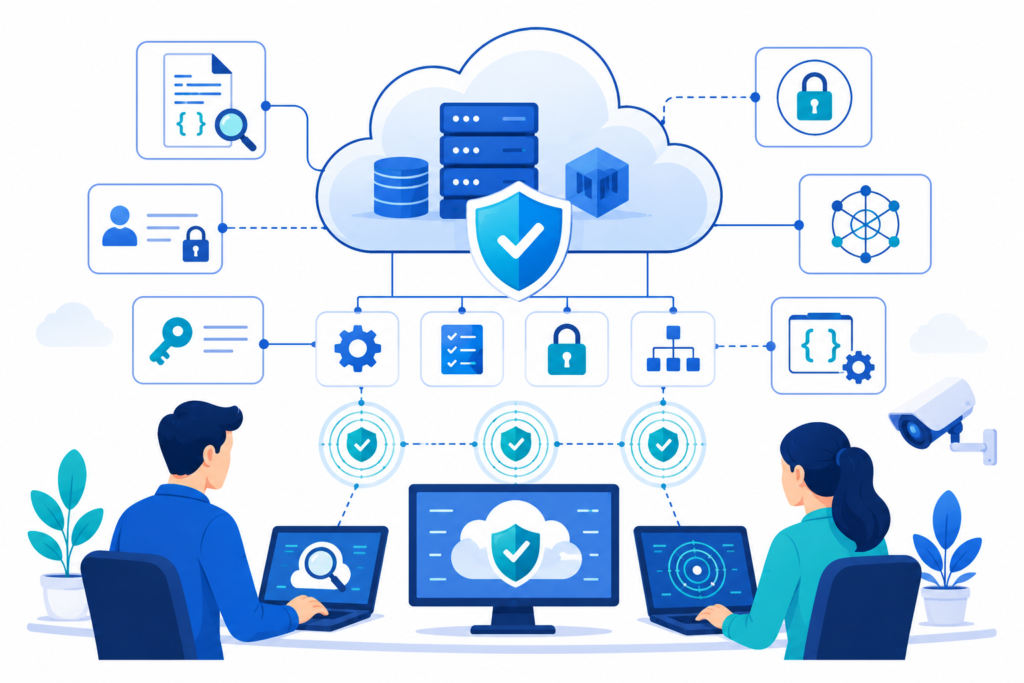
Managing security across multiple cloud platforms can be challenging because each environment has different architectures, configurations, and control requirements. Cloud infrastructure vulnerability scanning helps security teams evaluate risks across workloads, applications, resources, and configurations while maintaining a consistent approach to security assessment.
Cloud security assessments can cover various platforms, including:
- AWS cloud vulnerability scanning to review workloads, storage exposure, network access, and resource configurations
- Azure cloud vulnerability scanning to assess virtual workloads, applications, identity settings, and security controls
- Google Cloud vulnerability scanning to identify workload risks, configuration issues, and exposed resources
- OCI vulnerability scanning to evaluate compute resources, cloud configurations, applications, and network security settings
For organizations operating across multiple providers, multi-cloud vulnerability scanning helps identify inconsistent policies, security gaps, and remediation challenges that may appear between environments.
In our experience supporting MSSPs, selecting the right security technology requires more than comparing features. We help teams evaluate and audit security products to ensure their chosen solutions provide accurate visibility, reliable assessment capabilities, and the functionality needed to support their customers’ cloud security services.
How Do Cloud Network, Container, and Kubernetes Assessments Identify Security Risks?
Modern cloud environments are built on more than traditional servers. Containers, Kubernetes clusters, APIs, and distributed network architectures now support critical applications, which creates more areas for security teams to monitor.
As these components become increasingly connected, having clear visibility into potential exposure points becomes essential.
Cloud network vulnerability scanning and workload assessments help security teams identify risks across different parts of the environment, including:
- Exposed services, open ports, and accessible resources
- Network configuration issues and weak security settings
- Insecure communication paths between systems
- Unnecessary public access and internal network risks
External cloud vulnerability scanning provides insight into resources that attackers can access from outside, such as public applications, APIs, and cloud services. Meanwhile, internal cloud vulnerability scanning helps identify weaknesses within private environments that may become risky after unauthorized access.
Through cloud attack surface scanning, teams can discover potential entry points across applications, storage resources, virtual machines, containers, and third-party integrations. From our experience working with MSSPs, many security gaps come from overlooked exposure or configuration changes rather than sophisticated attacks.
At MSSP Security, we help MSSPs evaluate and audit security products to ensure the solutions they select provide accurate visibility, reliable assessments, and the capabilities needed to support their customers’ cloud security requirements.
How Do Container and Kubernetes Assessments Help Secure Cloud Environments?
Containers and Kubernetes have become core technologies for building and running modern applications. They give development teams more flexibility when deploying and scaling services, but they also introduce new security considerations across images, workloads, and runtime environments.
Container vulnerability scanning helps teams identify potential weaknesses before applications move into production, including:
- Vulnerable software packages and outdated dependencies
- Insecure container images and exposed components
- Weak runtime configurations
- Embedded secrets or sensitive data exposure
Regular assessments allow security teams to detect issues earlier and reduce the chance of vulnerable components becoming part of production environments.
Kubernetes vulnerability scanning focuses on reviewing security risks across clusters, workloads, and configurations. Common assessment areas include:
- Kubernetes cluster configurations
- Container workload security
- Access permissions
- Network policies
- Deployment settings
Based on our experience working with MSSPs, Kubernetes security works best when it is evaluated as part of a broader cloud security approach rather than as an isolated check. At MSSP Security, we help MSSPs assess and audit security products to ensure the solutions they select provide the right visibility, validation capabilities, and support for delivering stronger container and Kubernetes security services to their customers.
How Does Cloud Configuration Scanning Help Detect Security Risks?
Cloud configuration vulnerability scanning helps organizations identify security risks caused by misconfigurations, weak settings, excessive permissions, and improper access controls. Unlike traditional vulnerability assessments that mainly focus on software issues, cloud configuration scanning reviews cloud resources, security settings, network configurations, and compliance requirements to improve overall cloud security posture.
“Organizations that do not use industry standards to harden their environments leave themselves open to cyber-attacks and misconfiguration.” – Center for Internet Security (CIS)
This reinforces the need for security benchmarks, such as CIS benchmark cloud scanning and NIST cloud vulnerability scanning, to identify configuration weaknesses before they create exposure.
Cloud security baseline scanning helps organizations review key areas, including:
- Access controls and user permissions
- Encryption settings and security policies
- Monitoring practices and infrastructure configurations
By combining cloud misconfiguration scanning with CSPM and vulnerability scanning, organizations can improve visibility, prioritize risks, and strengthen cloud infrastructure protection. At MSSP Security, we help MSSPs evaluate security products to ensure they provide accurate configuration assessments and support stronger cloud security services.
What Are Advanced Cloud Scanning Methods for Modern Development Environments?
Cloud environments are constantly evolving as organizations release new applications, update workloads, and adjust infrastructure to meet business needs. Because of these changes, security teams need scanning approaches that provide ongoing visibility rather than relying only on periodic assessments.
Advanced cloud scanning methods help organizations identify risks earlier, improve vulnerability management processes, and integrate security checks into development and operational workflows.
When evaluating cloud vulnerability assessment approaches, teams usually consider two options: agentless and agent-based cloud vulnerability scanning.
Agentless cloud vulnerability scanning reviews cloud resources without requiring agents to be installed on individual systems. This approach can be useful for large or fast-changing environments where teams need broader visibility with minimal deployment effort. Common advantages include:
- Faster deployment across cloud environments
- Lower infrastructure overhead
- Wider visibility into cloud resources
- Easier assessment of temporary workloads
Agent-based cloud vulnerability scanning uses installed agents to collect more detailed information from workloads and systems. This method can provide deeper insights into:
- Operating system details
- Installed software components
- Runtime activities
- Local security configurations
Based on our experience supporting MSSPs, we have seen that the best scanning approach depends on the environment, service requirements, and customer expectations. At MSSP Security, we help MSSPs evaluate and audit security products to determine whether a solution delivers the right level of visibility, accuracy, and operational value before adding it to their security portfolio.
How Does IaC Vulnerability Scanning Improve Cloud Infrastructure Security?
Infrastructure as Code (IaC) has become a common way for organizations to build and manage cloud environments faster and more consistently. However, the same templates that simplify deployment can also introduce security issues if they contain weak configurations or improper settings.
IaC vulnerability scanning helps security teams review infrastructure code before resources are created. By identifying risks early in the development process, teams can address issues before they reach production environments. Common findings include:
- Insecure cloud configurations
- Excessive permissions and access rights
- Missing encryption settings
- Weak network controls
- Infrastructure definitions that do not meet security requirements
Terraform cloud vulnerability scanning helps organizations evaluate Terraform configurations for potential risks before changes are applied. This shift-left approach allows teams to reduce remediation efforts and avoid repeating security fixes after deployment.
In our experience supporting MSSPs, the effectiveness of IaC security depends not only on the scanning technology but also on how well it fits into existing workflows. We help MSSPs evaluate and audit security products to understand their capabilities, validate their performance, and select solutions that provide meaningful visibility across modern cloud environments.
How Does CI/CD Scanning Support DevSecOps and Secure Development?
Software teams move quickly to deliver new features, but faster release cycles can also create security challenges when vulnerability checks are delayed until the final stages. CI/CD cloud vulnerability scanning helps bring security reviews into the development pipeline, allowing teams to identify issues while changes are still being built and tested.
By integrating scanning into CI/CD workflows, organizations can:
- Detect vulnerabilities earlier in the development process
- Reduce risks before applications reach production
- Improve collaboration between development and security teams
- Maintain more consistent security checks during releases
DevSecOps cloud vulnerability scanning takes this approach further by making security part of the entire development lifecycle. Instead of relying on security teams to review applications at the end, developers and security professionals work together to identify and address risks throughout planning, coding, testing, and deployment.
Shift-left cloud vulnerability scanning supports this model by moving security testing earlier, helping teams achieve:
- Faster vulnerability remediation
- Lower effort when fixing security issues
- Greater developer awareness
- Improved application security practices
Through our work with MSSPs, we have seen that security programs are more effective when the right processes and technologies work together. At MSSP Security, we help MSSPs evaluate and audit security products to determine whether solutions align with their DevSecOps requirements, service models, and the security needs of their customers.
How Do Cloud API and Serverless Assessments Identify Security Risks?
Cloud applications increasingly depend on APIs and serverless architectures to support faster development and flexible scaling. While these technologies help organizations build more efficient services, they also introduce new security considerations that require proper visibility and assessment.
Cloud API vulnerability scanning helps teams identify weaknesses within application interfaces, including:
- Improper authentication and authorization controls
- Data exposure risks
- Insecure endpoints
- Excessive permissions
Since APIs often connect multiple systems, applications, and users, a single security gap can create wider exposure across the environment.
Serverless vulnerability scanning focuses on reviewing risks within serverless functions and their supporting components. Security teams typically assess:
- Function configurations
- Dependency vulnerabilities
- Access permissions
- Runtime security settings
- Event triggers
In our experience working with MSSPs, cloud security products need to provide accurate visibility across fast-changing environments rather than only identify isolated issues. At MSSP Security, we help MSSPs evaluate and audit security solutions to ensure the products they select can support effective assessments, improve risk visibility, and meet the security requirements of their customers.
How Does Cloud Vulnerability Management Improve Security Outcomes?
Finding vulnerabilities is only one part of maintaining cloud security. Organizations also need to understand which findings require immediate attention, assign the right priorities, and track whether remediation efforts are actually reducing risk.
A complete vulnerability management process typically covers:
- Cloud vulnerability discovery and detection
- Risk evaluation and prioritization
- Remediation planning and tracking
- Continuous security monitoring
Cloud vulnerability detection tools help teams identify weaknesses across workloads, applications, and configurations. However, the number of findings can quickly become difficult to manage.
Risk-based cloud vulnerability scanning helps security teams focus on issues based on factors such as severity, asset importance, exposure level, and potential business impact. This approach also supports cloud zero-day vulnerability detection and patch management scanning by improving response to emerging threats.
From our experience supporting MSSPs, effective vulnerability management depends on having the right technology and assessment process in place.
At MSSP Security, we help MSSPs evaluate and audit security products, ensuring selected solutions provide useful reports, dashboards, and remediation tracking capabilities that help their customers turn findings into measurable security improvements.
What Are the Best Practices for Choosing Cloud Vulnerability Scanning Tools?
Credit: Cloud Stack Studio
Selecting cloud vulnerability scanning tools involves more than reviewing features or technical specifications. Organizations need solutions that fit their cloud architecture, security processes, compliance requirements, and the way their teams operate.
A practical cloud vulnerability scanning strategy should focus on areas such as:
- Maintaining continuous visibility as workloads, applications, and configurations change
- Integrating security findings with existing workflows for reporting and remediation
- Using automation to improve efficiency without removing the need for expert analysis
Cloud vulnerability scanning automation can help security teams reduce repetitive tasks and identify issues faster. However, automated results still require human review to determine risk levels, business impact, and the most suitable remediation steps.
In our experience working with MSSPs, many challenges come from selecting security products that look capable but do not fully match operational requirements. We help MSSPs evaluate and audit security solutions to understand product capabilities, validate performance, and select technologies that support their customers’ security needs.
For enterprise cloud vulnerability scanning, a successful approach requires repeatable processes, clear priorities, and tools that provide meaningful visibility. At MSSP Security, we support MSSPs in making informed technology decisions that improve assessment quality and strengthen their security services.
How Can Continuous Vulnerability Management Strengthen Cloud Security?
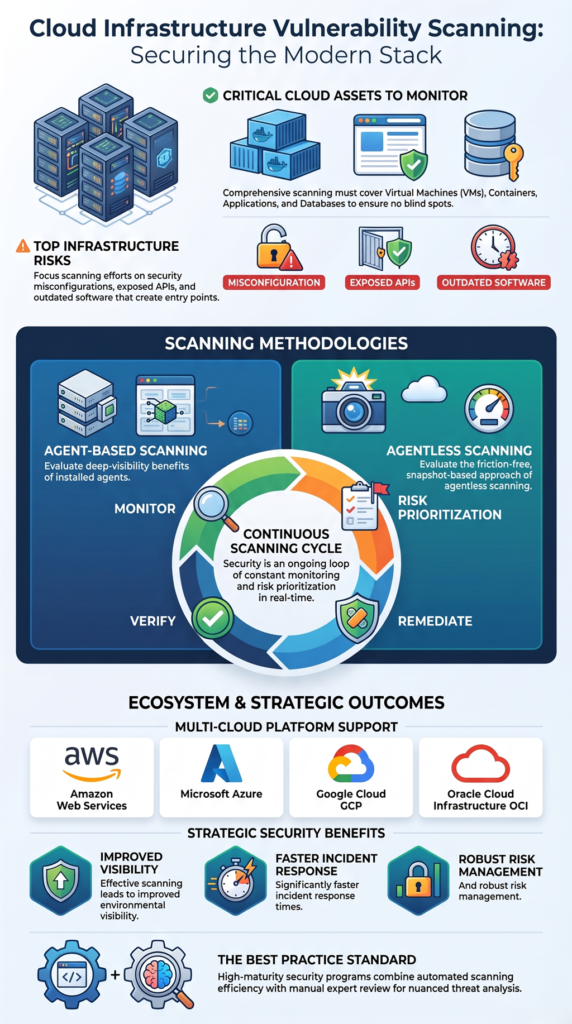
Cloud infrastructure vulnerability scanning has become an important part of maintaining security visibility across modern cloud environments. As organizations continue adopting cloud services, they need better ways to understand vulnerabilities, configuration issues, workload risks, and changes across their attack surface.
A strong cloud vulnerability management program typically brings together:
- Continuous monitoring of cloud assets and security changes
- Risk-based prioritization to focus on the most important issues
- Configuration assessments to identify security gaps
- Compliance alignment with industry requirements
- Remediation tracking to measure progress
- Security expertise to support better decisions
Cloud security requires ongoing attention because environments are constantly changing. New applications, workloads, and configurations can introduce risks that were not present during the initial deployment.
Through our work with MSSPs, we have seen that effective vulnerability management depends on more than finding security issues. Organizations need reliable processes and well-evaluated technologies to understand findings and take the right actions.
At MSSP Security, we help MSSPs evaluate and audit security products to ensure the solutions they choose provide meaningful visibility, support accurate assessments, and help their customers improve cloud security over the long term.
FAQ
What is cloud infrastructure vulnerability scanning?
Cloud infrastructure vulnerability scanning is a security process used to identify weaknesses across cloud workloads, applications, configurations, networks, and connected resources. It helps organizations discover vulnerabilities, misconfigurations, exposed services, and potential attack paths before they create larger security risks.
How is cloud infrastructure vulnerability scanning different from traditional vulnerability scanning?
Traditional vulnerability scanning mainly focuses on software weaknesses and outdated systems. Cloud infrastructure vulnerability scanning goes further by evaluating cloud-specific risks, including misconfigured resources, access controls, exposed assets, APIs, workloads, and security posture issues across dynamic cloud environments.
What types of cloud assets can be evaluated through vulnerability scanning?
Cloud vulnerability scanning can assess various assets, including virtual machines, cloud workloads, containers, Kubernetes environments, applications, databases, APIs, storage resources, and infrastructure configurations. The goal is to provide broader visibility across the entire cloud environment.
Why is continuous cloud vulnerability scanning important?
Cloud environments change frequently as organizations deploy new applications, modify configurations, and scale resources. Continuous cloud vulnerability scanning helps security teams detect new risks, monitor changes, maintain visibility, and respond to vulnerabilities before they become significant security issues.
How can MSSP Security help with cloud vulnerability scanning solutions?
MSSP Security helps MSSPs evaluate and audit security products before integrating them into their services. Our approach focuses on reviewing product capabilities, validating assessment quality, and helping MSSPs select solutions that provide accurate visibility, effective risk prioritization, and better security outcomes for their customers.
How Can Cloud Infrastructure Vulnerability Scanning Strengthen Security?
Cloud infrastructure vulnerability scanning helps organizations identify security weaknesses, improve visibility across cloud assets, and prioritize risks before they affect critical operations. As cloud environments continue to change, effective protection requires continuous monitoring, accurate assessments, and practical remediation strategies.
Through our experience supporting MSSPs, we understand the importance of selecting and auditing security products that provide meaningful insights. At MSSP Security, we help MSSPs evaluate solutions, optimize security tools, and improve assessment capabilities through vendor-neutral consulting and product guidance. Learn how MSSP Security can support better technology decisions and stronger security services.
References
- https://csrc.nist.gov/pubs/sp/800/115/final
- https://www.cisecurity.org/insights/blog/foundational-cloud-security-with-cis-benchmarks