

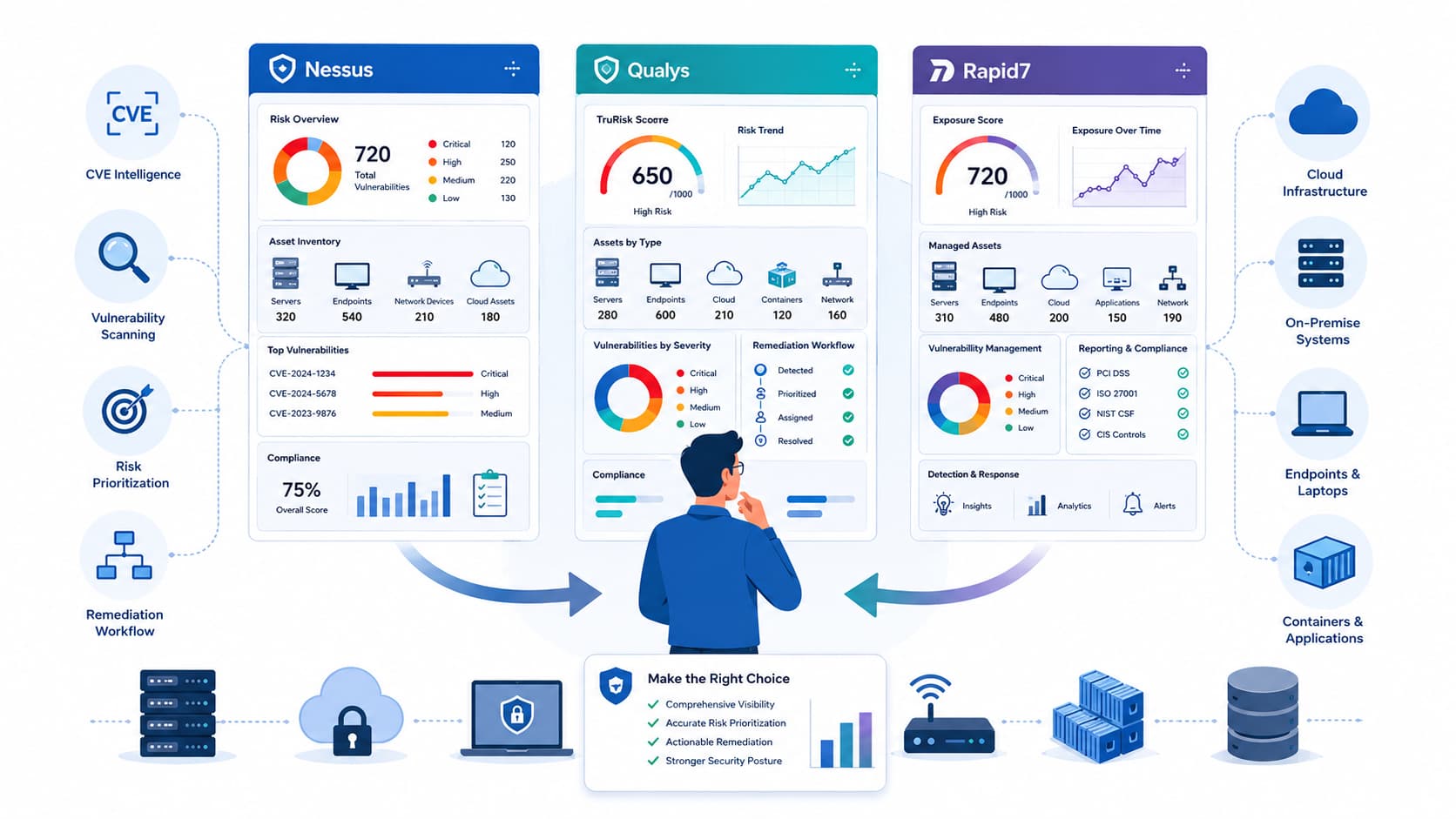
Choosing between Tenable, Qualys, and Rapid7 is a common challenge for security teams. The best platform depends less on feature count and more on how well it fits your environment, workflows, and long-term security objectives.
A manufacturing organization with legacy OT has very different needs from a cloud-native business focused on DevSecOps.
At MSSP Security, we help organizations evaluate vulnerability management platforms based on operational requirements, existing infrastructure, and business goals. To see where each platform performs best and the tradeoffs to consider, keep reading.
Your Vulnerability Management Decision in 60 Seconds
- This comparison shows that the best vulnerability management platform is the one that aligns with your security operations, infrastructure, and long-term goals.
- Match the platform to your environment. Choose Tenable for deep visibility and OT environments, Qualys VMDR for cloud-native operations with integrated patch management, or Rapid7 InsightVM for exploit-focused remediation and DevSecOps workflows.
- Validate with a proof of concept. Test each platform using your own assets, integrations, and remediation processes instead of relying solely on feature comparisons or vendor demonstrations.
Think beyond licensing costs. Consider implementation effort, staffing, integrations, reporting, and long-term operational overhead to identify the platform that delivers the best overall value.
Why are Tenable, Qualys, and Rapid7 compared so often?
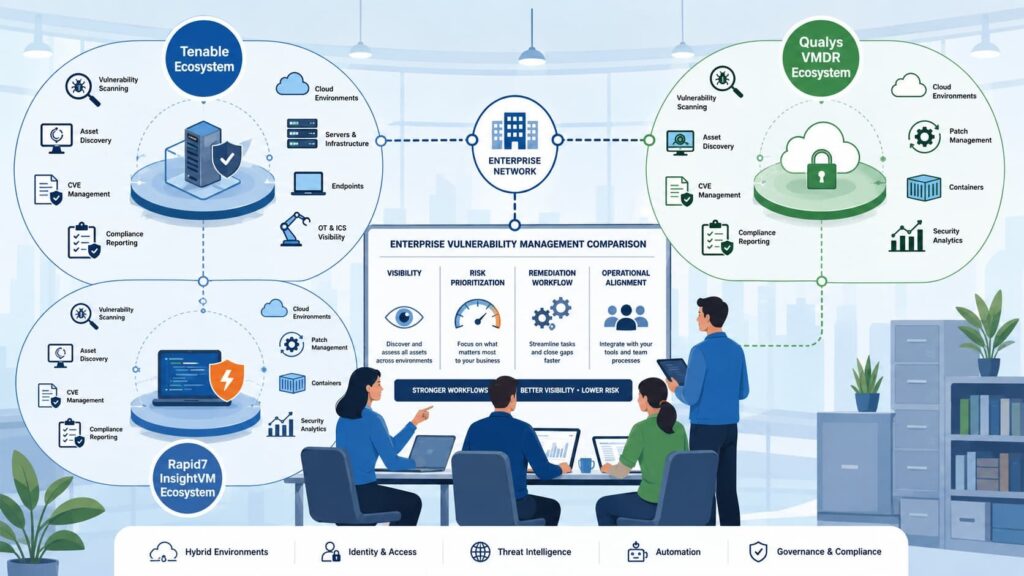
Tenable, Qualys VMDR, and Rapid7 InsightVM are frequently evaluated together because they solve the same core problem: helping organizations continuously identify, prioritize, and remediate vulnerabilities across complex IT environments.
Although all three platforms provide enterprise vulnerability management, they differ significantly in deployment models, risk prioritization, integrations, and operational workflows, while also taking different approaches to vulnerability scanner technology across enterprise environments.
Before selecting a platform, consider:
- Integration with ticketing systems and security workflows.
- Required compliance reporting and audit support.
- Coverage across cloud, hybrid, and on-premises environments.
- Available security staff to validate and remediate findings.
These platforms also align with the industry’s shift toward continuous threat exposure management (CTEM), where organizations prioritize vulnerabilities based on real business risk instead of simply counting CVEs.
- While they share many core capabilities, each emphasizes a different strength:
- Nessus (Tenable): Deep visibility into attack surface exposure.
- Qualys VMDR: Cloud-native vulnerability management with centralized operations.
- Rapid7 InsightVM: Risk-based prioritization and remediation guidance.
The most effective implementation is the one that fits existing operational processes. A platform that integrates smoothly with current workflows typically delivers faster remediation, higher adoption, and better long-term security outcomes than one requiring major process changes.
Which platform offers the deepest vulnerability coverage?
Tenable is widely recognized for its broad vulnerability coverage, particularly in complex enterprise environments that include legacy systems, network appliances, and operational technology (OT).
Its extensive plugin library helps identify vulnerabilities across a wide range of operating systems, firmware versions, and specialized devices, making it well suited to organizations with diverse infrastructures.
However, detection quality depends on far more than the size of a vulnerability database. Understanding how vulnerability scanners work also explains why a scanner can only assess assets it is able to access.
Without authenticated credentials, scans are generally limited to externally visible services, while unmanaged devices or shadow IT assets remain invisible regardless of the platform being used.
Strong vulnerability detection depends on several operational practices, including:
- Authenticated scanning to identify vulnerabilities beyond externally visible services.
- Accurate asset inventory to ensure all managed and unmanaged systems are assessed.
- Regular scan validation to verify coverage and reduce blind spots.
- Consistent remediation workflows to ensure identified vulnerabilities are addressed promptly. Each platform offers different strengths.
Tenable provides deep coverage for legacy, OT, and heterogeneous environments, Qualys VMDR emphasizes visibility across cloud and hybrid infrastructures, while Rapid7 InsightVM focuses on risk-based prioritization with strong DevSecOps integration.
How accurate are real-world scans?
Real-world detection quality depends far more on deployment quality than marketing statistics. Across enterprise vulnerability management engagements, organizations commonly encounter inconsistent credential management, fragmented network segmentation, incomplete authenticated scanning, and unmanaged assets during initial deployments.
These operational factors typically have a much greater impact on detection quality than the vulnerability scanner itself. Detection accuracy improves through:
- Credentialed scans
- Proper asset classification
- Scanner placement
- Network segmentation validation
Authentication remains one of the biggest performance multipliers available to security teams.
What do independent benchmarks show?
When we looked closely at independent laboratory benchmarks alongside our own internal testing data, a clear pattern emerged: a 5% advantage in a vendor’s published CVE database rarely translates to a 5% increase in real-world detections.
In practice, detection rates fluctuate wildly based on how a scanner handles edge cases like local privilege checks on obscure Linux distributions.
Don’t buy a platform based on a marketing spreadsheet boasting the largest plugin count; buy based on how accurately the scanner validates a vulnerability without knocking over a fragile legacy server
These findings reinforce a practical lesson for security teams: deployment quality matters more than database size.
Organizations that properly configure authentication, maintain accurate asset inventories, and optimize scanner placement generally achieve more reliable vulnerability detection than those relying solely on extensive plugin libraries.
How do their risk scoring models differ?
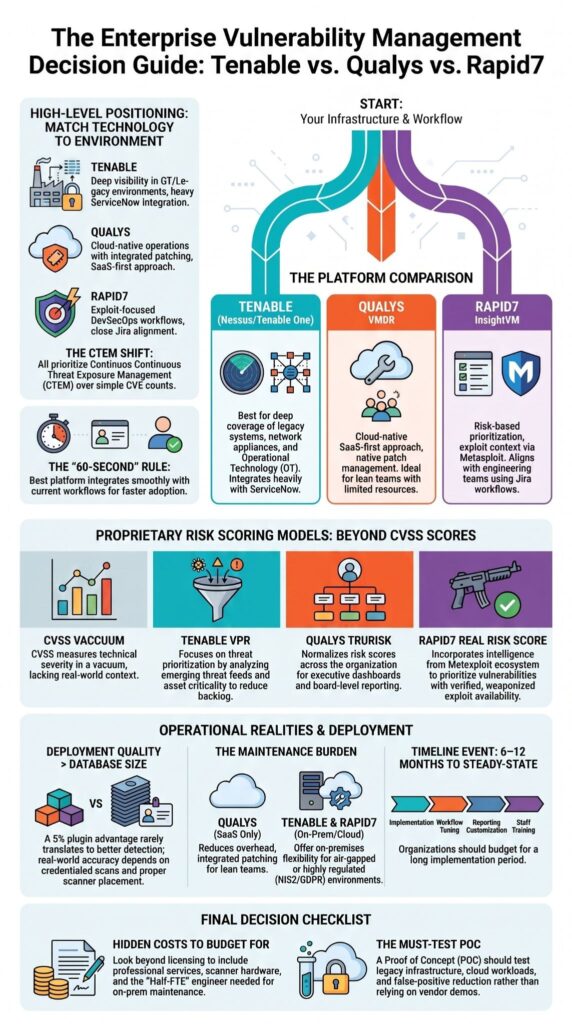
All three platforms extend CVSS with contextual intelligence that improves vulnerability prioritization. If your remediation team is still blindly chasing CVSS 9.0+ scores, you are burning your engineer’s time on theoretical risks.
A CVSS score measures technical severity in a vacuum, completely oblivious to whether a weaponized exploit code is actively circulating on GitHub. That is why these platforms have built proprietary filters.
Tenable’s VPR looks closely at emerging threat feeds, Qualys’s TruRisk normalizes scores for C-suite reporting, and Rapid7’s Real Risk Score pulls direct validation from their Metasploit ecosystem to tell you if a script kiddie can actually breach your perimeter tomorrow.
Research from Computers & Security:
“The resulting non-uniformity reduces comparability, complicates automation, and increases decision risk. Security teams lack clarity on which score should be treated as ‘authoritative’: legacy v2.0, the widely deployed v3.1, or the latest v4.0. The consequences include: constrained automation pipelines that struggle with mixed versions and gaps; policy ambiguity with fixed thresholds that can yield divergent worklists across versions; and broken comparability time series that may reflect specification changes rather than true risk dynamics.” – Computers & Security
| Platform | Risk model | Best suited for |
| Tenable | VPR | Threat prioritization |
| Qualys | TruRisk | Executive reporting |
| Rapid7 | Real Risk Score | Exploit-driven remediation |
Which score helps security teams most?
Each scoring model emphasizes different operational objectives. VPR incorporates exploit availability, threat intelligence, and asset criticality to reduce vulnerability backlog noise.
Qualys TruRisk produces normalized organizational risk scores designed for executive dashboards and board reporting. Rapid7 Real Risk Score incorporates intelligence from Rapid7 Metasploit, allowing organizations to prioritize vulnerabilities with verified exploit availability.
As noted by IEEE Xplore:
“The Common Vulnerability Scoring System (CVSS) remains the industry standard for initial risk assessment; however, empirical evidence highlights its limitations. Numerous vulnerabilities labeled as ‘Critical’ are never exploited, while high-impact security incidents have originated from vulnerabilities initially scored as ‘Medium’ or ‘High’. This discrepancy underscores a critical need for more nuanced and dynamic risk prioritization mechanisms.” – IEEE Xplore
These contextual models support:
- Better remediation SLA performance
- Lower false positive reduction effort
- Stronger KPI tracking
- Improved executive dashboards
Which platform makes remediation easier?
Qualys VMDR offers the most integrated remediation workflow because native patch management is included within the platform.
Scanning alone does not improve security posture. Vulnerabilities only become less risky after remediation is completed, validated, and tracked through the entire vulnerability lifecycle.
According to the NIST Cybersecurity Framework, identifying weaknesses is only one part of an effective cybersecurity assessment. Organizations also need repeatable remediation workflows and measurable outcomes.
In enterprise environments, the largest implementation challenge is rarely the vulnerability scanner itself. More often, organizations struggle to coordinate infrastructure teams, application owners, security operations, and compliance stakeholders while maintaining realistic remediation SLAs.
Teams with well-defined governance and remediation workflows generally reduce vulnerability backlogs more effectively than those relying primarily on scanner reports.
Native capabilities vary considerably.
- Qualys VMDR provides integrated/connected patching workflows and orchestration options (varies by module/environment).
- Automated deployment workflows reduce manual effort.
- Compliance automation benefits from centralized management.
That built-in approach reduces the need for separate orchestration projects, particularly for organizations with lean IT teams.
How do Tenable and Rapid7 compare?
Both platforms depend more heavily on integrations than native patching. Tenable Security Center, Tenable.io, and Tenable One integrate well with ServiceNow, making them attractive for enterprises already using structured ITSM ticketing and governance.
Rapid7 InsightVM emphasizes engineering workflows (e.g., Jira) and exploit context via Metasploit integration, helping DevSecOps teams synchronize remediation tasks directly with engineering workflows.
Organizations already invested in Rapid7 InsightIDR or Rapid7 Metasploit may also benefit from tighter operational alignment.
Ultimately, remediation success depends more on disciplined workflows than feature lists. Even the best platform cannot compensate for unclear ownership or inconsistent patch management processes.
Which deployment model reduces operational overhead?
From a pure maintenance standpoint, I usually steer lean operational teams toward Qualys VMDR simply because it is a true cloud-native SaaS.
You don’t have to dedicate a half-FTE (Full-Time Equivalent) engineer just to patch, database-tune, and maintain the scanning infrastructure itself.
On the flip side, if you are working within an air-gapped federal environment or bound by aggressive data-residency laws under NIS2, you will likely need the heavy, self-hosted deployment flexibility that Tenable Security Center or Rapid7 Nexpose provides just make sure you budget for the hardware and engineering hours required to keep them alive.
| Platform | Deployment model |
| Qualys VMDR | SaaS only |
| Tenable | Cloud or on-premises |
| Rapid7 InsightVM | Cloud-managed |
| Rapid7 Nexpose | Legacy on-premises |
Organizations operating under ISO 27001, HIPAA, PCI DSS, GDPR, or NIS2 compliance requirements often evaluate deployment flexibility alongside scanning capability.
Deployment choice also affects:
- Agent-based scanning
- Agentless scanning
- Hybrid cloud scanning
- Cloud security
- Compliance reporting
When does on-premises matter?
On-premises deployment remains valuable in several situations. Government agencies, regulated industries, air-gapped environments, and organizations with strict data residency obligations often require infrastructure that cannot rely entirely on SaaS services.
Of course, cloud-first organizations usually benefit from reduced administrative effort. The best deployment model is the one that aligns with operational realities rather than following industry trends.
How well do they support CTEM strategies?
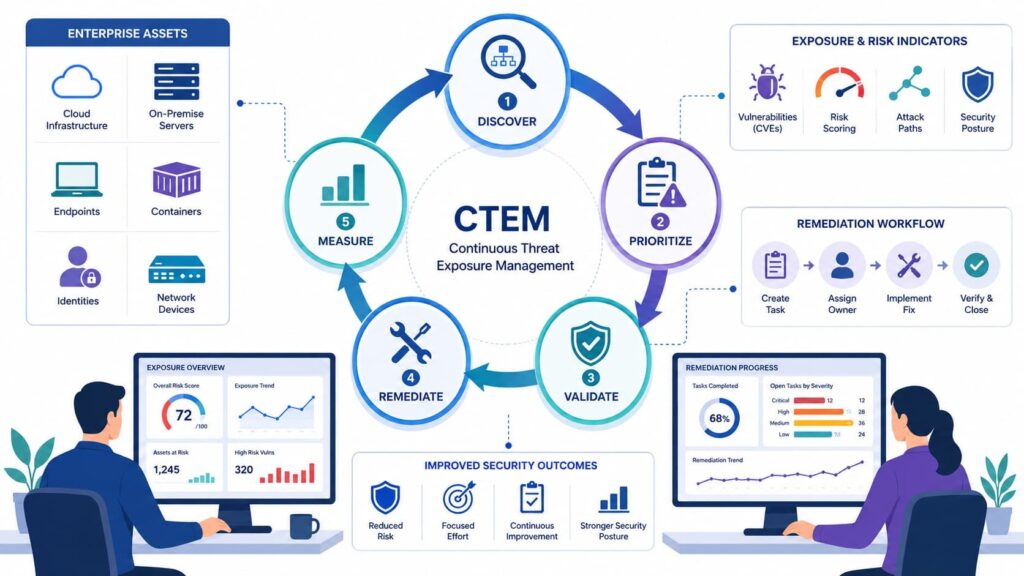
Tenable One is positioned as an exposure/CTEM‑style platform, alongside similar efforts from other vendors. Modern exposure management extends beyond vulnerability scanning.
Organizations increasingly evaluate external attack surface management (EASM), identity exposure, Active Directory risk, cloud posture management (CSPM), and workload visibility as part of one continuous program.
Successful CTEM programs require:
- Exposure visibility
- Business criticality
- Asset criticality
- Threat feeds
- Continuous prioritization
Where does each platform stand?
Tenable One combines vulnerability management, Tenable OT Security, identity exposure, cloud posture management, and external attack surface capabilities into a unified exposure platform. Rapid7 extends its ecosystem through Exposure Command, Rapid7 InsightVM, cloud capabilities, and application security offerings.
Qualys continues expanding through VMDR, TotalCloud, container scanning, workload protection, DAST, SAST, SCA, and software composition analysis. Organizations planning multi-year security transformation initiatives should evaluate these broader ecosystems rather than today’s scanning requirements alone.
What does pricing really look like?
License pricing represents only one component of total ownership cost. Enterprise vulnerability management programs require implementation planning, scanner placement, workflow tuning, reporting customization, and continuous optimization.
Teams often report several months (commonly 6–12) to reach steady-state operations, depending on project scope and change management. Pricing is typically per‑asset/per‑year and varies by modules, region, and volume; vendors usually provide quotes rather than public list prices.
Additional modules such as web application vulnerability scanners, container scanning, API security, EASM, and cloud security increase licensing costs across every vendor.
Which hidden costs surprise buyers?
Procurement teams frequently underestimate implementation expenses. Common hidden costs include:
- Professional services
- Scanner deployment
- Staff training
- ServiceNow integration Jira integration
- Additional security modules
We recommend budgeting for operational staffing alongside licensing. A well-supported vulnerability management program almost always delivers better long-term results than purchasing advanced capabilities that remain underused.
What do practitioners say after deployment?
Real-world feedback shows that every platform performs well in some environments while presenting challenges in others. Community discussions, implementation reviews, and enterprise case studies consistently demonstrate that no solution excels universally.
Infrastructure complexity, staffing levels, and internal processes influence user satisfaction just as much as technical capability.
Common strengths include: Tenable:
- Strong detection depth and broad visibility.
- Qualys: Lower operational overhead and integrated patching.
- Rapid7: Effective DevOps workflows and exploit-focused prioritization.
What complaints appear most often?
Recurring implementation observations include:
- Some user communities note that Rapid7’s interface can feel less intuitive for certain teams, while others find it adequate after onboarding.
- Organizations deploying many Qualys modules sometimes report greater administrative complexity; others find centralized management reduces overhead.
- Tenable’s broad portfolio and licensing options can require careful scoping during procurement; reviewers often recommend proving value with a focused pilot first.
That said, every observation should be validated during a proof of concept. Community experiences provide valuable context, but each environment has different asset inventories, compliance objectives, and remediation workflows.
Which platform should you choose?
The best platform depends on infrastructure, staffing, compliance requirements, and operational workflows rather than headline features.
Organizations evaluating vulnerability management, security metrics, board reporting, and risk-based prioritization should match technology with business objectives instead of selecting the platform with the longest feature list.
When Tenable Is the Right Choice
Organizations managing complex environments often find Tenable particularly valuable because of its broad plugin coverage and deployment flexibility. It is generally a strong fit when your environment includes:
- Operational technology (OT) or ICS that requires deep visibility.
- Legacy or highly diverse assets that benefit from extensive plugin coverage.
- ServiceNow-centered remediation workflows for automated ticketing.
- A long-term CTEM strategy or the need for flexible on-premises deployment.
When Qualys Is the Right Choice
Qualys VMDR is typically a better choice for organizations that prioritize operational simplicity and cloud-native management. It is especially suitable if you:
Prefer a SaaS-first deployment model.
- Want integrated vulnerability management and patching.
- Need centralized reporting for compliance and executive dashboards.
- Have a lean security or IT team with limited administrative resources.
When Rapid7 Is the Right Choice
Rapid7 InsightVM fits organizations that closely align security with engineering and DevSecOps workflows. It is often a good option if you:
- Rely on Jira-based remediation workflows.
- Prioritize exploit-driven vulnerability management.
- Already use other Rapid7 security products.
- Need stronger collaboration between security and development teams.
From our perspective at MSSP Security, successful platform selection begins with understanding operational realities.
We have seen organizations achieve excellent outcomes with different technologies because implementation, governance, and remediation discipline mattered more than individual feature comparisons.
How should you evaluate vendors before signing?
A structured proof of concept consistently reduces procurement risk more effectively than product demonstrations. Vendor demonstrations showcase ideal environments.
Real enterprise networks rarely resemble those scenarios. A practical evaluation should include representative infrastructure, legacy systems, cloud workloads, and operational reporting requirements.
Every proof of concept should test:
- Legacy infrastructure
- Cloud workloads
- Container scanning
- False positive reduction
- Executive dashboards
- Compliance reporting
Which questions prevent surprises?
Procurement teams should verify several operational details before signing.
- Which modules are included?
- How many scanners are required?
- Which integrations are supported?
- How will MSP reporting or MSSP workflow operate?
- What staffing assumptions are realistic?
- How are remediation SLAs measured?
- Agent or agentless scanning: which assets are covered?
- Which cloud connectors are supported?
- How are false positives tuned and validated?
Validating these questions early reduces implementation delays and creates more accurate ownership expectations.
Choosing the Right Path: Qualys VMDR vs. Rapid7 InsightVM for Enterprise Security
Credits: CyberComparison
When selecting the ideal vulnerability management solution, the breakdown by CyberComparison highlights that decision-makers must look beyond basic scanning features to evaluate deeper operational metrics.
The analysis contrasts Qualys VMDR and Rapid7 InsightVM across critical criteria, including deployment complexity, licensing models, automation playbooks, AI capabilities, and CI/CD integration.
For CISOs and enterprise architects managing anywhere from a thousand to over a hundred thousand assets, understanding how these corporate platforms scale, integrate, and maintain uptime is paramount to ensuring robust infrastructure security and alignment with long-term strategic goals.
FAQ
What factors improve vulnerability prioritization beyond basic CVSS scores?
CVSS provides a useful starting point for measuring severity, but effective vulnerability prioritization requires additional context. Security teams should evaluate risk scoring, CVE detection, exploit availability, threat intelligence, business criticality, asset criticality, and remediation SLA together. This broader approach helps organizations focus on vulnerabilities that present the greatest operational risk instead of relying only on severity ratings.
How do you design a scan cadence that handles ephemeral cloud workloads without breaking your budget?
In a modern hybrid cloud environment, running a traditional scheduled network scan once a week is fundamentally broken because auto-scaling cloud instances spin up and down in minutes. For dynamic environments like AWS or Azure, I advise teams to ditch scheduled network sweeps entirely for cloud infrastructure. Instead, deploy lightweight, continuous host agents combined with real-time cloud connectors (API integrations) that instantly detect when a new workload is provisioned. Reserve your deep, authenticated network scanning schedules for your static, on-premises core infrastructure where assets don’t disappear mid-scan.
How do these platforms handle local credential storage risks during authenticated scanning?
When deploying authenticated scans at scale, a common operational risk is the mishandling of high-privilege service accounts. Tenable relies heavily on secure integrations with external credential managers like CyberArk to pull credentials dynamically per scan. Qualys utilizes a highly secure, distributed local agent architecture that bypasses the need for broad domain-admin network scanning credentials altogether. Rapid7 InsightVM bridges this by leveraging its Insight Agent alongside tight Metasploit integration, allowing security teams to immediately pivot from an authenticated finding to a safe, simulated exploitation path to prove the risk to skeptical system administrators.
Which compliance frameworks commonly require vulnerability management activities?
Many security and privacy regulations require organizations to maintain an ongoing vulnerability management program. Common frameworks include the NIST framework, ISO 27001, PCI DSS, SOC 2, HIPAA, GDPR, and NIS2 compliance. Organizations can support audit readiness through consistent compliance reporting, documented policy enforcement, measurable security metrics, and a structured remediation workflow.
How can organizations reduce vulnerability backlogs without increasing security risks?
Organizations can reduce a vulnerability backlog by prioritizing remediation based on risk instead of addressing vulnerabilities in chronological order. Effective programs combine patch management, remediation workflow, threat feeds, business criticality, security analytics, dashboard reporting, executive dashboards, KPI tracking, and vulnerability trends. This strategy improves remediation efficiency while maintaining a strong and measurable security posture.
Choosing the Right Vulnerability Management Platform
Picking a vulnerability management platform affects your daily work more than you might expect. The right choice helps you find issues faster and keep remediation moving without adding extra effort. While Tenable, Qualys VMDR, and Rapid7 InsightVM all offer strong capabilities, long-term success comes from choosing the one that fits your team, existing processes, and business goals.
If you need expert guidance, book a consultation with MSSP Security. Our team helps managed security service providers evaluate vulnerability management platforms through vendor-neutral assessments, needs analysis, PoC support, and technology stack optimization. With more than 15 years of experience and over 48,000 completed projects, we provide practical recommendations that improve visibility, reduce tool sprawl, and help you build a security stack aligned with your operational and business goals.
References
- https://www.sciencedirect.com/science/article/abs/pii/S0167404826001549
- https://ieeexplore.ieee.org/document/11313442