


Choosing the right SIEM platform is one of the most important decisions for an MSSP Security provider. The platform affects threat detection speed, operational efficiency, reporting, and long-term costs while supporting multiple clients.
Comparing SIEM platforms MSSP uses also helps organizations understand which solution best matches their security and business needs. From cloud-native tools to traditional platforms, every option has different strengths. Keep reading to discover what matters most when evaluating SIEM platforms.
What You’ll Learn
Before comparing the leading SIEM platforms, here are the most important factors every MSSP should consider.
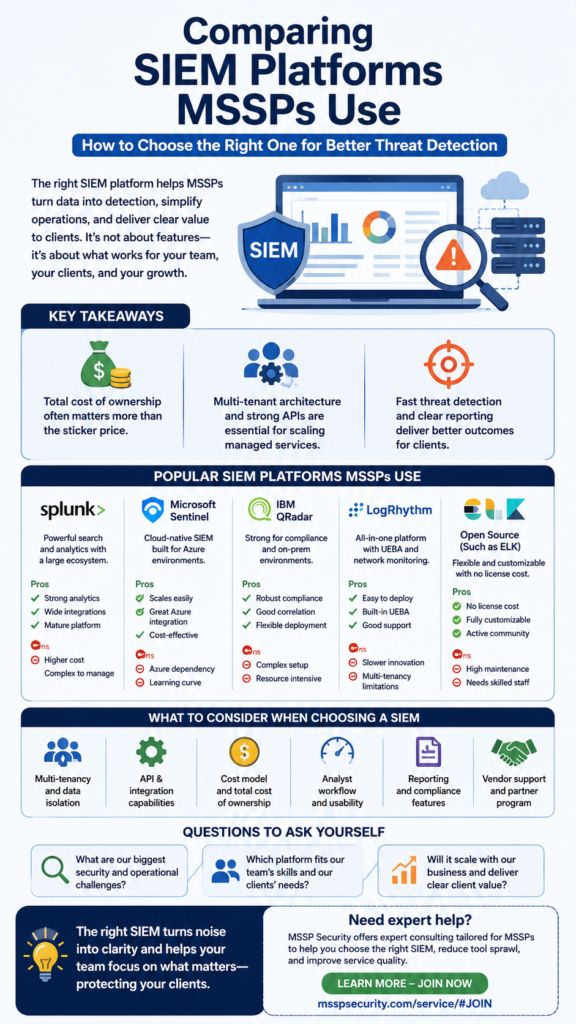
- Total cost of ownership often outweighs the sticker price, involving licensing, staffing, and infrastructure.
- Multi-tenant architecture and APIs are non-negotiable for scaling an MSSP service efficiently.
- The platform must enable fast threat detection and clear, reportable outcomes for clients.
Splunk vs Sentinel MSSP Comparison: Which Platform Fits Your Service Model?

You walk into a security operations center, the screens are glowing. One analyst is working a case in Splunk. Another is checking Sentinel alerts. From the outside, they look similar, just different colors. But the devil, as they always say, is in the details for an MSSP. The major platforms handle data ingestion and correlation differently under the hood.
We’ve had to build playbooks around these nuances. A platform’s built-in automation capabilities, or lack thereof, directly impact how many incidents a single analyst can handle per shift.
That’s a direct line to your profitability. Then there’s the ecosystem. Some platforms have vast marketplaces of third-party integrations, which is great until you’re managing a dozen add-ons for a single client.
- Licensing Models: Per GB, per host, or user-based. Each fits different client data profiles.
- Deployment: Cloud-native, on-prem, or hybrid. This dictates your implementation timeline and resource needs.
- Analyst Experience: The learning curve for new hires can be steep, affecting your team’s agility.
The choice often comes down to the clients you already have and the ones you want to attract. A platform perfect for a large financial institution might be overkill for a mid-market manufacturer. You’re not just comparing technology, you’re matching a business model.
QRadar Managed SIEM Review in Fullerton: Is It Still a Good Choice?
Credits: Day Johnson
Fullerton’s business landscape, with its mix of healthcare, education, and mid-sized enterprises, creates unique security demands. Clients here often need robust compliance reporting, think HIPAA or CMMC, without the budget for an in-house SOC.
This is where a managed QRadar service can find its niche. It’s a known entity, especially for organizations with legacy IT investments who are wary of a full cloud leap.
We’ve operated it for clients who have deep on-premise footprints. Its appliance-based history means it can handle certain network data flows with a familiarity that newer cloud-first platforms are still catching up on. For an MSSP, offering it as a managed service abstracts away its notorious complexity.
The client gets the log correlation and compliance reports without needing a certified administrator on payroll. But it’s a commitment. The resource overhead for your own team is real. You need engineers who live and breathe its rules and architecture.
In a competitive California market, you must ask if those resources could be better deployed on a more agile platform. For the right client profile, though, it’s a solid, defensible choice that gets the job done.
Best SIEM Platforms for MSSPs: What Makes a Platform Stand Out?
The “best” SIEM isn’t the one with the most buzzwords. For an MSSP, it’s the one that disappears into the background of daily operations while making your team superheroes. It starts with multi-tenancy.
A platform built for MSSPs lets you segment client data completely, manage user roles from a single pane, and roll out global detection rules without touching every individual tenant. It’s the foundation.
Next is operational efficiency. How many clicks does it take to investigate a medium-fidelity alert? We’ve timed it. The difference between platforms can be minutes per incident, which scales to hundreds of hours per year.
That’s staff time, that’s money. Then there’s the data story. Can you easily show a client what you blocked, what you found, and why it matters in their language? A good platform turns telemetry into a narrative. Finally, consider the partner program.
LogRhythm MSSP Features: Pros and Cons for Managed Security Services
LogRhythm has been around the block. It’s like a reliable truck, it might not have the flashy new features every quarter, but it can carry a heavy load predictably. For an MSSP, that predictability has value. Its all-in-one suite approach, with UEBA, network monitoring, and SOAR-ish automation in a single pane, simplifies the initial technology stack.
You’re not stitching together five different tools. Deployment can be relatively straightforward, which means faster time-to-value for new clients, and we appreciate that.
“MSSPs (Managed Security Service Providers, organizations running security operations on behalf of multiple client organizations simultaneously) require architecturally distinct SIEM capabilities: strict data isolation between clients, a centralized management console, per-client reporting, and licensing that scales without deploying a new SIEM stack per customer.” – Ciphers Security
But the trade-offs are real. Its approach to multi-tenancy can feel bolted on compared to cloud-native competitors, sometimes requiring creative engineering to achieve true isolation. The innovation pace has felt cautious at times, especially when compared to the furious development cycles of Azure-native or AWS-centric tools.
Choosing a SIEM for Security Outsourcing: What Should Companies Consider?
You’re handing over the keys to your security telemetry. It’s a big deal. The first step isn’t comparing vendor datasheets, it’s looking inward. What are you actually trying to achieve? Compliance? Threat hunting? Just basic alerting? Get clear on that.
Then, audit your own environment. What logs can you actually generate? A fancy SIEM is useless if you can’t feed it quality data. We’ve seen companies buy a Ferrari only to realize they’ve been collecting the wrong type of fuel.
Next, involve your potential MSSP early in the SIEM selection process. A good one will have a strong opinion, and for good reason. Ask them why they prefer a certain platform. Is it for their operational ease, or for your superior security? The answer tells you a lot. Demand a pilot. Run it for 30 days with real data.
Measure the outcomes: alert fatigue, mean time to respond, clarity of reporting. The platform should be a bridge between your team and the MSSP, not a wall. Finally, think about the exit. If you change providers in three years, how portable is your data and your investment in rules? Lock-in is a real cost.
Why SIEM Choice Is the Foundation of an MSSP Technology Stack
Think of the SIEM not as a tool, but as the central nervous system. Every other security tool, the EDR, the firewall, the email gateway, feeds into it. Its health determines the health of the entire security practice.
For an MSSP, this is magnified. A poorly chosen SIEM creates bottlenecks in data ingestion, slowing detection. It makes investigation clunky, burning analyst hours. It generates opaque reports, eroding client trust.
The right SIEM, conversely, amplifies everything else. It allows for the seamless integration of best-of-breed tools. A new endpoint solution comes to market? You can plug it in and start correlating its alerts with network data within days.
It enables scalable service delivery. You can onboard a new client using a templated framework, not a custom project. Most importantly, it’s the source of truth.
What Does a SIEM Platform Selection Consultant in California Do?
It’s part therapist, part architect, and part fortune teller. In California, with its dense concentration of tech firms and strict privacy laws, the job is especially nuanced. We don’t just recommend Product A over Product B.
We start by untangling a company’s actual risk profile from their perceived one. A startup in Silicon Valley scaling on AWS has fundamentally different needs than a family-owned manufacturing plant in Fresno with legacy industrial control systems.
The real work is in the requirements gathering. We ask about things clients rarely consider: data retention laws, internal skill gaps, merger and acquisition plans. Then we map those needs against the landscape.
We might run proof-of-concept tests, not just for features, but for operational feel. How does the platform perform during a simulated incident at 2 AM? We also negotiate. Vendor licensing agreements are minefields of future costs, and a good consultant knows where the traps are.
Integrating Different SIEM Platforms Across Multiple Clients
You can, but it’s a choice that brings constant friction. Some MSSPs do it, often because they acquire other companies with entrenched toolsets, or they cater to clients who demand a specific platform. It’s a reality of the business. The integration challenge isn’t at the data level, logs are logs, it’s at the human and process level.
Your analysts now need proficiency in multiple query languages and interfaces. Your playbooks must be rewritten for each ecosystem. Your reporting templates need separate versions.
We’ve managed two primary platforms before. It doubles the training burden and can create a knowledge silo effect on the team. The hidden cost is in the lost opportunity for standardization. You can’t create a single, elegant automated workflow that works for everyone. Instead, you maintain two or three.
The argument for doing it is client acquisition; you never have to say “no” because of your tech stack. But the operational toll is heavy. It’s only sustainable with very clear segmentation, like dedicating specific analyst pods to each platform. Otherwise, you risk burnout and inconsistent service quality. Simplicity usually wins.
Open Source SIEM Alternatives for MSSPs: Are They Worth It?

The allure is strong: no licensing costs, complete control, no vendor lock-in. The reality is a math problem of time and talent. An open source stack, think the ELK (Elasticsearch, Logstash, Kibana) trio plus security plugins, is powerful. You can build exactly what you want. But you are building it.
“The product is ok, but there can be an annoying pattern of new features being pulled out as separate, chargeable products, so you never get any real new features in the product you’re paying for. Their service and support teams are almost comically mercenary, there is no notion of partnership or flexibility, even for very long term customers.” – Gartner
For a niche MSSP focusing on tech-savvy clients who value transparency, it can be a differentiator. It shows deep expertise. But for general managed services, it’s a hard sell. Your margins come from efficiency and scale, not custom engineering projects. When a new threat emerges, you need detection rules now, not after your dev team sprints for two weeks.
And then there’s support. At 3 AM during a major incident, you can’t call Elastic’s enterprise support line if you’re on the community version. You’re on your own. It’s a viable path, but only for providers whose core competency is software engineering, not just security operations.
A Simple Comparison of Key MSSP SIEM Considerations
| Feature | Priority for MSSP | Why It Matters |
| True Multi-Tenancy | Critical | Isolates client data and customizations without manual work. |
| API-First Design | Critical | Enables automation, integration, and custom tooling. |
| Predictable Cost Model | High | Allows for stable, profitable client pricing without surprise bills. |
| Efficient Analyst Workflow | High | Lowers mean time to respond and reduces burnout. |
| Built-in Compliance Reporting | Medium | Saves hundreds of hours on frameworks like PCI DSS or HIPAA. |
| Vendor Partner Program | Medium | Provides deal support, training credits, and influence. |
FAQ
How does Network Threat Detection fit into an MSSP’s SIEM choice?
It’s often the first layer of real detection. EDR is great for the endpoint, but network traffic doesn’t lie. A SIEM that ingests and analyzes netflow, DNS, and proxy logs effectively gives us a broader battlefield view. We can see the lateral movement that endpoint tools might miss. The platform must handle this data type at scale without choking.
Is cloud-native SIEM always better for an MSSP?
Not always, but usually. Cloud-native offers elasticity and removes hardware management. For an MSSP, this means scaling a client up or down is a billing change, not a hardware upgrade.
The operational overhead is lower. But for clients with data residency requirements or massive, stable data volumes, a well-tuned on-prem setup might still be more cost-effective.
What’s the biggest hidden cost in a SIEM platform?
Professional services and customization. The license fee is just the start. Making the tool fit your specific processes and building integrations can double the initial investment. Always budget for the implementation, not just the software.
How long does a typical SIEM platform evaluation take?
A thorough one, from initial research to contract, takes 90 to 120 days. Rushing it leads to regret. Key phases are internal assessment (2 weeks), vendor demos/POCs (4-6 weeks), and contract negotiation (2-4 weeks). Piloting with your own data is non-negotiable.
Final Thoughts on Comparing SIEM Platforms
Choosing among the SIEM platforms an MSSP uses is about finding the solution that best supports your team, clients, and long-term growth. The right platform improves threat detection, simplifies daily operations, and scales as your business expands.
If you need expert guidance, MSSP Security’s consulting services can help. With over 15 years of experience and 48,000+ completed projects, the team provides vendor-neutral SIEM selection, PoC support, stack optimization, and practical recommendations to help you build an efficient, scalable security operation.
References
- https://cipherssecurity.com/best-cloud-siem-2026-sentinel-splunk/#MSP_and_MSSP_Multi-Tenancy_Support
- https://www.gartner.com/reviews/market/security-information-event-management/compare/product/ibm-security-qradar-siem-vs-insightidr