

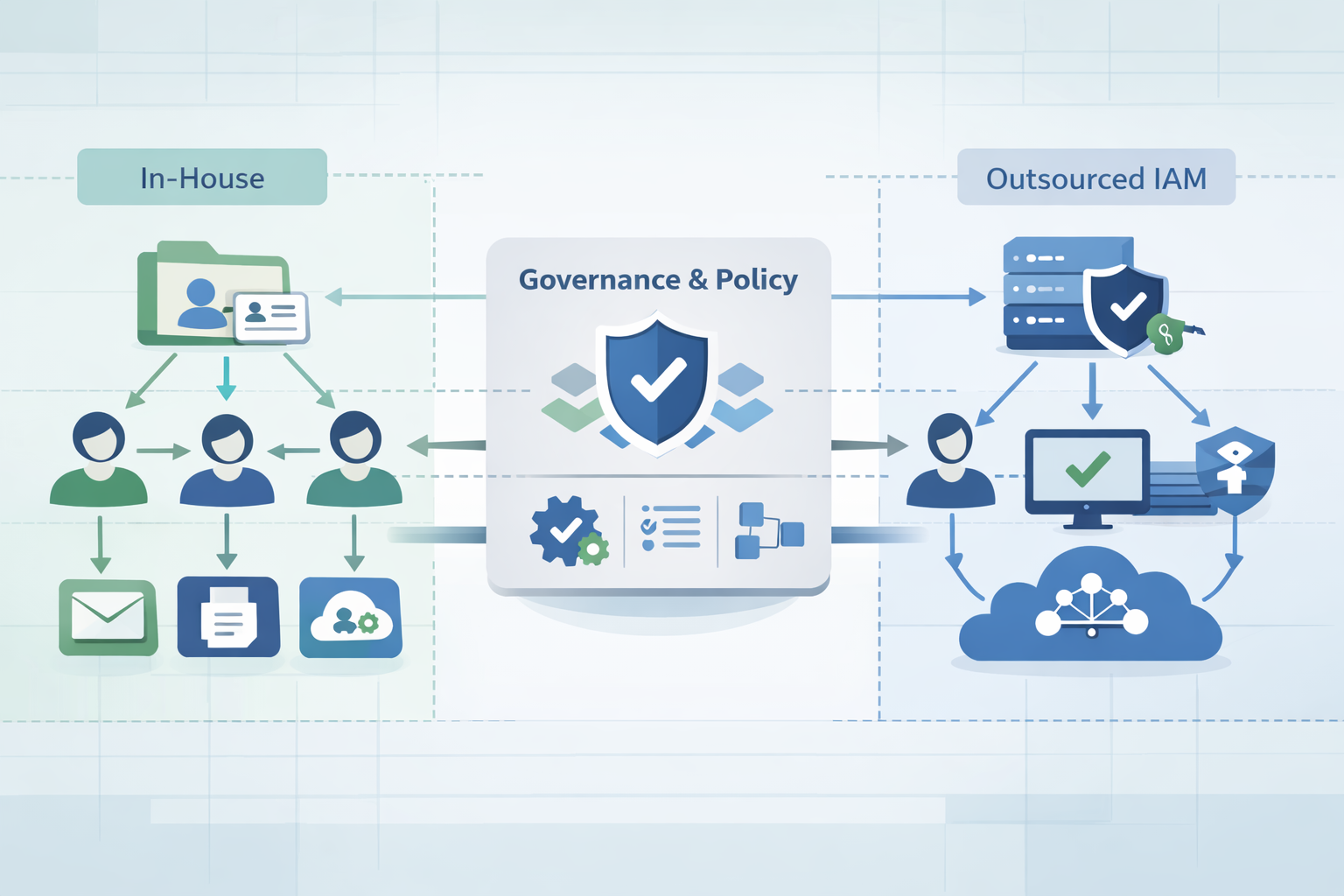
Outsourced identity access management now runs quietly behind most modern security operations. We have seen this firsthand across real environments. Teams no longer debate whether identity matters; they struggle with running it reliably at scale. When identity governs every login, API call, and privileged action, keeping it fully in-house often introduces risk instead of control.
Outsourcing IAM shifts lifecycle management, authentication, and access governance to specialists, while organizations retain ownership of strategy and policy. The outcome is tighter security, smoother operations, and fewer hidden gaps. Identity has become the control plane for everything else. Keep reading to see why this shift matters.
Key Takeaways
- Outsourced identity access management reduces operational risk while enforcing least privilege at scale
- Identity management services support Zero Trust, remote access, and compliance without internal overload
- MSSP Security approaches IAM as a security program, not just a toolset
What Outsourced Identity Access Management Means
When organizations outsource IAM, they are not giving away control of “who can access what.” They are giving away the heavy lifting of running the systems that enforce these rules, keep them updated, and prove they are working.
Instead of:
- Building and tuning IAM platforms alone
- Maintaining connectors for every app
- Writing custom scripts for provisioning and deprovisioning
They bring in a provider that runs IAM as an always-on service.
We see two big shifts when this happens:
- IAM turns from a project into a program.
No more “yearly cleanup” exercises. Identity lifecycle, policy updates, and reviews become part of the daily rhythm. - Security and operations finally line up.
Identity is no longer just HR records, or just SSO. It is the guardrail for Zero Trust, remote access, and privileged work.
For MSSPs, outsourced IAM also changes the consulting work. Our own role is to help MSSPs:
- Pick IAM products that actually support managed services
- Audit providers and platforms for security, logging, and multi-tenant behavior
- Test if IAM controls hold up under real attacker techniques, not just demos
Outsourcing IAM does not remove responsibility. It changes where the work happens and who does what.
Core Responsibilities Handled by IAM Providers
Day to day, IAM providers sit in the path of every access decision. The work is more detailed than many MSSP leaders expect the first time we map it out.
Typical responsibilities include:
- Identity lifecycle management
- Joiner / mover / leaver handling
- Automated provisioning and deprovisioning
- Role updates when someone changes teams or clients
- Directory and identity store operations
- Managed Active Directory or LDAP
- Cloud directory syncing
- Keeping attributes and groups accurate across systems
- Authentication enforcement
- Multi-factor authentication (MFA) everywhere it is needed
- Passwordless options, risk-based login checks
- SSO across web apps, VPN replacements, and portals
- Authorization and access governance
- Role-based access control (RBAC) design and maintenance
- Least privilege rules and just-in-time access for admins
- Periodic access reviews and recertifications
- Auditing, logging, and monitoring
- Recording every login, elevation, and policy decision
- Sending identity events to SIEM or MDR platforms
- Alerting on suspicious access patterns
When we sit with an MSSP and map these flows, the pattern is always the same: the provider’s value comes from consistency. The rule is applied the same way at 3 a.m. Tuesday as it is at noon Friday, no matter who is shouting for an exception.
How Outsourced IAM Differs From In-House IAM
On paper, in-house and outsourced IAM can look similar. Same protocols. Same buzzwords. But day to day, the differences become clear very quickly.
Table In-House IAM vs Outsourced IAM (Operational View)
| Aspect | In-House IAM | Outsourced IAM |
| Primary focus | IAM shared with other IT and security tasks | Identity operations as a dedicated service |
| Operating model | Reactive, ticket-driven, manual fixes | 24/7 service with standard runbooks |
| Change management | Informal, often rushed | Controlled, documented, auditable |
| Cost structure | Projects, upgrades, specialist hires | Predictable service-based pricing |
| Accountability | Shared and often unclear | Defined SLAs and ownership |
Key contrasts we see:
- Focus
- In-house teams: juggle IAM with firewalls, EDR, cloud, tickets, and “one-off” demands.
- IAM providers: live and breathe identity. That is the job.
- Operations style
- In-house IAM: often reactive, lots of manual fixes, spreadsheet access reviews.
- Outsourced IAM: run as a 24/7 service with standard runbooks and change control.
- Cost model
- In-house: big projects, upgrades, and specialist hires.
- Outsourced: predictable service fees that scale with users or use.
- Accountability
- In-house: if something breaks, blame is fuzzy.
- Outsourced: SLAs define uptime, response, and reporting. There is a contract line for “who owns what.”
We have seen MSSPs stuck in the middle: they are asked to “review IAM” or “help with MFA,” but the underlying platform is half-built by internal teams. Outsourced IAM, when selected and audited well, gives MSSPs a firmer base to secure everything else.
Core Components of an Outsourced IAM Framework

Outsourced IAM is not just one big platform logo. It is a framework made of pieces that need to work together cleanly. When those pieces clash, MSSPs feel it first during incidents and audits.
We usually break it down into four core parts.
Identity Repositories and User Directories
Identity repositories are the source of truth. If they are wrong, every access decision built on top is wrong too.
In a solid outsourced IAM setup, we expect to see:
- Managed directories
- Active Directory or LDAP managed by the provider
- Cloud directories (like Azure AD / Entra ID) tied into the same rules
- Clean lifecycle feeds
- HR or client systems feeding join/move/leave events
- SCIM or API-based provisioning into apps and SaaS tools
- Federated identity
- External partners and B2B clients authenticating via federation
- No random duplicate accounts hanging around in each app
Any time we audit an MSSP’s environment and find multiple “sources of truth,” we know access risk is already baked in. Good outsourced IAM keeps those sources aligned and constantly checked.
Authentication Mechanisms and MFA
Attackers love weak authentication. That is why we pay so much attention to how IAM providers handle it. Modern guidance aligns with this reality. The research makes it clear that access decisions should not rely on a fixed perimeter, but instead be continuously evaluated based on identity, context, and risk [1]. This is why outsourced IAM must enforce MFA, adaptive checks, and step-up authentication as default behavior, not optional controls.
Core elements we look for:
- MFA everywhere that matters
- Admin and privileged accounts
- Remote access, portals, and management consoles
- High-risk or high-value systems
- Adaptive controls
- Extra checks for risky logins (new locations, odd devices)
- Step-up authentication for sensitive actions
- User experience balance
- SSO to reduce password reuse
- Clear, simple flows so users do not bypass controls with shortcuts
We have watched MFA projects fail because users hated them and leadership backed down. When authentication is managed well by an outsourced IAM provider, friction is low enough that users accept it, and strong enough that attackers do not.
Authorization Policies and Least Privilege
Authentication answers “who are you.” Authorization answers “what are you allowed to do.” For breach impact, authorization usually matters more.
In outsourced IAM, we expect:
- Structured RBAC
- Roles mapped to job functions, not individuals
- Clear separation of duties for admins and operators
- Least privilege and just-in-time
- No standing domain admin or god-mode accounts “for convenience”
- Time-bound elevation with logs and approvals
- Ongoing access governance
- Scheduled access reviews with clear owners
- Easy ways to remove unused rights, not just add more
From our side, when we help an MSSP pick products, we test how easy or hard it is to enforce these controls in real life, not just on slides. The difference shows up fast when there is an incident.
Auditing, Logging, and Monitoring Tools
Without identity logs, the SOC is half-blind. This is not just an operational inconvenience, it is a proven risk pattern. The study reports that credential misuse remains one of the most common paths attackers use to access environments [2]. When IAM events are missing, delayed, or incomplete, security teams lose the ability to trace how access was gained and what actions followed.
Outsourced IAM should bring:
- Full access logging
- Logins, MFA prompts, failures, and approvals
- Privileged actions and changes to policies
- Tight SIEM / MDR integration
- Clean, structured events sent to the MSSP’s detection stack
- Enrichment with user and device context
- Retention and reporting
- Logs held long enough for compliance and for slow-burn attacks
- Reports suitable for audits without a week of manual work
We push hard on this when we audit products for MSSPs. Identity logs are where real Zero Trust monitoring starts.
Key Benefits of Outsourcing Identity Access Management
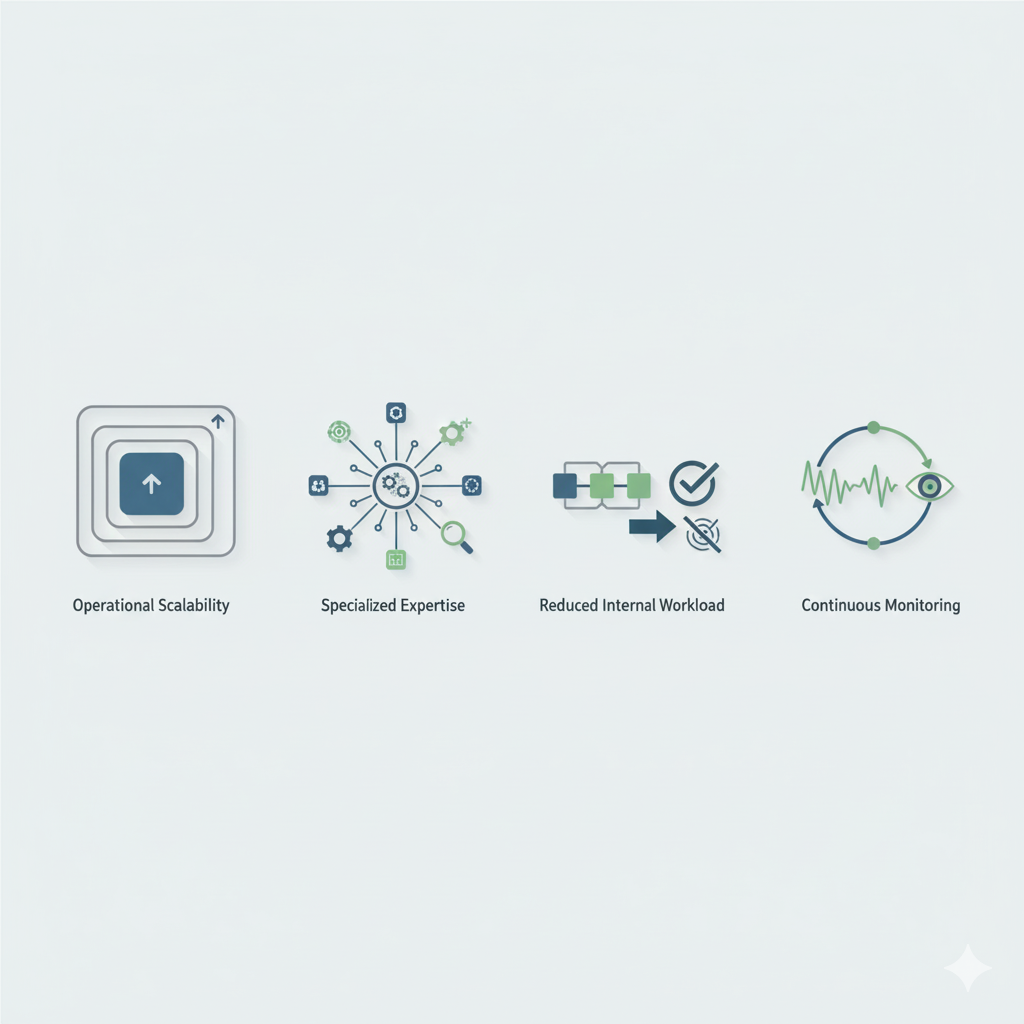
Organizations rarely outsource IAM to save a few dollars. They usually do it because the current identity setup is fragile and the risk is too high.
For MSSPs and their clients, the main benefits tend to cluster around cost, expertise, scale, and compliance.
Cost Efficiency and Reduced Operational Overhead
Running IAM well in-house means:
- Hiring people who deeply understand identity protocols
- Keeping up with constant platform changes
- Building and running your own high-availability setups
Outsourced IAM turns those into a service with predictable monthly or yearly costs, shared infrastructure managed by specialists, and fewer surprise upgrade projects. For many teams, this operational stability comes from relying on managed IAM support services that treat identity operations as a continuous security function rather than a series of one-off projects:
- Predictable monthly or yearly costs
- Shared infrastructure managed by specialists
- Fewer surprise upgrade projects
We see MSSPs benefit here too. Instead of babysitting a custom IAM build for each client, they can lean on standardized, audited services, and focus their time on detection, response, and consulting.
Access to Specialized IAM Expertise
Identity is a deep niche. It touches SAML, OAuth, OpenID Connect, SCIM, device trust, and more. Most general IT or security teams only touch parts of it.
IAM providers bring:
- Teams that work with identity issues every day
- Familiarity with edge cases across many clients
- Faster response to new standards, attacks, and vendor changes
Our own consulting work often starts here. We help MSSPs judge whether a given IAM vendor actually understands:
- Zero Trust IAM design
- Microsegmentation and access into workloads
- API and machine identity management
Theory is easy. Enforcement is what counts. We use real-world scenarios to tell those apart.
Scalability for Growing and Distributed Workforces
User counts rarely stay flat. Remote work, contractors, partner access, and customer portals all stretch identity systems.
Outsourced IAM helps by:
- Scaling provisioning without rewriting custom scripts
- Handling spikes in logins, especially during incidents or onboarding waves
- Normalizing access for employees, contractors, and third parties
We have seen MSSPs struggle when each new client brings another custom IAM puzzle. When the core is outsourced and designed for multi-tenant use, adding new users and new clients becomes a predictable task instead of a fire drill.
Built-In Compliance and Regulatory Support
Identity sits in the middle of most security frameworks. Regulations rarely say “use this specific IAM product,” but they do demand:
- Least privilege
- Strong authentication
- Logging and review of access
A mature outsourced IAM provider usually supports mapped controls for GDPR, SOC 2, ISO 27001, NIST frameworks, and NIS 2, along with pre-built reports to show access reviews, MFA coverage, and admin activity. This level of audit readiness is often reinforced through MSSP compliance reporting services that translate identity events into evidence auditors can actually use:
- Mapped controls for GDPR, SOC 2, ISO 27001, NIST frameworks, and NIS 2
- Pre-built reports to show access reviews, MFA coverage, and admin activity
- Audit-friendly change tracking
For MSSPs, this is useful twice: once for their own operations, and again when they help clients prove compliance. We routinely evaluate if a product’s IAM features can actually produce the evidence auditors ask for, not just tick a sales checkbox.
Risks and Challenges of Outsourced IAM

None of this is free of risk. When you hand over identity operations, you are trusting someone else with your most sensitive control surface.
We spend a lot of time helping MSSPs understand these trade-offs clearly.
Supply Chain and Third-Party Risk Exposure
If an IAM provider is breached or misconfigured, many customers can be exposed at once. That is classic supply chain risk.
Mitigation steps we watch for:
- Strong vendor assessments and security questionnaires
- Clear incident handling clauses in contracts
- Transparency about data flows and third-party sub-processors
Our stance is simple: treat IAM providers as critical infrastructure. If they fail, the blast radius is large, so the due diligence needs to match that.
Multi-Tenant Isolation and Data Segregation
Most IAM platforms are multi-tenant. That is normal. The question is how tenants are separated.
We look for:
- Technical separation between tenants, not just “we promise” in contracts
- Clear controls to prevent cross-tenant access by mistake or by design
- Independent logging and keys per tenant where possible
During product audits for MSSPs, we ask hard questions here. How is tenant context enforced in code? How is it tested? Weak answers are a red flag.
Loss of Direct Control Over Identity Systems
When IAM is outsourced, some teams feel they are “losing control.” In practice, what usually changes is the type of control:
- Less hands-on access to low-level settings
- More focus on policy, governance, and oversight
Healthy outsourced IAM setups give:
- Admin portals with clear visibility into policies and logs
- Regular reporting and reviews with the provider
- Strong change control processes that require customer approval for major shifts
We encourage MSSPs to push clients toward this mindset: operational control can move outside, but governance must stay in-house.
Implementation Considerations Before Outsourcing IAM
Choosing to outsource IAM should be treated like a design decision, not a quick purchase. We have seen projects go sideways when this step is rushed.
A few areas always deserve careful review.
Integration With Existing Applications and Infrastructure
If IAM cannot reach your apps, it cannot protect them.
Integration checks should cover:
- Legacy apps that may need agents, proxies, or custom work
- Existing directories like Active Directory, and how they sync
- Cloud workloads and SaaS platforms that already have their own identity models
For MSSPs, we also test how IAM integrates with existing SIEM, SOAR, and MDR tooling, ticketing systems for approvals and reviews, and endpoint tools that may supply device trust signals. This is where strong Identity Access Management (IAM) support matters, because integration failures often surface first during incidents, not during design reviews:
- Existing SIEM, SOAR, and MDR tooling
- Ticketing systems for approvals and reviews
- Endpoint tools that may supply device trust signals
Integration is where “nice architecture” meets reality.
Support for Modern Access Models
Most of the MSSPs we work with are heading toward some form of Zero Trust model, even if they do not use the label. IAM must support that path.
Requirements usually include:
- Remote access without over-reliance on VPNs
- Risk-based authentication and step-up checks
- Support for passwordless options where practical
We also pay attention to customer and partner-facing IAM (CIAM and B2B). If those are bolted on as an afterthought, scale and privacy problems show up later.
Service-Level Agreements and Governance Controls
SLAs are where expectations become enforceable. Weak SLAs lead to finger-pointing.
Good IAM SLAs tend to cover:
- Uptime targets for core services
- Incident response timelines and communication rules
- Access to logs and audit data
- Data residency and retention
We advise MSSPs to push for clear shared responsibility models. Who patches what? Who handles misconfigurations? Who talks to regulators if something goes wrong? Writing this down early saves a lot of pain later.
Hybrid Models and When Outsourcing Makes Sense

Not every organization wants, or needs, to outsource everything. Hybrid IAM models are common, and sometimes the best choice.
We see this most often in regulated sectors and in MSSPs with very sensitive internal environments.
Combining Outsourced IAM With Internal Oversight
A balanced hybrid approach might look like this:
- The provider runs day-to-day operations: provisioning, MFA, SSO, logging.
- The internal team (or MSSP) owns: policies, approvals, and high-risk configuration.
- Certain “crown jewel” systems keep extra internal checks or separate keys.
In this setup, outsourced IAM becomes a force multiplier. Internal staff set rules and review outcomes, while providers handle the constant operational churn.
Our consulting work often sits right here: helping MSSPs define where the line should be, and which IAM products support that split cleanly.
Common Use Cases Across Industries
We see outsourced IAM patterns repeat across sectors:
- IT outsourcing firms and MSPs
- Need to manage many client environments without building a custom IAM stack for each one.
- Benefit from standardized, audited identity controls.
- Security-focused MSSPs
- Want identity signals tied directly into detection and response.
- Need IAM tooling that exposes clean APIs, logs, and policy hooks.
- Distributed enterprises
- Have remote staff, contractors, and partners in multiple regions.
- Use outsourced IAM to avoid building their own global identity infrastructure.
From our side, we approach IAM not as a shiny product category but as a living security system. It breaks, it evolves, it gets tested by real attackers every day. Our job is to help MSSPs pick, question, and audit IAM products so their clients get stronger controls, not just more dashboards.
FAQ
What problems does outsourced identity access management solve for security teams?
Outsourced identity access management helps teams avoid daily access issues and security mistakes. IAM outsourcing takes over user provisioning services, access control outsourcing, and identity lifecycle management. This reduces errors with privileged access management and role-based access control. Internal teams spend less time fixing access problems and more time setting rules, reviewing risk, and supporting the business safely.
How does IAM outsourcing support Zero Trust without slowing people down?
IAM outsourcing supports zero trust IAM by checking access every time, not just once. It enforces least privilege enforcement, just-in-time access, and multi-factor authentication outsourcing in the background. Users log in securely without extra steps. This also replaces VPN access with zero trust network access, endpoint access control, and safer remote access IAM.
What identity tasks do third-party IAM providers usually manage?
Third-party IAM providers handle outsourced user management and identity lifecycle management. This includes Active Directory outsourcing, LDAP management, SCIM provisioning, and federated identity outsourcing using SAML outsourcing, OAuth services, and OpenID Connect providers. They also manage session management services, privileged account management, and IAM monitoring to spot risky behavior early.
How does outsourced IAM help with compliance and audits?
IAM managed services make audits easier by keeping access records in one place. Providers run access governance, audit logging outsourcing, and compliance reporting IAM. They support GDPR IAM outsourcing, SOC 2 IAM services, ISO 27001 IAM, and the NIST IAM framework. This gives clear proof of who accessed what, when, and why.
When is outsourced IAM cheaper than managing it in-house?
Outsourced IAM often costs less when systems grow across cloud IAM providers and hybrid IAM models. External IAM solutions reduce tool overlap, failed setups, and manual fixes. IAM cost optimization improves with scalable IAM solutions, clear service level agreements IAM, and fewer emergency issues. Teams avoid hiring more staff just to manage access problems.
When Outsourced Identity Access Management Becomes a Strategic Advantage
Outsourced identity access management is no longer about convenience. It is about survival in an access-driven threat landscape. Identity now governs users, workloads, APIs, and customers, and when those controls fail, everything downstream fails with them.
Teams that outsource IAM well gain consistency, visibility, and resilience. Those that delay usually uncover identity risk the hard way. Treat IAM as a managed security discipline from day one, backed by governance and real operational expertise.
Work with MSSP Security to build and audit IAM the right way
References
- https://csrc.nist.gov/publications/detail/sp/800-207/final
- https://www.verizon.com/business/resources/reports/dbir/