

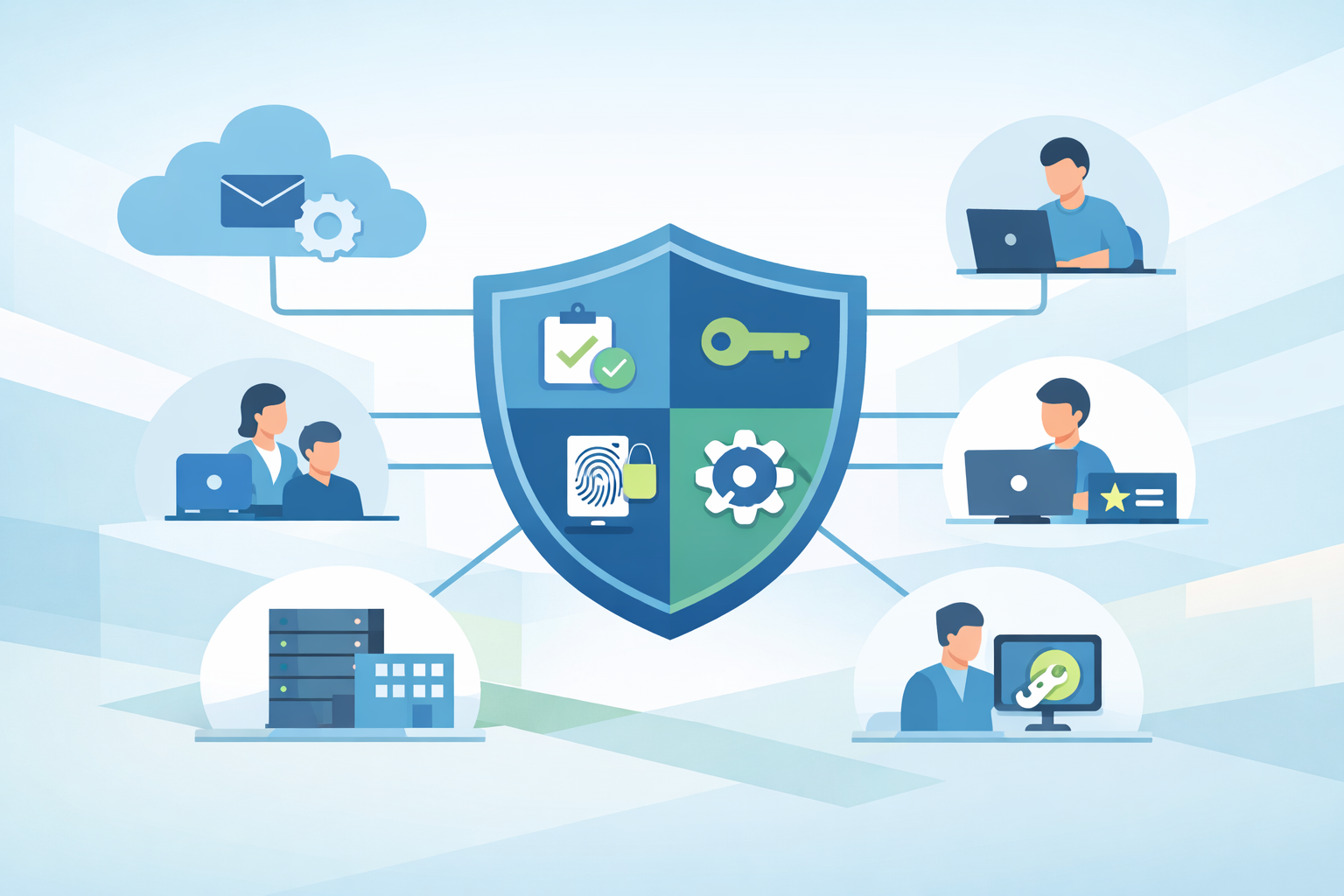
Managed IAM support services exist because identity now is the control plane of modern security. Every user, device, API, and workload authenticates nonstop, and when access breaks, business slows or stops. We’ve seen teams buckle under manual provisioning, constant audits, and alerts that never end.
Outsourcing IAM operations to a trusted provider shifts that operational weight without surrendering ownership or visibility. Done right, it tightens security, steadies day-to-day operations, and gives internal teams room to focus on real priorities instead of constant access fires. Keep reading to see how managed IAM support actually works, where it adds value, and who gains the most.
Key Takeaway
- Managed IAM support services act as an extension of internal IT and security teams.
- Identity-first security reduces breach risk, compliance effort, and help desk load.
- A mature provider blends governance, monitoring, and automation across environments.
What Is a Managed IAM Support Service
At its core, a managed IAM support service is simple: you outsource the operation of identity and access management to people who do it all day, across many clients, with repeatable patterns. This approach allows organizations to treat Identity Access Management (IAM) support as an operational discipline, not just a toolset, while retaining full ownership of access policies and risk decisions.
Table Managed IAM Support vs Internal IAM Operations
| Area | Internal IAM Team | Managed IAM Support Service |
| Policy Ownership | Internal security team | Client retains full ownership |
| Day-to-Day Operations | Handled by internal staff | Operated by provider specialists |
| Coverage | Business hours or limited on-call | 24/7 or SLA-based coverage |
| Skill Availability | Depends on hiring and retention | Pooled IAM experts across clients |
| Incident Response | Often reactive and tool-driven | Process-driven with root cause analysis |
| Audit Readiness | Manual evidence collection | Continuous reporting and access evidence |
Instead of every company hiring rare IAM engineers, a provider runs:
- The identity platforms (cloud, hybrid, on‑prem)
- The workflows for access requests and approvals
- The monitoring and incident response around logins and permissions
Policy stays with the client. Operation sits with the provider.
From our vantage point working with MSSPs, the most effective managed IAM services behave like part of the internal team. They show up in change advisory boards, they join incident reviews, and they align with the MSSP’s SOC workflows instead of building a parallel universe.
Typical managed IAM support includes:
- 24/7 or 5×8 IAM support and incident handling
- User provisioning and deprovisioning automation
- Access reviews and role management
- Platform maintenance, patching, and upgrades
- Audit reporting and compliance support
We’ve seen this model work across small teams and large enterprises. The pattern that never changes: identity doesn’t sleep, so the team running it can’t either.
Why IAM Management Is Critical in Modern Cybersecurity
Most modern attacks don’t start with a firewall bypass, they start with someone logging in with the wrong level of access. Phishing, stolen tokens, reused passwords, misconfigured roles, these all sit in the identity layer.
When IAM is weak:
- A single misconfigured role can expose a whole S3 bucket or database.
- An orphaned account can become a perfect entry point for lateral movement.
- A missed access review can leave ex-contractors inside email and VPN.
Study on organizational security notes that identity and access management frameworks are designed to “monitor digital identities, manage permissions, and enforce access policies to protect organizational systems and data from unauthorized use [1]. We have helped MSSPs investigate incidents where a simple identity mistake led to:
- Email compromise and fake invoices
- Brand impersonation through hijacked domains or mailboxes
- Data leaking slowly through third‑party SaaS tools
That’s why IAM can’t stand alone. Strong identity management needs to connect tightly with:
- Email security and phishing prevention
- Brand protection and domain monitoring
- Endpoint, SIEM, and SOAR workflows
When IAM enforces least privilege and supports zero trust principles, the blast radius of any stolen credential shrinks. Attackers might still log in. They just can’t go very far.
Core Components of a Managed IAM Support Service

A serious managed IAM offering isn’t just a help desk for password resets. It’s a set of connected building blocks that keep access both safe and usable.
IAM Platform Monitoring and Maintenance
Healthy IAM starts with quiet platforms. No surprise outages, no expired certificates, no forgotten connectors.
A mature managed IAM service will:
- Monitor identity providers (IdPs), federation services, and authentication flows
- Track performance, error rates, and login failures
- Watch API access to and from IAM platforms
- Keep connectors to cloud platforms (AWS, Azure, GCP, SaaS) working as expected
When we audit IAM tools for MSSPs, we often find logging turned on but not watched, or watched but not interpreted. Small patterns, like a slight jump in failed logins from a new country, often signal bigger issues. Good monitoring catches that before it becomes a breach or outage.
Incident Resolution and Advanced Support Levels
Not every IAM problem needs a war room, but some do.
Managed IAM providers usually define tiered support:
- Tier 1: Basic login issues, standard requests
- Tier 2: Complex access problems, integration errors
- Tier 3: Deep platform issues, architecture, and root cause analysis
This layered approach matters because IAM does not operate in isolation. Research on organizational security highlights that the integration of IAM strategies across monitoring, governance, and incident response is essential for enhancing security, reducing risk, and ensuring compliance in increasingly complex digital environments [2].
We see MSSPs succeed when:
- They offer clear SLAs by severity level (for example, S1 = access outage for many users)
- 24/7 coverage exists for high-severity incidents
- Incident data feeds into the SOC’s SIEM and case management tools
From our own project work, the faster teams can contain IAM incidents, the less time they spend arguing about which tool “caused” the problem. People and process still decide the outcome far more than any single product.
Identity Governance and Access Control
Governance sounds dry, but this is where risk actually shrinks.
Core pieces include:
- Role-Based Access Control (RBAC)
- Multi-Factor Authentication (MFA) enforcement
- Just‑in‑time access for sensitive tasks
- Periodic access reviews and certifications
- Segregation of duties (SoD) controls
We’ve helped MSSPs evaluate vendors that claim “full governance” but lack usable review workflows or clear SoD policies. The right tools and services should let you:
- See who has access to what, and why
- Revoke access cleanly when roles change
- Protect privileged accounts with vaulting and session recording
Without that, governance becomes a checkbox, not a control.
Change Management and Application Onboarding
IAM breaks most often during change.
New apps, acquired companies, cloud migrations, and DevOps pipelines all need updated access paths. If no one owns the IAM side, you get silent failures or noisy outages.
A strong managed IAM model handles:
- Application onboarding and SSO setup
- Federation (SAML, OIDC) configuration
- SCIM or API‑based provisioning
- Role mapping for new business units or teams
We’ve seen outages that lasted hours because one app went live without proper IAM change review. When MSSPs choose vendors, we push them to test:
- How easy it is to onboard a new app
- How rollbacks work if a change fails
- How IAM changes are logged and reported
Change management around identity must be as disciplined as code deployment.
Patch Management, Upgrades, and Compliance Reporting
IAM platforms move quickly: security fixes, new MFA methods, connector updates, and policy features all show up fast.
Managed IAM providers should:
- Apply patches on a defined schedule, with emergency paths for critical fixes
- Plan and test upgrades in non‑production first
- Maintain clear SLAs around platform availability
- Generate audit‑ready reports for access changes, admin actions, and policy updates
Strong audit readiness depends on structured evidence and repeatable reporting. Teams that align IAM operations with broader mssp compliance reporting services can produce access logs, approval trails, and configuration histories without scrambling during audits. This makes compliance a steady process instead of a last-minute exercise.
For MSSPs, we often review whether a product makes it easy to export these reports or automate them. Audits are less painful when:
- Log retention is clear
- Access review evidence is easy to show
- Configuration changes are tracked and signed off
Standards like NIST, ISO 27001, and others all point to continuous monitoring and access review as core identity practices. Managed IAM turns that theory into a daily routine.
Key Benefits of Using a Managed IAM Support Service

Reduced Operational Cost and IT Workload
Identity work never stops. New hires, role changes, leavers, contractors, password resets, it all piles up.
Automation inside a managed IAM model can:
- Handle onboarding and offboarding consistently
- Move routine password resets and access approvals into self‑service
- Cut repetitive help desk tickets
We’ve watched small internal teams reclaim hours per week once IAM workflows shifted from manual emails and spreadsheets to managed, automated processes. Cost doesn’t disappear, but it becomes more predictable and far less chaotic.
Access to Certified IAM Expertise
Finding and keeping strong IAM engineers isn’t easy, even for large companies. For MSSPs, it’s even tougher because clients often span multiple platforms.
Managed IAM support gives access to:
- Certified engineers on major IAM platforms
- People who have seen similar patterns across many clients
- Specialists who understand both technical and regulatory requirements
In our consulting work, we see a big gap between “knows the product” and “knows how to run it across ten clients safely.” The right managed provider closes that gap for the MSSP.
Improved Security Posture and Risk Detection
Modern IAM tools can use AI and machine learning to spot strange access behavior, but that only works if somebody tunes and checks the outputs.
Managed IAM can:
- Analyze login patterns for anomalies
- Detect high‑risk behavior, like privilege escalation or unusual locations
- Feed identity events into SIEM and SOAR tools for faster response
When we audit products for MSSPs, we look for:
- Clear APIs or integrations to share signals with other tools
- Usable risk scores, not just raw logs
- Evidence that identity data helped stop or limit real attacks
CISA and other agencies keep repeating the same message: strong identity controls are key to stopping lateral movement. Managed IAM makes those controls more reliable under pressure.
Scalability Across Hybrid and Cloud Environments
As clients move from single data centers to multi‑cloud and SaaS‑heavy environments, identity complexity grows quickly.
Centralized IAM helps:
- Keep roles consistent across AWS, Azure, GCP, Kubernetes, and SaaS apps
- Enforce MFA and conditional access everywhere, not just in one corner
- Support remote work and BYOD without losing oversight
We often help MSSPs test vendors on scale questions:
- How many apps can they onboard cleanly?
- How do they handle multiple tenants and regions?
- Can they support both old on‑prem systems and new cloud tools?
Scalability isn’t just “more users.” It’s about handling more use cases without creating new blind spots.
Compliance With Regulatory and Security Standards
Regulators don’t just care about whether you have IAM; they care about how you use it and what proof you can produce.
Managed IAM supports compliance with:
- GDPR access and deletion rights
- ISO 27001 controls around access management and logging
- PCI DSS, HIPAA, PDPA (including Indonesia), and internal policies
The most useful managed services can:
- Map controls directly to frameworks
- Produce audit‑ready reports on demand
- Show who approved which access, and when
For MSSPs, we pay close attention to how well IAM tools and services align with client governance. A tool that’s “secure” but impossible to audit doesn’t help much during a real review.
Implementation Considerations for Managed IAM Services

Initial Assessment and Gap Analysis
Every successful IAM engagement starts with a clear picture of today.
A good assessment will:
- Map current identity flows (HR to IAM to apps)
- Identify over‑privileged accounts and dormant users
- Review existing tools and manual steps
When we support MSSPs, we often begin by asking:
“What access questions can you not answer today?”
The gaps appear quickly from there.
Migration and Automation Strategy
Moving to managed IAM is less about big bang cutovers and more about safe phases.
A sound strategy:
- Starts with pilots on low‑risk apps
- Keeps old and new flows running in parallel for a time
- Introduces automation where it removes manual risk
We push vendors and MSSPs to define:
- Rollback plans for failed IAM changes
- Clear milestones for onboarding applications
- Guardrails so automation doesn’t over‑provision access
Data Protection and SLA Governance
Contracts and SLAs matter because IAM touches so much sensitive data.
Core areas to lock down:
- Data handling, storage, and residency
- SLA targets for incident response and platform uptime
- Change windows and approval paths
From our audit work, we’ve seen MSSPs succeed when they:
- Monitor provider performance against SLAs
- Tie IAM reporting into broader governance dashboards
- Keep clear accountability for who owns what in an incident
Alignment With Email Security and Brand Protection
Identity doesn’t stand alone. If it does, it usually fails at the worst time. When IAM integrates cleanly with email defenses, the benefits of managed email security become more measurable. Compromised credentials are contained faster, suspicious behavior triggers access restrictions automatically, and identity abuse tied to phishing or impersonation becomes easier to detect and stop.
Strong alignment means:
- Phishing‑resistant authentication for privileged and high‑risk users
- Conditional access that reacts to email compromise signals
- Shared indicators between IAM, CASB, secure web gateways, and DLP
We pay special attention to whether IAM tools can:
- React to signals from email security (for example, auto‑step up MFA)
- Help contain brand abuse attacks that start from compromised identities
Who Should Consider a Managed IAM Support Service
Managed IAM support services tend to fit best when:
- The environment is complex (multi‑cloud, SaaS-heavy, remote work)
- Internal IAM skills are limited or already at capacity
- Compliance pressure is high, and audits keep surfacing identity issues
We often see three common profiles:
- Enterprises with legacy systems, new cloud stacks, and strict audits.
- Regulated industries that must explain every access decision.
- Security‑focused teams and MSSPs that want identity to support, not slow, their broader services.
When identity becomes a stable, managed layer, everything on top of it, email security, endpoint protection, SOC operations, runs cleaner. Access is predictable, auditable, and much harder for attackers to quietly abuse. For MSSPs, that’s not just a technical win; it’s a service quality win their clients actually feel. This model is less effective for static, low-change environments.
FAQ
What problems do managed IAM support services fix?
Managed IAM support services fix daily access problems. They handle identity access management tasks like user setup, access removal, and access control services. This cuts mistakes and reduces help desk tickets. Teams stop chasing access requests all day. Security becomes steadier, and fewer issues turn into real business problems.
How is managed IAM different from basic outsourcing?
Managed IAM is ongoing help, not a one-time setup. Outsourced IAM often ends after tools are installed. Managed IAM support stays involved every day. It includes IAM support, 24/7 monitoring, incident resolution, and change management access. Your team keeps control of rules, while experts handle the work.
Can managed IAM support cloud, hybrid, and on-prem systems?
Yes. Managed IAM support services work across cloud IAM, hybrid IAM, and on-premise IAM. They manage identity providers, single sign-on support, and access links between systems. This keeps access rules consistent as people move between apps, cloud tools, and older systems without creating gaps or confusion.
How does managed IAM help with audits and compliance?
Managed IAM helps teams stay ready for audits. It supports IAM governance with role-based access control, access reviews, and audit reporting identity. Access changes are tracked as they happen. When auditors ask questions, teams can show clear records instead of rushing to collect proof at the last minute.
Does managed IAM really reduce security risks?
Yes. Managed IAM reduces risk by enforcing multi-factor authentication management and zero trust IAM rules. It watches for strange login behavior and limits access when risk is high. This helps stop phishing damage, account misuse, and over-privileged access before small issues turn into security incidents.
Managed IAM Support Services as a Foundation for Trust
Managed IAM support services bring order to an area where mistakes carry real risk. Identity becomes predictable, auditable, and resilient. Security teams spend less time firefighting. Users get access without friction. Auditors find fewer gaps to question. For organizations serious about cybersecurity IAM, managed IAM is no longer optional. It forms the base of digital trust and stable operations because access decisions become predictable and reviewable.”.
Work with us to strengthen your IAM strategy and get expert, vendor-neutral guidance that helps MSSPs reduce complexity, improve integration, and build a stack that truly fits their maturity and goals.
References
- https://www.researchgate.net/publication/374034268_IAM_Identity_Access_Management-Importance_in_Maintaining_Security_Systems_within_Organizations
- https://www.preprints.org/manuscript/202503.1830